
Login
User name:
Password:
Remember me 
Year Archive
This Month
September 2010
Sun Mon Tue Wed Thu Fri Sat
1 2 3 4
5 6 7 8 9 10 11
12 13 14 15 16 17 18
19 20 21 22 23 24 25
26 27 28 29 30
Search
View Article  WE HAVE SEEN THE FUTURE


. . . and it is empty.


After our Red Lobster experience yesterday my nephew Harry and I decided to make a thorough investigation of City Center, the massive city within a city which recently opened in the middle of The Las Vegas Strip.  I'd visited a casino there and a room at the Aria Hotel, where some friends were staying, but I wasn't quite prepared for the scale and complexity of the whole development.


It started to go up when Las Vegas was booming, almost went bankrupt when the economy crashed, and somehow managed to get completed last year.  It represents an astonishing vision -- a vision of the 21st Century as it might have been imagined by people in the Sixties.  Wandering around it is like wandering around in the world of Jean-Luc Godard's Alphaville.


And there's hardly anybody there.  It's like a vast movie set the day before filming is due to start.  The urban vision it reflects seems to belong to the past and yet the theatricality of it has a kind of charm.  It's sort of soul-killing, and sort of enchanting.  In short, it's pure Las Vegas.

Who knows what it will be like when the extras arrive to people the streets -- if they ever do arrive.

[I'll be writing more about this bizarre, brand-new ghost city in future posts.]
View Article  RED LOBSTER


Recently I began to be seriously disturbed by the fact that I had never eaten at a Red Lobster.  I did not expect that the experience would be a good one, but avoiding the experience seemed . . . well, it seemed un-American.


My nephew Harry's current visit to Las Vegas offered a rare opportunity to enlist a companion for a visit to a Red Lobster, because Harry is mad for seafood.  Despite his profound lack of enthusiasm for this particular venture -- he had eaten at a Red Lobster once before and had found it underwhelming -- he agreed to it in a spirit of scientific inquiry and patriotism.


The results of the inquiry can now be reported.  The decor of a Red Lobster is predictably generic.  The service at a slow hour was acceptable.  An appetizer plate of fried calamari, clams and broccoli was appetizing.  The recently-live Maine lobster I had was red, and perfectly fine.  The crustaceans on Harry's Ultimate Feast platter, a lobster tail and snow crab legs, were tasty -- the fried shrimp edible, the shrimp scampi not so much.


So . . . o. k. seafood in a boring setting at a stiff price.  I wouldn't revisit the place here in Las Vegas, where there are so many great seafood restaurants, but I can imagine being grateful to find a Red Lobster in a desolate
strip mall somewhere in the heartland, not too far from a desolate motel one happened to be stuck in for one reason or another.

At any rate, I feel that my credentials as an American have been honorably renewed.
View Article  A DIMA DRJUCHIN FOR TODAY


Dima has a blog now -- derealization.
  Cool stuff there -- check it out.
View Article  HARRY


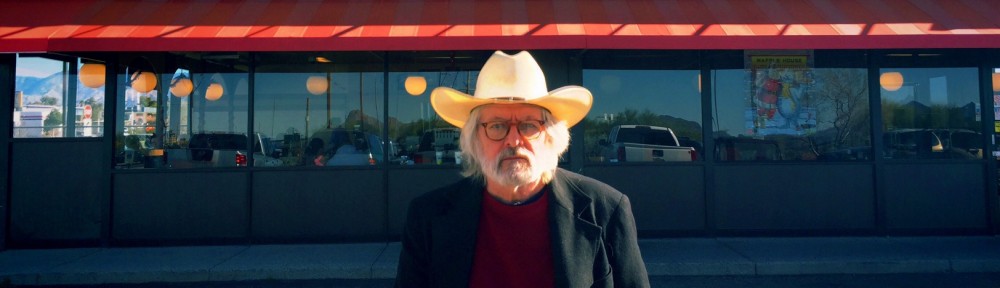
My nephew on the terrace of Mon Ami Gabi at the Paris -- in his cool Seven Samurai T-shirt.  We feasted like kings -- oysters, snails, chicken-liver mousse, steak, lobster.


Groups of crazed bachelorettes dressed like hookers, with plastic tiaras and beauty-pageant sashes, swirled around us but did not deter us from serious talk about movies.
  As you can probably tell from my expression in the photo above, the conversation has just turned to the subject of André Bazin.
View Article  FROM THE ARCHIVES: REPORTAGE DE LA PLAGE, 23 AVRIL 1999


En Californie, le printemps n'existe pas.  Entre l'hiver et l'été, l'année souffre une crise d'identité.  Les jours sont entrés dans une folie d'oscillation entre une chaleur luxurieuse et une mélancholie d'automne, brouillée par les nuages.


On a l'impression d'habiter un film assemblé par un monteur derangé, sous la direction d'un metteur en scène dément.  Votre rôle dans la drame est morcelé.  Quelquefois on parle Anglais, quelquefois on parle Francais.  Quelquefois, la mer parle dans la voix d'une femme -- et alors l'ocean interromps le discours tendre dans la voix d'un homme.

On a l'envie des longeurs de la saison d'été, monotone et stupide, mais fixée, lorsque elle vous dirai "Cowabunga, dude!" et on repondra avec le sourire d'un idiot.
View Article  A CÉZANNE FOR TODAY


Nature morte . . .

View Article  HIGH COUNTRY FOR OLD MEN


Before the anti-Western there was the twilight Western -- a series of films which seemed to sense that the genre was almost played out, or at least that America no longer looked to it for wisdom and inspiration.  The iconic Western stars were becoming old men in the 1960's, and no figures of comparable stature were riding in to replace them, with the possible exception of Clint Eastwood (who would start the important part of his journey far from Hollywood) but the older stars still had box-office pull, for some part of the audience.


So we were given Westerns about the passing of the West, the last days of aging heroes.  These Westerns continued to affirm the traditional values of the genre but acknowledged that the world might no longer need them, or if it did need them, no longer understand them.


The twilight Western really began with the last shot of John Ford's The Searchers in 1956.
  Ethan Edwards, a somewhat deconstructed hero, walks off alone, having performed his last heroic deed -- there is, at any rate, a suggestion that no more such deeds await him.

Ford continued the deconstruction of the Western hero, and offered a look at the times that made him irrelevant, in The Man Who Shot Liberty Valence -- a film told mostly in flashback.  Budd Boetticher had previously made a series of brilliant films starring the aging Randolph Scott, still noble and implacable in virtue, but always alone -- not just a lone wolf, like many Western heroes, but marked with a sadness  for lost times.  The Boetticher-Scott Westerns are uncompromising in their celebration of traditional values, but haunted, too, by a sense of something coming to an end . . . by the idea that Scott's stoic hero may be the last of his breed.


This idea is made explicit in Sam Peckinpah's first Western (and second feature), Ride the High Country, from 1962.  Scott (above on the left) plays an aging hero who loses faith, at least for a while, in the code he has always lived by.  Joel McCrea (above on the right), almost as old as Scott, holds on to that code, knowing full well that the world no longer gives it much credit, if it ever did.


The film is an elegy for and affirmation of this old code of the Western hero -- a combination that is both inspiring and poignant.  It's a new kind of Western, too, in its treatment of its female lead, played by Mariette Hartley (above).  She offers, as in many Westerns, an occasion for testing the gallantry, and thus the true worth, of the male characters, but Peckinpah makes an effort to get inside her head, to let us imagine what the test means for her.  One can't really call Peckinpah's perspective feminist, but it's a step in that direction.


Ride the High Country has taken on a deeper emotional significance over the years, since we now know that the end of the Western genre it seemed to sense was in fact just over the horizon.  Curiously, the most successful revivals of the Western have gone back to the twilight theme -- Lonesome Dove and Unforgiven, for example, have aging heroes out for one last adventure.  It's a pattern also followed in two modern-dress Westerns, The Three Burials of Melquiades Estrada and No Country For Old Men, both starring Tommy Lee Jones, of Lonesome Dove.  The title of the Coen brothers' film might have served as the title of Ride the High Country as well.  Both films suggest that with the passing of the old men, some hope for the redemption of the new world coming into being has been lost.
View Article  PULL MY DAISY


Paul Zahl (of this site's The Zahl File and his own marvelous PZ's Podcast) observes beats and a bishop cavorting on screen in a strange document of the Fifties:

SNAKE-DANCING BISHOP

 
Pull My Daisy, the 1959 "beatnik" movie by Robert Frank and Alfred Leslie, with narration by Jack Kerouac and music by David Amram, has one amazing character in it, unique, I'll bet, in American literature.  The character is a Christian bishop possessing, to put it mildly, wide-ranging interests.


Pull My Daisy is a casual treatment in film of Act Three of Kerouac's 1957 play entitled Beat Generation.  The play was not produced.  It concerns some Lower Manhattan beatniks, played by Allen Ginsberg, Gregory Corso, Peter Orlovsky, and Larry Rivers, who receive a chaotic visit from "The Bishop", played by Mooney Peebles.  During the visit, the beatniks, especially Allen Ginsberg, try out their ideas on this religious man, and variously try to tease him.


Here is Kerouac's narration of the Bishop's grilling:
 
"And Allen is saying, Is ignorance rippling up above the silver ladder of Sherifian doves?
 
"(The Bishop) says, Yes yes yes, Sherifian doves, yes . . .  In any case we are not concerned one way or the other about what we're thinking about, about anything in particular.  But perhaps we sit in some kind of quiet bliss.  And he goes on trying to explain it because he really knows what he's talking about."


Later, the filmmakers, in a high reflective pause, somewhat lengthy, show The Bishop leading the women and children of the beatniks in prayer and song, all standing out in front of the Third Avenue loft building where the visit is taking place.  Kerouac voices this over: "The angel of silence hath flown over all their heads."
 
Towards the end of
Pull My Daisy, The Bishop excuses himself in order "that I go now and go make my holy offices (laughter): if you know what I mean."
 
But Wait!  There's more on this Kerouacian Bishop.
 
We learn in Act One of
Beat Generaton, on the third act of which Pull My Daisy is based, that The Bishop's denomination is "the new, ah, Aramaean church."


We also learn The Bishop is wonderfully weird.  He says to the Allen Ginsberg character, "We cannot expect solutions, or nirvana, eh, if you wish to call it that, without making some eff-
fort in the direction of God, some movement (AND HE TWISTS)"
 
IRWIN (Allen Ginsberg):  Ooh you twisted just like a snake then . . .  Yes your movement then was exactly like a supernatural illustrated serpent arching its back to Heaven . . . I mean that was the
hippest thing I've seen you do tonight."
 
The Bishop also praises the Kerouac character, whose name is "Buck": "You're making sense and you do drink (LAUGHTER)"
 
Our "Buck" has the last word on The Bishop:
 
"Bishop, let me say, you're positively right in everything you say and you're a very sweet man."
 
BISHOP: My disciple here!


Behold, then, dear Sisters and Brothers, a hip bishop, snake-dancing with the beats over on Third Avenue.  May his tribe increase.
View Article  A ROBERT MCGINNIS FOR TODAY


[Via  Golden Age Comic Book Stories]
View Article  A COMIC BOOK PANEL FOR TODAY


We forget that large rock concerts are often occasions for shattering heartbreak . . .

[Via  Golden Age Comic Book Stories]
View Article  ESSAY IN HONOR OF ANDRÉ BAZIN: PALPABLE SPACE


Follow this link for the eighth in a series of essays in honor of André Bazin . . .
View Article  A BENDA FOR TODAY


A study in green by W. T. Benda, Polish-American artist and illustrator from the first half of the 20th Century.  He later became more famous for making exquisite masks used in theatrical productions.

[With thanks, as so often, to  Golden Age Comic Book Stories, the greatest web site known to humanity.]
View Article  AMERICA IN COLOR


Montana, August 1942.  Some things don't change.

[Reproduction from color slide. Photo by Russell Lee. Prints and Photographs Division, Library of Congress]

View Article  A BÉRAUD FOR TODAY


Jean Béraud's portrait of remorse -- but for what?  Thus did the Victorians tease and titillate . . .

View Article  A WESTERN MOVIE POSTER FOR TODAY


[Via  Golden Age Comic Book Stories]