Login
User name:
Password:
Remember me 
This Month
September 2007
Sun Mon Tue Wed Thu Fri Sat
1
2 3 4 5 6 7 8
9 10 11 12 13 14 15
16 17 18 19 20 21 22
23 24 25 26 27 28 29
30
Year Archive
View Article  TRUFFAUT HITCHCOCK


Among the many interesting things to be found at the If Charlie Parker Was A Gunslinger web log are audio files of many of the Truffaut-Hitchcock tapes, from which Truffaut's great book of interviews with Hitchcock was compiled.


It's fascinating, and inspiring, to hear the actual voices of the two men talking about film with such wisdom and passion -- and, in the case of Hitchcock, often enough, sly misdirection.

You can find the tapes here.

View Article  MOVIE DREAMTIME


When we think of dreamlike films, or dream sequences within films, we inevitably think of the expressionistic style filmmakers often use to signal a dream state -- but of course real dreams do not present themselves in that way. We might, in a dream, find ourselves at home and discover a previously unnoticed door opening onto a previously unsuspected wing of the house -- but that wing is not appointed like the cabinet of Dr. Caligari . . . it is as convincingly real a place, in the dream, as the actual house we know.


View Article  CAMILLE PAGLIA ON ALFRED HITCHCOCK


"Space is like an opaque medium that Hitchcock knows how to carve, trim and slice as if it were a side of beef."

This is from Paglia's book-length essay on The Birds -- and what she says of Hitchcock is true of all the great directors, who carve up and reshape space before our eyes, drawing us ever deeper into the spatial illusion of the cinematic image, the core of its sensual appeal and the primary medium of its emotional expressiveness.  This malleability of space,
its ability to be carved and reshaped in cinema, is what places cinema squarely among the plastic arts.

It's a hard concept to grasp, which is why film is traditionally analyzed in terminology derived from the visual arts, like painting, or the literary arts, like theater and the novel, even though its most powerful effects more closely resemble those of sculpture, architecture and dance.  Albert Einstein said, "Space is not merely a background for events, but possesses an autonomous structure."  Film does not simply create occasions for visual or literary events -- it
investigates the structure of space, associates the structure of space with the structure of dreams. Orson Welles said that on some level every great film is a chase -- which is just another way of saying that on some level every great film is about space.


[Paglia's short book on The Birds, published as part of the BFI Film Classics series, doesn't, to me, get at the heart of the film's themes, but it's an exhilarating intellectual tour de force with a dazzling range of allusions to other works of art and to the cultural matrix from which the film emerged.  It's an indispensable text.]
View Article  THOMAS CARLYLE ON ALFRED HITCHCOCK


Actually, this is Carlyle (pictured below) on Dickens, but the application to Hitchcock is clear enough:

". . . deeper than all, if one has the eye to see deep enough, dark, fateful, silent elements, tragical to look upon, and hiding amid dazzling radiances as of the sun, the elements of death itself."

Dickens and Hitchcock both hid within the conventions of popular art, and one misses a lot, one misses close to everything, if one takes their disguises too literally.


View Article  T. S. ELIOT ON ALFRED HITCHCOCK


Well, not precisely, but this quote by Eliot about poetry offers a key to analyzing Hitchcock's films, and, indeed, all great suspense thrillers:


“The chief use of the ‘meaning’ of a poem, in the ordinary sense, may be . . . to satisfy one habit of the reader, to keep his mind diverted and quiet, while the poem does its work upon him: much as the imaginary burglar is always provided with a bit of nice meat for the house-dog."

In Hitchcock's movies, the plot mechanics, the mystery to be solved, the suspense engendered by the nominal physical jeopardy of the characters -- all this belongs to the territory of the "maguffin", the essentially arbitrary device that sets the narrative in motion.

The truth of the film is experienced on another level -- which is one reason it's so enjoyable to watch Hitchcock's movies over and over again, why they always seem new.  You forget the plot mechanics instantly -- they don't linger in the mind for even a moment after the film is over.  All you're left with is the memory of confronting, and surviving, some nameless, existential dread.


[I am indebted to Ken Mogg's The Alfred Hitchcock Story for pointing me towards the Eliot quote and suggesting its connection to the Hitchcock maguffin.  The Alfred Hitchcock Story is a pictorial survey of Hitchcock's films with pithy commentary by Mogg and other Hitchcock experts.  It's worth tracking down the British edition, published by Titan Books, since the American edition is unfortunately and unaccountably abridged.]
View Article  SAUL STEINBERG AND ALFRED HITCHCOCK


The delightful drawings behind the opening credits of Alfred Hitchcock's 1955 film
The Trouble With Harry were done (uncredited) by famed New Yorker artist Saul Steinberg, riffing on images from the paintings of Paul Klee.  Hitchcock was a collector of Klee's work and may well have asked Steinberg to incorporate the homage.

The Steinberg drawings seem to echo a style in 50s design and animation called "cartoon modern", which I wrote about in an earlier post -- though of course the cartoon modern style derives from the whimsical abstractions of artists like Klee and Steinberg, not the other way around.  It's an example of the way artistic ideas percolate up and down the scale from high to popular art.  In 1955, Klee was high-brow art, Steinberg (at least when he was publishing in The New Yorker) was middle-brow art and Hitchcock was low-brow art.  Today you could hardly rank Hitchcock below either of the other two on any scale of art -- which just goes to show how silly and ephemeral such distinctions are, and ought to make us wonder what art today is undervalued because it's stuck into some temporary and ultimately meaningless hierarchy.
View Article  A DIRECTOR'S LIFE


Alfred Hitchcock: A Life In Darkness and Light
may be the best biography of a film director ever written.  Long and detailed, filled with fascinating information about all aspects of Hitchcock's life and films, it's also a great read, almost as entertaining as a Hitchcock film.

There have been two previous full-scale biographies of the director.  Hitch, by John Russell Taylor, was published in Hitchcock's lifetime and with his cooperation -- it sets forth the basic facts without delving too deeply into problematic areas.  Donald Spoto's well-known The Dark Side Of Genius, published a couple of years after the director's death, was more detailed and uninhibited but, as its title suggests, had a somewhat slanted point of view.  It marshaled evidence and highlighted it in such a way as to expose primarily the neurotic and malicious side of the man.

Patrick McGilligan, as his title suggests, tries for a more balanced view, and specifically challenges many of Spoto's interpretations of events and sources, while treading fearlessly into territory that Taylor avoided.

None of the books solves the mystery of Hitchcock's genius and art, because genius and art are mysteries without solutions, but in McGilligan one finds a plausible Hitchcock, one that contains all the complexity and contradiction of the films themselves, the darkness and the light.

It's a terrific achievement.


[Apologies for the web log's disappearance for a couple of days -- it exceeded its allotted bandwidth     . . . too many visitors!  I think the problem has been solved, and thanks for the interest!]
View Article  ISLE OF THE DEAD


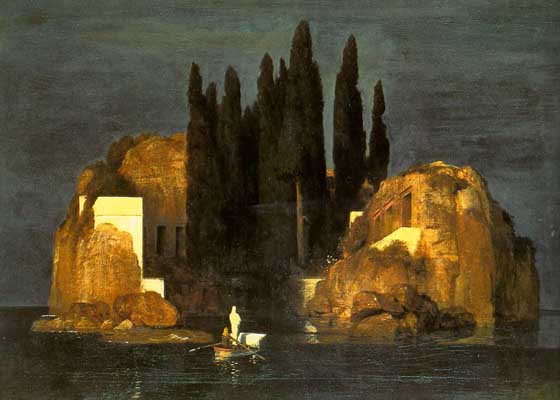
Above is an amazing image by the 19th-Century Swiss symbolist painter Arnold Böcklin -- Self Portrait With Death.  I stumbled across it while looking for another Böcklin painting, The Isle Of the Dead, which Hitchcock reportedly used as a visual frame of reference for Vertigo.

The Isle Of the Dead (below) is almost as spooky as the self-portrait, and while it's not referenced directly in Vertigo, its mood and basic visual strategy obviously informed a lot of the film's compositions involving Madeleine, the ghostly, morbidly-obsessed heroine, who often appears as a distant, deathly-still figure set against backgrounds of dark trees and the sea.


View Article  WRONG MAN, RIGHT MUSIC


The 20th-Century notion of "absolute music" tended to capture the imaginations of composers who wanted to be thought "modern".  They generally abandoned the emotional, descriptive and/or narrative ambitions of 19th-Century program music in favor of a more severe system of abstraction.  This marked the end of concert music as a popular art form but not the end of program music, which went on its merry way in movies, where it continued to enthrall a large public.

Of course, people didn't pay as much conscious attention to this music as they used to in the concert hall, but they could have, with profit.  To prove this assertion all you have to do is listen to the many classic film scores now available on CD -- the original tracks recorded for the films or later re-recordings of the scores.  Many of them are magnificent pieces of music in their own right.  It helps to have the "program" in mind, a memory of the films this music supported, but it's not absolutely necessary with the very best scores -- like those of Bernard Herrmann, for example.


Hermann didn't specialize in creating memorable melodies but he was a master at using the colors of an orchestra to evoke mood and he had a great and subtle understanding of the dramatic uses of rhythm.  All of his Hitchcock scores are brilliant, even the less famous of them like the score he did for
The Wrong Man.  Edgy, dark, minimalist, jazz-inflected, it perfectly mirrors the bleak and jagged realism of Hitchcock's 50s-era New York City, its dehumanizing institutions and its spiritual chaos.  But it has a lyrical core, too, that echoes the protagonist's yearning for deliverance.


It's not absolute music, to be sure -- but it's absolutely wonderful.

View Article  THE BIRDS


Robin Wood's thoughtful and penetrating analysis of The Birds in Hitchcock's Films Revisited is ultimately disappointing to me, because I don't think Wood gets at the thematic heart of the film, although he does acutely perceive its nature, it's basic aesthetic strategy, which is one it shares with all of Hitchcock's great films -- and I think The Birds is one of Hitchcock's great films.

The characteristic strategy of The Birds is to lure the viewer into largely unconscious emotional reactions to images and situations and then to shift the perceptual ground slightly (or shockingly, as the case may be) in such a way that the viewer is compelled to become conflicted about those reactions, consciously or not.

The goal with Hitchcock is always to heighten moral and/or spiritual awareness but his methods never involve pronouncements of any kind, and thus rarely involve symbols than can be reduced to a precise intellectual meaning.  He is only interested in the psychic currents which he can tap, appeal to and uncover within the experience of the viewer as he or she watches the film.

All great artists work this way of course, but if you think that Hitchcock is just an entertainer, a supplier of sensation for its own sake, a clever if eccentric practitioner of genre, you will miss (at least on a conscious level) the full depth of his art.

So when Wood says that the birds in The Birds don't symbolize anything specific he is quite correct.  But what the birds do, and when they do it -- their function as psychic agents in a narrative about characters we are alternately drawn to and suspicious of -- are crucial issues.

The film opens with a man in a pet shop trying, unsuccessfully, to buy a pair of lovebirds as a gift for his young sister.  In the shop he meets a woman who's attracted to him, later buys the pair of lovebirds and drives them up to the remote fishing village where the man's sister lives, and leaves them for her.  The film ends with the young sister carrying the birds on an escape through an apocalyptic landscape -- devastated by a lethal revolt . . . of birds.

What's going on here?  The lovebirds are not symbolic per se in the artistic scheme of the film -- they're an image that means different things to different characters at different stages of the narrative.  What's crucial, it seems to me, is that the lovebirds are a couple and that they live in a cage.  They incarnate a paradox -- are they trapped, or are they safe?  They're both, obviously -- but which condition is most important?  That's the question the film poses, and answers, after a fashion.


The woman in the pet shop is an irresponsible heiress -- a bird in a gilded cage, as Wood observes, but alone.  When she runs into a man who wants lovebirds in a cage, she develops what seems to be an irrational attraction to him.  The imagery is very ambiguous here, but suggestive.  Is she looking for company in her cage, a man who'll share her prison with her? 


It turns out that the man is the son of a woman who lost her husband, his father, and is thoroughly traumatized by the loss.  She clings to her son, interferes with his desire to find a partner of his own -- places an intolerable burden on him to become the head of the family, father to his sister.  The mother's grasping is not Oedipal, exactly -- it's more a terror of being alone, of being incomplete.  The family's loss of its father/husband has created a vacuum in which neurosis breeds.

So the lovebirds, to the man, are an image of the wholeness he can't supply -- a magical substitution which might allow him to seek his own wholeness in a new relationship.

The lovebirds may not mean exactly the same thing to the man and the woman in the pet shop but they crystallize each other's deepest needs and desires.  How could they not fall in love in the presence of such an image?

But the image won't stay put -- won't stabilize itself for either of them.  Other birds, uncaged birds, gather above them menacingly.  The man catches the woman delivering the lovebirds to his sister, is touched, intrigued, drawn to her, as she obviously is to him.  At that moment a seagull attacks the woman, for no apparent reason.

Later, the woman reveals to the man that her mother deserted her when she was child.  At that moment a flock of birds suddenly attacks the children at the sister's birthday party.  It's as though the creatures have emerged demonically from the woman's ravaged psyche.


The bird attacks grow more numerous, more lethal, more surreal.  They attack the man and the  sister and the mother in their own home, where the woman is visiting.  There seems to be no defense, no hiding place.  But a new family is forming, as the man and the woman fall deeper and deeper in love, as the sister comes to rely on the woman emotionally, as the mother slowly softens towards her.

The birds pause in their attack.  The family decides to make a run for it.  The sister insists on carrying the lovebirds in their cage.  As they drive away though fields of menacing, roosting, temporarily placid birds, the mother takes the woman in her arms, in a mother's embrace.

The lovebirds in their cage have become a talisman of salvation -- an image of the confinement of commitment, the cage of family and love, but also of immunity from outright destruction.  It's like the bait and switch Hitchcock engineered in Shadow Of A Doubt, where the "oppressive" and suffocating prison of the family, as we see it at the beginning of the film, is revealed as the only refuge against forces darker than anyone in that family could ever have imagined.

Only the lovebirds in their cage are free, provisionally at least. Outside the cage is simply irrational, meaningless horror.  This is not exactly a conservative or romantic endorsement of committed love and family.  Happiness is not really at stake here, much less moral rectitude or an all-encompassing psychic fulfillment -- only survival.  So why is that mother's embrace at the end of the film so powerful, so profound, so moving?  Because it's something, set against nothing.


The newly constructed family drives off jammed into a small sports car, caged.  They incarnate a paradox -- are they trapped, or are they safe?  Both, obviously -- but which condition is most important?  It's clear enough which way the film leans on this issue, but Hitchcock isn't making any promises.  He insisted that "The End" not appear at the film's close -- partly as a gimmick ("The birds are still out there!"), partly to keep the psychic and moral tension alive in the audience . . . but also partly, no doubt, because he knew subconsciously that he would return to the female protagonist of this film again, would explore her existential jeopardy in greater depth, which he did in Marnie, using the same actress, playing a very similar lost soul in search of a mother's embrace.


The hidden, poisoned springs of many Hitchcock films run through the pathology of dysfunctional parents, shattered, perverted families, wrecked marriages -- and the provisional redemption these films offer often involves new families reconstructed on the ruins of old ones.  Hitchcock's view of the family, all families, was ambiguous -- and his passionate defense of the family as a bastion against terror, against meaninglessness, was inflected by this ambiguity.  Even so, his view was inaccessible to many critics, like Wood, who were, for personal and political reasons, deeply suspicious of the family as a social phenomenon -- an attitude that became fashionable, almost a matter of faith, among 20th-Century intellectuals.  Wood wanted to analyze The Birds as a vision merely of conflict between order and disorder, missing the fact that, for Hitchcock, this conflict was centrally bound up with the idea of family.

Hitchcock was canny.  He knew that society cannot face its deepest concerns, its deepest fears, directly.  He knew that those fears had to be displaced in art, given an indirect expression -- blamed, as it were, on the birds.


View Article  THE UNCUT PSYCHO


The original cut of
Psycho which Alfred Hitchcock delivered to Paramount ran just under nine hours.  Hitchcock lobbied hard to have the film released at this length, in a special day-long presentation with two intermissions, but violent reactions from audience members who saw test screenings of the nine-hour version (including, reportedly, at least two unpublicized suicides) convinced the director to cut the film drastically and release it at a normal length.

All prints of the original cut were thought to have been destroyed -- until early this year when one somehow turned up in the basement of a house under demolition in St. Louis.  The house had once belonged to a man who owned a small chain of movie theaters in the Midwest, and apparently at least one print had made it to one of those theaters, presumably for test purposes.

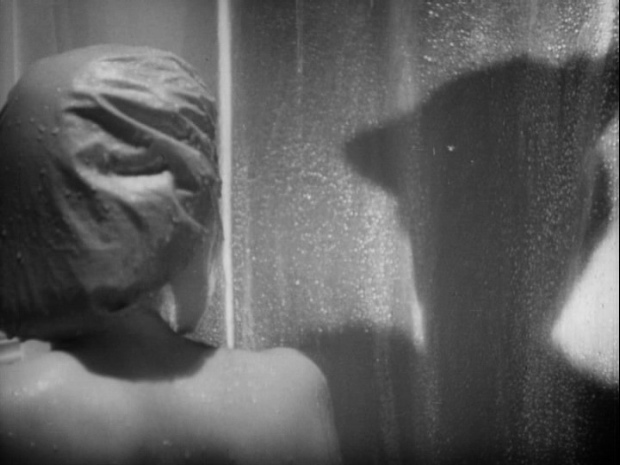
Robert Harris, who has restored several classic films, including Hitchcock's Vertigo, and will be restoring the uncut Psycho, is one of the few people who's watched the new footage in its entirety.  Harris reports that the famous shower scene runs to forty-five minutes in Hitchcock's original cut and personally made him sick to his stomach.  "It's film history," says Harris, "and needs to be preserved, but I can't say I'm happy that this new version has survived.  The world would be a better place without it."

Picture negative and original sound elements for the new footage do not survive, so the reconstruction will be uneven.  Universal, which now controls the film, plans to release the uncut Psycho in a three-disc special edition late in 2008.


View Article  THE CATHOLIC HITCHCOCK AND THE PROTESTANT HITCHCOCK


Alfred Hitchcock was raised a Catholic and educated by the Jesuits.  The influence of his Catholic upbringing is evident in his films, sometimes in surprising ways.

On a purely psychological level, Hitchcock was attracted to stories in which someone is judged unfairly, mistaken for someone else and asked to pay for that other person's sins.  This is a common enough response to the harsh and demanding educational system of the Jesuits -- a sense of living under perpetual (and seemingly unjust) accusation.  In many Hitchcock movies the unfairly accused protagonist redeems himself by heroic actions -- which in theological terms might be related to the doctrine of justification by works, the idea that a man can, with a little help from God, save himself by his own actions.

But there's deeper and more complex theology at work in certain of Hitchcock's films -- most notably in I Confess and The Wrong Man.  Interestingly enough, these are two of the director's most naturalistic films, shot in great part on location and in black and white.  It's odd that when he wanted to delve most deeply into religious themes he should have chosen to present them in a quasi-documentary form.

In I Confess a priest, played by Montgomery Clift, is unjustly accused of a murder.  The real killer has confessed to him, but he can't, as a matter of religious conviction, tell anybody about it.  In this film, the protagonist does not redeem himself except by passive sacrifice.  His heroism is simply to accept his fate humbly, stick to his faith.


His convictions here are church-related -- he must sacrifice himself to the principle of the sanctity of the confessional, to ecclesiastical procedure.  He's saved from paying the ultimate penalty by the witness of another character, who sacrifices herself to reveal his innocence.  Presumably his own sacrificial posture has inspired her to this act.

So far we are well within the Catholic tradition, which sees the church, personified in the figure of the priest, as a divine agent in the world -- adherence to its doctrine and ritual leads to salvation.

But something very different is going on in The Wrong Man.  Here an innocent man, played by Henry Fonda, is accused of a crime and his whole life is shattered.  He's a religious man, and carries his rosary beads with him through his ordeal -- but it doesn't seem to help.  The wheels of justice, the oppression of the legal system, operating quite reasonably on the face of it, crush him like an insect.


Finally his mother asks him to pray -- and he does, not with the rosary beads, not in a church, but directly to an image of Jesus.  Instantly, the real criminal appears and is caught -- the accused man is redeemed.

This is a long way from Catholic theology in that the church plays no mediating role.  It's just between "the wrong man" and Jesus.  He's saved by no action of his own, not even by the humble acceptance of his fate.  He's saved by a simple cry for help.

We're now, oddly enough, in Protestant theological territory, closer to the doctrine of justification by faith, in which neither the church nor the suffering man play any role whatsoever in the man's salvation, which is a gift of Grace from God, pure and simple.

It's clear that in these two films Hitchcock was not just expressing resentment over the terrors and the residual guilt inculcated by a Catholic education.  He was articulating complex themes in Christian thought, trying to dramatize them in an entertaining way but also to situate them in the real world, in a plausible evocation of modern-day Quebec, where I Confess is set, and New York, where The Wrong Man is set.


"Film is not a slice of life," Hitchcock famously said, "it's a slice of cake".  But there's very little cake on display in either of these films -- and in the mean streets of The Wrong Man, in the suffocating rooms and cells and hallways of police stations and prisons and courthouses, there is only wormwood and gall.

The two films stand out as great and profound works of Christian art, explicit meditations on Christian theology in a century (and an industry) not noted for such concerns.  Like all good parables they can be enjoyed simply as stories, but Hitchcock makes it very clear (see the image from I Confess at the beginning of this post) that he had heaven on his mind when he made them, that he was asking deep questions about the nature and the mechanism of salvation.

View Article  ALFRED HITCHCOCK: THE MASTERPIECE COLLECTION


Alfred Hitchcock: The Masterpiece Collection
, a 15-disc DVD box set, might be the best bargain in the entire history of entertainment.  It includes 14 films plus a bonus disc of extras, and can be had from Amazon for $84.99, possibly less from other sources -- about $5.70 per disc or about $6 per film.  Four of these films are indeed masterpieces of world cinema, two are minor masterpieces, two are interesting misfires, and the rest are just superior entertainment with bravura passages of pure, breathtaking cinema.

Each of the films has, among other extras, a short documentary about the making of it, including some fascinating interviews with Hitchcock collaborators, and the bonus disc has longer documentaries about the making of Psycho and The Birds.  The Vertigo disc, which offers the best DVD transfer of the film currently available, has an excellent commentary by one of the film's producers and by the two men who did the comprehensive modern-day restoration of Hitchcock's masterpiece.

If you invest in this set, and an equally wondrous companion set called Alfred Hitchcock: The Signature Collection, which has another 9 of Hitchcock's best movies for about $53, you will never spend another restless rainy night at home in front of the television.  You will have an endless supply of enchantment.  Just add popcorn.

You can check out the contents of the sets and buy them here:

Alfred Hitchcock: The Masterpiece Collection

Alfred Hitchcock: The Signature Collection
View Article  SHADOW OF A DOUBT


Alfred Hitchcock's Shadow Of A Doubt, from 1942, is a kind of proto-film-noir.  It shares the dark view of human nature and the
deeply skeptical vision of "respectable" society that would inform the post-WWII film noir.  WWII was just getting under way for America when the film was made, but much of the rest of the world had already been at war for three years by then, and clearly the global conflagration was beginning to create a deep anxiety in the psyches of sensitive, thoughtful artists like Hitchcock and Thornton Wilder, who co-wrote the screenplay.

At the beginning of the century America had participated in a "war to end all wars" and now the continents were aflame again.  There seemed to be some intrinsic, irrepressible evil in the nature of human beings, or in the organization of their societies, which led to wholesale destruction at regular intervals, despite the best efforts of mankind's intellect and collective goodwill.


The fragility of human institutions, especially the family, was acutely sensed.  Shadow Of A Doubt was pre-noir in that it didn't concentrate on the world's corruption or on the impotence of manhood, personified in the devouring femme fatale, but rather on the human being's inward capacity for evil, which seemed to erupt without reason or warning.  "The world needs watching," says the young hero at the film's end -- meaning, mankind needs watching.  There was still, in 1942, a faith in the idea that watching might do some good.  At the core of the post-war film noir was a sense that such a faith was delusional.

The magnificent irony at the heart of Shadow Of A Doubt is that the threatened family is presented at the beginning of the film as a trap, a web of annoyance and boredom.  The glamor of the unconventional, rootless, iconoclastic Uncle Charley is presented as a deliverance from the suffocating everyday reality of family and small-town life.


But as our suspicions of Uncle Charley grow, we begin to treasure the ordinary goodness of the family he seems to be rescuing from its rut.  Only in the light of their fragility can we appreciate family and community for the treasures they are, the bulwarks they are against the world's insidious darkness.


It's easy to see how this related to the mood of the nation, and the world, when the film was made -- but its resonance has if anything grown deeper as the post-war era has played out, with the family and community in deeper and deeper jeopardy, threatened now in "advanced" societies not by external violence but from within.  Wilder and Hitchcock are still reminding us how truly naked and vulnerable we are in the face of the world's horrors -- still reminding us that those horrors originate in the human heart, and that our few defenses against them are both frail and inexpressibly sweet.

Shadow Of A Doubt was Hitchcock's favorite film -- he certainly never made a greater one.
View Article  VERTIGO


Vertigo
, Alfred Hitchcock's masterpiece from 1958, is about many things -- that is, it can be analyzed from many different perspectives -- but one of the most important things it's about is the medium of movies itself.

Every work of art is on some level about the medium in which it's expressed -- its nominal subject, sometimes confused with its "content", is often merely an excuse for a demonstration of the metaphysical resonance of a particular set of techniques.  The process of art itself is a subject, a conveyor of meaning, which interacts with the nominal subject of a work in complex ways.


The technique of Jan Van Eyck's Altarpiece Of Ghent testifies to a lifetime of study and mastery in the discipline of painting, a supreme commitment to the medium, which is inseparable from the religious devotion of the work -- they become co-identical.  By the same token, when Robert Rauschenberg wraps bits of an old tire around a tree stump and calls it sculpture, he is expressing a cynicism not just about art but about life, about all human endeavor.

The obvious text of Vertigo, the narrative element which can be rendered into words, clearly has parallels to filmmaking.  A man dresses a woman up and coaches her in playing a part to facilitate a murder, creating an image that another man falls in love with -- and when that other man loses the woman he thinks he's fallen in love with he dresses yet another woman up and coaches her in playing the part of his lost love.


Critics have seen the images of the two men in the film as images of a film director, who on one level constructs drama for cynical, mercenary purposes, but can also, like Pygmalion, fall in love with his creation and want it, like Galatea, to come alive and embrace him.

To the degree that we as spectators enter into the activity of the director, become seduced by it -- first as entertainment, then as the motivation of real desire -- we share the director's dilemma and the director's temptation.  We risk falling in love with ghosts -- the ghosts we've summoned, cynically or narcissistically, from our own psyches.

As I say, this analysis of Vertigo is available to us on a literary, intellectual level just from the plain narrative of the film.  The art of the film, however, lies in the way Hitchcock makes us feel the spiritual jeopardy of his protagonist in personal, often subconscious ways -- to experience his protagonist's jeopardy as our own.  The genius of the film, then, is the way Hitchcock uses the medium of movies not just to express its nominal subject but to internalize it in the psyche of the spectator.


Primarily, Hitchcock does this by encouraging the pleasure we take in being spectators, voyeurs, luring us into a comfort zone about the activity, and then subtly deconstructing our comfort, our distance from the activity.

The film moves with astonishing fluidity between different kinds of images, which place us in different relationships to them.  The simplest example of this is found in the early scenes in which Jimmy Stewart follows Kim Novak's car through the streets of San Francisco.  Location shots in which the moving camera, representing Stewart's point of view, pull us imaginatively through the fascinating urban landscape of a real place, delight us and so pull us imaginatively, emotionally, into the chase narrative.  But these shots are intercut with oddly quiet and dreamlike reverse shots on Stewart filmed against patently unreal backscreens.  Stewart is clearly not driving a real car, he's clearly not really in the streets he seems to be driving down -- he's watching something from a distance, as we are.  Subliminally, we're being told that we can enjoy this chase without having to imagine it as real -- because it's just a movie -- but we're also being told, and shown, that we can choose to enjoy it as real, to whatever degree we like.


This dynamic is a paradigm for the aesthetic strategy of the whole film.  As the Stewart character becomes more and more obsessed by the Novak character, Hitchcock progressively eroticizes her as an image on screen, inviting us to fantasize about her also in purely sensual terms -- but he keeps stepping back and forcing us to step back, to see her once again as merely an image, perhaps a dangerous one.


Finally Hitchcock is able to bring us to the spiritual climax of the film, when Stewart is so thoroughly enchanted by the erotic illusion of Novak that he's willing to suspend his disbelief in her reality in order to possess her, whatever the hell that might mean under the circumstances.  As spectators, we are right with him.  Hitchcock can tell us with every means at his command as a filmmaker that Stewart is living in a dream, that we are watching a dream, but can at the same time so eroticize Novak that we don't care -- we want the dream to be true.  We want it right up until the final shot, when, like someone having a wonderful dream he or she doesn't want to end, we try to incorporate the sound of the alarm clock into the dream, so as not to be forced to switch our mode of consciousness.


The paradox is presented from a predominantly male point of view, but isn't limited to one.  The moment in the hotel room when Stewart waits for the embodiment of his deepest sexual fantasies to walk out of the bathroom with her hair done just so is one of the most erotic moments in all of cinema.  It connects with the hope and suspense of every sexual encounter -- and not just for men.  Kim Novak said that the scene was incredibly powerful for her -- that she was literally trembling with emotion, involuntarily, when she walked out of that bathroom, because the moment connected for her with all those amorous moments in real life when she wanted to be perfect for her lover, wanted to perfectly embody his fantasies.

The self-reflection of a film director, the spiritual jeopardy of voyeurism on the part of moviegoers, thus becomes universalized in Vertigo into a profound reflection on the hope and suspense and illusion (and charity, and fun) of sexual love.  The medium incarnates the message and we receive it not as a message but as an interior insight, a wisdom born of our own experience.

This all but magical ability to incite interior experience in the spectator is of course an attribute shared by all great art, and explains why we can watch Vertigo repeatedly and still have it play out as new -- much like the sex act itself.  We're not just being shown something, not just being told something, not just doing something when we watch Vertigo.  Something is happening inside us over which we have very little conscious control -- and it happens again and again each time we see the film.