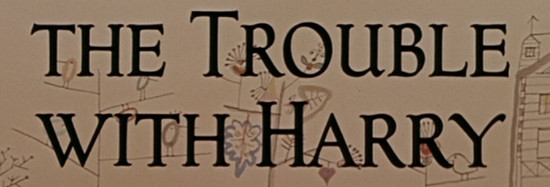
The delightful drawings behind the opening credits of Alfred Hitchcock’s 1955 film The Trouble With Harry were done (uncredited) by famed New Yorker artist Saul Steinberg, riffing on images from the paintings of Paul Klee. Hitchcock was a collector of Klee’s work and may well have asked Steinberg to incorporate the homage.
The Steinberg drawings seem to echo a style in 50s design and animation called “cartoon modern”, which I wrote about in an earlier post — though of course the cartoon modern style derives from the whimsical abstractions of artists like Klee and Steinberg, not the other way around. It’s an example of the way artistic ideas percolate up and down the scale from high to popular art. In 1955, Klee was high-brow art, Steinberg (at least when he was publishing in The New Yorker) was middle-brow art and Hitchcock was low-brow art. Today you could hardly rank Hitchcock below either of the other two on any scale of art — which just goes to show how silly and ephemeral such distinctions are, and ought to make us wonder what art today is undervalued because it’s stuck into some temporary and ultimately meaningless hierarchy.
Recently I saw the delightful credits for Hitchcock’s The Trouble with Harry, and Googled my way to your site. While I believe you are correct in locating Steinberg’s work under the general rubric of “cartoon modern” I believe there is another, more immediate visual allusion of interest. The charming birds, flowers, and quaint structures are direct borrowings from antique New England crewel embroidery samplers. The freshness of this opening took me quite by surprise.
Thanks for your blog, I have enjoyed discovering it. nw
Yes, I can see that Steinberg may well have been trying to convey an echo of New England embroidery motifs in his designs, just as Hitchcock was trying in the opening shots of the film to establish a classic New England locale.
Pingback: Mid mod film credits-The Trouble with Harry | boskybelle.com