Login
User name:
Password:
Remember me 
This Month
March 2008
Sun Mon Tue Wed Thu Fri Sat
1
2 3 4 5 6 7 8
9 10 11 12 13 14 15
16 17 18 19 20 21 22
23 24 25 26 27 28 29
30 31
Year Archive
Main Page  »  Food
View Article  BEER


Benjamin Franklin said, "Beer is proof that God loves us and wants us to be happy."  You probably know this already, and may know the famous advertising line for Guinness Stout -- "Guinness Is Good For You."  In fact it is -- incredibly good for you.  A moderate daily intake of beer has long been known to reduce stress and the risk of heart attack but there are ingredients in beer that work many other wonders besides lowering cholesterol, including reducing the risk of cancer and cognitive decline (drink beer, stay smart forever!) and fighting off viruses.  Beer also increases the metabolism of protein, which is useful if the consumption of beer causes you to neglect regular meals.  (Hey, it can happen.)

And you thought your love of beer was based purely on moral depravity.  Not so, my friend!  Far from it!  A beer belly is the unmistakable sign of a lifelong commitment to personal health.


Some anthropologists believe that grain was first cultivated by the human race not as a food source but for fermentation into beer -- bread was a happy by-product of the activity.  (The figures above are ancient Egyptians making beer.)  This would mean that the entire advance of human civilization, which was founded on the cultivation of grain, proceeds from the desire to toss back some suds.  The next time you're enjoying a Bach Cantata or a play by Shakespeare or the sculptures of the Parthenon, raise a glass to the good old boys and girls of 10,000 B. C., who got the party going.

Check out the good news here:

Men's Health

. . . and cheers!
View Article  NO LIMIT


My friend John Sosnovsky was just in town and brought as a gift a copy of Just Enough Liebling, a collection of A. J. Liebling's writing about food, boxing and war.  In one of the articles about food Liebling offers an extended paean to Tavel, the rosé wine from the
Rhône region of France.  It brought back many memories.  Tavel is a wine often served in the South Of France with seafood (although Liebling insists it's so good it can go with anything) and I've drunk it with many fine meals in that part of the world, usually in restaurants or on the terraces of restaurants with a view of the sea.


On John's last night in Vegas I tracked him down in the card room at Caesars around 9pm.  He'd been playing poker all day, with mixed results, and said he was pokered out, so we decided to meet at Mon Ami Gabi, a terrific French bistro in the Paris, Las Vegas casino.  Once installed on its very pleasant terrace I discovered that they had a Tavel on their wine list, and John and I decided to drink a bottle in honor of Mr. Liebling.  And we decided to drink it with steak, to test Mr. Liebling's assertion that it can go with anything.


It went exceptionally well with the steak, with the brisk night air and with our conversation, which kept circling back to the upcoming fight between Ricky Hatton and Floyd Mayweather, Jr. next Saturday in Las Vegas.  John is a member of the Fancy and very knowledgeable about boxing, but even he seemed baffled by the question of who was likely to prevail in this contest -- Hatton, the brawler with heart, or Mayweather, the scientist with lightning-fast but hardly lethal hands and canny instincts for defense (or unseemly evasion, as some consider it.)

The best we could surmise was that Hatton had a chance only if he got inside and ripped Mayweather apart with body shots, shocking him and breaking his will.  That didn't seem likely, but it seemed possible.  Such imponderables are what have made this fight one of the most anticipated in ages.  Mr. Liebling, long since deceased, would have had much to say on the subject and we missed his wisdom keenly.


After the Tavel and the beef, John decided that perhaps he wasn't pokered out after all.  We set off to see what tables might be going in the Paris' card room.

The night before, at the Palms, John had cajoled me into sitting down at my first no-limit Hold-'em game in a casino.  (I'd played a few hands at a no-limit game in the old card room at the Rancho Fiesta, but it had broken up almost as soon as I arrived at the table.)  I was terrified of playing at the Palms -- not least because Phil Helmuth (below, playing in a tournament) and Layne Flack, two high-profile high-limit poker pros, were hanging around my table to watch a couple of their friends play.  It's tough to make your debut at a no-limit table under the eyes of a winner of the Main Event at the World Series Of Poker.  (Helmuth won it in 1989 at the age of 24, the youngest player who's ever done so.)


No limit Hold-'em is intrinsically terrifying.  Any amount of money can be bet on a hand at any time, which means you can lose every chip in front of you if you call an "all-in" bet with the wrong cards in the wrong situation.  On the other hand, you can use big bets to push your fellow players around -- to make them fold better cards than you have, for example.  It's a wild and exceedingly complex endeavor.

Miraculously, as soon as I sat down at the table I felt cool and perfectly in command of things.  I've played endless hands of no-limit poker for fake money online and I understand the dynamics of the game -- far better than I've ever understood the dynamics of limit Hold-'em, where you can bet only certain fixed amounts.   I've always played limit Hold-em because it seemed on the face of it less risky.  No-limit Hold-'em for money, however, is a far more logical game, far less dependent on the random fall of the cards, though the logic is sometimes the logic of ruthlessness and terror.

I played for three or four hours in this heady atmosphere and walked away about a hundred dollars
down.  Not good -- but not devastating, either.  You can pay more for a good meal or a rock concert and not enjoy either half as much or for half as long.


There were no poker pros hanging around the Paris' card room (above) -- just a lot of genial players who seemed like people on vacation looking for a good time . . . and to say they'd played poker in Las Vegas.  They weren't bad players but they played too many hands, eager for action.  I waited for my chances, bet hard when they came and walked away three hundred and thirty dollars ahead --
by far the most money I've ever won at any poker table.  More importantly, it left me over two hundred dollars ahead for my first two nights of no-limit poker. 

John did even better, walking away over seven hundred dollars ahead -- covering the cost of all his poker playing in Las Vegas and his hotel room and his flight here, with a little left over for celebratory drinks afterwards.  To say that we raised our glasses joyfully would be putting it mildly.

[The snapshot of the Paris poker room above is from a useful web site, vegasrex, which describes and reviews the various card rooms in Las Vegas and has a lot of other stuff about what's going on in town.]
View Article  PARIS


I have no memory whatsoever of my first view of Paris -- what I must have seen of it on a cab ride from the airport to my Left Bank hotel in the winter of 1983.  I have a vague memory of the view from the hotel room, a charming chamber up under the eaves of a small, venerable and recently refurbished establishment near the École des Beaux Arts.  I looked out over the rooftops of Paris, which reminded me of Paris in the movies, but I'm not sure what else I saw, besides possibilities.

I arrived at the hotel late at night but my companion, who'd been to Paris before, knew a restaurant that was open 24/7, one she was fond of, and we went there.  It was at the edge of Les Halles, the site of the legendary produce market.  The market had long since been moved to the outskirts of Paris and was then just a ghost of itself, but the restaurant, Au Pied de Cochon,
which had been there in the glory days of Les Halles, remained.  It opened in 1946 and has not closed its doors since.  Once, obviously, it served the all-night workers and truckers of Les Halles when it was a functioning market but people still made their way to it at all hours of the night.  There was a small crowd there when we arrived sometime after midnight.  I had a sense that many of them were musicians grabbing some food after an evening's gig, though I'm not sure at this remove what made me think so.  Perhaps one of them was carrying an instrument in a case.  Perhaps one of them pulled out a guitar and sang some snatches of a song.


The restaurant was rather plain in those days, even shabby, reflecting its original working-class milieu.  It has been remodeled at least a couple of times since then -- it has an unfortunate faux-Belle Époque décor now (see above) but still isn't particularly fancy.  It specializes, as its name suggests, in pig's feet and other rustic fare, and also in shellfish, which seems to be de rigeur for all-night restaurants in Paris.

It had a wide selection of raw oysters, and I ordered a dozen Belons, the small, tangy oysters of the Breton coast that have a considerable reputation.  When the round tray of them arrived at the table, they created my first intense visual memory of Paris.  The opened oysters and some cut lemons were nestled on a bed of ice decorated with sprigs of seaweed.  The tray was placed on a wire rack directly in front of me, giving me a good view of and easy access to the oysters.  On a plate in a holder built into the wire rack beneath the tray was a
small bowl of red wine vinegar and finely chopped onions, some slices of brown bread and some butter.  The oysters in the picture below are not Belons -- I offer it just to show the general set-up.


I revere oysters extravagantly.  To see them served in such an exalted way stirred my deepest admiration.  (I had never seen such a presentation in an American restaurant, though now it's fairly common in upscale French eateries.)  They were the tastiest, most mysterious oysters I had ever eaten.  I ordered twelve more.

Several times in the preceding few hours I had thought to myself, "I'm in Paris!"  But I didn't quite believe it.  Halfway through the second tray of oysters, I believed it.

Next February, it will no longer be possible to smoke in Parisian restaurants, so I will most likely never go back to Au Pied de Cochon.  This is not altogether a bad thing.  The places you love that you can never return to are also places you can never leave.  They become part of your own small portion of eternity.
View Article  AFTER ACTION REPORT


My friend Jae and I supplemented our modest cooking skills with large doses of improvisation and luck to concoct a truly splendid Thanksgiving meal.

Jae, in an impulse of reckless ambition, decided he would make mashed potatoes.  "I'm going French with them," he said, but would not explain what he meant by this.


In the end he made stupendously good mashed potatoes and only after they'd been tasted would he reveal his ingredients.  Half-and-half for creaminess, a large but not overpowering amount of finely chopped garlic, one single, large shallot, a small amount of freshly grated Romano cheese and a pinch of cayenne pepper.  I can't say what's French about any of this but I can say that the results were delicious.


Jae made stuffing but added to it at my request some oysters and, on his own initiative, as likely to complement the taste of the oysters well, some crumbled fried bacon.  Again . . . delicious.

Our large turkey for some reason did not produce much in the way of fat drippings, so that late in the cooking of it we despaired of having enough liquid in the pan to make gravy.  On another inspired impulse, Jae poured some pumpkin ale into the pan, which made for a very fine gravy in the end -- an improvisation that could well become a Thanksgiving tradition.


I confess I couldn't savor the meal as slowly and carefully as I might have, because I started drinking too early in the day, and too many different things.  A rosé wine, then some of the pumpkin ale, which had a cheerful, festive taste to it, then some Chimay ale and finally a Merlot with the dinner.  I was past consciousness even before I got to the pumpkin pie, which served as a fine breakfast the next day.

Friday was a bit of a blur, sharply focused only by a turkey sandwich and by a viewing of Vertigo, which still yields up treasures after countless viewings in the past.

And so the time of leftovers begins.  From the look of things this should last quite a while.
View Article  LOUP GRILLE AU FENOUIL


Loup grillé au fenouil
, translated precisely from the French, means wolf grilled with fennel. Those familiar with Mediterranean cooking will recognize, however, that the wolf, the loup, referred to here is loup de mer, the wolf of the sea, or sea bass. Sea bass grilled with fennel is one of the glories of southern French cuisine.

I first encountered it in one of the restaurants facing onto the harbor of Villefranche, a small town just east of Nice -- a restaurant called Mère Germaine. There are several restaurants just like it facing the harbor, and loup grillé au fenouil is not prepared better in Mère Germaine than in any of the others, but Mère Germaine is where I first had it, and so that must remain the center of my nostalgia for the dish.


It has certainly never tasted better anywhere else -- except perhaps on a terrace barbecue in Seattle once. A friend living there had discovered wild fennel growing near him in a vacant lot, and used its seeds to season the fish, its stalks to fuel the fire beneath, resulting in a wholly satisfying sensory experience.


Nostalgia is a potent spur to culinary ambition. One day while peeking into the tiny seafood selection at my local supermarket I noticed a tempting fillet of Chilean sea bass. I bought it, along with some dried fennel seeds from the spice racks, and decided to see how close I could come to recapturing the taste of those long ago nights on the Côte d'Azur.

I coated a small pan with olive oil, salted and peppered the bottom of the pan, then covered it with fennel seeds.  I placed the fillet of sea bass in the pan and made two slits in the fillet. I coated the top of the fillet with olive oil, salted and peppered it, and covered it with fennel seeds, filling up the slits with extra seeds.

I set it under the broiler in my oven until the fennel seeds were brown and thoroughly roasted, at which point the fish was cooked through but still moist.

I ate it with a respectable Chardonnay from the Coppola vineyards, and the wine was fine, but a drier one would have suited the taste of the fish better. The taste of the fish was miraculous -- light but flavorful -- and the toasted fennel seeds gave a pleasant reminder of the dish as it's prepared on the shores of the Mediterranean.

It was not by any means loup grillé au fenouil as you'd encounter it there, cooked on a real charcoal fire, seasoned with fresh fennel. But it was poignantly close.
View Article  THE WORLD'S GREATEST SALSA


I'm not kidding -- you've never tasted better salsa than this, and it's so easy to make . . . there's really no excuse not to have a supply of it on hand at all times.

What you need to make it is four medium-sized tomatillos, three or four cloves of garlic, two canned chipotle chilies in adobo sauce, some water and some salt.  Take the husks off the tomatillos, wash them and cut them in half.  Place them in a non-stick skillet, cut side down, over medium heat, along with the unpeeled garlic cloves.  Roast them all for about four minutes, then flip them over for another four minutes, or until the tomatillos are soft all the way through.

Put a quarter cup of water into a blender, place the roasted tomatillos and the peeled roasted garlic into the blender along with the chilies and a couple of pinches of salt.  Two chilies makes for a very spicy but not overwhelming salsa.  Just add one if you want something a little milder but still very tangy.  If you want to knock your socks off, add three or more -- but don't say I didn't warn you.

Grind this all up into a slightly coarse blend, transfer it to a bowl and add more salt to taste, if necessary.

In this salsa the flavors of the roasted tomatillos and the roasted garlic are a perfect complement to the smoky fire of the redoubtable chipotle.  It's good with tortilla chips of course, and on any kind of taco.  Mexican food guru Rick Bayless, in his book Mexican Everyday, where I found this recipe, says he likes it on everything but ice cream -- and I'm not sure I'd rule out ice cream entirely.

It's sublime stuff.
View Article  THE ULTIMATE CUBA LIBRE


The cuba libre, rum and Coke, always seemed like a pop cocktail to me.  I guess I associated it with early drinking in college, when it was the only mixed drink anyone knew how to make and seemed like a painless way to ingest a lot of alcohol.

But that was before I tried Ernest Hemingway's recipe for a cuba libre, which is something else again.  The key to this recipe is getting hold of a Mexican Coke, which is still made with sugar, as it was in Hemingway's day.  You want to taste the rum and its parent cane
sugar all at once.  (If you can't find Mexican Coke, forget I ever mentioned the cuba libre -- corn syrup has no place in it.)

Squeeze half a lime into a cocktail glass.  Pour in a jigger of Bacardi white rum, add the remains of the squeezed lime and plenty of ice and pour the Coke over it.  The result is not too sweet and not too sour and it has an exhilarating freshness.  After a couple of these you'll be imagining you're on a tropical beach somewhere . . . and after a few more you'll be convinced you really are on a tropical beach somewhere.

At that point, just relax and listen to the sounds of the surf and the wind rustling the palm fronds.
View Article  CARNE ASADA TACOS


The next time you feel like fixing yourself a hamburger, try a carne asada taco instead, which is sort of the equivalent of a hamburger south of the border, fast, ubiquitous and comforting.

Here's how to make the ultimate carne asada taco, courtesy of Rick Bayless' indispensable Mexican Everyday:

Get yourself some skirt steak, a 7-ounce can of chipotle chiles in adobo sauce, a few medium white onions, some flour or corn tortillas and some olive oil.  (A bottle of hot sauce is optional.)

Put the chipotle chiles and their sauce into a blender and purée them  Remove the fat and white membranes from the meat and then brush the chipotle purée over both sides of it.  Let this sit for a while.  (You will have lots of the purée left, but it will keep for weeks in the fridge.)

Eventually . . . turn your oven on at its lowest setting.  Cut up an onion into quarter-inch thick slices.  Heat two tablespoons of the oil in a skillet over medium to high heat and sauté the onions until they're lightly browned but still crunchy.  (Takes about five minutes.)  Transfer them to an oven-safe container, leaving as much of the oil in the skillet as possible, and place the container in the oven.  Return the skillet to the burner at the same heat setting, add another tablespoon of oil and cook the chipotle-smeared steak until it's well done.


Cut up the steak into thin slices, mix it with the onions from the oven, salt it to taste, add some hot sauce if you want (the chipotle sauce is fairly spicy to begin with) and roll it all up in a tortilla.  Eat it with a cold beer or a Mexican Coca-Cola (which is still made with real sugar and can be found at many of the smaller Latin markets in the U. S.)


This is just about as easy to make as a hamburger with grilled onions and way more interesting -- Mexican food at its most basic and most delicious.
View Article  FOOD IN LA PAZ


It's hard to have a bad meal in La Paz, especially if you stick to seafood.  In fact, if you stick to seafood (and avoid the Burger King and Applebee's) it's hard not to stumble upon some of the best meals of your life, just about anywhere.

The fanciest place we ate at in La Paz was the Bermejo, the restaurant at Los Arcos, our hotel, but we didn't pay fancy prices there because we dined on fish we'd caught ourselves (an experience I'll write about in a later post.)  The hotel, which caters to fishermen, is happy to prepare fish you supply yourself, and to freeze any of it you want to carry home with you.
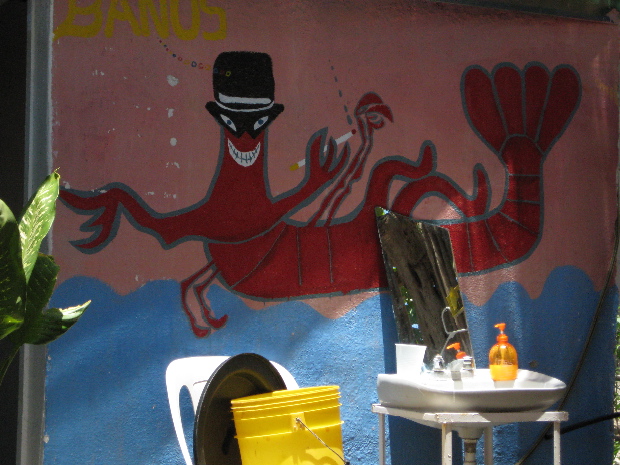


The simplest place we ate at was the Super Tacos de Baja California Hermanos Gonzáles, an outdoor stand with a big terrace that's an outgrowth of a sidewalk stand that got so popular it had to expand.  My sister Lee had some stupendous fish ceviche there, Harry and I shared some equally stupendous octopus and clam tacos.  (Nora isn't a seafood fanatic and often had quesadillas of one sort or another.)  We never ate better or cheaper food anywhere in Baja California.  One wall of the place had cool murals (above.)
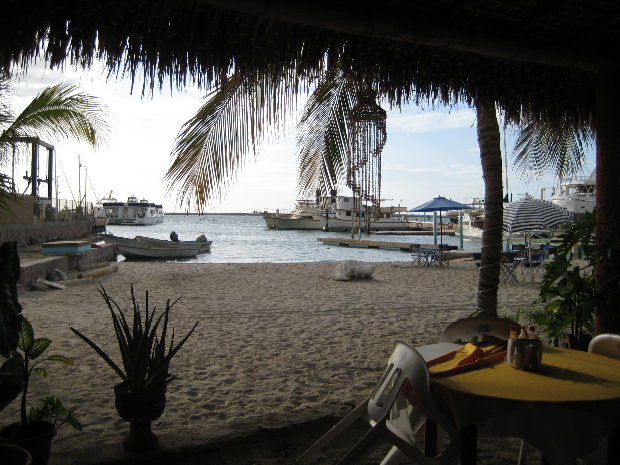


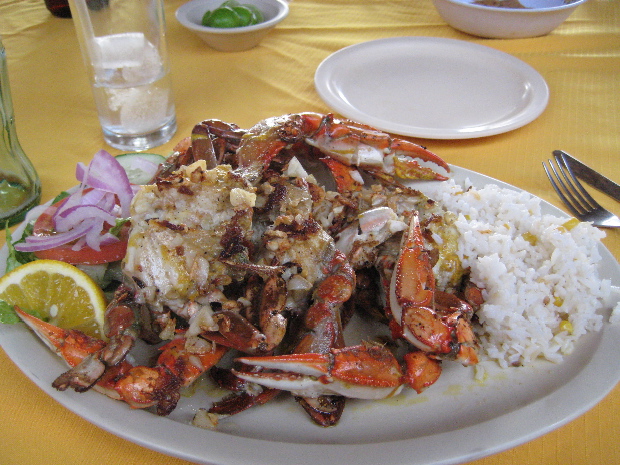
One evening we took a lengthy walk along the marinas to the south of the malecón to a medium-priced restaurant called the La Costa, palapa-roofed, right next to the water.  We had super-fresh seafood there and Harry felt moved to record the crab dinner he ate.  "A lot of work," he said, "but worth it."


The Bismark is a rarity -- an indoor seafood restaurant back several blocks from the
malecón.  The seafood was terrific and the decor was even better:
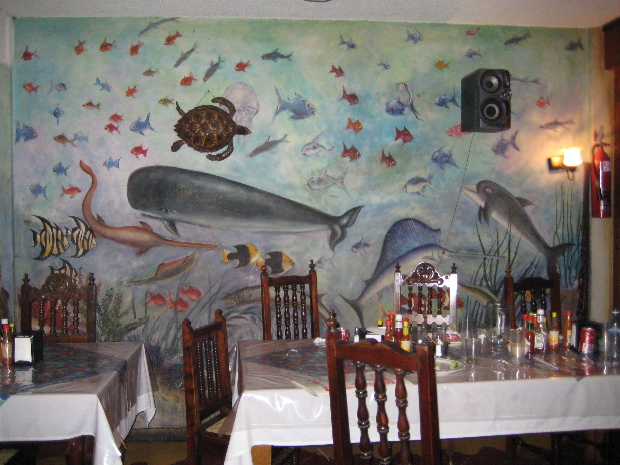


Harry and I had dinner one evening at the Bismark II, which the clerk at our hotel recommended.  It's right across the street from the
malecón, with seating on a terrace or back under a high palapa roof.  A charming place with the same great seafood as its parent establishment.

The only bad experience we had dining out in La Paz was at a place right on the
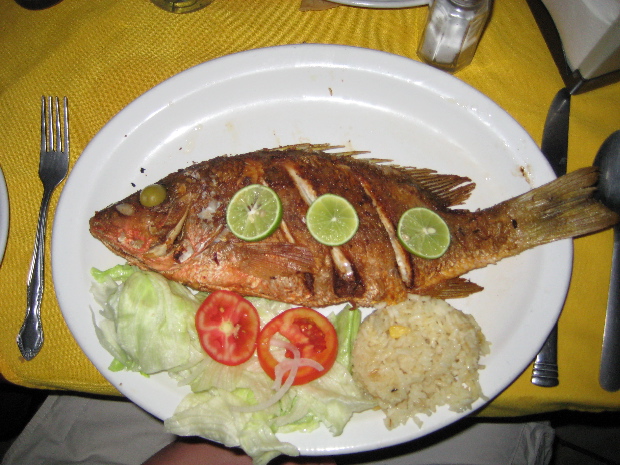
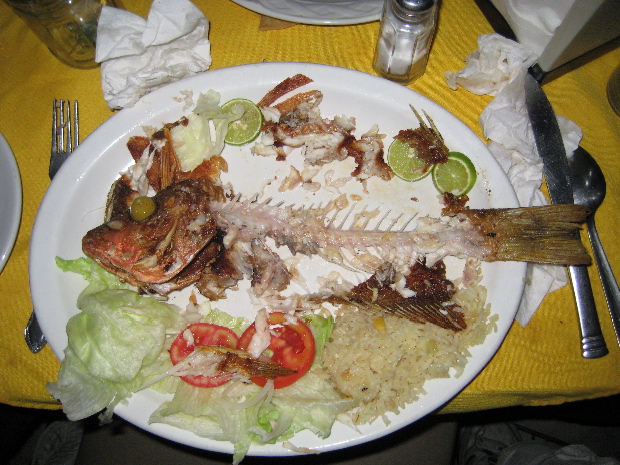
malecón, the Kiwi.  Lee and I had fine smoked marlin tacos and Harry had a wonderful pescado entero -- a whole fish fried quickly in super-hot oil and then served whole (but with olives replacing the fried eyes), which Harry also felt moved to record (see the images at the beginning and end of this post.)  But Nora ordered fish and chips and the fish had gone bad -- very bad.  There's just no excuse for this in a restaurant within spitting distance of the ocean, in a town where fresh seafood is so ubiquitous and so cheap.  Foisting a small bit of bad fish on a child might have saved the restaurant as much as fifty cents, I suspect, but it lost our goodwill forever.

La Paz is a seafood lover's paradise, not just because there's so much and such a great variety of it, and not just because it's so fresh, but because of the simple, perfect ways it's cooked and served.  You feel you're eating the same food the chef would make for himself or herself, or for their families, prepared with the same unpretentious care and respect.


For previous Baja California trip reports, go here.

[Photos © 2007 Harry Rossi]
View Article  CAMARONES


The best way to cook shrimp is just to boil it in beer, in the shell, until it turns bright pink and fills your kitchen with that distinctive boiled shrimp aroma.  Then you drain it, dump it out on some newspapers spread on your table, salt it heavily in the shell and get to work -- with drawn butter or spicy cocktail sauce for dipping and plenty of cold beer to wash it down with.  A better meal than this cannot be had anywhere, at any price.

But if you're looking for something a bit more exotic, or if you're stuck somewhere dreaming about Mexico and wishing you were there, try this amazing dish from Rick Bayless, the Mexican food guru -- camarones enchipotlados, shrimp in chipotle sauce.  (Bayless' excellent book Mexican Everyday can be found here.)


You need a 15-ounce can of Muir Glen organic, fire-roasted diced tomatoes.  (This is worth tracking down.)  You need a can of chipotle chiles en adobo -- the La Morena brand is easy to find and excellent.


You need one chayote, a kind of Mexican squash -- zucchini will also do.  Make sure you have some fresh cilantro, garlic and olive oil on hand -- and about a pound of fresh shrimp, peeled and veined.  (Some fancy grocery stores sell uncooked shrimp that's been peeled and veined for you, with the tails left on, and that's worth the slightly extra cost, since peeling and veining uncooked shrimp is exceedingly boring.)


Put three tablespoons of olive oil into a large skillet.  Peel and chop up the chayote into small chunks and sauté it lightly over medium heat in the oil.  Drain the diced tomatoes, saving the liquid, and put them into a blender.  Add one or two chipotle peppers and a tablespoon of their canning sauce and blend until smooth.  Finely chop or press three garlic cloves and add them to the skillet -- wait about a minute until the garlic is brownish and fragrant, then add the sauce from the blender, with the liquid from the tomato can.  Cook this for about five minutes, to let the flavors blend, seasoning it with salt to taste.  Then add the shrimp.

Cook the shrimp in the sauce, stirring constantly, until it's as done as you like.  After about four minutes the shrimp will no longer
be translucent and so ready to eat, but I like my shrimp better done than that.  You have to keep checking by taste to get it just right.  Add water or chicken (or fish) broth if the sauce gets too thick and pasty.

Eat the shrimp, with some roughly chopped cilantro on top for a garnish.  It's good with rice or just by itself, and great with a strong beer, like Negra Modelo, served ice-cold.


You'll be astonished at how easy and delicious this dish is -- it brings the sea and Mexico to you, wherever you are.


[Original photos © 2007 Lloyd Fonvielle and Harry Rossi]
View Article  ELVIS FOOD


Admit it -- sometimes you just get a taste for Elvis food, for the stuff he really loved, like banana cream pie.  Tucking into an oversized slice of banana cream pie you can almost feel what it must have been like to be a bloated, drug-addled cultural icon and genius on the road to destruction, and sense Elvis's own childlike bewilderment at it all.

Incidentally, if you live near a Marie Callendar's, as I do, try their banana cream pie, which tastes old-fashioned somehow, like a pie you'd get served at a 50s-era lunch counter or school cafeteria.  I just know Elvis would have approved.
View Article  BLUE TROUT


Sometimes after a long day of writing my mind is gripped by strange ideas about food -- strange in the sense that they don't involve Swiss cheese and crackers or peanut butter sandwiches or frozen meatloaf dinners.

One day, as it happened, I was reading a piece by Mr. Ernest Hemingway about trout fishing in Europe. In it he described a method of cooking trout he had encountered in Switzerland at rural inns. It involved boiling the trout until it turned blue in a liquor made of water, white wine vinegar, bay leaves and red pepper -- not too much of any ingredient in the water, says Mr. Hemingway, without further elaboration.

This is not the blue trout described by M. F. K. Fisher, which involves placing the trout live into boiling water, unless the Swiss innkeepers were holding out on Mr. Hemingway, but it sounded fine.

I remembered that my local supermarket sometimes offers fresh rainbow trout, so I headed over there late at night and found one handsome specimen in the fish department. I brought it home, filled up a large pot with water -- it was a large trout -- emptied about six ounces of white wine vinegar into the water, added six fragrant bay leaves and a light sprinkling of cayenne pepper, and set it all to boil. When it was bubbling I slipped the fish in.

I turned the heat down and simmered the trout for about fifteen minutes. In fully boiling water, ten or less would have been more than sufficient. I tested the fish using a method recommended by an old edition of The Joy Of Cooking -- which is to separate the meat from the bone of the spine at the thickest middle section of the fish. When the meat there is tender but no longer translucent, the fish is done.

I ate the fish with drawn butter, as Mr. Hemingway says the Swiss did. "They drink the clear Sion wine when they eat it," adds Mr. Hemingway, but they don't depend on the beverage department of a supermarket for their wine. I made do with a perfectly respectable Pinot Grigio by Bolla, cheap, dry and light.  I keep looking for the clear Sion wine, though -- Sion, pictured below, is the primary wine-producing region of Switzerland:


Even without the Swiss wine, the result was a meal of almost unimaginable delicacy. Trout is delicate anyway, and the light seasonings in the water only emphasized the subtlety of its taste. It all resonated on the tongue like a memory of food -- insubstantial and fleeting.
View Article  EL TACO FRESCO


About a five minute walk from my house is a little mini-mall with a taco shop that serves the best tacos in Vegas, by far -- the best carnitas tacos I've ever had anywhere.  The carnitas is tender but has crispy, charcoal-flavored edges -- the fried fish in the fish tacos is fresh and moist but crunchy on the outside.  The tacos are two bucks apiece and two of them make a fine meal.

The shop opens onto a dingy dive bar next door where they'll serve the food and where you can smoke and drink.  The bar and the shop are both open 24/7.  The weirdest people in the world go there, so I feel right at home.

It's my new favorite joint in Vegas.
View Article  CREAMY QUESO ANEJO SALAD DRESSING


If you're like me and get glassy-eyed at the thought of vegetables, if you basically hate the whole idea of salad, yet still think it would be a good idea to eat these things from time to time, the key to everything is sauces and dressings.  The strategy is to come up with a sauce or dressing so good that the concept of vegetables and greens as food is eliminated -- they become simply the means of conveying some sort of tasty topping into the mouth.

For salads, you can't just buy some Paul Newman's gourmet dressing and think that will do the trick.  This stuff tastes like salad dressing -- salad dressing.  It's there to "dress", to tart up, something you don't want to deal with in the first place.  You need to be creative.  You need to make something yourself which doesn't resemble anything you've ever encountered at the dressing station of a salad bar.

Here's a recipe from Rick Bayless, that guy on PBS who does shows about Mexican cooking, for creamy queso añejo dressing.  Queso añejo is a flavorful aged Mexican cheese which tastes a bit like Romano.  You can find it at just about any Mexican market (look for the kind that's actually made in Mexico) but Romano, which you can find anywhere, works just as well.

Start with 3/4 of a cup of olive oil in a mixing bowl or blender.  Add 1/4 of a cup of rice vinegar.  Add 3 tablespoons of mayonnaise.  Add 3 generous tablespoons of grated (freshly grated!) queso añejo or Romano.  Add slightly less than a tablespoon of salt.  Add 2 to 4 cloves of roasted garlic.

Attention!

Here's the simple way to roast garlic.  Put the unpeeled cloves in a dry skillet over medium heat.  Roast the cloves, turning them often, until they're soft and splotchy brown.  It takes about 15 minutes.  Remove them from the skillet and when they're cool enough to handle, remove the skins.  Put the 2 to 4 cloves into the mixing bowl or blender -- i
f you're going to be mixing the dressing by hand, run the garlic through a garlic press before you add it to the bowl.  (Be sure to roast a good number of extra garlic cloves to eat while they're still warm -- few things are more delicious . . . mild, nutty and slightly sweet.)

Add some chopped-up cilantro or parsley if you feel like it.  Mechanically blend or mix (with a whisk) the contents of the bowl.   Add a little more salt to the dressing if needed then pour it over Romaine or butter lettuce for a most delightful dish.  Save what's left in a sealed glass jar in the refrigerator -- but trust me, it won't last long.  It's just too good.  You'll wonder why you didn't buy more lettuce.


View Article  MEXICAN COKE


Mexican Coca-Cola, like Coke in most parts of the world, is still made with sugar, instead of vile-tasting and hard-to-digest corn syrup. Real sugar in a Coke makes for a different drink altogether, and one delightfully familiar to anyone who grew up in the Fifties or Sixties, before government-subsidized corn crops made fructose the more economical sweetener for soda makers in the U. S.

Mexican Coca-Cola costs about twice what regular neo-faux Coke costs, but it's more than twice as good. It can be tracked down in most areas of the U. S. which have any significant Latino population -- which is to say that it can be tracked down most anywhere. Well worth the effort.
View Article  FRENCH ONION SOUP


Everybody talks about French onion soup -- it comes to mind unbidden on cold winter nights, or in the middle of a bad case of the flu -- but almost nobody does anything about it. My sister Lee is a notable exception. One day after much wheedling and outright begging I got her to pass along her recipe, modified from a rule in The Joy Of Cooking with her own refinements. She would not actually send me the recipe, thus committing it to writing, but gave it over the phone while I took notes.

Then I did something about it.

To make this soup you first slice up three moderately large brown onions, as thinly as possible -- don't chop the slices up. (Now is the time for your tears.) Put three quarters of a stick of butter into a big pot that can hold six cups of liquor, plus the onions, and melt it.

Now, as my sister explained, in hushed tones, a terrifying game of chicken with the onions begins. Your goal is to sauté them slowly, patiently in the butter until they turn a dark, a very dark brown. When they have turned the darkest brown possible they will be just seconds away from burning and turning black -- at which point all your slicing, all your tears, will have been in vain. The onions will try to fool you, by leaving black deposits on the side of the pot, so you will think they are as brown as they can possibly get -- but they aren't. Not yet -- not quite yet! Bonne chance, mon vieux!

When the onions are browned to perfection, remove them from the heat and add into the pot six cups of beef broth. Beef broth can be over-salty, especially the cubed kind, so it's good to use a mixture of low-sodium broth with the regular stuff. I used two cans of low sodium and one of regular broth. Grind some fresh pepper into the pot.

Simmer this slowly for about half an hour, adding a dash of sherry at the very last moment if you want.

To serve, place the soup in an oven-safe bowl. Take thickish slices from a baguette of French bread, toast them lightly and then float them on top of the soup, grate Gruyère generously over the surface of all this and bake it in the oven until the cheese melts.

Eat it with a strong, simple red wine and feel the flu, the chill of the night, the melancholy of the day recede. Rejoice in the fact that, by following this recipe, you will have plenty of soup left for the days and nights ahead, when it will only taste better.
View Article  CAULIFLOWER AND GRUYERE


How often do we take a moment from our busy lives to think about Gruyere? Not very often, I suspect. And yet it is a cheese of deep philosophical interest, simple, distinctive and useful.

There was a time when I thought of it only in connection with French onion soup, for without the Gruyere that's melted on the piece of thick toast that floats on top of the soup, it is not French onion soup at all. It's just brown stuff made out of onions.

I began thinking about Gruyere seriously and appropriately due to a chance remark by Mary Frances Kennedy Fisher, speaking of dining alone. She observed that it's just as easy to eat a piece of Gruyere with a loaf of crusty sourdough bread as to down some fast-food alternative, and more nourishing to the soul, more respecting of one's dining companion -- you.

By a simple taste test, I discovered that she was right. Rarely has a philosophical observation been so easy to prove.

I began reading other gastronomical observations by Fisher with a keener interest. I could not test all of them practically, since my kitchen facilities at the time were limited -- no oven, just two electric burners and a toaster oven.


But then I read about the first kitchen Fisher presided over, in Dijon in 1931. It had no running water (which had to be carried in from the landing) or ice box . . . and its stove consisted of two gas burners with a tiny cover that could be fitted over them by way of an oven. My excuse vanished, and I decided to make one of her specialities from that time, for which she gives no rule, just a vague description. But it was enough.

You take a head of cauliflower and split the fleurs apart, in clusters that are not too small or too large -- enough of them to cover the bottom of a baking pan. Boil them for about three minutes, no longer, drain them and lay them in the pan. Pour heavy cream over each of the fleurs, enough so that the cream covers the bottom of the pan to a depth at least halfway up the sides of the fleurs, and then perhaps a little more if you feel reckless.


Put a lot of fresh grated Gruyere on top of the fleurs and the cream, enough to make a somewhat less than solid layer of cheese over the whole thing, part of it floating, part of it on the fleurs. Then grind fresh pepper over it all.

Bake it in an oven at maybe 350° (Fisher doesn't say, because her little oven probably didn't have a thermostat.) Certainly no lower.

When the top of the thing is toasty brown, take it out. (Fisher wasn't quite sure why her little oven browned the top of the dish. It must have been because enough of the Gruyere stayed on top of the bubbling sauce to get toasted, and it worked the same way in my toaster oven.  In a real oven you need to place the pan on a high rack to get the same effect.) Eat it immediately, with some full-bodied red wine of whatever simplicity. A Cahors would be cool, if you could find it.


Have some good bread to dunk in the strange, rich sauce in which the Gruyere has and has not quite merged with the cream.

This is the meal -- barring some salad or desert afterwards, if you care about those things.

When you eat this meal, the word elegant will not spring to mind. The words perfection, miraculous and inspiring will.

First of all you will have a connection with certain evenings in Fisher's long-vanished life in Dijon -- a connection which can only be described as complex. It makes you feel sad and hopeful, all at once.

Second, you will never think about cauliflower again in quite the same way -- and I say this as someone who almost never thinks about cauliflower at all.

Third, you will discover a new aspect to the complicated personality of Gruyere. As with French onion soup, its flavor will make you feel like a virtuous old peasant. In this dish, it will make you feel like a virtuous old peasant whose kindness has touched the lives of heroes and saints. (This is the inspiring part.)

I am perhaps diluting the absolute virtue of the experience by sharing it here, but really, how can I keep quiet about a thing like this? Any more than Fisher could?
View Article  OYSTER STEW


It's easy to make oyster stew. Here's how you do it. Get a lot of oysters, medium sized, the sweetest and freshest you can find (hard on the West Coast, where they're most often big and bland). It's o. k. to get them in jars, fresh and raw, because you want them out of the shell anyway.

Put some whole milk in a saucepan and start to heat it and when it's just barely tepid put the clean oysters, minus their juices, into the pan. You don't want the milk to cover the oysters -- you need to be able to observe them.

When the milk starts to steam just the slightest, slightest bit, sprinkle in celery salt, a fair amount, a dose of regular salt, ground pepper, paprika and three drops (in the name of God no more!) of Tabasco. Don't mix all this stuff in, just sprinkle it on top, well distributed. Then quickly put in two chunks of unsweetened butter and just when the butter has all melted, pour the whole thing into a big bowl and let the pouring itself do the mixing.

Eat it with a light, dry white wine and have lots of French bread handy for sopping, which is sublime.

If the oysters are rubbery, you didn't get the seasonings and butter in fast enough.

I pass this along from Mary Francis Kennedy Fisher, slightly modified, because it's a miracle that something so wonderful is so easy to make.

The secret, of course, is the oysters, complicated and strange, bringing with them such tales of currents and tides and the mysteries of the not so deep, that they want only a simple setting to recount them in, and a hungry heart willing to listen.


View Article  AN ELEGY FOR OYSTERS


. . . by the great Irish poet Seamus Heaney:

Alive and violated
They lay on their beds of ice:
Bivalves: the split bulb
And philandering sigh of ocean.
Millions of them ripped and shucked
and scattered.

We are eating oysters again, and will be until
April, the last month with an r in it until next September . . . but we must remember that each of their alien, unfathomable lives is precious, not to be taken lightly.