DISINCLINATION

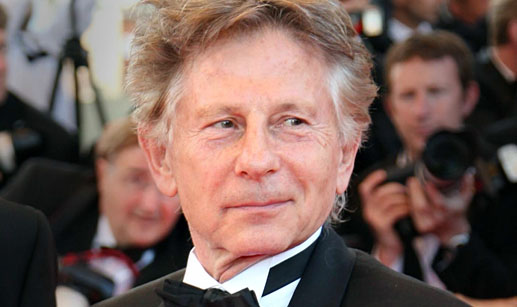
A current article in the online edition of The New York Times about
Roman Polanski says, “He is being held for possible extradition to the
United States more than three decades after fleeing sentencing on sex
charges in 1978.”


Sex charges?  Why be so vague?  Mr. Polanski was charged with rape.  It
was “statutory rape”, which can imply sex with a “consenting” minor —
assuming you think that a 13 year-old girl can give meaningful consent
to sex with a 43 year-old man — but the sex, according to the victim's
undisputed testimony, was not consensual.  It would have been rape, by
most reasonable definitions, even if she had been of age.


What can explain this strange disinclination to face what Polanski actually did?

ARS GRATIA ARTIS

James Naremore's The Films Of Vincente Minnelli is a thoughtful and illuminating work of criticism but Naremore, like any respectable modern critic, is fixated on the conflict between art and commerce, finding in Minnelli's work for “the dream factory” of MGM a paradigm for that conflict.

But what is this conflict, exactly?  When was that golden age when art and commerce were separated?  Where was that fabulous Arcadia which played host to artists who worked for the sake of art alone?  I cannot find it in history, anywhere I look.

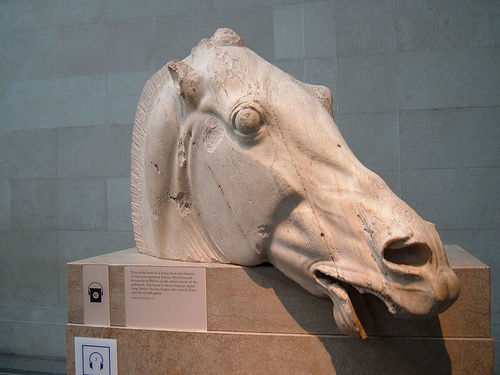
We don't know much about the artists who created the great sculptures of ancient Greece — we have just a few quotes from them.  One of them is this — “Sculptors should strive for excellence in their works so they can win competitions and thus earn more money than their fellow sculptors.”  This was how the guys that decorated the Parthenon thought about art.

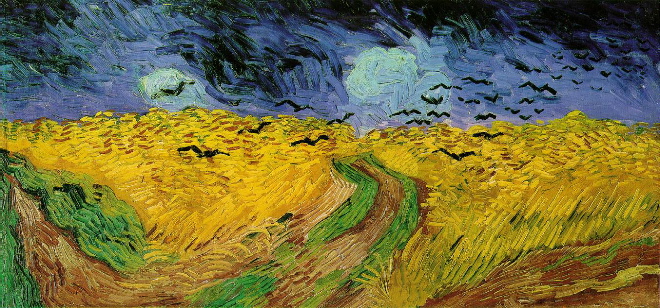
Vincent Van Gogh dreamed fondly of becoming a commercial artist, obsessively collecting and copying magazine illustrations that delighted him.  This is how the painter of Crows Over A Cornfield thought about his talent and the uses to which it might be put.

In the 20th Century, Igor Stravinsky said, “There are only two questions a musician should ask — how long should the piece be and how much money do I get paid for it?”  This is how the guy who created Le Sacre du Printemps thought about art.

The idea of art for art's sake, as Naremore points out, was created by artists at the dawn of the industrial age, when art began to be thought of as a mass-market commodity.  Artists who wanted to separate themselves from the values of the industrial age concocted a pose in which they were somehow above it, just by virtue of being artists.  The romance of the starving artist as cultural hero was born with this — starvation being an unknown ambition among artists of the past.

It's all a lot of hooey.  There has always been conflict between artists and their patrons, between artists and their audiences.  This is built into the nature of art, which navigates a fine line between novelty and familiarity, between challenge and reassurance.  The enterprise is hazardous for the artist, who must encompass the paradoxes involved and constantly renegotiate an inherently unstable compact.

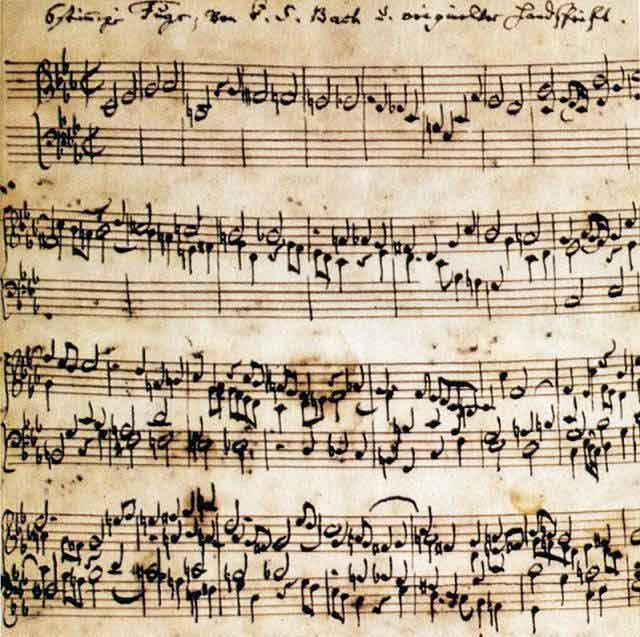
But to see Minnelli's relationship with MGM as somehow different, conceptually, from the relationship of Phidias with the city fathers of Athens, from the relationship of Michelangelo with the Vatican, from the relationship of Bach with his vestry members, is absurd.

Art functions on so many different levels and is so intertwined with the everyday business of life, including commercial intercourse, that the idea of “art for art's sake” makes about as much sense as the idea of “food for food's sake”.  The French may think that they appreciate food for food's sake, but what they eat still gets converted into energy and fat and excrement.  However sublime a meal may be, it is still an integral part of a most prosaic human process . . . and so is art.

HELLO, MR. CHIPS

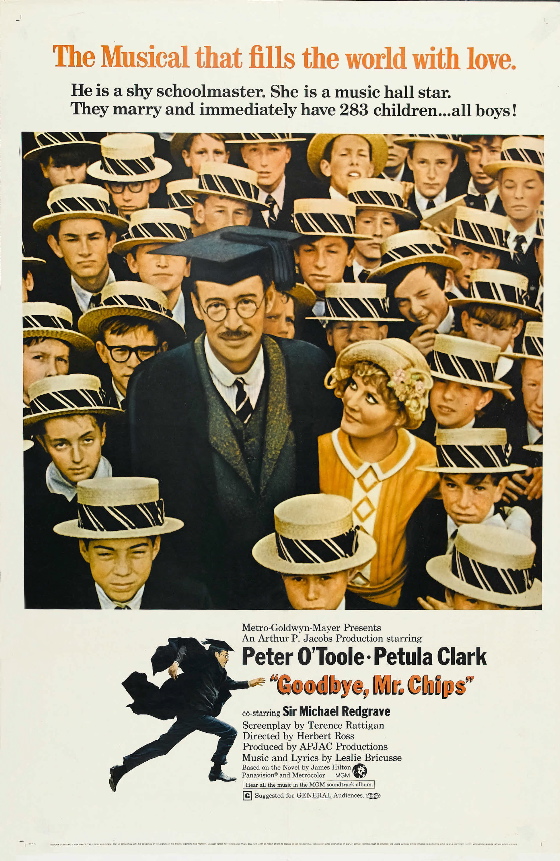
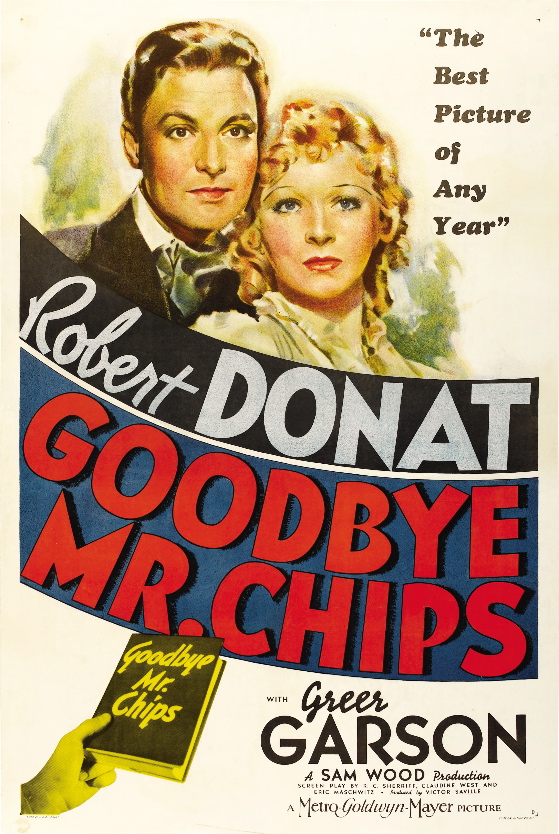
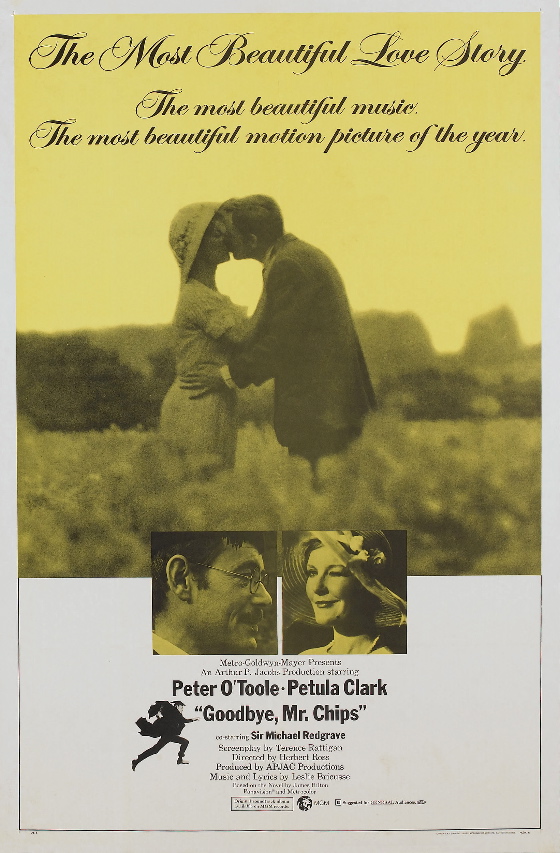
Paul Zahl, the Preacher From the Black Lagoon (see The Zahl File), revisits a commercial disaster from days gone by — the 1969 version of Goodbye, Mr. Chips:

A MOVIE WITH SOUL

by Paul Zahl


I am beginning to know James Hilton's books and the movies made of
them, such as
Lost Horizon, in two wonderful versions; Random Harvest,
which is an almost perfect elegy to selfless love; and
Goodbye, Mr.
Chips, also in two wonderful versions.


The second version of
Chips, which bombed in 1969 (with the exception
of Pauline Kael's memorable praise), is an interesting case of a film
that more or less disappeared after its initial showing, became almost
notorious for its over-dubbed and stream-of-consciousness songs, and
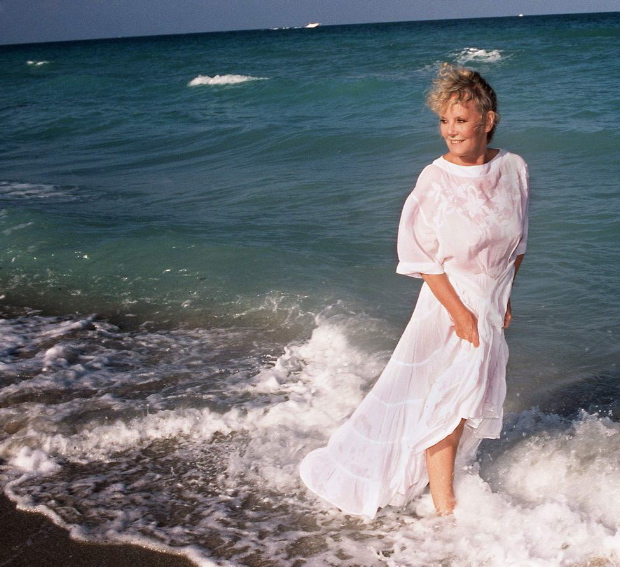
co-starred the now less-remembered English pop star Petula Clark.


A personal interest in James Hilton, together with an interest in the
English playwright Terence Rattigan, led me to this movie recently,
which was released on DVD last January.  And yes, it is an odd
collection of things — a familiar drama (or so it seems at first) of
life in an English boarding school; a use of idyllic outdoor long shots
and zoom effects that are like ads for Tab, or even Coke, back in the
'60s; spectacular and also heavily edited musical numbers within a
story concerning a Latin master of the 1920's; and in the heart of it,
right at the core of it, a love story that rings completely true.


In short, this is a movie with soul, which is also greater than the sum
of its parts.


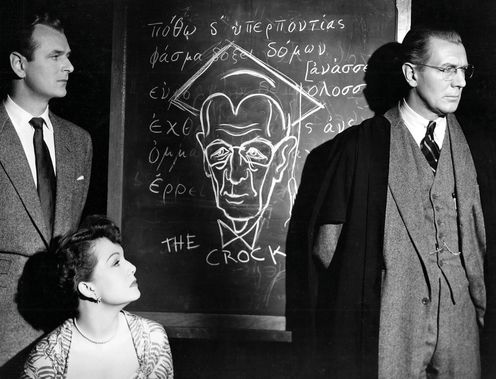
After watching two versions of Terence Rattigan's
The Browning Version,
both of which were filmed on the same location (i.e., Sherborne School
in southern England) as the 1969
Chips, I felt saturated with this
elite context. 
(The first version of The Browning Version, with Michael Redgrave, is illustrated above.)  Is there much left to say, after these two persuasive
works, about the introversion and disappointments of prep school
teachers of Latin and Greek?  Well, Rattigan must have believed there
was, because he took a familiar story, Hilton's novella of Brookfield
School, and batted it straight into the stratosphere.


His script, which now focusses almost completely on the love story of
Mr. Chipping, played by Peter O'Toole, and the unlikely love of his
life, played by Petula Clark, is literary and beautiful, full of
Classical allusions yet uncontrived.  When Rattigan puts the Ancient
Greek maxim “Know thyself”, together with the God Apollo, at the
turning point of the story, it is fully apt and touching and true.


He also writes a scene between the two meant-for-each-other lovers,
filmed by the Victorian greenhouse at Syon House on the Thames, which
is as affecting a proposal of marriage — it is basically she  who
proposes to him, yet with no tenor of forwardness — as anything of its
kind on film.  Incidentally, I write as someone who has performed
hundreds of marriages and who gladly embraces Lloydville's title, Preacher From the Black Lagoon.


How does a movie acquire soul?  We have an impressive script by a
master, Terence Rattigan.  We have a great theme from James Hilton: the
transformation in real time and life that is effected by a devoted
woman in relation to a shy misunderstood schoolmaster, and the
consequent effect of the couple's marriage on an entire community,
Brookfield School, petty, political, and witchy.  Yet these two
elements don't fully account for the movie's soul, which means you
start crying by the middle of act two and can't stop until way after
the end.


I think there are two other things that make
Chips something like a
great movie, although probably not a great movie in the way of
cinematic art.  The first is its visual style, which, as I said, is
full of long shots of the heroine and hero, with flowers in the
foreground; constantly changing colors to mirror the emotions of the
leads; many zooms from high up (God's eye!); and basically the most
accomplished style of the kind of thing Dan Curtis was doing in his
made-for-television horror movies of the same era: a little arty,
consciously 'visual', and plain pretty.  It works here and you probably
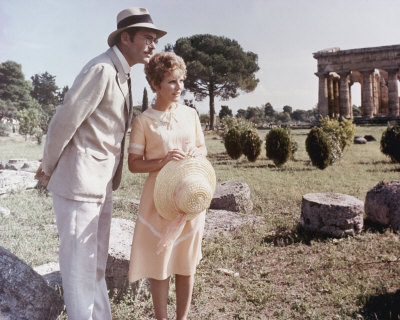
wouldn't alter a thing.  Thus the sequence at Pompeii and Paestum works
because the honey-colored marble of the sublime ruins matches the early
love of the surprizing surprized couple.


The second added thing in this wondrous movie is the music.  The songs
are by Leslie Bricusse, who wrote “Stop the World, I Want To Get Off”;
and the instrumentation is by John Williams.  The songs were considered
forgettable when
Goodbye, Mr. Chips first opened, without much for
tunes.  Yet they are mostly sung by Petula Clark and Peter O'Toole as
narrations rather than lip-synch performance.  They are internal
monologues.  They are therefore true to life.  Petula Clark's song
“Apollo”, for example is subtle and everything that the word “nuanced”
is now supposed to mean.  And I will guarantee something to the readers
of this blog:  If you see Chips  and do not go straight to YouTube or
iTunes and listen to “Fill the World With Love”, over and over again,
you had better check to see if you still have a heart.  To be honest
with you, now that I know what that Bricusse-composed school hymn means
in light of the powerful story in which it figures so prominently, I
don't ever want to sing anything else again.  (Maybe “Be True To Your
School” by the Beach Boys, but nothing more, ever again.)


So, here is a movie with soul. 
Goodbye, Mr. Chips from that hinge year
1969 is hard to explain.  It's got Hilton in the first stratum,
Rattigan in the second, sublime if ever so slightly cheesy visuals, and
introspective songs that work, partly because they do not overwhelm the
other elements.


There is a fifth element, however, one more thing, to add.  There is
Peter O'Toole and Petula Clark.  These actors were made for each
other.  Clark embodies a kind of heroine that you rarely see any more. 
(I married one 36 years ago.)  She loves her husband,  supports him
with everything she has and thus brings out qualities in him that he
never knew he had, and she's humble while having a kind of luminosity
— a word like “nuanced” which suffers from over-use — or inner
spiritual strength that is contagious in this self-absorbed world. 
Katherine Brisket, which is the name of Clark's character, is the
strongest entity in the entire movie.  Yet her life's work is love. 
That is why the bull's eye center of
Goodbye, Mr. Chips is the scene
when Mrs. Chipping takes the entire student body and faculty to a new
and noble level as she leads them, not by design, in the school hymn
“Fill the World With Love”.  This is not dumb!  It completely works. 
No wonder O'Toole's character falls in love with her, defends her, and
establishes an unforgettable rock of a life with her.


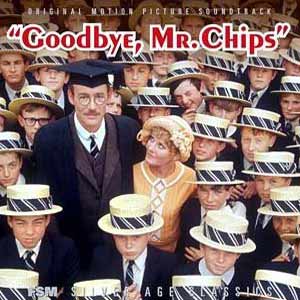
Goodbye, Mr. Chips is now available on a beautiful DVD, its soundtrack
also available on a connoisseur's three-disc CD from Film Score
Monthly.


Oh, and I just took a look at
Joanna, made one year earlier in England
with Donald Sutherland and Genevieve Waite (and Rod McKuen — listen to
the warm) in order to get some perspective on the period.  Odd isn't
it:  I loved
Joanna back then, and thought Chips was dumb.  Now I love
Chips and think Joanna is the queen of dumb.

STILL OUR TOWN

It's hard for any American to get through life without seeing at least one production of Thornton Wilder's Our Town.  The play is a perennial favorite of high school drama departments and amateur theatrical companies, because it has a lot of parts (only one of which has a lot of lines), requires little scenery and almost always packs a punch, emotionally.

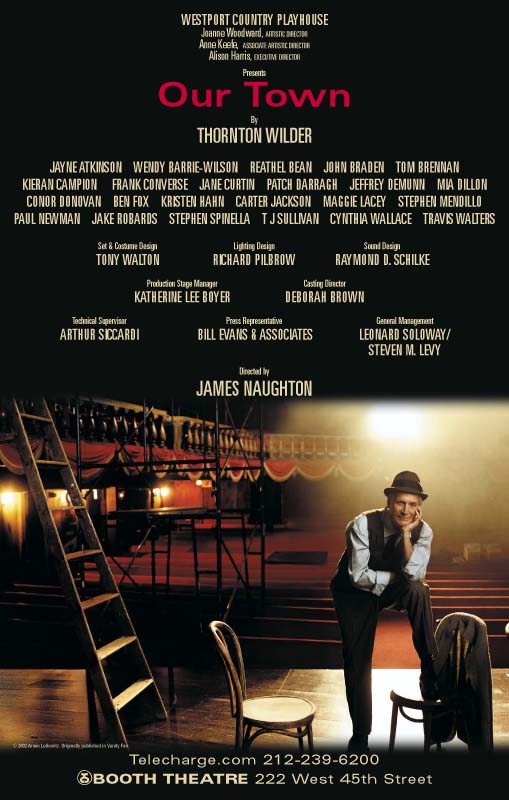
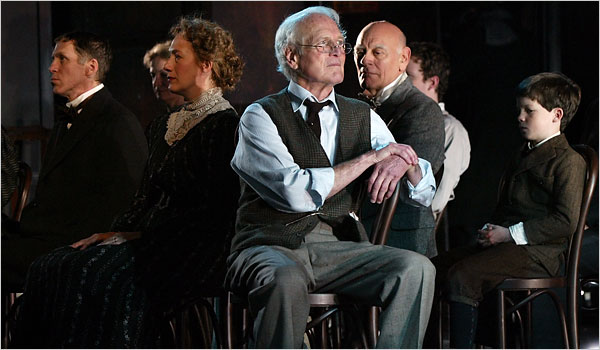
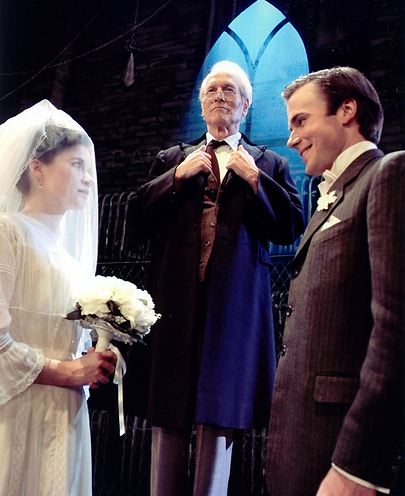
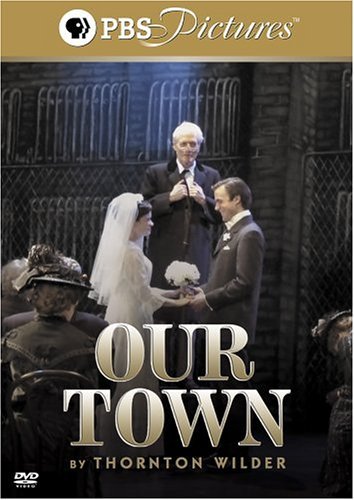
I must be one of the very few who managed to get through almost 60 years in this great land of ours without ever encountering it.  My interest in it was aroused, however, by a report from Paul Zahl for this site on a celebrated production of the play done recently in New York.  I put a couple of filmed versions of it in my Netflix queue and one of them showed up in my mailbox last week — a videotaped record of a production by the Westport Country Playhouse starring Paul Newman as the Stage Manager (the part with a lot of lines.)

The Stage Manager sets the scenes for us, comments on them — he's a busier version of the Shakespearean chorus.  The setting of the play is a small town in New Hampshire in the first decades of the 20th Century, the characters are “ordinary” American folk.  The subject is the passing of time — which is to say, death, towards which all time on this earth trends.

The play asks, in effect, what will remain of us, what will our lives have added up to, in the gaze of Eternity?  In Grover's Corners, where the play unfolds, we know it will not be anything grand, or out of the ordinary, for anybody.  All virtues there, and all vices, all successes and all failures, are modest in the great scheme of things.

Of course, one is bound to reflect if there are any virtues, vices, successes or failures which are not modest in the great scheme of things — in the greatest scheme of things, in cosmic history.  When our sun has burned itself out, when the universe returns to the nothingness from which it emerged, as some believe it inevitably will, what difference will Shakespeare or Napoleon have made, not to mention you and I?

Wilder offers an answer to this question.  It is mystical, of course, as all such answers must be, but it is not facile, not made up of off-the-rack concepts of an intellectual or philosophical or theological sort.  It's flavored with Christian imagery but also calls to mind imagery from Buddhism and even Nietzche.  It can't be reduced to words, but one can say that it's more minatory than consolatory.

It might not change your life, but it could easily change the way you look at your life.

The videotaped version of the Westport Country Playhouse production, available on DVD, is very well done.  Newman is superb — I think it might be his best performance ever.  The Stage Manager could easily come off as a bit of a fuddy-duddy, but Newman brings a no-nonsense virility to the part which rivets our attention and cuts through what might at first seem like a flood of nostalgic sentimentality.  Our Town is not a sentimental play, nor is it, except technically, a period piece — which is one reason that productions of it go on and on.  Its purpose it to evoke the now — the eternal now, in which even death must take a supporting role.

Wilder suggests that we ought to start giving thanks for it now.  Right now.

MARIONETTES

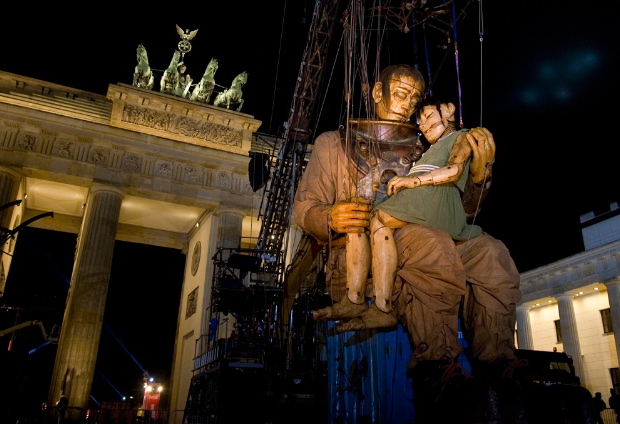
Part of the appeal of puppets and marionettes is the contrast of scale they present to the real world.  They usually inhabit a smaller version of our world, and are smaller versions of ourselves — but sometimes they inhabit a larger one.  Very large puppets, however, generally represent creatures who are “naturally” large, imaginatively speaking — like the dragons in Chinese street parades.  Colossal representations of humans occur more often in sculpture, like the Statue Of Liberty, for example.

The colossal marionettes picture here, creations of the French Royal de Luxe street theater company, offer a delightfully witty inversion of the usual inversion.  Marionettes, customarily reduced versions of ourselves, here reduce humans to the proportions of marionettes, or even toy soldiers.

I find them unspeakably wonderful.

These photographs, from the Boston Globe's Big Picture site, record a performance at a celebration in Berlin marking the anniversary of the fall of the Berlin Wall.  The deep-sea diver and the little girl moved towards  each other across the city for a reunion, which offered another inversion — the colossal girl became a little girl again.

For more pictures of this event go here (with thanks to Boing Boing.)

THE CITY UPON A HILL

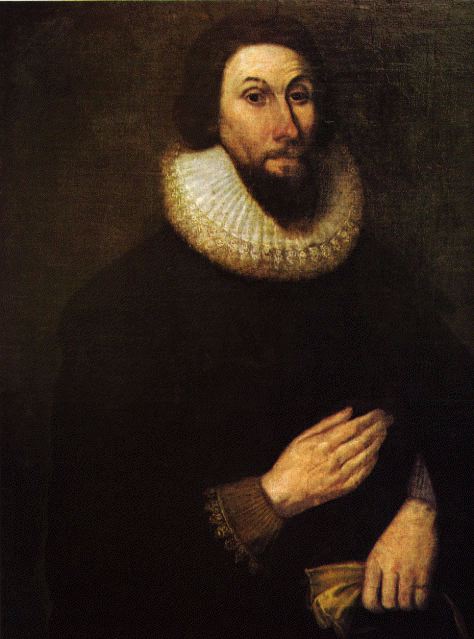
Most of us likely recall how much Ronald Reagan loved to misquote John Winthrop's sermon to prospective members of the Massachusetts Bay Colony on shipboard before they landed in the New World, speaking of the new community they would found as “a shining city upon a hill”.  Winthrop (above) only spoke about “a city upon a hill” — Reagan added the “shining” for rhetorical effect.

Reagan never quoted the best and most inspiring line from that sermon — “We must delight in each other; make others’ conditions our own; rejoice
together, mourn together, labor and suffer together, always having
before our eyes our commission and community in the work, as members of
the same body.”  That, after all, has the stink of socialism on it.  It might imply that there was something fundamentally, aboriginally, American about banding together to avert the terrors of old age for our fellow citizens with Social Security, or to avert the terrors of illness though publicly guaranteed health care.

It's the hypocrisy, the selective memory, the mendacity and the sheer unbridled meanness of the American right which are stinking up the body politic these days.  The American left is, and probably always will be, naive, incompetent, a tad deluded and more than a tad self-righteous, infuriating traits all, but the American right has become — there's no other way of saying it — morally depraved.  Winthrop, hardly a tolerant man, for all his Christian idealism, would have put modern-day conservatives in the stocks and left them to rot there, for abandoning their commitment to “community in the work”, the sine qua non of the American experiment and the only part of it authentically derived from the actual teachings of Jesus.

America remains a predominantly Christian nation, in the sense that most Americans identify themselves as Christians, and we are still a city upon a hill, shining or not.  People look upon this “Christian nation”, see how we treat our sick brother and sisters of modest means and draw their conclusions accordingly — just as Winthrop knew they would.

(With thanks to the writer Sarah Vowell for getting me to go back and read what Winthrop actually said . . .)

TOMBS OF THE BLIND DEAD


                                                                                               [Photo by Mary Zahl]

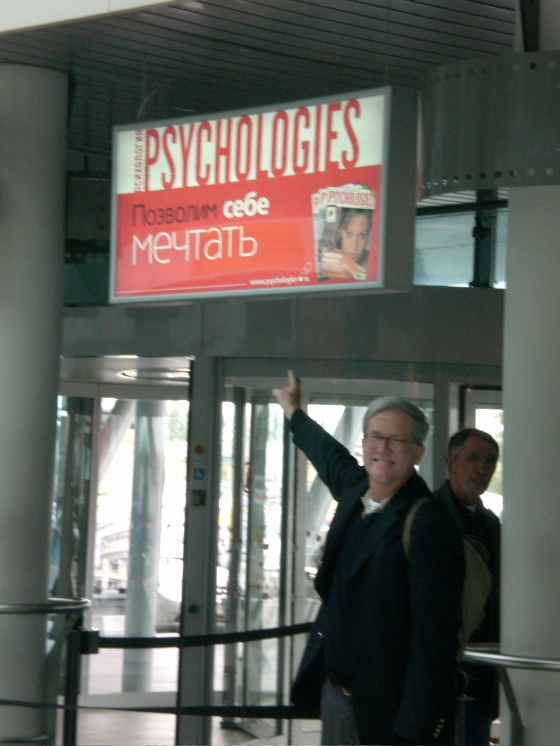
Here's
a piece by Paul Zahl (of
The Zahl File) about another strange place he
visited this summer.  Paul forgot to take his camera along on his visit
and I wasn't able to find any images of it online, apart from the
low-res view of its exterior below — the modern-day travel industry in
Russia doesn't seem interested in promoting it as an attraction and no
tourists seem to have left snapshot records of it on the Internet —
but Paul vividly evokes what he saw there in prose:


This past August, I slipped away for an afternoon from the tour group I
was helping to lead in Russia and the Baltics.  I slipped away in order
to see a weird museum in St. Petersburg. 


I had heard heard of it before, and its original form under the
Soviets, the notorious Museum of Atheism.  Until a few years ago,
Russian young people used to be taken to the former St. Isaac's
Cathedral in Leningrad/Petrograd/St. Petersburg to witness a
State-operated exhibition displaying the folly, ignorance, and
wickedness of Christianity, with side-exhibits on Buddhism, Animism,
Judaism, Islam, and the Greek and Roman Gods.


After perestroika, the Museum was dismantled and St. Isaac's became a
Russian Orthodox cathedral again.  The exhibits persist, however, in
a big old gray crate of a building about three blocks away . . .

Click here, if you dare, to take the full tour . . .

PLUTOCRACY IN ACTION

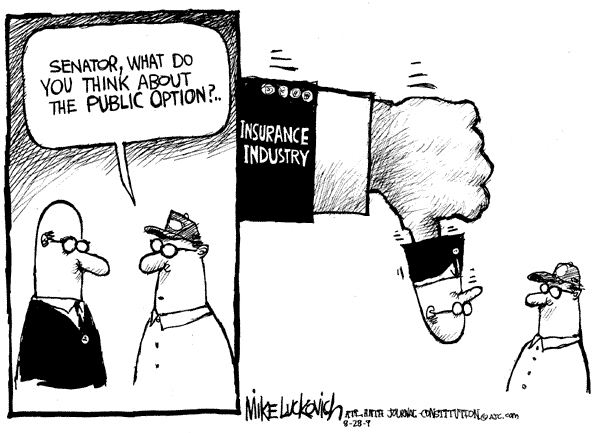
Barack Obama was elected President, by a significant majority of Americans, on a platform that called for heath care reform with a public option.  In current opinion polls, a significant majority of Americans still favor heath care reform with a public option.  An overwhelming majority of the U. S. House of Representatives favors heath care reform with a public option.  A smaller but still solid majority of the U. S. Senate favors health care reform with a public option.  But we can't have heath care reform with a public option because a minority of the Senate opposes it — a minority made up of Senators who have taken millions of dollars in contributions from the health care industry and are standing with the health care industry to the bitter end, even though many of them represent states in which a significant majority of their own constituents favor health care reform with a public option.

What's going on here?

Plutocracy.  The vast financial resources of the health care industry have subverted the clear will of the people and their government.  That's what plutocracy means — rule by the wealthy — and that's what America has become . . . a plutocracy.

Get used to it.

THERE STANDS THE GLASS


                                                                                                              [Photo © 2009 Tristan Forward]

Tristan, over at the new emotional blackmailer's handbook, continues to post his lovely photographs of lovely things — and what could be lovelier than the pint glass above, sitting on a table in a cozy pub, filled with amber magic?

There stands the glass,
Fill it up to the brim
'til my troubles grow dim —
It's my first one today.

Cheers!

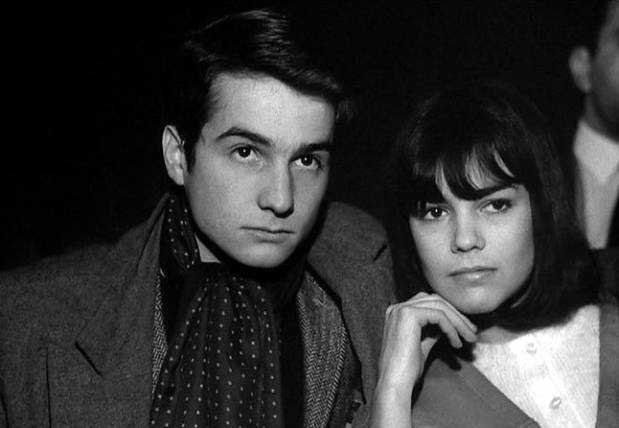
MASCULIN FÉMININ

It wasn’t the film we dreamed; the film we carried in our hearts; the film we wanted to make and secretly wanted to live.

                                                      — Jean-Luc Godard, Masculin Féminin, 1966

THE MYSTERY OF GARDENS


                                                                                                                                [Photo by Mary Zahl]

Mary Zahl, the wife of Paul Zahl (see The Zahl File), is a renowned
designer of gardens — serious, amazing gardens.  She was kind enough
to send along this report of a recent trip she made to Charleston, S.
C., revisiting the place where her career and vocation as a garden
designer got kicked into higher gear by a terrible natural disaster:


Last week I was in Charleston, S. C., speaking on garden design to the
Charleston Horticultural Society.  It was my first 'official' return to
the garden scene there after leaving in 1992.  In my talk, I was
reflecting on twenty years of designing gardens, mostly residential. 
What was particularly apt about this timing was that it was in
Charleston that my work in this field took a giant step forward, both
in scope and volume.  There was one reason why: Hurricane Hugo came
through the Low Country on September 21, l989, leaving countless
devastated gardens that, in turn, became the jump-start for my career.


Hurricane Hugo was the only real disaster I have lived through.  What
affected me the most and lasted the longest was the sheer ugliness of
it all: giant trees uprooted or snapped off, huge piles of debris for
weeks on end, dried up places which had been shady and green, general
chaos everywhere.  Even the birds and butterflies disappeared.  It was
depressing, and hard to summon the energy that was needed to put life
back on track.


But, as my work meant bringing a little beauty and order into lives
surrounded by ugliness and disorder, my eyes were opened to the
importance of what I was doing.  'Garden design' became more than an
end in itself; with a cleared and freshly planted garden, I saw hope
return and anxiety decrease in those I was helping. 


Before this experience, I had struggled with whether or not I was doing
something 'important' with my work.  I loved flowers, and loved being
out in the garden, and even helping bring to life something that my
clients could not do for themselves.  But it felt like the icing on
life's more serious cake.  Through this experience, I had a little
window into the power of art/beauty to feed the soul.


                                                                                                              [Photo by Mary Zahl]


It still feeds mine, after all these years.  Just strolling through
this garden of Frances and Milton Parker in Beaufort, S. C., last week
(seen in the photos above) took my breath away with its serenity and creative energy, two apparent
opposites.  I wanted to sit — for hours if I could — and take it in. 
It lives in my mind's eye, just as the paintings we saw this summer at
The Hermitage in St. Petersburg do.


Paul and I were recently watching Warren Beatty's movie
Reds.  The
struggle of the main character, John Reed, was between his art as a
writer (
Ten Days that Shook the World) and his passion to get
involved in the political situation in Russia.  His wife begged him to
stay at home and help the revolution by being the writer/artist he was,
but he went abroad to be a part of the action.  He died there at a
premature age.  I personally wish he had valued his art more.

BABY


                                                                                                               [Photo by Libba Marrian]

My niece Keaton just had a baby, a boy named Jackson, which
makes my sister Libba, my little sister Libba, a grandmother, my mother a great-grandmother, and me a
grand-uncle.


Will wonders never cease?

SWEETNESS . . . EVEN GRACE

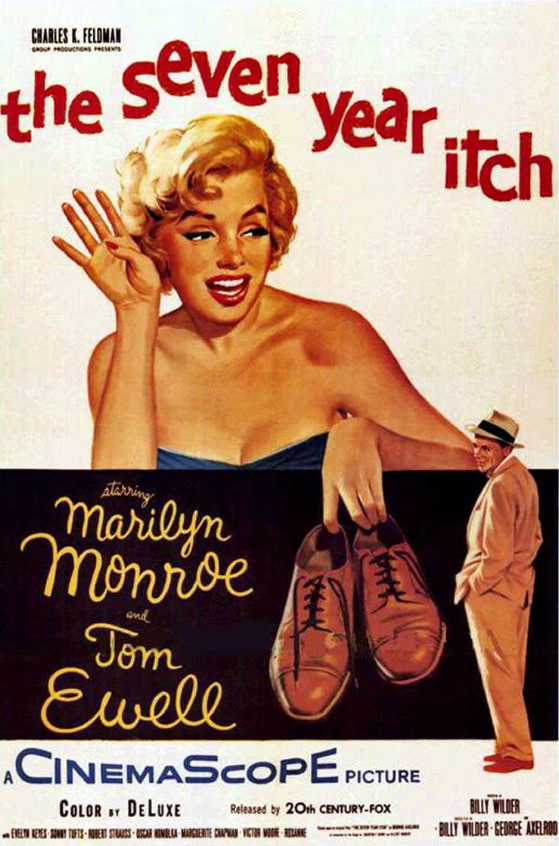
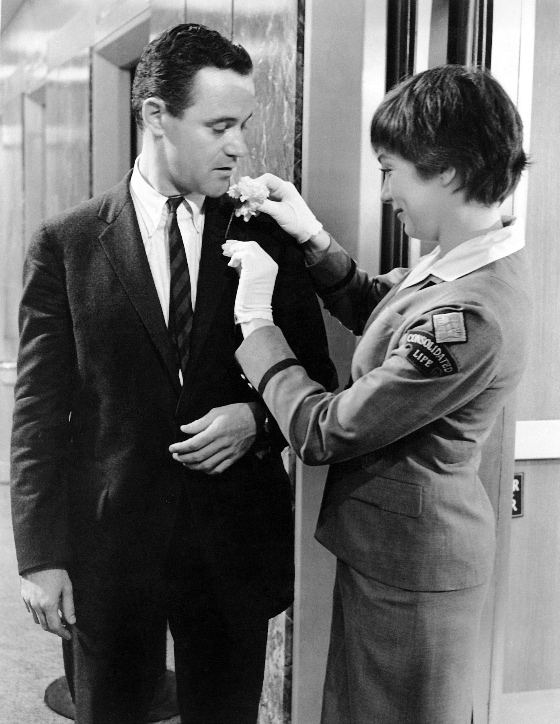
Tom Sutpen, over at Illusion Travels By Streetcar, has posted a couple of paragraphs from a piece about Billy Wilder's Kiss Me, Stupid which he'll be publishing in full next month . . . a preview of a coming attraction.  Here's an excerpt from the excerpt:


As a confirmed devotee of Ernst Lubitsch and his fabled ’Touch’ . . . Wilder was capable of investing the most sniggering innuendos
with a dash of wit and a wholly tender, yet never treacly,
sentimentality. Charm. That was the condition his well-honed technique
sought out; and in his direction of such actresses as Marilyn Monroe
and Shirley MacLaine, he became the only artist in American cinema who
could find whole reservoirs of sweetness, even grace, in all the things
that make men drool.


This is an insight into Wilder's work which I've never run across before, and it helps explain how he pulled off Some Like It Hot — a movie about cross-dressing which doesn't have even a hint of neurotic prurience, of homosexual panic, of misogyny.  The influence of Vienna must have something to do with it — the twilight years of an empire seem to provide a good vantage point from which to survey the foibles of sex without taking them too seriously.  (If only Freud had gotten the message!)

Tashlin had some of this in his view of things — see the tender way he treats Jayne Mansfield in The Girl Can't Help It.  The pop culture of America in the Fifties and early Sixties was one long snigger when it came to women — Wilder, like Tashlin, knew that he had to indulge the puerile impulses of American men in order to deconstruct them, in order to revive a vision of sweetness and grace between the sexes . . . of summer nights in the Prater with waltzes playing somewhere in the distance.

One realizes that “Shut up and deal” is just a very kind way of saying “grow up . . . look me in the eye and ask me to dance”.

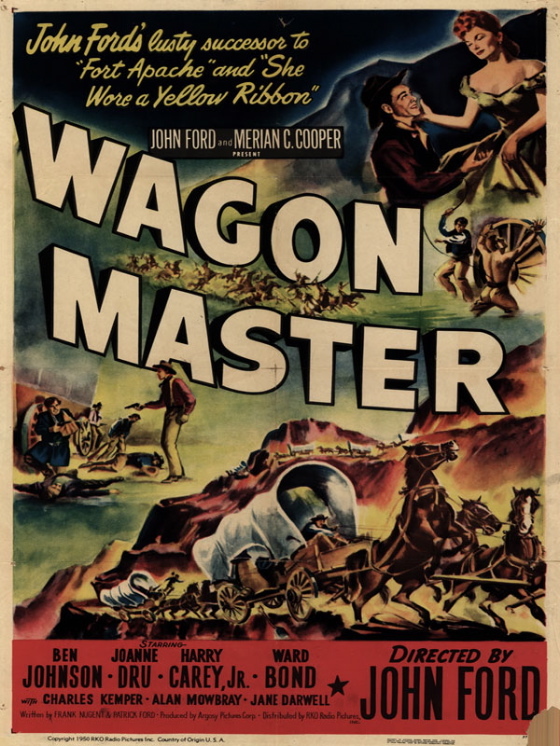
WAGON MASTER: A WORLD OF SPIRIT

This September saw two important events in the life of our culture.  One of them got a lot of attention, the other didn't.  The attention went to the CD release of the remastered Beatles catalogue — an event that was important but in great measure symbolic.  It was wonderful to have all those albums sounding so good — as good as CDs probably can sound — but it's not like the music had been unavailable before the remasters.  The remasters were primarily an excuse to listen to it all again and begin thinking about The Beatles' place in history.

A week after the remastered Beatles catalogue was released, John Ford's Wagon Master appeared for the first time on DVD in the U. S.  Its arrival didn't cause much of a stir.  Wagon Master was a film that had been very hard to see, and for that reason lingered at edge of Ford's body of work, greatly admired by some but generally considered a second-rank effort in the Ford canon.  The reviews of the DVD I've run across online, very respectful for the most part, have confirmed this status — the consensus seems to be that it's good to have the movie on DVD at last, even though its appearance is not likely to spark a major critical reevaluation, placing it in the same league as The Searchers, for example.

However, that's just where it belongs.  Wagon Master may well be Ford's greatest film, his most perfectly realized film and, in some ways, his most radical film.

It is certainly one of his most personal films and he himself often cited it, sometimes in company with The Sun Shines Bright, as his favorite film.  Harry Carey, Jr., who starred in the film with Ben Johnson, Ward Bond and Joanne Dru, said that Ford was in a good mood the whole time he was making it.  This was not usual for Ford, to put it mildly — he had a vicious streak that almost always found its way onto the sets of his movies.  It was nowhere in evidence on the set of Wagon Master, which Ford banged out in 30 days in something resembling a state of bliss.

One can imagine a few personal reasons for this.  It was a low-budget film, made by his own independent production company, and it had no name stars in it.  Ford had no executives on his back up there in Moab, Utah, where he shot most of it, and no star egos to keep in check.  He made this film with almost complete freedom from studio interference.

Ford said that he fought a thousand battles with the studios in his career and lost all of them.  Occasionally, with a studio head like Daryl Zanuck, he was fighting with someone he admired, grudgingly.  But look at the changes Zanuck made to My Darling Clementine between the surviving preview version and the release version.  They all coarsen the film, diminish its poetry and its subtlety.  They may or may not have been wise changes from a commercial standpoint — we will never know — but the film would have been a greater work of art if Zanuck had kept his hands off of it.
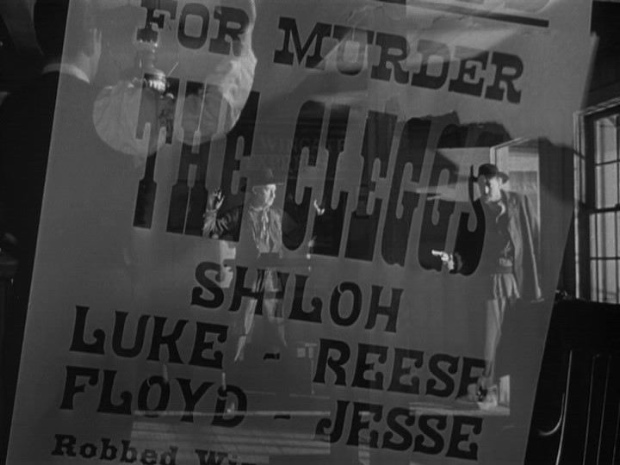
Wagon Master is one of the only Hollywood films I can think of which does not open with a corporate logo.  It's not marked up front with the brand of the nasty little men who controlled Hollywood by the simple expedient of exercising a virtual monopoly over film distribution in America.  (If you think any of those guys would have survived six months in a free market for movies, you just haven't looked past the glamor of their artificially-created power.)

Instead of a corporate logo, Wagon Master opens with a dark image of a robbery in a small office, superimposed over a wanted poster of the robbers (above) — the Cleggs, a family of outlaws who will figure importantly in the story we're about to see.  There's probably an ironic joke in this.  When Ford tried to create his independent production company, he was robbed blind by the studios he still depended on for distribution — and there was nothing he could do about it.  Working on a small profit margin, Ford's company eventually failed because the financial edge it needed was stolen from him by the studios he was trying to break free from.

So Wagon Master is brought to you by the Cleggs — like every other Hollywood movie from the era.  Dumb, brutal thugs, the Cleggs will come a beggin' to the good folks of the film's wagon train, sponging off them, feigning gratitude, just waiting for the moment when they can exercise their ugly form of control.  You can see the good folks of the wagon train as the people in Hollywood who actually did the work there, who actually made the films there, for the benefit of the dimwits with the guns.  How delightful it must have been for Ford to set the dimwits up in this way, all the while knowing that in the story of this film, at least, they would get their comeuppance, and then some.  No wonder he was in a good mood out there on the frontier, telling this tale.
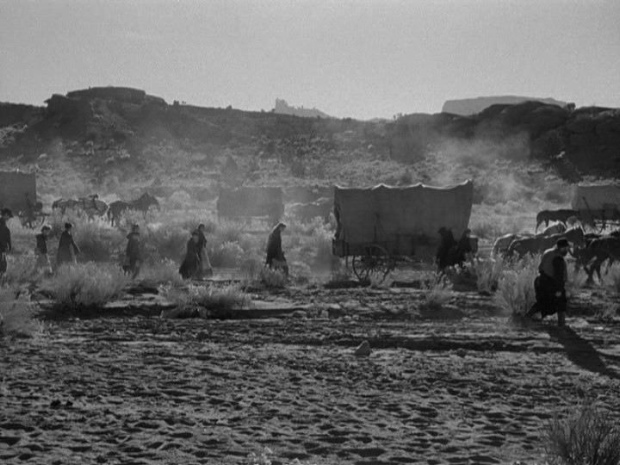
But even if this joke is embedded in Wagon Master it's not finally what the film is about.  It's a lot deeper than that, a lot more complex.  On one level it's about the way men and horses move through landscapes — about the way horses behave when they're pulling wagons through rivers, about the way Ben Johnson sits a horse.  The way Ben Johnson sits a horse is at the very heart of the film.
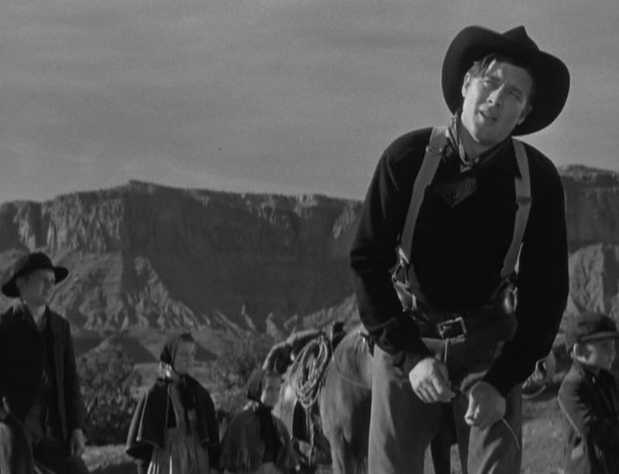
Johnson's grace in the saddle is every bit as magical as Fred Astaire's casual defiance of gravity in his dances, and every bit as cinematic.  It helps to have some familiarity with riding to appreciate it.  On the commentary for the new DVD, Harry Carey, Jr., himself a fine horseman, keeps crying out with pleasure at Johnson's way with a horse.  (“That's how you get on a horse!” Carey will shout occasionally.  “That's how you get on a horse!”)  But even if you've never been close enough to a horse to smell it, you can feel the magic of what Johnson is doing — just as you can feel the magic of Astaire even if you've got two left feet.
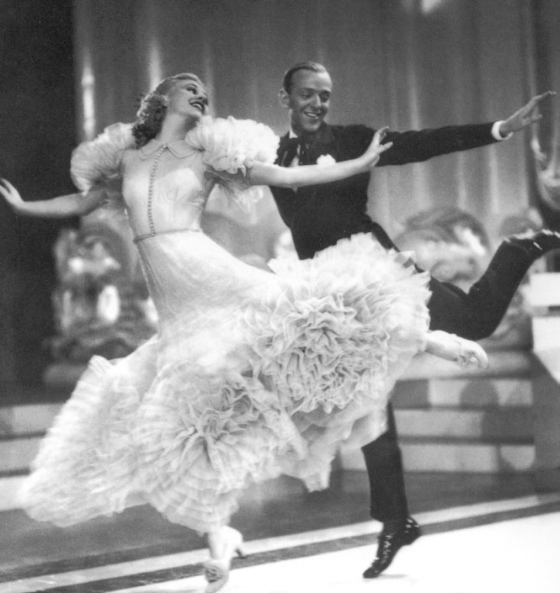
As with dance, horsemanship suggests moral values.  Treating a horse in a kindly, respectful way parallels the courtly partnership of a great pas de deux.  Skill and ease on a horse, the physical virtuosity of it, evoke character, testify to history.  Johnson, like Astaire, had the sort of virtuosity which can only be achieved through a lifetime of discipline, a lifetime spent in the saddle or in the practice studio.

Here's something to look for in Wagon Master — a scene where Johnson does his most spectacular riding, fleeing from a band of mounted Navajos.  He and his horse traverse rough ground like water flowing over a rocky stream bed.  At one point Johnson loses his right rein at a full gallop downhill and leans down to retrieve it like a short-stop scooping up an easy grounder.  Johnson once said of a spectacular ride in another Ford film, “I was just a passenger on that one.”  This gets close to the mystery of riding — a great horsebacker is always a great passenger, in tune with his mount, with the ground they cover, in tune therefore with the earth but creating new possibilities of movement in space, like a dancer.  It is a combination of mastery and surrender, of harmony and challenge, an image of human potential at its extreme limits.

When you see Astaire dance, you know he's going to get the girl in the end.  When you see Johnson ride, you know he's going to save the dream of the Mormons migrating west.
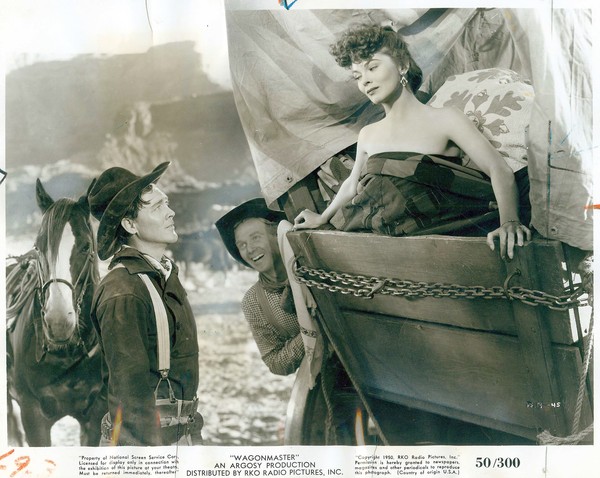
You know he's going to get the girl, too.  The “love story” between Johnson and Dru, playing a slightly worn showgirl, is one of the deepest in all of Ford's work, and one of the sexiest, though Ford doesn't even give them a fade-out kiss.  It's all about the gracious courtship of a woman who has long ago given up dreams of gracious courtship.  It's about her surprise at this, and mistrust of it, and final surrender.
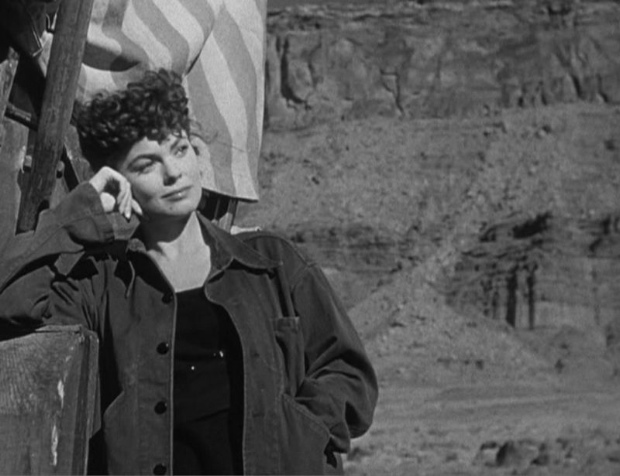
It's a romance that plays out in physical terms, in the way he moves and the way she moves — a complicated sexual display in which every casual touch or glance is erotically charged.  In the last two-shot of the couple, riding on the seat of a wagon, nothing has been spoken about what's ahead for them, but you can see it in their eyes.  It's almost indecent, what you see in their eyes.

Wagon Master is a film made up of closely observed physical phenomena which Ford has somehow invested with moral and spiritual meaning.  Good and evil don't need to be given symbolic markers — we see them at work without masks, without name-tags.  In all of art, I think only Tolstoy, in War and Peace, got anywhere close to this effect.

In Wagon Master, Ford shot a thoroughly convincing documentary about the world of spirit . . . about spirit made flesh, literally.  Other films have tried to do this, but Wagon Master makes even the best of them, like The Diary Of A Country Priest, look ham-handed by comparison.

The ending of Wagon Master is as odd and unconventional as its opening.  Just as the settlers get within sight of their promised land the narrative deconstructs itself — we are presented with a montage of discontinuous shots.  Some seem to show the characters riding on to a new life, others are shots from earlier in the film.  Time dissolves, the wagon train moves on, in the mystical dimension the film has conjured from its meticulous rendering of actualités.

To put it very bluntly, as Ford might have, to get us off the scent of his piety and faith, Wagon Master is a God-damned miracle.
CEVICHE!!!!!!!!!!!!!!!!!!!

(With thanks to Maya for the extra exclamation points . . .)

Here's my personal recipe for ceviche, arrived at by combining a couple of rules I've run across:

The Marinade

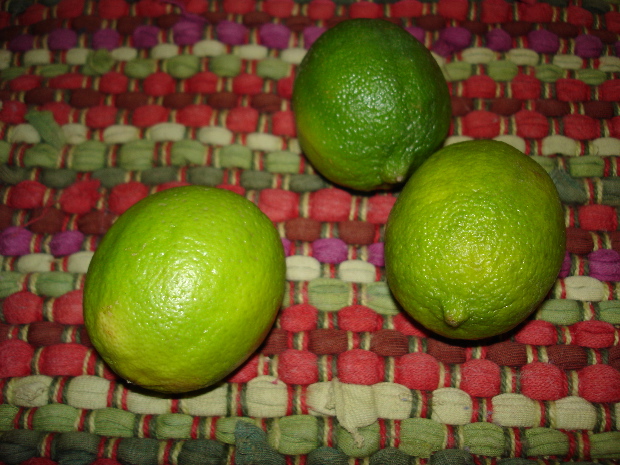
1 cup of freshly-squeezed lime juice
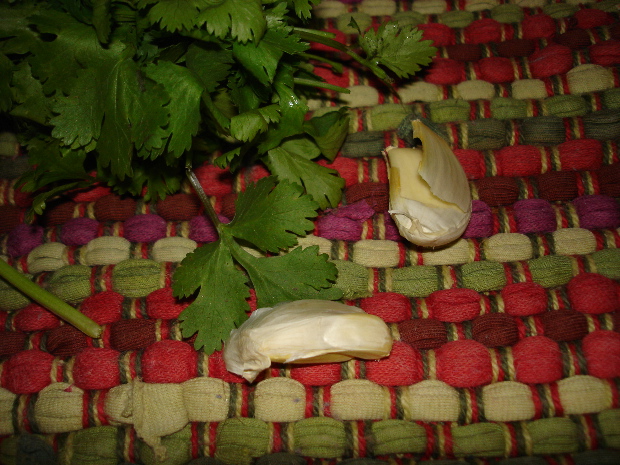
2 cloves of roughly-chopped garlic (I actually use 4 or more cloves, but that's just me)
1 serrano chile, stemmed and roughly chopped (I use 2, for a very hot taste — if you want to wimp out, you can remove the seeds from the chile)
1/2 loosely-packed cup of coarsely-chopped cilantro
1 teaspoon of salt

Put all this in a blender and mix it up but good.

The Fish

1 to 1&1/4 lbs. of fresh fish, filleted and skinned and chopped up into small cubes.  An oily fish like mackerel is ideal but halibut or sea bass will do.  Indeed, just about any seafood will do — shrimp, scallops, octopus, squid, though you need to boil the latter two for 1/2 hour first, to tenderize them.

Put the fish cubes in a bowl with the marinade and let it “cook” in the refrigerator for four hours, stirring occasionally.  If you use “sushi-grade” fish, available at some markets, you can wait just long enough for the marinade to flavor the fish before eating it, essentially raw.  (This is how it's done in Peru, apparently, and it's very fashionable these days, but not to my taste.)

The Garnish

While the fish is marinating, chop 10 (or more) cherry tomatoes in half and thinly slice a couple of green onions.

When you're ready to eat the fish, pour off the marinade, but save it.  Toss the tomatoes and the onions in with the fish.  Add a bit more salt to taste.  If you're going to be eating the ceviche with taco chips (highly recommended) you won't need much more salt.  At this point you can also sprinkle a little freshly-chopped cilantro over the ceviche for color.

Eat the ceviche with some cold cervezas.  For leftovers the next day, if any, dress them lightly with the marinade you've saved.

This dish is incredibly easy to make and unbelievably good.  You can find ceviche just about anywhere along the shores of the Mar de Cortes, where it's almost always sublime — and now, you can have it right in your own home, wherever you are.