THE WORLD MOVES ON

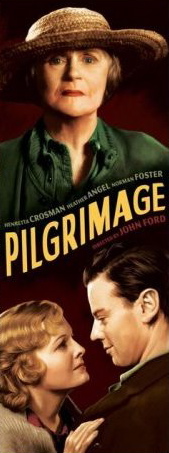
The World Moves On, starring Madeleine Carroll and Franchot Tone (above),
is a fairly undistinguished and only mildly entertaining John Ford film
from 1934.  One might be tempted to see it as an assignment in
which he had no great personal interest, except for the fact that its
themes are ones that preoccupied him all his life — family, war and
religion.

The film is an epic family saga that begins in 1825 with the setting
up, in New Orleans, of an international textile combine.  After
this lengthy prologue the film concentrates on the first third of the
20th Century — showing how war and greed destroy not only the combine
but the family that runs it and, by not so subtle implication, the
fabric of civilization itself.  There are chilling and prophetic
hints of the war to come — with documentary images of Hitler reviewing
marching Nazis, of Imperial Japanese and Russian and French troops on
parade, of British ships and American warplanes on maneuvers.

The coming apocalypse — which in 1934 could conceivably have been
averted — is presented, like the previous apocalypse of the Great War,
as the direct consequence of rejecting Christian values.  At the
end of the film, when the lead couple visit their crumbling home in New
Orleans, the ruined patriarch says, “There's nothing left.”  His wife
answers that there is something left — and points to a crucifix hanging on the wall.

Ford was rarely so explicit in his references to religion, because he
didn't need to be.  They were built into the narratives of his
films, as they were built into the parables of Jesus (before he
explained them in private to his disciples, at which point they lost most of their
power.)  Here the religious references seem imposed from outside
the narrative — one
of the few cases in which we catch Ford preaching.  Ford wasn't at
his best in a pulpit — like Jesus, he did his best work out of
doors, in taverns and in the homes of ordinary people.

The most moving sequence of the film shows a series of
soldiers walking through a town towards the train that will take them
to the front.  We see the film's young lovers but also nameless
characters — a stiff-upper-lip officer walking with his son, tenderly holding the little boy's
hand, a soldier walking with his mother, who babbles advice as a way of
not falling apart.  In these small vignettes we feel the truth of
war, feel its threat to decency and humane life, far more deeply than in
the noble pronouncements of the characters who expound Ford's
sentiments directly.

PILGRIMAGE

[With plot spoilers — don't read what follows unless you've seen the film . . .]

Pilgrimage,
a John Ford film from 1933, is unapologetic melodrama — it makes a
shameless appeal to the emotions.  A modern sensibility, schooled
in a cynical age, tends to resist this sort of appeal and I did, too,
the first two times I saw the film, and it worked — up to a point.  Beyond that point I found myself crying
like a baby.  I'm still not entirely sure how Ford got around my
defenses (twice!)  but I'm
forced to admit that he deployed the complex and mysterious resources
of melodrama with devastating effectiveness.

One of the key resources of melodrama, especially cinematic melodrama,
is indirection — while the conscious mind is busy resisting the
obvious assault on the heartstrings, the filmmaker finds an unexpected
avenue around the conscious mind, and the emotion catches you unawares
by some other route than the one you were defending.

Pilgrimage tells the story of
a possessive mother who ships her son off to WWI rather than lose him
to the young woman he plans to marry — and the kid dies “over
there”.  The fiancée is pregnant with the boy's child, whom the
grandmother refuses to recognize.  Something has to give — but
where, and how?

The first radical shift in the tone of the film is visual rather than
(explicitly) emotional.  The embittered old woman is offered a
trip to France to visit her son's grave and is shamed by her neighbors
into going.  We cut to the station where she's boarding her
train, and the cut is a shock — because the station is an exterior
location, shot in sunlight . . . the first such shot in the film. 
Everything else, even the rural exteriors, has been shot on a sound
stage, with moody, often expressionistic lighting.  (There is a
single shot prior to this, of a moving train at night, which couldn't
have been shot on a sound stage but might as well have been — all we
see is the train surrounded by darkness.)

From this point on in the film, Ford shoots on real exterior locations or sets built out-of-doors
as often as he can.  Real sunlight becomes a player in the
tale.  You don't need to notice this consciously for it to have
its effect.  It's disarming.  It prepares us for deeper
changes.  At the station, the mother of her son's child asks the
old woman to take a bouquet of flowers to the grave for her.  She
raises it up to the window of the train compartment where the old woman
is sitting, unseen by us.  Slowly the old woman's hand reaches out
and takes the bouquet, draws it in to the train.

We never see the old woman's face in this exchange — and we really
want to.  We want to know if she takes the flowers angrily or
tenderly, if she's softening or still hard as stone.  Ford
won't tell us.  The next time we see her, we look at her a bit
more closely — suspicious that Ford might be keeping something else
from us.  We might think we don't care about this old woman and
her damned intransigence — but the damned director better not try to
hold out on us like that again.  It's a master melodramatic stroke.

As we watch what happens to the old woman in France, surrounded by
other mothers who lost sons in the war, things develop in a conflicted
and complicated way.  The old woman finds a kind of companionship
she's never known in her life — and we suddenly realize the depth of
the loneliness that made her want to hang on to her son.  We'd
been looking at the pathology of it before, at its horrifying effects
on other people's lives — now we're blindsided by an awareness of the
unutterable isolation and sadness at the core of her being.  She
doesn't seem so much delighted as bewildered by her ability to get on
with others —
and that's what breaks our hearts

But as the old woman comes alive among her peers, she also grows more
distant from them, dealing with the fact that they mourn loving relationships
with loving sons while she wrecked her son's life, and sent him off to
die.  She faces up to her guilt with courage but it estranges her
from these woman in whose company she has blossomed as a human being
for perhaps the first time.

In Ford films, of course, with their strong Christian, Catholic
underpinnings, facing up to one's sins leads to redemption — often by
miraculous means.  In this case it's a young suicidal man the old
woman meets on the street and saves from himself — a surrogate son,
who gives her a second chance to be a good mother.  This doesn't
remove her burden, but it gives her the final measure of courage she
needs to visit her son's grave.

That visit is shot on an exterior set built inside a sound stage, lit
moodily,
with a long tracking shot through the crosses in the graveyard. 
Stylistically, we're back where we started in the film — we have made
a kind of circle through the sunlight and come back to the shadows
again.  The old woman places the withered bouquet given to her by
her son's fiancée on the grave — then falls into the dirt and asks her
son's forgiveness.  She's saved — and somehow Ford has badgered,
enchanted and tricked us into following the mechanics of her salvation,
believing in them because we have felt them, in spite of
ourselves.  The Christian dynamic of confession, repentance and
redemption is rendered in convincing psychological terms.

In one sense, it's all done with mirrors, with clever deviations and
circumnavigations around the story's deep undertow — but the tears it
draws out of us, the tears it allows us, finally, to release, are quite real . . . and precious.

JOHN FORD AND THE COMING OF SOUND

In
a 1966 interview John Ford was asked what happened when talkies
came to Hollywood.  “Nothing,” Ford said, “we just made them with
sound.”

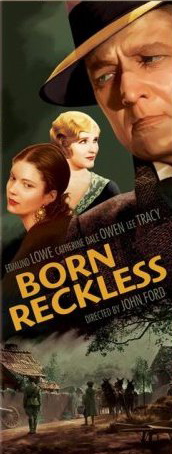
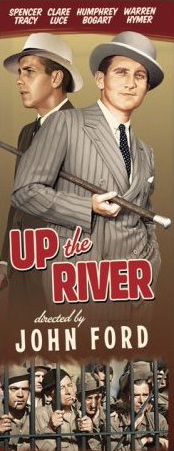
That might seem like typical Ford bluster but on the evidence of his first three sound features for Fox — Born Reckless, Up the River and Seas Beneath, all included on the new Ford At Fox DVD box set (and all
from 1930!) — it seems like a fair assessment of his own remarkably
assured transition into the sound era.  (Ford had made one sound
short and one silent feature, The Black Watch, which was released with interpolated talking sequences, before the three sound features from 1930.)

The first two of the three are admittedly clumsy programmers. 
Ford moves his camera occasionally in these films but they also have a
number
of scenes that feel stagebound, with proscenium
framing and little dynamic choreography within the shots.  Often
these scenes were staged and directed,
at Fox's insistence, by “dialogue experts” with stage experience.


The results could be truly dreadful — especially so for a film like Born Reckless,
which was meant to be a gritty underworld drama.  To hear actors
portraying hoods declaiming street slang in theatrical tones, with
slight pauses between lines to avoid overlaps, is laughable today, and
was probably laughable to a lot of people when the film first came
out.  Interestingly there is one scene in a bar, undoubtedly
directed by Ford himself in an experimental mood, which features fast
overlapping dialogue by a number of characters.  It's impossible
to make out much of what's said but the film suddenly feels modern for
a few moments.

Up the River, a whimsical
prison comedy, had better lead actors — Spencer Tracy and Humphrey
Bogart no less — and so feels a bit more naturalistic, but it's a
routine film, with Ford often straining too hard for his comic effects,
as he had a habit of doing throughout his career.  The inspired
visual touches are few and far between.  It doesn't help that Up the River
as presented in this set derives from a severely damaged print, with
missing frames (and thus dropped bits of the soundtrack) which make the
dialogue in several places impossible to follow.  Apparently this
print represents the best surviving material for the film.

Then suddenly we have Seas Beneath
The story material is potboiler stuff — recounting the adventures of
some plucky U. S. sailors in WWI venturing forth on a decoy ship to
hunt German submarines.  But visually the film is breathtaking,
with scenes shot at sea that have to be seen to be believed.  Even
the built sets, for the episode when the sailors go on shore leave in
the Canary Islands, have solidity and depth and often look out onto
exterior sets alive with action.

The delivery of dialogue is occasionally stilted, but you can see that
Ford was going for something resembling natural speech.  He's
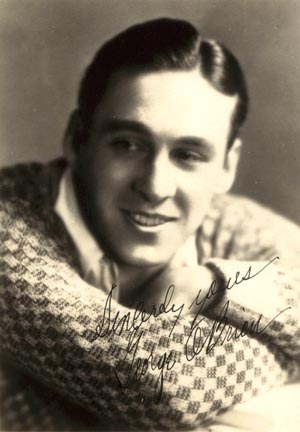
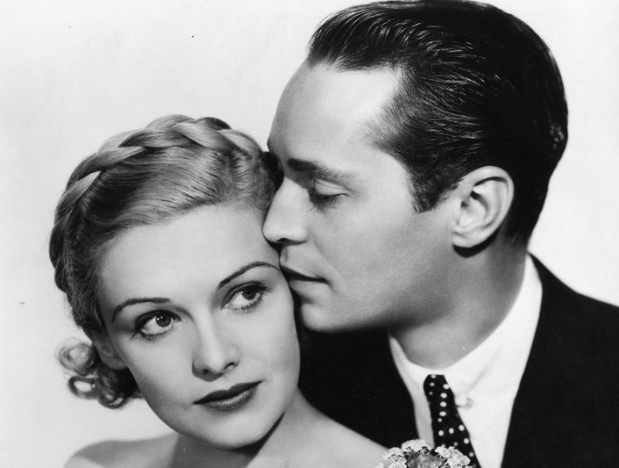
greatly aided by George O'Brien (above) in the lead role, whose lack of stage
experience is a decided advantage to him here.

The film has some remarkable action sequences and many beautiful,
powerful images, reminiscent of silent-era filmmaking.  Ford
doesn't seem to be straining against any limitations imposed by the
microphone — he seems perfectly at home in what amounted to a new
medium.  The visual bravura lifts the film above its pedestrian
story and script, as it so often did in the silent era.  One can
easily imagine it as a silent film.  Ford just made it with sound.

NO ROOM AT THE INN

When
very young kids hear the Christmas story for the first time, and you
then ask them what they remember most about it, they will invariably
say, “There was no room at the inn.”  That looms larger than the
cute animals, the happy shepherds, the magical gifts.  Kids know
what the story is really about, where it really begins — in rejection,
exclusion, humiliation.  These are subjects that preoccupy very
young kids.  Growing up, we tend to find ways of managing these
preoccupations, but they never leave us.

Christmas is not just about the hope renewed by the birth of a child —
it's about the ways hope is lost.  If sorrow and despair don't
figure into your understanding of Christmas, the story of it won't add
up to much.  Dickens' A Christmas Carol, the happiest Christmas story in post-Biblical literature precisely because it is
the saddest Christmas story in post-Biblical literature, may be the best proof of that.

Here's an incredibly powerful holiday tale from the Flickhead blog — a most appropriate meditation for the season.

A NORMAN ROCKWELL FOR TODAY

O. k., Norman Rockwell did sometimes push the cuteness factor a bit too
hard, especially in his advertising work.  (The image above is
from a magazine ad — the family is excited because dad is bringing
home a new Plymouth for Christmas.)  The expression on the face of
the boy on the right is just a bit too orgasmic for the occasion. 
The expression on the face of the dog makes up for this to a degree — I get
a feeling he's looking forward to urinating on the Plymouth's new
tires.  The self-absorption of the birds also makes for a nice
counterpoint to the ecstasy induced by conspicuous material consumption.

Yet for all that the image moves me.  It sums up exactly how I felt in the Christmases of my youth, which is pretty much exactly
how I still feel at Christmas — surprising considering how many
such seasons I have under my belt.  Sometimes art isn't meant to
make us rethink how we feel about things — sometimes it's meant to
remind us how we feel about things.

Remove the Plymouth from the equation — imagine it's just dad, a
salesman perhaps, back from a long road trip in time for the
holidays.  That works, too.

CONTRABAND

Contraband is a Powell-Pressburger film from 1940 recently released in a film noir DVD box set by Kino.  It's not by any sensible definition a film noir
— it's a suspense thriller in the Hitchcock mold, involving wartime
intrigue in the London of the blackout.  (Its U. S. title was Blackout.)

As imitations of Hitchcock go, this one is pretty good, as agents and
innocent folk caught up in the adventure chase each other through
improbable locations in the blacked-out city.  It displays a lot
of visual wit and cinematic whimsy, and has the usual Hitchcockian
drollery applied to dark and dangerous doings.  Indeed, it makes
us aware of how much Powell and Pressburger's work owes to Hitchcock,
especially in terms of attitude.

But it falls far short of Hitchcock in its cumulative effect, and it's
worth examining why.  Powell was a great enough director to
analyze and reproduce Hitchcock's tone, his witty use of locations, his
dreamlike progression of narrative incidents.  But what he doesn't
do, doesn't seem to realize that he needs to do, is find ways of
implicating the audience in the moral and physical jeopardy of the
protagonists.

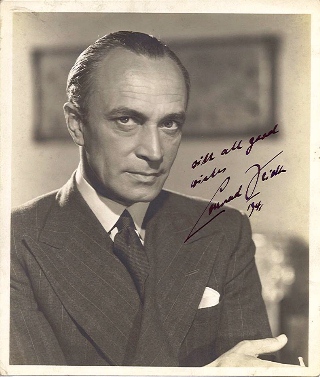
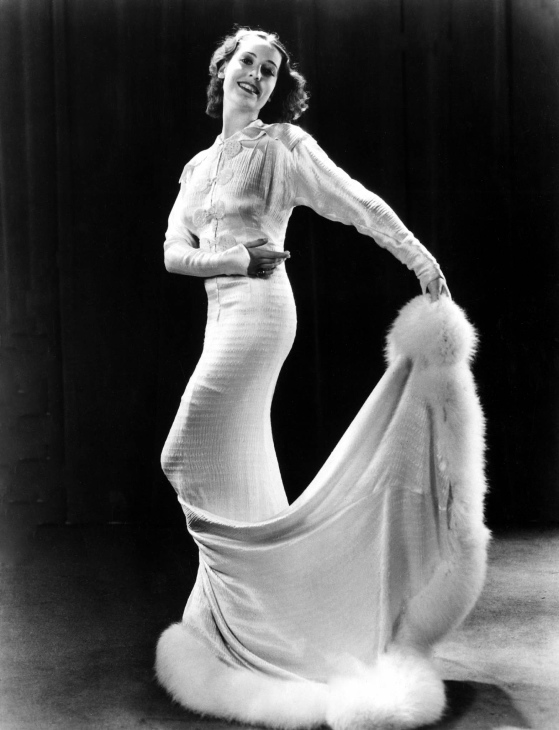
Valerie Hobson and Conrad Veidt, as the leads, are introduced as
interesting and eccentric characters.  We might well be curious
about what's going to happen to them, and between them romantically,
but we don't see, we don't feel any of it from their perspective.  The
protagonists are introduced through he eyes of subsidiary characters
— a build-up that makes them seem fascinating but distant from us.

This is an acceptable strategy for a standard star vehicle, a romance
or a drama — it doesn't work for a Hitchcockian thriller, in which the
plot incidents are all a bit silly when viewed literally. 
Unless we feel responsible for the characters' predicament, identify
intimately with the mistakes and confusion that have led them into it,
the film itself starts to seem silly.

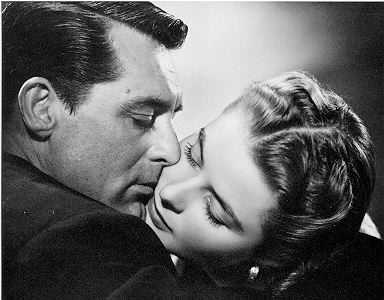
In Notorious, for example,
Grant and Bergman are morally implicated in Bergman's jeopardy — he by
the “duty” which impels him to put her into it, she by the self-hatred which allows
her to be used in that way.  The literal jeopardy she finds
herself in thus becomes an objective correlative to an inner turmoil,
an inner conflict — which we experience as well, because we want their
patriotic enterprise to succeed even as we want their romance to
survive it.  We are emotionally and morally implicated in the
resulting tension.

No such inner identification is ever established in Contraband
Veidt's character is an innocent caught up in a dangerous situation,
but Hobson's character is only indirectly responsible for this. 
Veidt and Hobson are both behaving admirably out of pure motives —
their jeopardy is
merely circumstantial, with no moral ambiguity.

The result is that we watch the intricate elaboration of the intrigue
as interested spectators not involved on any deeper level.  We
root for the good guys, know they are going to win in the end and feel
only the slightest trace of satisfaction when they do.  At the end
of Notorious we feel redeemed.  At the end of Contraband we feel, at best, diverted and amused.

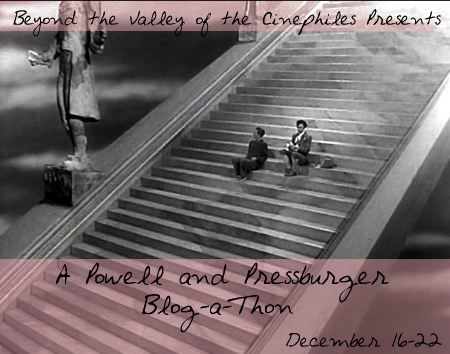
[This post is a contribution to the Powell and Pressburger Blog-aThon hosted by Beyond the Valley of the Cinephiles.]

BLACK COMEDY

When
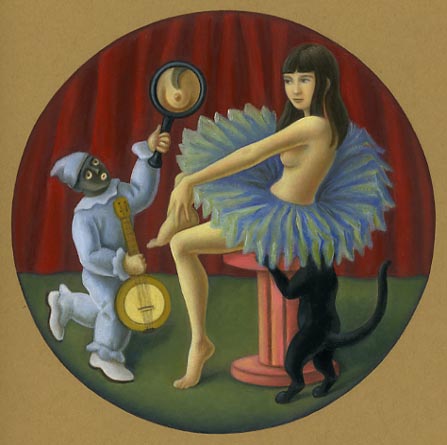
I discovered the work of Amy Crehore, via Boing Boing, I was particularly
struck by the image above, titled Black Comedy, and reproduced it at the head of my first
post
about the artist.  This holiday season someone gave me an
original limited-edition print of the image, which is not just striking
but ravishing, far beyond anything an Internet reproduction could
convey.

The odd tone of the scene is intensified in the print — a dreamy, erotic
playfulness that has something to do with the theatricality of sex, or
the sexiness of theater, but floats mysteriously above any precise
interpretation.

Anyone looking for a special gift this Christmas could do worse than peruse the prints available at Crehore's web site.

The peek-a-boob joke in the painting puts me in mind of something that
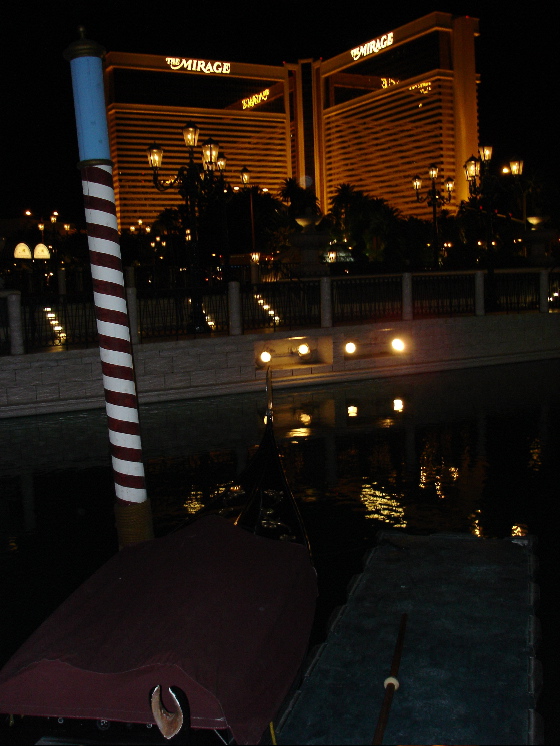
happened to me recently here in Las Vegas.  I'd just had a drink
at the Mirage with my friend the architect Deane Evans, in town for a
conference, and went out to pick up my car at the valet stand. 
There were two guys in cowboy hats (the rodeo is also in town) and two
girls at the stand waiting for their truck.  As I came up to them
one girl, very tall, very attractive and very drunk, turned to me and
opened the front of her blouse, flashing her very impressive
breasts.  Then she broke up laughing.  I didn't know how to
respond to this cheerful greeting and just said, with what was probably
a goofy smile, “Thank you.”

The greeting wasn't personal — the young lady was flashing her boobs
and laughing delightedly at any guy who came near her, including the attendant who delivered her
ride.  They all responded with goofy smiles.

I now realize, given the season we're in, that I should have said, “Merry Christmas to you, too.”

366

I
started this web log just over a year ago and this is my 366th post —
very close to the post-a-day goal I set for myself.  Readership
has grown steadily over that year — I've twice had to buy more
bandwidth to accommodate the traffic — but seems to have leveled off
in recent months, which strikes me as good occasion to switch to a more
leisurely pace, especially since the press of other work is growing
heavier as the new year approaches.  I've set a new goal of at
least one post a week, with
occasional extras as the mood strikes.  The archives remain available 24/7, of course.

Thanks to all who've visited, left comments or e-mailed me — the whole thing has been great fun!

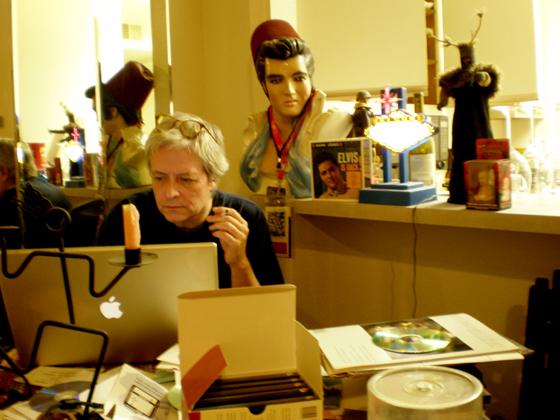
[Photo © 2007 Jae Song]

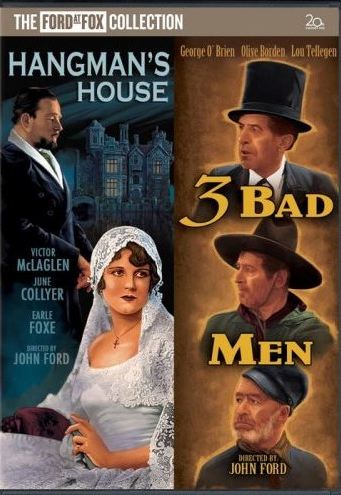
HANGMAN'S HOUSE

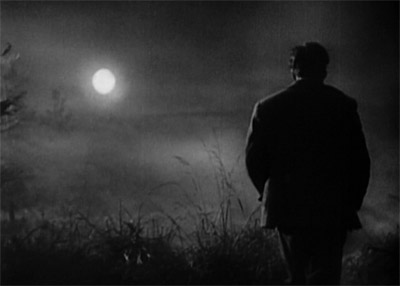
Hangman's House is the last, and least, of the five silent films included in the new Ford At Fox box set.  It's not a bad film, exactly, just sort of respectably mediocre.

Ford here abandons his effort to out-Murnau Murnau.  He moves his
camera very little, and only once or twice with any real effect or
beauty.  Generally he returns to his more characteristic style of
fixed camera positions looking into deep spaces with lots of
choreographed movement within them.  There is some moody lighting
here and there, and some fog effects on studio “exterior” sets,
reminiscent of those in Sunrise — but the film rarely comes alive visually.

You get a feeling that Ford simply wasn't all that inspired by this
somewhat creaky melodrama — entertaining enough, but just
barely. 
Viewers who only know Victor McLaglen's work as a comic Irish drunk in later Ford films will be surprised by his easy, restrained performance here.  It makes you wish he were the
romantic lead in the film, instead of the limp Larry Kent.  And there's one
really powerful camera move — in on the villain as he appears suddenly
in an apparently deserted house.  It's spooky and unsettling — like the push-in on Ethan's face in The Searchers as he registers the horror of the condition of the female captives
just  freed from the Indians.  It's markedly different from the longer, Murnau-esque camera moves in Four Sons, which are typically about exploring locations or expressing high spirits.

In his book on Ford, Andrew Sarris said that if Ford's career had ended
with the coming of sound, he wouldn't be recognized as a major
director.  Even Joseph McBride, in his notes for this new set,
says that Pilgrimage, a talkie from 1933, is Ford's first great film.  Having seen just the five silent films in this set, along with Kentucky Pride a few years ago, I must say I find these judgements puzzling.  3 Bad Men and Four Sons are hardly lesser works than Pilgrimage, The Iron Horse is a masterful film with elements of greatness, and Four Sons is one of the finest achievements of the silent cinema.

Ford would go on to make finer films, but he was “major” well before the coming of sound, at least in my book.

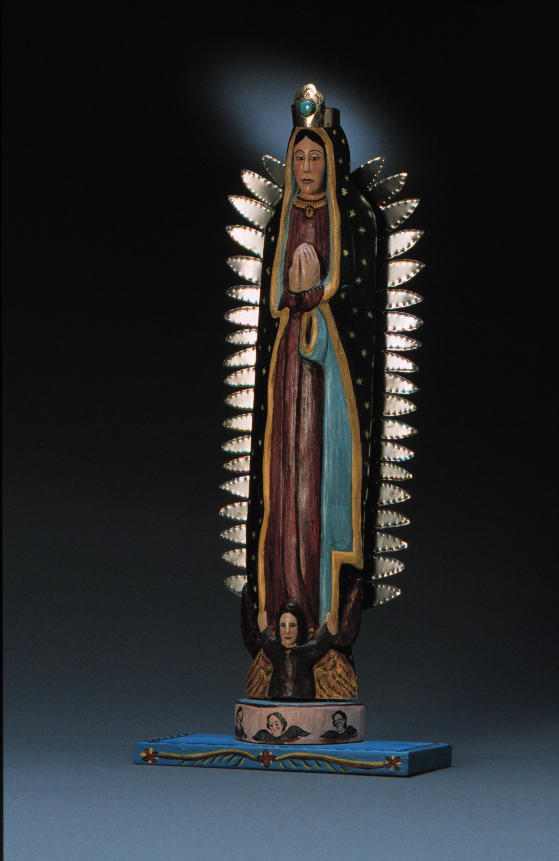
NUESTRA SENORA DE GUADALUPE

Today
is the feast day of Nuestra Señora de Guadalupe, the Mother of God, who
in 1531, not long after the Spanish Conquest, appeared to Juan Diego,
an Indian convert to Christianity, on a hill outside what is now Mexico
City.  To the amazement of Juan Diego, and to generations of
Mexicans since, she appeared in the form of a young Aztec girl.

Since that appearance, she has become both patron saint and national
symbol of Mexico, the embodiment of its own peculiar form of
Christianity.  She endured through all the anti-clerical episodes
of Mexican history and her image is omnipresent in the country today —
an abiding solace and guide.

This Christmas season might be a good time to think of her children who
are living in the United States without proper documentation, in
constant fear of the law, scorned and reviled by many but working hard, supporting their families
here and back in Mexico and contributing untold millions to our economy.

These are, for the most part, good and gracious people, industrious and
committed to sacrifice almost anything for their children's
future.  We are lucky to have them among us.  Their children are our children.

Feliz navidad, compadres!

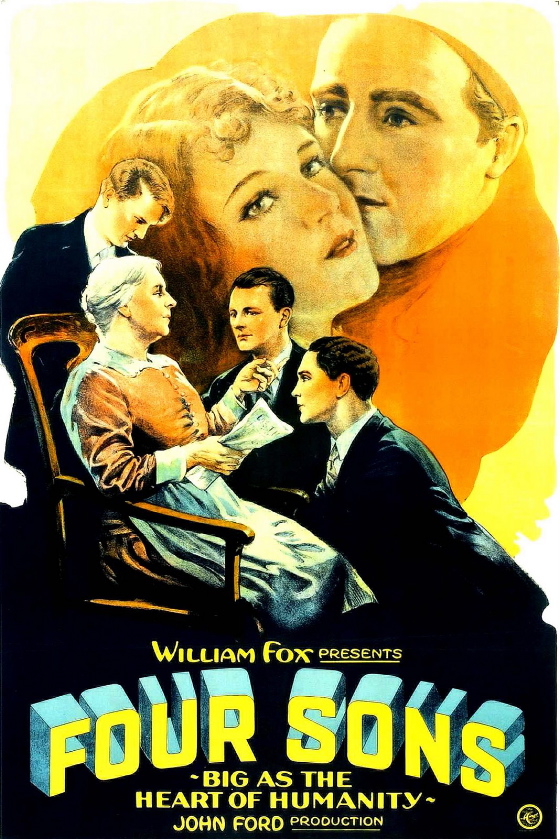
FOUR SONS

Four Sons,
from 1928, is one of the greatest works of German expressionist cinema
— even though it was made by the Irish-American John Ford in
Hollywood, U. S. A.  Ford doesn't just seem to be working under
the influence of Murnau here — he seems to be channeling Murnau. 
If the film had somehow been misattributed to Murnau, it would be very
difficult to correct the mistake by means of a stylistic
analysis.  Ford even, at one point, seems to be following in
Murnau's missteps — Four Sons, like The Last Laugh,
has an odd extended epilogue which violates the tone of the rest of the
film but somehow seems to work in spite of that, lightening the mood
in a strange, surreal way without diminishing the power of the work as a whole.

In Four Sons Ford moves his
camera as elegantly and expressively as any director ever has — and
the plastic invention involved is ravishing.  The lighting is
typical of Murnau, employing soft, glowing, complex chiaroscuro
effects as opposed to the stark contrast of light and shadow often
associated with expressionist cinema (and which Ford himself came
to favor in his later “expressionist” films, from The Informer to The Fugitive.)

Ford had two great masters in his formative years, first Griffith and
then Murnau.  What's astonishing is how totally he was able to
absorb each man's style — he didn't seem to be imitating it so much as
working within it naturally and unselfconsciously.  Maybe even
more astonishing is that Ford absorbed Murnau so quickly.  We know
how powerfully Sunrise
affected him — just from viewing the rushes he declared it the
greatest film ever made.  Less than a year later he was working
with full confidence and mastery in the Murnau style — and even shot
parts of Four Sons on sets from Sunrise that were still standing.

Apart from its lack of a strong female lead, Ford's Just Pals
could have been directed by Griffith and would rank among Griffith's more
enjoyable minor films.  The epic visual poetry of Ford's The Iron Horse bears favorable comparison with the epic visual poetry of The Birth Of A Nation — which is saying a lot.  If Four Sons had been directed by Murnau, it would rank among the German director's most important works — and that may be saying even more.

3 BAD MEN

[Caution — this post contains plot spoilers.]

In
modern-day Hollywood it's fashionable to analyze drama in terms of
“character arc”.  A character starts off a tale with a problem
which he or she must then develop the skills and inner resources to
solve, and this development follows a chartable arc.  I think
corporate executives are drawn to this model of storytelling because it
reminds them of the charts and case studies they used in business
school — it reduces human experience to something resembling the
problem of growing a business or maximizing profits.

The model is useless, of course, for understanding the actual life
experiences of human beings or the great stories and dramas in the art
of the past.  Achilles has no character arc, neither does
Hamlet.  They both undergo various experiences which sometimes
reveal their characters, and sometimes make their characters seem
hopelessly mysterious.  Neither of them “solves” anything.

The character arc model is particularly useless for analyzing the films
of John Ford, which are full of characters who suddenly do complete
turnarounds, often without the slightest explicit motivation — the
most famous case in point being Ethan Edwards in The Searchers
Their “arcs” are unchartable, mysterious — they raise more questions
than they answer, but the questions are ones of profound interest . . .
they provoke moral thought in audiences.

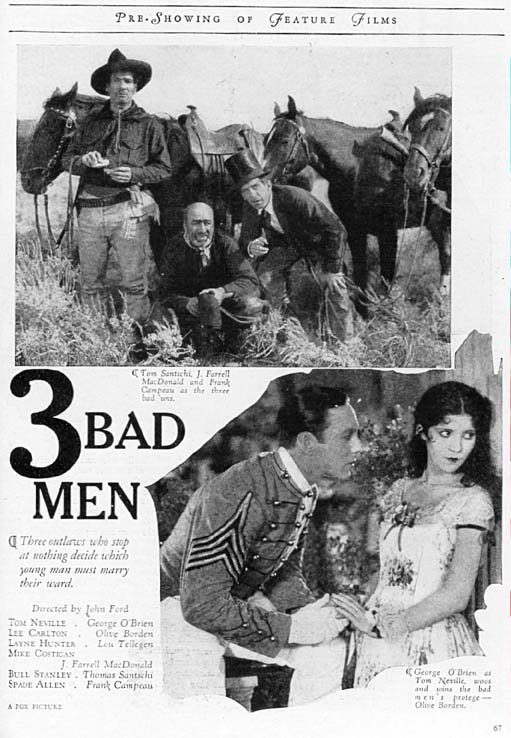
In 3 Bad Men, a silent film by
Ford from 1926, three criminals are suddenly converted into saints by a
young woman who mistakes them for heroes, and from that moment on they
behave like heroes, and in the end sacrifice their lives for her. 
Such a tale would never make it past the first story conference in
Hollywood today.  The film would have to spend most of its length
working up to that moment of conversion, showing the conflict within
the men as they struggled with the decision to be good.

Instead, Ford presents us with a mystery up front, and lets us spend
the rest of the film wondering what it means.  For Ford, the
answer lies somewhere in the realm of the moral, the spiritual, the
religious.  This is a realm not studied in business schools, not
relevant to ordinary business practice, and thus meaningless to the
corporate executives who run Hollywood today.  In modern corporate
culture, which is Hollywood's culture, moral issues are covered by
charitable contributions, perhaps by a dedication to ethical behavior
or to worthy political causes.  The issue of saving souls does not
arise.

But the saving of souls is what Ford's films most often concern, which
involves positing the existence of souls in the first place.  3 Bad Men
suggests that the worst of men have souls and are just waiting for a
chance to save them — just waiting for a call to goodness.  And
it further suggests that goodness is not always approached on paths
with chartable arcs.  Sometimes goodness descends on men like a
dove and changes them in an instant.

We may cheer when the hapless nerd grows his business or maximizes his
profits against all odds — but the bad men in Ford's movies,
unaccountably redeemed, make us cry.  It can be argued that they
also make us wise in the actual ways of the human heart.

[With thanks to the Silents Are Golden web site for the images above.]

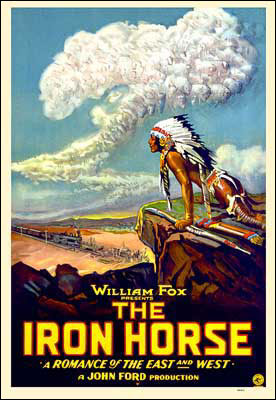
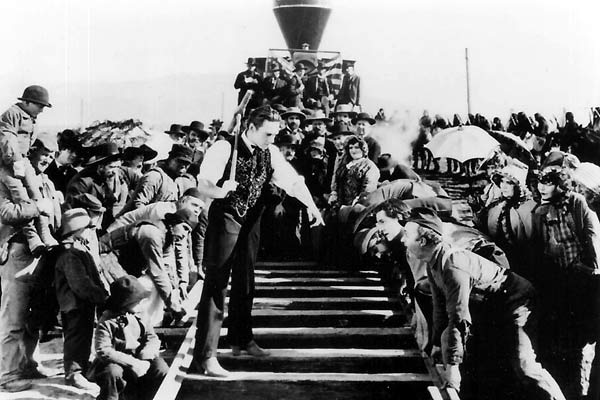
THE IRON HORSE

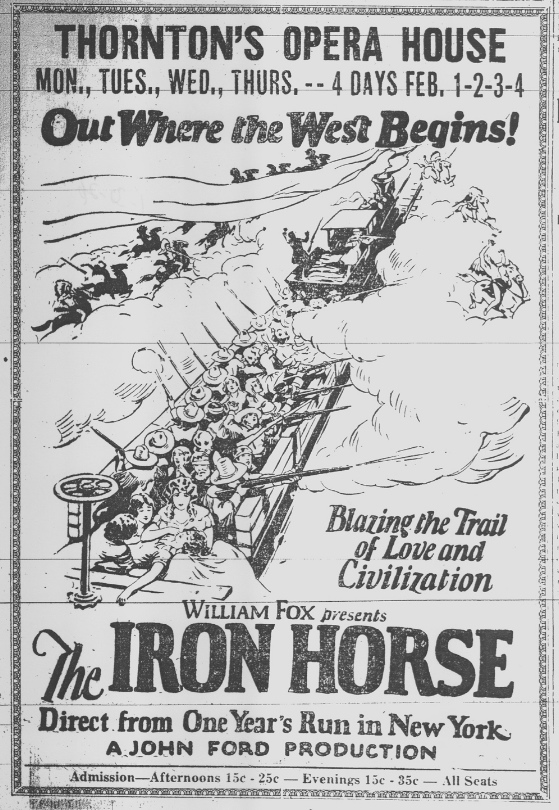
You can look at John Ford's The Iron Horse
in two ways — as a silent melodrama set against the epic backdrop of
the building of the transcontinental railroad, or as an epic poem about
the building of that railroad with some melodrama woven through it to
give it a more coherent structure.

In truth the film is both these things, simultaneously or alternately
— the two halves of its nature are never entirely reconciled.

The melodrama isn't at all bad — it's entertaining and sometimes
moving — though it has one of the lamest lovers' misunderstandings in
all of movies.  (Interestingly, the international version of the
film tries, through rewritten intertitles, to make the misunderstanding
more plausible but just succeeds in making it even lamer than it already was.)  The real
problem is that the epic poem which hosts
the melodramatic narrative is one of the most sublime achievements of
the silent cinema.  It's hard to imagine any melodrama which could
holds its own with such poetry.  (It should be noted that Griffith
faced the same dilemma with The Birth Of A Nation, and similarly failed to solve it.)

The epic poem within The Iron Horse
has themes and developments peculiar to itself.  Ford is
interested, as he often was, in the process of things, which in this
case centers on the land, the physical fact of the land, which
determined the challenge the road builders faced.  Ford is also
interested in the moral development this challenge prompted —
specifically the uniting of diverse peoples in a national consciousness.

The inclusiveness of the film is notable, and notably modern. 
Building the railroad unites former antagonists in the civil war
between
North and South.  It unites Eastern engineers with Western scouts
and hunters.  It unites ethnic groups — most specifically the
Irish
and the Italians, though there are a few scenes demonstrating
good-natured camaraderie between Europeans and Chinese.  It unites
women and men, who at one point take
up arms together to rescue some besieged track layers . . . and in the
climax of that scene, a band of light cavalry rides to the rescue —
not U. S. soldiers but Pawnee Indians, allies of the train
workers.  The only people conspicuously absent from this American
mosaic are blacks — probably to avoid alienating white Southern
audiences of the time.

The epic poem of America that's at the heart of The Iron Horse unfolds
at a stately pace, even though it's brimful of incident and exquisite
lyrical images.  (There's enough pure cinema in this picture to
supply a dozen ordinary movies)  Unless you surrender to its
rhythms, are willing
to just sit back and enjoy the sheer spectacle of it, you are likely to
find The Iron Horse tough going.  If you're primarily interested in the
melodrama, wanting Ford to get on with it already, you'll find it even
tougher going.

On the other hand, if you let Ford take you at his own pace, show you
want he wants you to see, you'll be deeply rewarded.  Here is the
vernacular lyricism of Leaves Of Grass
applied to a truly epic subject and translated into visual terms that
transcend its melodramatic armature.  It's an imperfect but genuinely awesome work.

The film is part of the new Ford At Fox
box set, where it's presented in two versions — the American release
and the somewhat abridged international release, derived from a
separate negative made up of second-camera shots and alternate
takes.  The American version is far superior but apparently better
print material survives from the international version.  You
really need to be familiar with both to appreciate the film fully.

The international version on the set has a first-rate commentary by
Robert Birchard, filled with a wealth of information about the
personalities involved in the making of the film and about the
production.

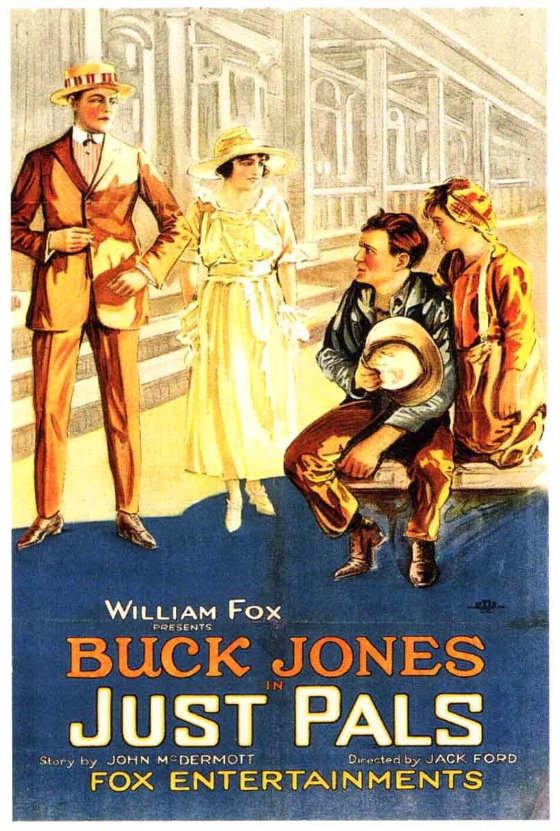
JUST PALS

Just Pals, the first film John Ford made for Fox, makes an
illuminating pendant to another silent film also recently released on
DVD, D. W. Griffith's True Heart Susie.  They could have been made by
the same director — which is to say that Ford, the younger of the two
and the one newer to the business, obviously studied hard at his
master's feet.


Both films fall into the American Pastoral genre, both feature plots
that are outrageously melodramatic, unashamedly sentimental — and both
are visual masterpieces.


We forget it sometimes, but American culture is in love with virtue — a
love tempered only by the desire not to be taken for a fool.  We like
our virtue delivered sidewise.  In less cynical times than the present,
this sidewise delivery could be only slightly oblique.  So we have
Griffith's gentle teasing of the innocent protagonists of his tale, and
Ford's cursing urchin in his.  But simple decency is the theme of each
film — as it is of Huckleberry Finn, from an earlier age, and of Casablanca, from a later one.  The differences in attitude mainly
involve how cynical the narrator or protagonist has to pretend to be
before getting down to doing or celebrating the right thing.


The message of most works of art can be boiled down to a platitude, if
one is so inclined.  The message of Huckleberry Finn is “blacks are
human, too, and anyone who thinks otherwise risks losing his or her own
humanity.”  But art is not about messages.  It's about creating psychic
movement within the audience — about internalizing the wisdom
trivialized in a platitude.


In silent movies, this process of internalization happens visually —
not in the plot or in the intertitles.  In Just Pals, Ford convinces
us that he loves his protagonists not by making them narrative agents of
good but by the way he situates them in space, in the settings of the
story.  The cursing urchin is revealed as plucky and independent and
admirable not by his curses but by the way he rides a moving train.
Bim's moral authority in foiling the express office robbery is conveyed
not by his statements of resolve but by the way he commandeers and rides
a horse in the execution of his resolve.


Just Pals is a celebration of sacrifice — of the mechanics of
sacrifice — not a sermon about sacrifice.  It makes sacrifice seem
beautiful by making the mechanics of sacrifice beautiful.

Just Pals is part of the recently released Ford At Fox DVD box set.  It can't be said often enough that the release of
this set is one of the most important cultural events of
recent times.