
There's
now a button in the column to the left (Film Reviews A-Z) which will
take you to a list of all the movies reviewed on the site and allow you
to link to them directly.
FILMS REVIEWED
Amarilly Of Clothesline Alley
Apocalypto
Baby Face
The Bad and the Beautiful
The Bellboy
The Big Combo
The Big Trail
The Birds
Blind Husbands
Born Reckless
Bring Me The Head Of Alfredo Garcia
Casablanca
Cherry 2000
Cheyenne Autumn
Chimes At Midnight (Falstaff)
Chinatown
Citizen Kane
City Girl
The Civil War
The Clock
The Conformist
Contraband
Crime Wave
Daisy Kenyon
The Dark Corner
Diamonds Are Forever
Double Indemnity
Dracula (1931)
The Dreamers
El Cid
Electric Edwardians (DVD Collection)
Eternal Sunshine Of the Spotless Mind
Eyes Wide Shut
Falstaff (Chimes At Midnight)
Flesh and the Devil
Force Of Evil
Four Sons
G. I. Blues
The Garden Of Eden
The Ghost and Mrs. Muir
The Girl Can’t Help It
The Glass Bottom Boat
The Great K & A Train Robbery
Hangman’s House
He Who Gets Slapped
Headin’ Home
How Green Was My Valley
The Hunchback Of Notre Dame (1923)
I Confess/The Wrong Man
Intolerance
The Iron Horse
It’s All True
Just Pals
King Kong (2005)
The Ladies Man (1961)
Laugh, Clown, Laugh
Laura
Lawrence Of Arabia
Leap Year
Leave Her To Heaven
The Lord Of the Rings
Loving You
The Marriage Circle
The Married Virgin
Merry-Go-Round
Miss Lulu Bette/Why Change Your Wife?
Mr. Arkadin (Confidential Report)
My Best Girl
1900
Nosferatu (1922)
Odds Against Tomorrow
On Dangerous Ground
Out Of the Past
The Oyster Princess
Pandora’s Box
The Penalty
Peter Pan (1924)
Pilgrimage
Pitfall
Sadie Thompson (1928)
Saved
Scarlet Street
Seas Beneath
The Set-Up
Shadow Of A Doubt
The Shop Around the Corner
Show People
Spider-Man 2
Summer Magic
Sumurun
The Sundowners
They Live By Night
3 Bad Men
The Three Burials Of Melquiades Estrada
Titanic
Tobacco Road
Trapped
Uncle Tom’s Cabin (1927)
Up the River
Vertigo
Vicky Cristina Barcelona
War Of the Worlds (2005)
The Way Of Peace (Frank Tashlin Short)
What Time Is It There?
Why Change Your Wife?/Miss Lulu Bette
Why Worry?
The World Moves On
The Wrong Man/I Confess
THE FILM NOIR CANON
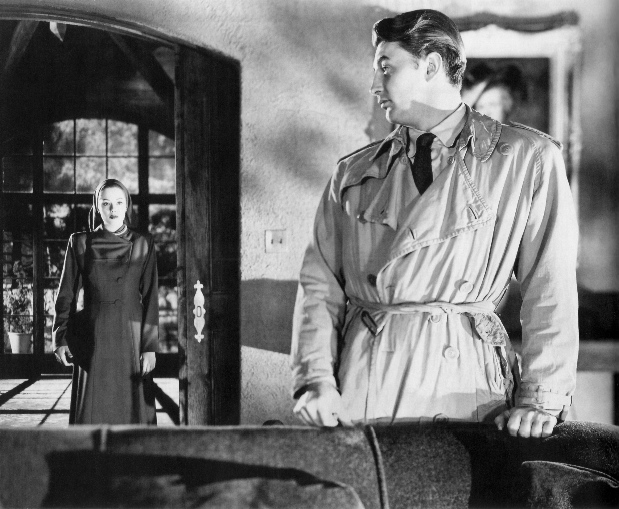
People who love film noir also love to argue about what films belong in the category and what films don't. They compile lists of films noirs and break them down into subcategories. The general drift of this activity is to call almost any film noir
as long as it was made in Hollywood in the 1940s or 1950s, in black
and white, and features moody lighting, cynical attitudes and
some content related to crime.
This inclusiveness is abetted by studio home video departments, which will designate any film with the above attributes a film noir because the label is sexy and apparently helps sell DVDs.
In the process, the term gets so vague as to be useless. I would
argue that there is a core set of films that are truly and uniquely noir,
reflecting a particular time in America, with a particular mind-set, a
mood of existential dread that seemed to invade the American psyche
after the end of WWII, at the beginning of the atomic age.
This sense of dread was in the air before then, of course, as the world
hurtled towards war. It can be felt very clearly in some dark
films made during the war — in Hitchcock's Shadow Of A Doubt, in Wilder's Double Indemnity, in Huston's The Maltese Falcon. The first two of those films, along with Leave Her To Heaven, fall into a distinct category of their own — the domestic noir.
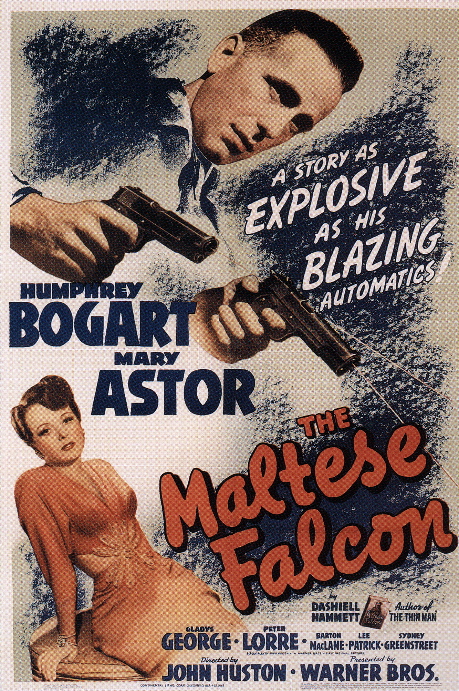
The Maltese Falcon seems on its surface to belong to another distinct category, the hardboiled detective thriller, which had noirish
elements but whose essentially noble protagonist rescued it from
existential dread. Yet Bogart's Sam Spade seems to be losing
faith in the nobility of his code, to see it as meaningless, and I
think that fact alone allows one to call The Maltese Falcon a true film noir. Just compare Bogart's Spade to his Phillip Marlowe in The Big Sleep, which plays like a hardboiled romantic comedy by comparison with Huston's film.
The point about The Maltese Falcon can be argued, of course, and I place it among the true films noirs with that reservation in mind. Here are some of the other films I think of as truly noir, without such reservations:
Out Of the Past
The Killers
His Kind Of Woman
The Dark Corner
The Set-Up
Gun Crazy
Fallen Angel
Angel Face
Touch Of Evil
Detour
The Wrong Man
Criss Cross
The Killing
In A Lonely Place
On Dangerous Ground
Crossfire
Where the Sidewalk Ends
Brute Force
The Sweet Smell Of Success
Night and the City
Thieves Highway
The Lady From Shanghai
14 Hours
The Long Night
Nightmare Alley
Odds Against Tomorrow
Act Of Violence
Crime Wave
They Live By Night
Decoy
The Big Steal
Side Street
Where Danger Lives
Tension
Kansas City Confidential
The Big Combo
Gilda
Note that not all of these films end badly for the protagonist, and not all of them feature femmes fatales — several actually have femmes
that rescue the protagonist, and in one of them the protagonist is
rescued, just as improbably, by Jesus. But in all of them the
protagonist needs rescuing, in all of them he's lost in a nightmare world that's
existentially different from the world that existed before WWII and he can't, by his own efforts, get out of it.
Even a film like His Kind Of Woman, which goofs comically on this world, is also recognizing it.
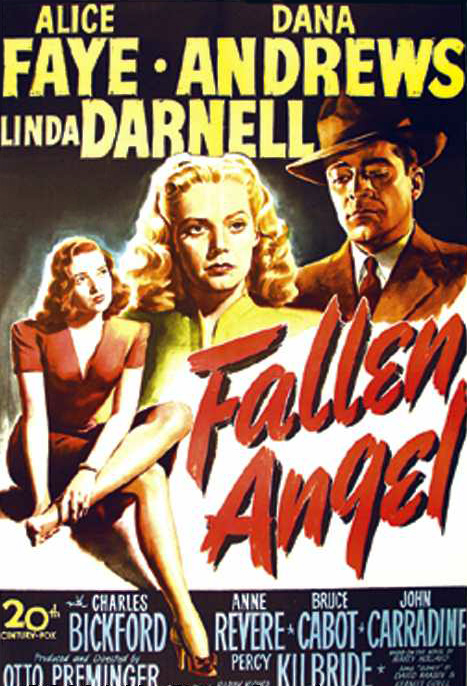
In future posts I'll list some of the films commonly called noir
which I don't think really are, because, though they may reflect to one
degree or another the same existential dread as the true noir,
they don't acknowledge it as a profound and inescapable condition.
It's almost a spiritual distinction, and therefore hard to
define precisely, but I think it's one worth making.
A BOUGUEREAU FOR TODAY
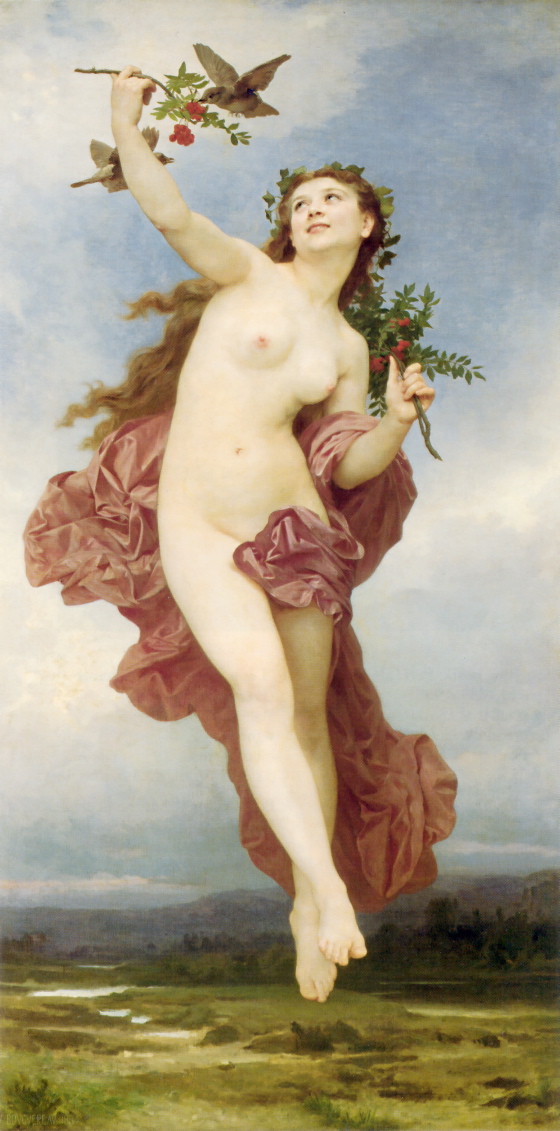
Bouguereau’s figures are so solid that when he sets them floating in the air the effect is unsettling, uncanny, but in a pleasant way, as flying in dreams is pleasant.
CHINATOWN
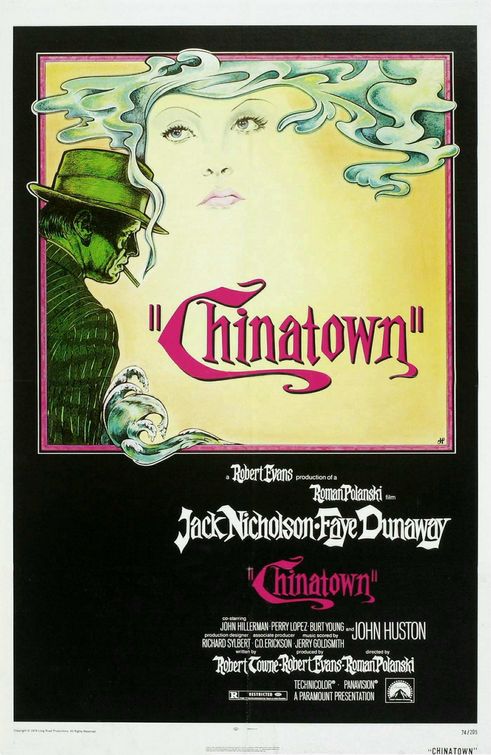
Chinatown is one of the few neo-noirs that really lives up to the designation. Its view of the world is truly bleak — a moral maze from which there is no escape. As with many films noirs there’s an indictment of the political system but also a sense that corruption
is universal, not limited to any one class. It’s an existential corruption.
The big difference between Chinatown and the classic post-WWII noirs is one of gender perspective. The post-war noirs were centrally concerned with male anxieties, with the way the world looked from the point of view of a suddenly inauthentic and insecure
manhood. In them, a man might be ruined by a powerful female, a traditional femme fatale, or he might be saved by good woman, but in both cases the situation was beyond his control. Chinatown finally took a look through the other end of the telescope, imagining what the general collapse of manhood might mean for women.
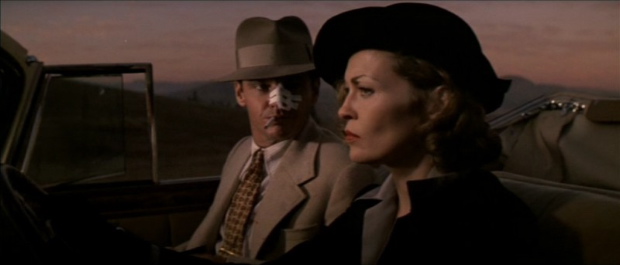
As screenwriter Robert Towne has said, Evelyn Mulwray is the only
character in the film who operates out of purely decent motives, trying
to rescue herself and her daughter from the clutches of a rancid,
decayed patriarchy. The protagonist of the film, private eye
Jake Gittes, is a decent enough fellow but impotent when it comes to
helping, much less saving, her.
We’re not quite dealing with a feminist perspective here — we’re still
looking at the mess from a male viewpoint, assessing the male’s failure
of responsibility rather than exploring the female’s search for empowerment —
but we’re a long way from the phallocentric cry of male bewilderment and pain that
was at the heart of film noir.
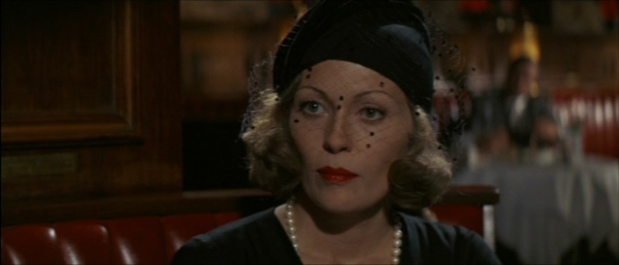
Still, the deconstruction of the traditional femme fatale
is very thorough and deliberate, because Evelyn Mulwray is first
presented as a kind of spider woman, with all the generic clues that
used to alert us to the fact that the woman in question was going to be
trouble . . . and that’s how Gittes constructs her. The big
switcheroo is that Evelyn is in much more trouble than she has the
capacity to cause anyone else, that it’s her father’s fault and that
Gittes isn’t smart enough or strong enough to deliver her from it.
Towne’s conversation with the noir tradition is very elegant and profound. He goes back, in the film, to 1937, to the hardboiled detective fiction out of which film noir mutated, and deconstructs the “tarnished knight” of that form, locating in him the existential nullity of the film noir protagonist. Gittes has Phillip Marlowe’s private code of nobility, his commitment to a kind of rough justice, but it’s not enough anymore. The only real nobility he has left is his ability to recognize the cost of his own impotence.
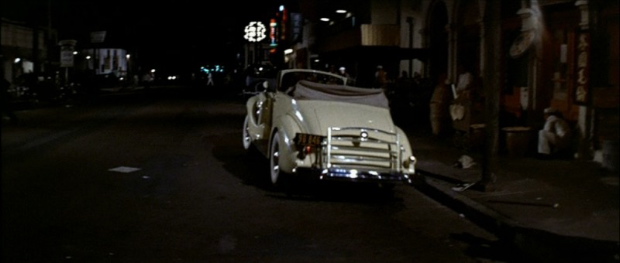
When his associate speaks the film’s famous last line to him, “Forget
it, Jake — it’s Chinatown,” we know he won’t, we know he can’t.
He lives there now — and somehow, because of his failure, we all do.
A NORMAN ROCKWELL FOR TODAY
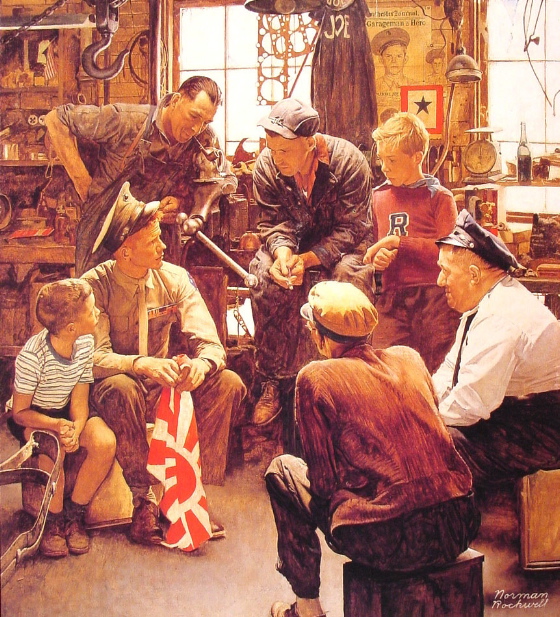
America is at war right now but you'd never know it from any kind of
personal experience, unless you're serving in the military or know
someone who is. Most of us
are asked to make no sacrifice, there is no meaningful national debate
about the war's prosecution or aims — just a lot of
ideological posturing, on both ends of the political spectrum.
With a volunteer army,
aided by thousands of private mercenaries, there is no direct pressure
on the nation as a nation to come to terms with what's happening.
They are fighting the war for us, unless they happen to be our own sons, daughters, fathers, mothers, husbands, wives.
Whatever you think of the war, I think you have to admit that the
current administration has committed the one unforgivable sin for the
leadership of a democracy — sending soldiers into a war without the
broad commitment of the nation behind them. Any war that we, the people, don't fight together is bound to turn into a bad one and very likely into a losing one.
Look at the image above by Norman Rockwell, from a Saturday Evening Post
cover. The young soldier, obviously just back from the Pacific
Theater, is a Marine. Viewers of the time would know that he most
likely is just back from Hell, from Iwo Jima or Peleliu or Okinawa — that he has
participated in unimaginable horrors. There is no glimmer of
triumph or satisfaction in his face, just a sense of awe, of almost
bewildered hardness. The folks who make up his audience seem to
appreciate, even if there's no way they could possibly understand,
what's he just done for them, and one thing he's just done for them is
separate himself from their world irrevocably, forever.
They seem to comprehend this — they all seem suffused with the gravity of it, they all seem to take responsibility for it.
This is so far beyond catchphrases like “We support our troops.”
The image reflects a moral complexity, a moral tenderness, that only art can evoke — an
ideal of citizenship that seems to have vanished from our democracy.
MALE ANXIETY AND FILM NOIR
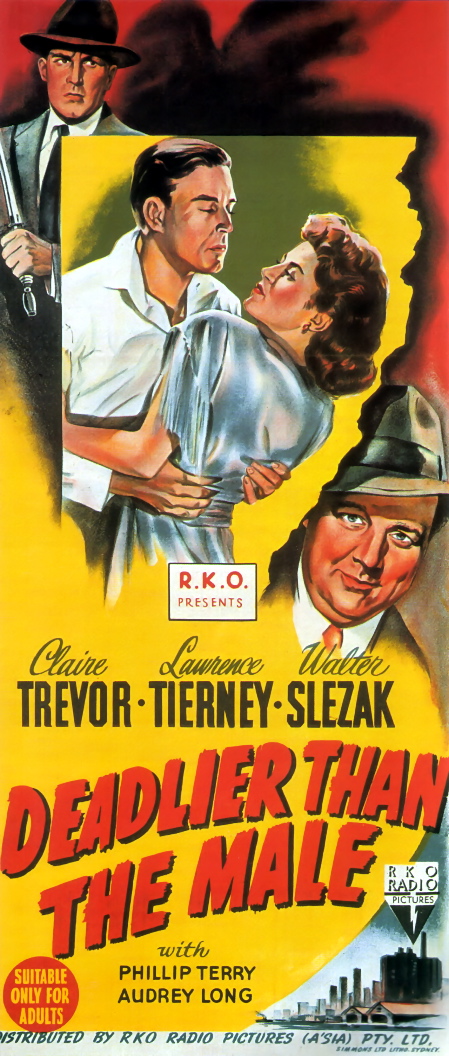
The anxious, existentially befuddled male is at the heart of film noir.
Caught in a trap that’s not always of his own making, but almost always
worse than he deserves, he stumbles around in a maze with no
exit. Sometimes he’s destroyed by a powerful female, against whom
he has no defenses, sometimes he’s saved by a powerful female operating
out of unaccountable charity. In either case, the situation is
ultimately out of his control, which on some level makes each type of
female equally threatening.
Some people have located the source of this paradigm for male anxiety in the new economic status women achieved by entering the
workforce in large numbers during WWII, but this is a very superficial
explanation for the mythology of noir. Eddie Muller, probably the best and certainly the most entertaining commentator on film noir, points out that the good girls of the tradition are almost always working girls, while the femmes fatales are almost always looking to get something for nothing, and certainly not a paycheck for an honest day’s work.
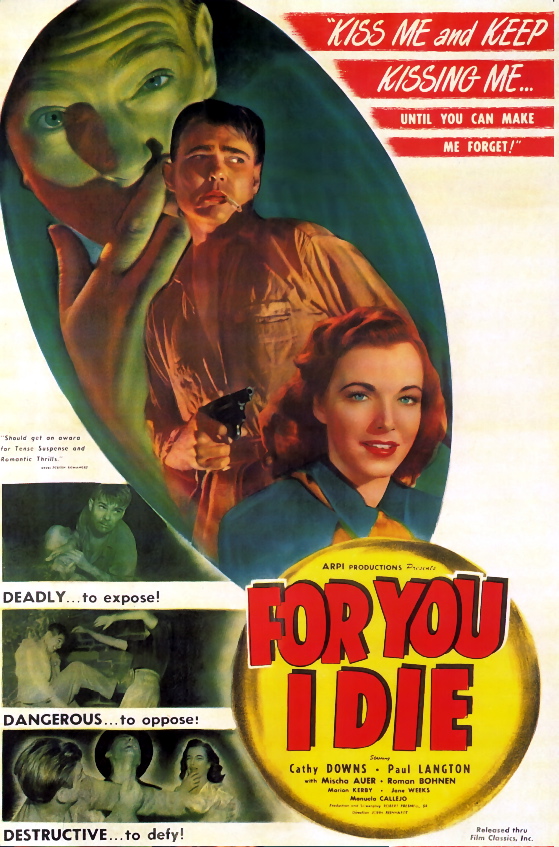
The male anxiety embodied in the tradition clearly derives from a
deeper source — the moral discombobulation of war itself, the
spiritual exhaustion this particular conflict induced, and the
inconceivable fact of the atomic bomb which raised moral issues and
created fears that the human psyche was ill-prepared to engage.
The ravaged psyches of Americans in the aftermath of a “good war”, a good war they won, so vividly explored in film noir, in some ways says more about the nature of all wars than any works of art which dealt with the conflict itself.
ELVIS FOOD

Admit it — sometimes you just get a taste for Elvis food, for the stuff he really loved, like banana cream pie. Tucking into an oversized slice of banana cream pie you can almost feel what it must have been like to be a bloated, drug-addled cultural icon and genius on the road to destruction, and sense Elvis’s own childlike bewilderment at it all.
Incidentally, if you live near a Marie Callendar’s, as I do, try their banana cream pie, which tastes old-fashioned somehow, like a pie you’d get served at a 50s-era lunch counter or school cafeteria. I just know Elvis would have approved.
LORD LEIGHTON: A VICTORIAN ARTIST YOU SHOULD KNOW
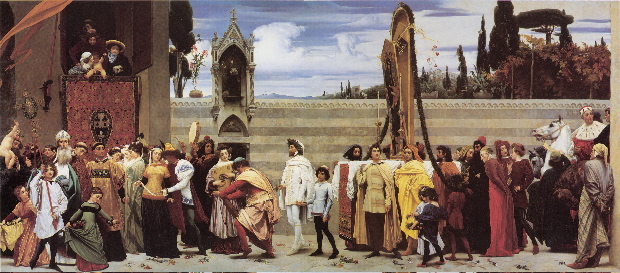
Lord Leighton was generally considered the dean of Victorian academic painters.
He combined the decorative stylization of the early Pre-Raphaelites with a more photo-realistic draftsmanship, an approach which made his work popular with a wide public and influential among his fellow painters.
The painting above, exhibited in 1855, caused a sensation and
established his reputation. An enormous, 17-foot-long work
depicting a procession in Renaissance Italy, it was admired by Queen
Victoria, who bought it.
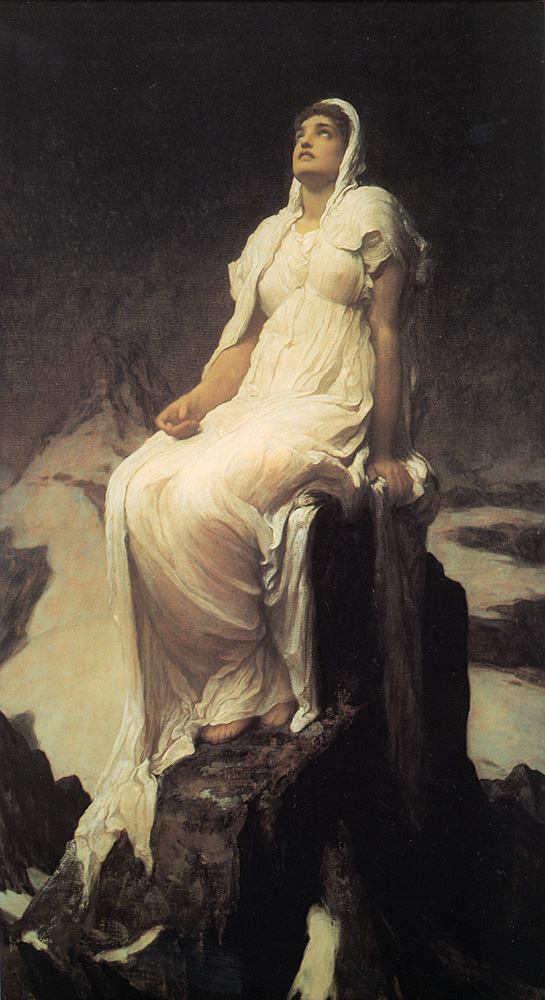
Leighton also did works in a style that might be called magical
photorealism, like the one below, which reminds one of similar images
by Bouguereau:
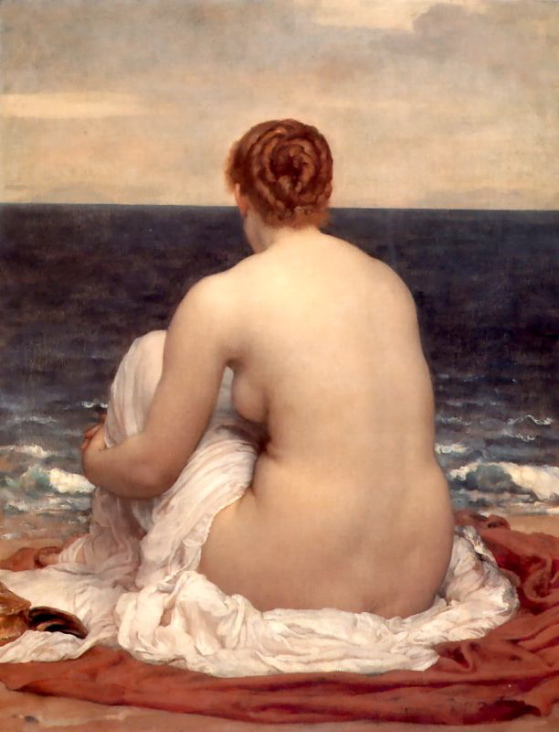
He could also, like Bouguereau, be frankly sensual in a more naturalistic mode:
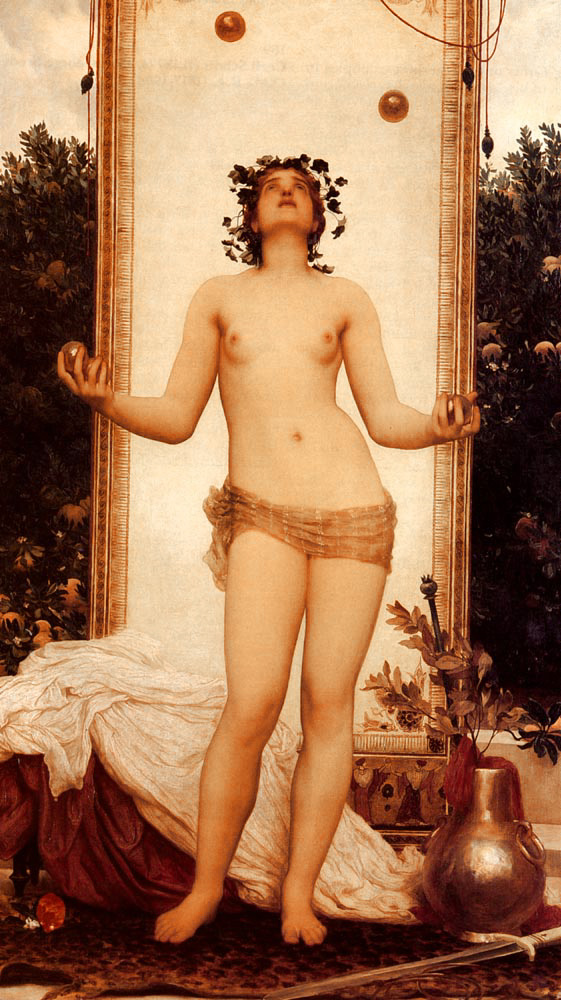
Like Alma-Tadema he did vexing evocations of the ancient world:
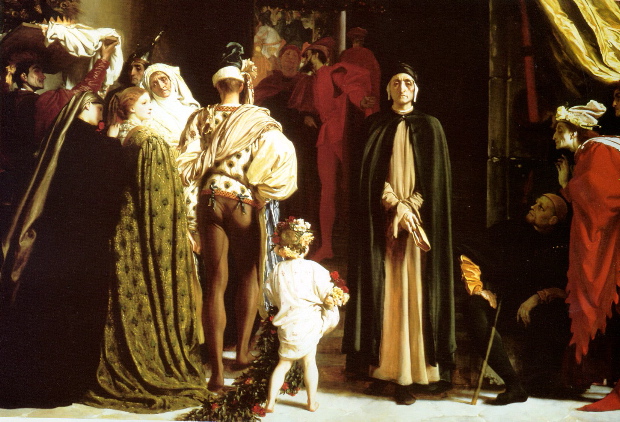
His historical paintings could have strong narrative and theatrical qualities, like this one, Dante In Exile:
On top of all that he produced some fine portraits, like this famous image of the explorer Sir Richard Burton:
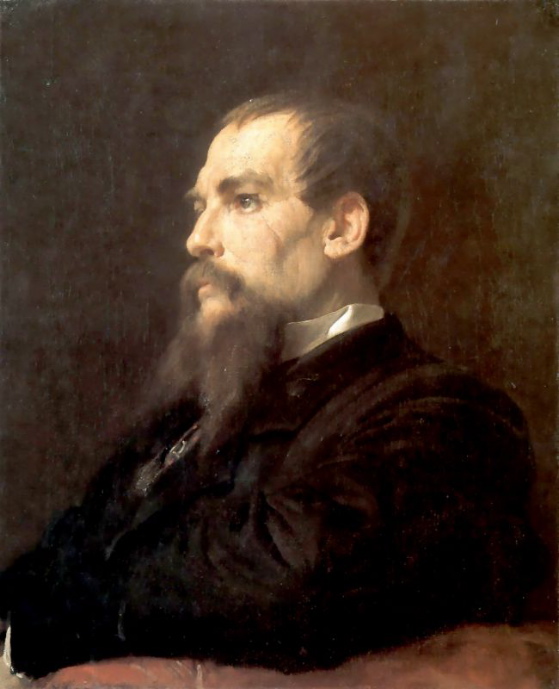
All around, Leighton was really cool.
A VINTAGE CELL-PHONE PHOTOGRAPH FOR TODAY
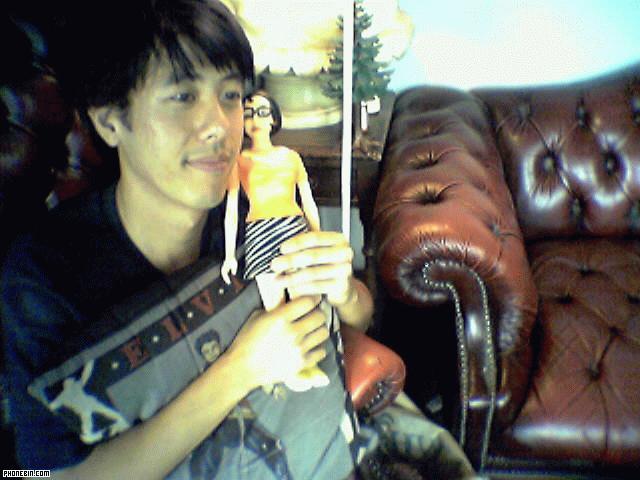
Jae Song and my (then) new High-Fashion Glamour Doll of Enid, from Ghost World — a photograph taken in New York a few years ago with my cell phone
camera.
BLUE TROUT

Sometimes after a long day of writing my mind is gripped by strange ideas about food — strange in the sense that they don’t involve Swiss cheese and crackers or peanut butter sandwiches or frozen meatloaf dinners.
One day, as it happened, I was reading a piece by Mr. Ernest Hemingway about trout fishing in Europe. In it he described a method of cooking trout he had encountered in Switzerland at rural inns. It involved boiling the trout until it turned blue in a liquor made of water, white wine vinegar, bay leaves and red pepper — not too much of any ingredient in the water, says Mr. Hemingway, without further elaboration.
This is not the blue trout described by M. F. K. Fisher, which involves placing the trout live into boiling water, unless the Swiss innkeepers were holding out on Mr. Hemingway, but it sounded fine.
I remembered that my local supermarket sometimes offers fresh
rainbow trout, so I headed over there late at night and found one
handsome specimen in the fish department. I brought it home, filled up
a large pot with water — it was a large trout — emptied about six
ounces of white wine vinegar into the water, added six fragrant bay
leaves and a light sprinkling of cayenne pepper, and set it all to
boil. When it was bubbling I slipped the fish in.
I turned the heat down and simmered the trout for about fifteen minutes. In
fully boiling water, ten or less would have been more than sufficient. I
tested the fish using a method recommended by an old edition of The
Joy Of Cooking — which is to separate the meat from the bone of the
spine at the thickest middle section of the fish. When the meat there
is tender but no longer translucent, the fish is done.
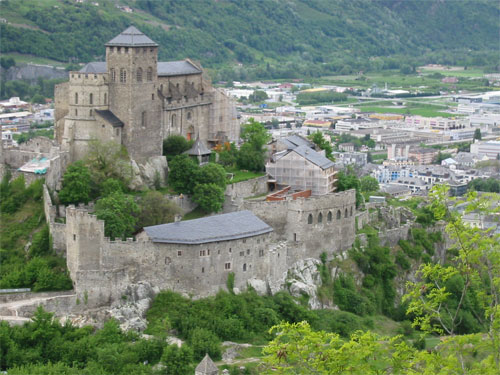
I ate the fish with drawn butter, as Mr. Hemingway says the Swiss did. “They drink the clear Sion wine when they eat it,” adds Mr. Hemingway, but they don’t depend on the beverage department of a supermarket for their wine. I made do with a perfectly respectable Pinot Grigio by Bolla, cheap, dry and light. I keep looking for the clear Sion wine, though — Sion, pictured below, is the primary wine-producing region of Switzerland:
Even without the Swiss wine, the result was a meal of almost unimaginable delicacy. Trout is delicate anyway, and the light seasonings in the water only emphasized the subtlety of its taste. It all resonated on the tongue like a memory of food — insubstantial and fleeting.
WHAT IS REFRIGERATOR ELVIS WEARING TODAY?
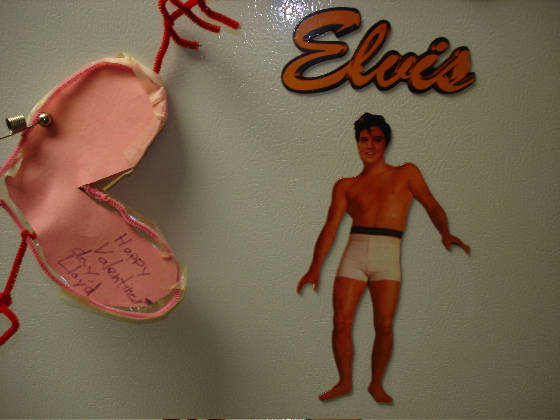
Just his bathing suit at the moment — he looks ready for some summertime Vegas poolside fun!
NOIR AND EXISTENTIALISM
Tony D'Ambra, on his informative films noir
web log, questions my recent post on The Genealogy Of Noir for not paying sufficient attention to the influence of European Existentialism on the
style. I think he's got a valid point here, though the subject is
complicated. Existentialism itself was influenced by Poe, via
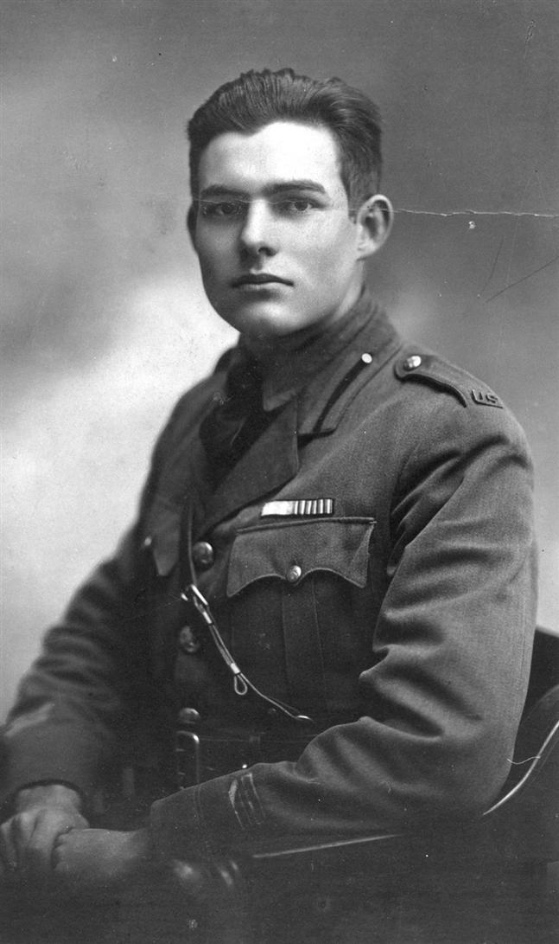
Baudelaire, and Hemingway's proto-existentialism, expressed most purely
in his early short stories, directly influenced film noir — and of course these short stories preceded the seminal writings of Sartre and Camus.
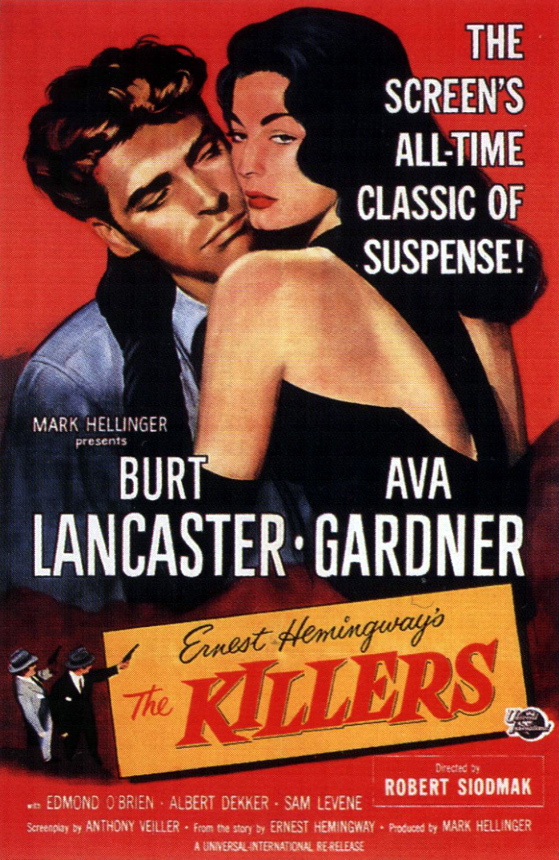
The influence of Hemingway on noir is of course most distinct in Robert Siodmak's The Killers,
based on the Hemingway story. The story was published in 1927 and
reflected a bleak view of human virtue, which is shown to consist
largely of facing death with stoic conviction. This decidedly
unromantic attitude was clearly a product of Hemingway's experiences in
WWI, and resonated precisely with the mood of the generation which had
just fought a second world war.
We can't see the existential dread that informs film noir as simply a product of Europe, an import, even though, as D'Ambra points out, many of the crucial filmmakers in the noir tradition were refugees from the European catastrophes of
the 30s and 40s. This view wouldn't explain the extraordinary
popularity of the form with American audiences for almost two
decades. Film noir must
have reflected anxieties buried deep in the post-war American psyche,
aroused by the sheer horrific spectacle of total war on a global scale
and by the unthinkable reality of the atomic bomb.
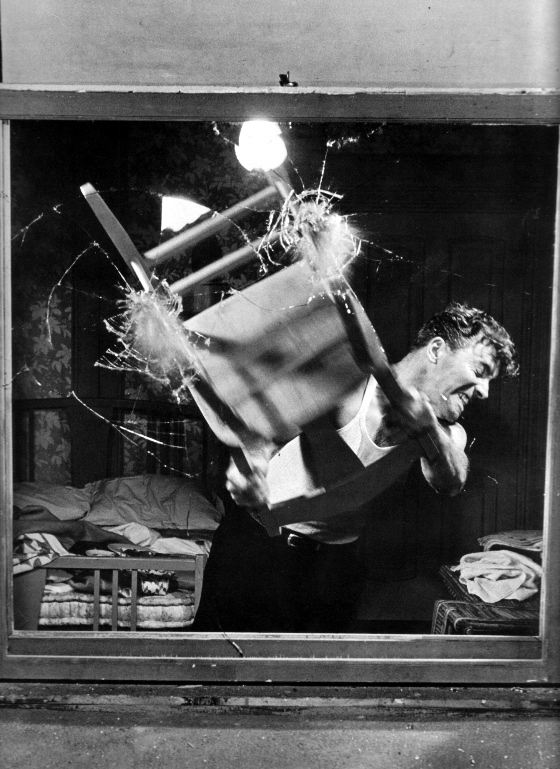
Although Siodmak's film softens Hemingway's story by giving us a
positive, resourceful guide through the moral maze that ultimately
destroys the Swede, the film approaches the condition of pure noir
because Lancaster's Swede is the star part in the picture — it's his
bleak fate we identify with, not that of the successful insurance
investigator played by Edmund O'Brien.
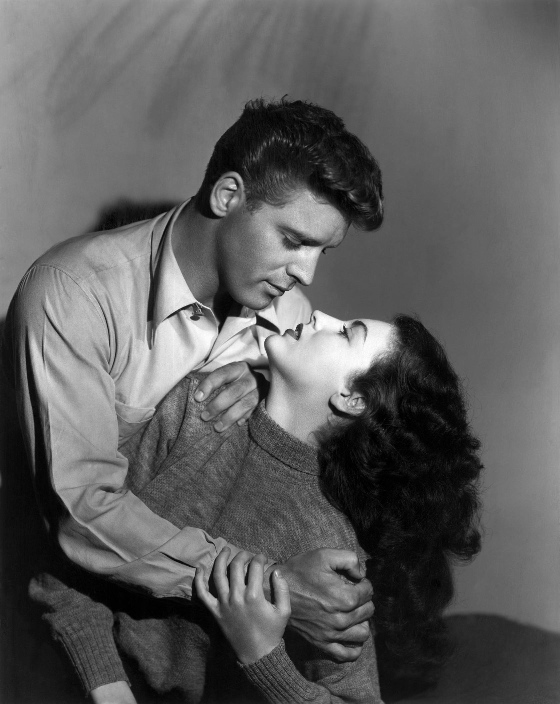
Lancaster, after all, is the one who gets to put his arms around
Ava Gardner, for which going to Hell seems a small enough price to pay
— and once you start thinking in those terms, you're already caught up
hopelessly in the maze of the noir's dark city.
COKE FLAG

I painted the image above on the wall of a farmhouse in Vermont
sometime in the late Sixties. For some reason the owners of the
farmhouse decided not to paint over it and so it has survived for going
on 40 years, as I just discovered via this photograph of it, taken by a
friend last Sunday when he was visiting the place.
The design is kind of cool, even if the draftsmanship leaves something
to be desired. It still sums up what the Sixties felt like to me
at the time, when the idea of being patrotic about American culture
made more sense than being patriotic about the American state.
CASABLANCA: THE ACTRESS AS AUTEUR
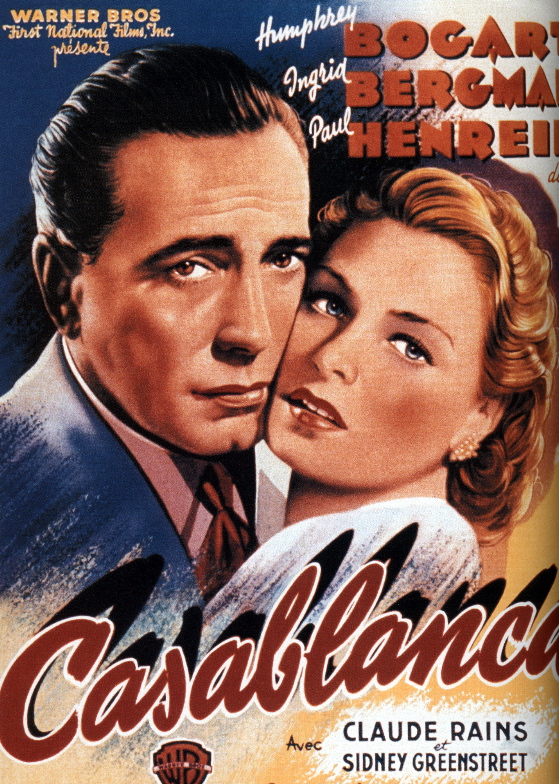
Casablanca
is a genuinely miraculous film, one of the few Hollywood masterpieces
that really was created by committee. The script incorporated the
work of six principle writers, who had lots of editorial
supervision. One of the film's most memorable lines, “Here's
looking at you, kid,” was reportedly contributed during filming by the
actor who spoke it, Humphrey Bogart, and supervising producer Hal B.
Wallis wrote the famous last line, “Louie, I think this is the
beginning of a beautiful friendship”, which was added as a wild line
after principal photography ended.
If the film has a nominal auteur
it would have to be Wallis, who organized the collective that made the
film and generally had the last word on what became part of the final
product. Jack Warner, the head of the studio, made only one
creative suggestion — to cast George Raft in the Bogart role, an idea
that would have made the film the instantly forgettable potboiler it
might easily have become. Wallis talked Warner out of the idea,
but he had some bad ideas of his own, including turning Sam into a
female African-American — but Wallis himself got talked out of these ideas in
turn.
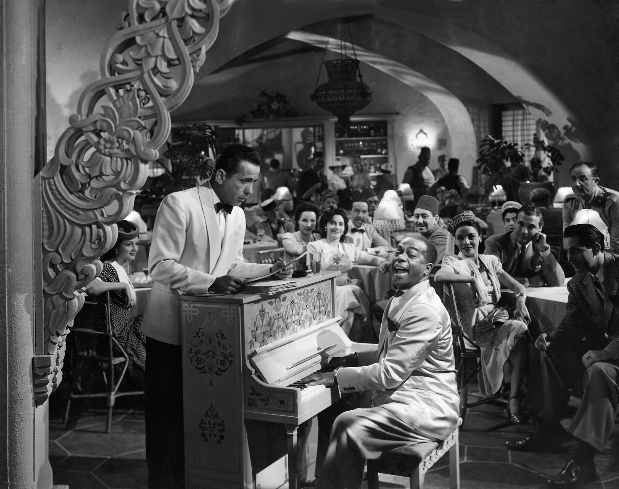
The film's director, Michael Curtiz, was known as a great “director of
scenes”, with a sure sense of pacing, but he spoke English badly and
apparently had no sense of story construction. It was Wallis who
“constructed” Casablanca.
One of the delights of the film is its multifaceted quality. The
play it's based on provides the milieu of the story and some of its
dramatic highlights, but has none of the elements that make the film an
enduring classic. The screenwriting Epstein brothers provided
most of the witty dialogue and writer Howard Koch pushed its political themes
to the fore, but I would argue that it was another writer, Casey Robinson, who didn't
receive credit, who supplied the glue that made Casablanca cohere.
It was Robinson who wrote the principal love scenes between Bogart and
Bergman, developing Bergman's character into the emotional center of
the film. He gave Bergman the opportunity to supply the film with
its heart. Without Bergman's performance the film would be
nothing more than a diverting programmer with an admirable “message”.
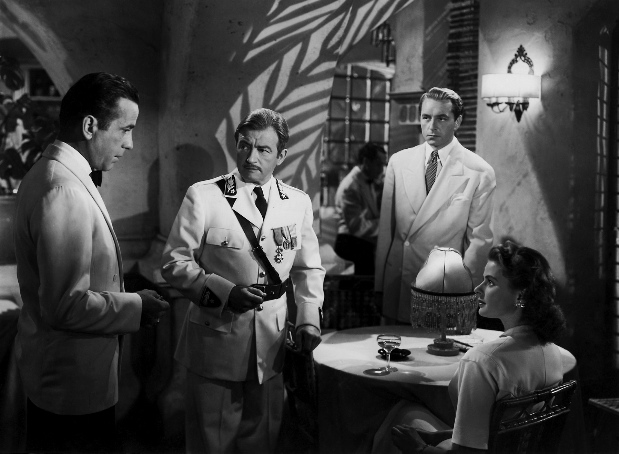
The sheer acting craft on display in Casablanca
is stunning, but most of it is just that — craft. Bergman brings
an emotional commitment to her role that's of a different order.
She suggests an inner life that is mysterious, complex, fully
rounded. It's through her eyes that Bogart becomes sexy, that
Henreid becomes admirable, that the dangers of Casablanca become real.
The film's narrative promises much in the way of romance and intrigue and
adventure, but Bergman is all those promises fulfilled. Audiences
loved Bogart and accepted him as a romantic leading man because he held his
own with Bergman in this film, tried to expose himself to her
emotionally on her level and often enough succeeded. Study his expression, his eyes,
in the very brief close-up of Bogart taking his last look at Bergman's
face on the airfield — it's devastating, a moment of total
exposure. By the same token, we recoil at Henreid's Victor Lazlo
because he never opens himself to Ilsa, because he stands on idealism
and form even when gazing into her miraculous eyes.
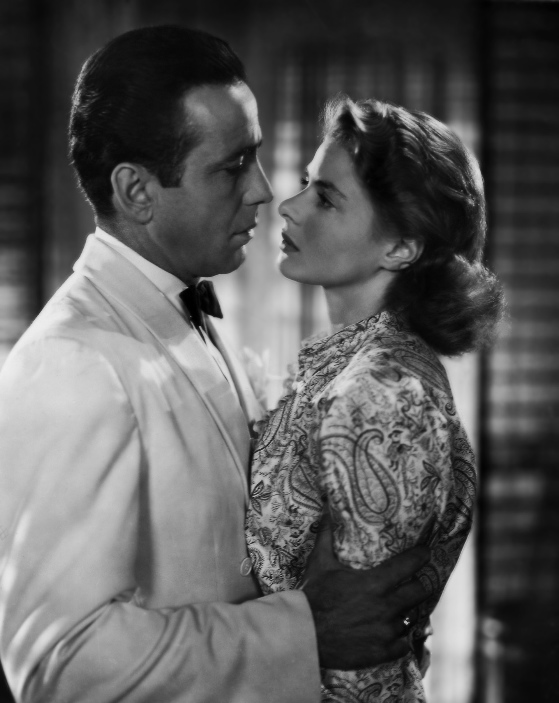
Roger Ebert has pointed out how Bergman could paint an actor's face
with her eyes — we can see her trying to penetrate his being, and in
the process she gives him being. It's the alchemy of romantic love incarnated. We instinctively despise any
leading man who doesn't treasure her for this, we instinctively admire any leading man who does.
The ending of Casablanca is
morally thrilling, glamorizing virtue and sacrifice, but it would be
little more than a literary gesture without Bergman's presence, without
Bogart's appreciation of her presence. His sacrifice of it breaks
our hearts over and over again because we feel it as our own
sacrifice. By that point in the film she's become every great love that anybody has ever lost and
we hate to see her go — always have, always will. Ingrid Bergman
is the true author of the miracle of Casablanca.