FLOATING AWAY


                                                                                                [Photo © Hugh McCarten]

A year ago today Oscar
Fruchtman died, way before his time.  Oscar was an extraordinary presence in the lives of everyone who knew him — brilliant, hilariously funny, haunted by demons.  He was a gifted musician and songwriter, who could write funny and also write sweet.

My friend Hugh McCarten was one of the people who knew him best, and Hugh was asked to deliver the eulogy at Oscar's memorial service, which is linked to below.  But before you read it, listen to a song Oscar wrote (with Hugh contributing some to the lyrics), “Floating Away”, which is both funny and sweet — a song about Noah, about hope and rebirth and faith:

Floating Away
2010 A. Fruchtman/H. McCarten)

This is a live recording from The Rose Tattoo in Key West, Florida, from March of 1979 — with Oscar and Ed “Woody” Allen on guitars, Din Allen on bass, Hugh on toy organ, Oscar singing lead and the other lads doing back-up vocals.

Here's what Hugh had to say about Oscar when it came time to bid him farewell:

Eulogy For A Luftmensch

(In the eulogy, Hugh quotes the lyrics from another song by Oscar, “Brooklyn Boy” — you can listen to Oscar perform it here.)

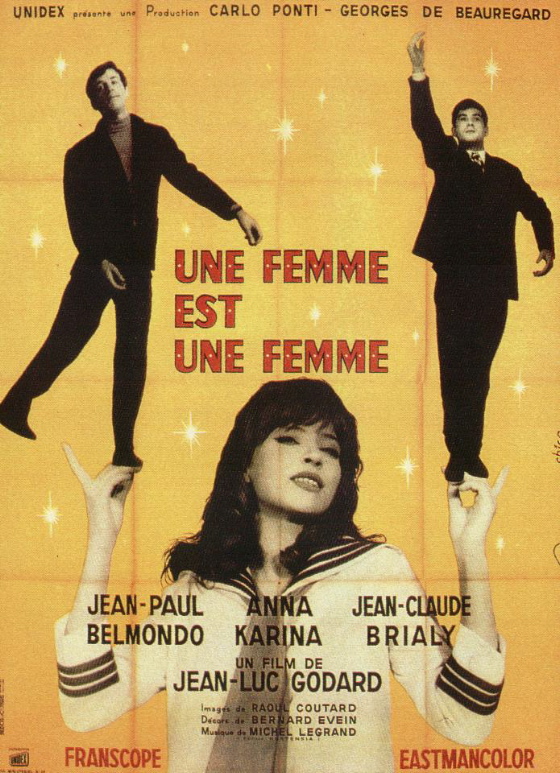
UNE FEMME EST UNE FEMME

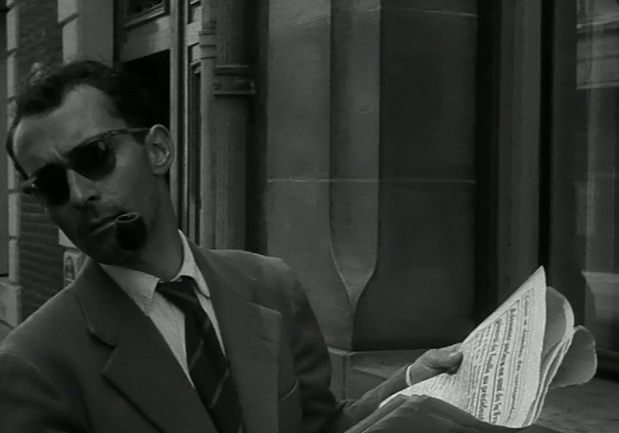
Une Femme Est Une Femme was Jean-Luc Godard’s third feature film and first in widescreen and color.  It’s a work of narrow but intriguing ambitions.  Godard said that it was a film about the tragic fact that life is not a Hollywood musical.  It evokes the surreal effects and moods of a Hollywood musical without the virtuosity of dance and vocal performance Hollywood could provide, resulting in an unsettled and unsettling tone.

On one level the film is an attempt to imagine Anna Karina, Godard’s muse at the time, as a creature of the mythic territory of the great MGM musicals.  Godard even has his actress, in character, say that she wants to star in a musical with Cyd Charisse and Gene Kelly.
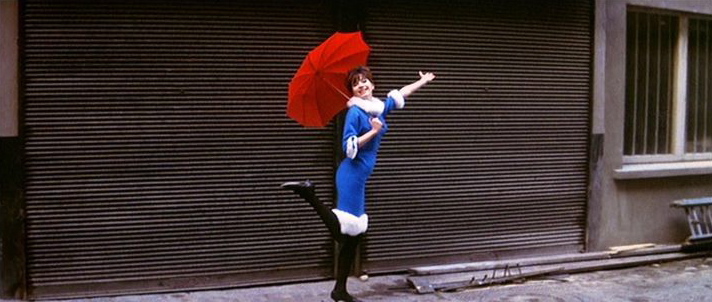
Karina has the charm and beauty and screen presence for this but not the dancing and singing chops.  So the silly romantic comedy plot, and the somewhat dimwitted bourgeois characters caught up in it, keep dragging the film relentlessly back into the mundane.
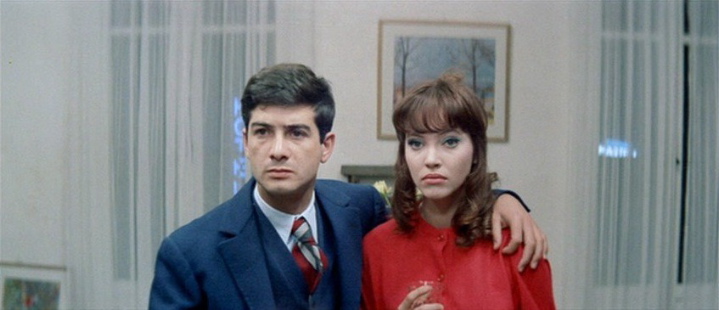
This can be read in several different ways — as a critique of bourgeois culture, enchanted and misled by an illusory screen world it cannot ever be a real part of . . . as a hopeless fantasy by Godard about his lover actually inhabiting such a world, or about himself actually creating one cinematically.  One suspects that Godard was in part just covering himself with the notion of the film as a critique — that his own fantasies played as much a part in the film’s creation as his theoretical deconstruction of the musical form.
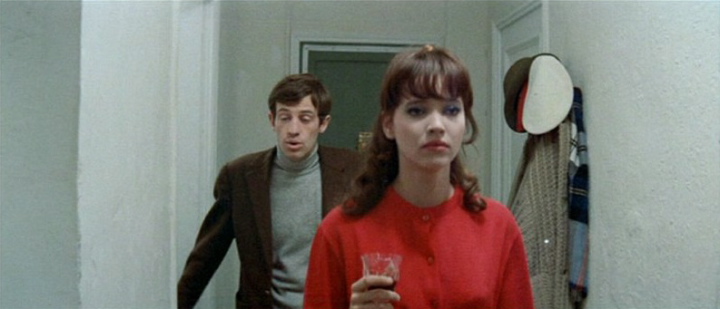
This dynamic haunts all of Godard’s cinema — he came to hate the part of himself that was enchanted and misled by Hollywood, but it remained a part of him.  For Godard, celebrating and reviling the Hollywood cinema were two sides of the same coin, reflecting a singular passion for and contentious dialogue with American films.
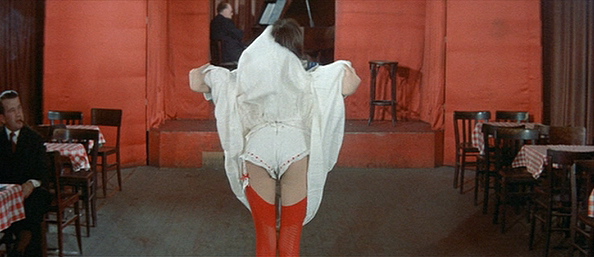
By deconstructing the odd conventions of American musicals, pushing them into a new mode of self-consciousness, Godard teaches us a lot about how these Hollywood films seduce us, move us half-consciously into a cinematic dream.
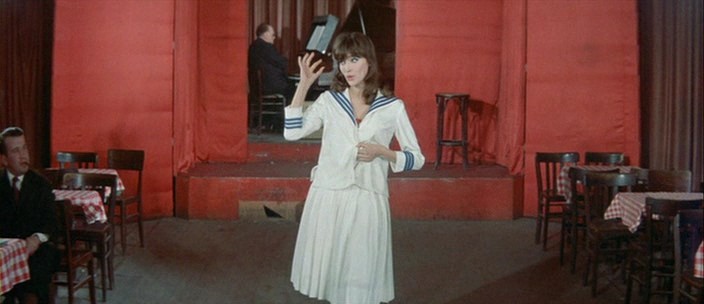
Karina’s petulant, amoral femme is not a terribly appealing character, but when she sings, however amateurishly, in one of the film’s fractured production numbers, when she smiles sweetly at the camera, to let us know she’s in on the joke, she wins us over — transports us out of the banal narrative and dialogue into a world where wonders might be possible.  She can’t keep us there, or transcend the mundane world her character inhabits through virtuoso dancing or singing, but she shows us how the door into transcendence is opened.
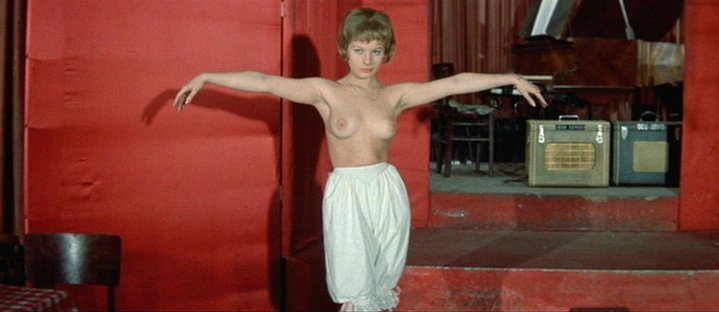
Although this film has a fairly conventional story, and a lighthearted tone, it is in some ways the most severely theoretical of Godard’s early films — or perhaps one should say it is best appreciated on that level today.  As a “documentary” about Karina behaving in front of the camera the film bears too much evidence of Godard’s self-indulgent obsession with the woman herself.  The film’s whimsy hasn’t aged at all well.
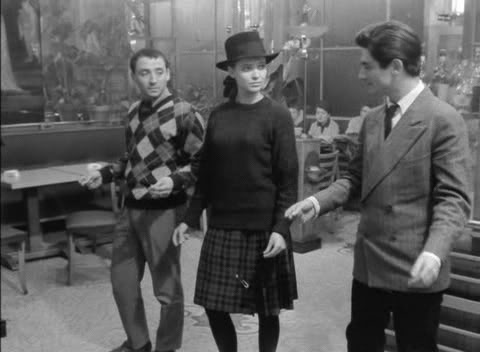
There are no moments of genuine movie musical magic — such as can be found in the Madison dance in Bande À Part, for example, which, modest as it may be by MGM standards, was achieved the old-fashioned way, by a month of daily rehearsals before shooting.
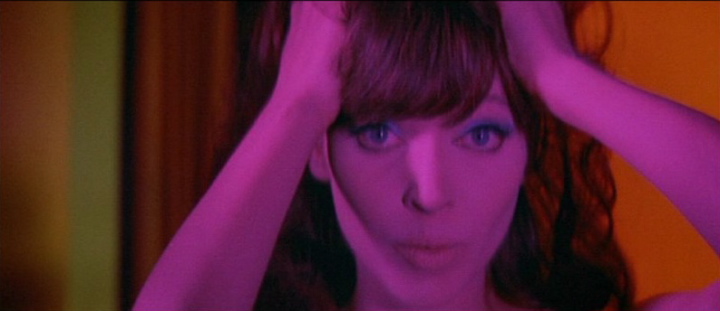
As a meditation on, as a hopeless love letter to American musicals, the film rewards close investigation, however, and is a fascinating case study in Godard’s problematic relationship with American cinema in general, which ravished and horrified him in equal measure.  American cinema is the real femme of the film’s title, the real subject of its final punning lines.
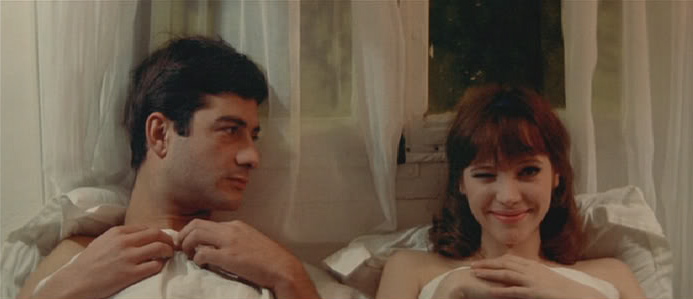
“Tu es infâme,” says the Brialy character to his lover — you are despicable.  “Non,” says Karina’s character, with a last irresistible wink and smile, “je suis une femme” — I’m just a woman.  From somewhere in between these two views, of women and of Hollywood, all the contradictions of Godard’s own practice of cinema arise.


SAVING GRACE

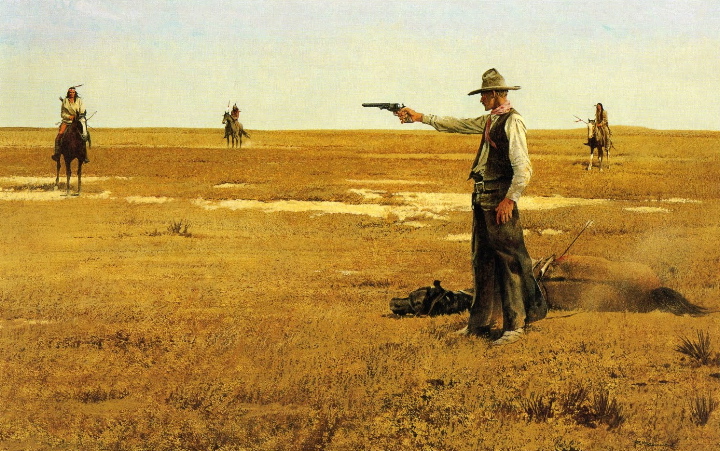
Sixty years ago, John Ford shot most of Rio Grande near the spot pictured above, a few months after I was born.  The river is still just rolling along, quite unfazed by all the intervening anniversaries of these momentous events, before which I stand somewhat amazed:

By this time I’d 'a thought I would be sleeping

In a pine box for all eternity.

I’ve escaped death so many times, I know I’m only living

By the saving grace that’s over me.

(With thanks to BD for the words and PZ for the picture . . .)

STILL BREATHLESS

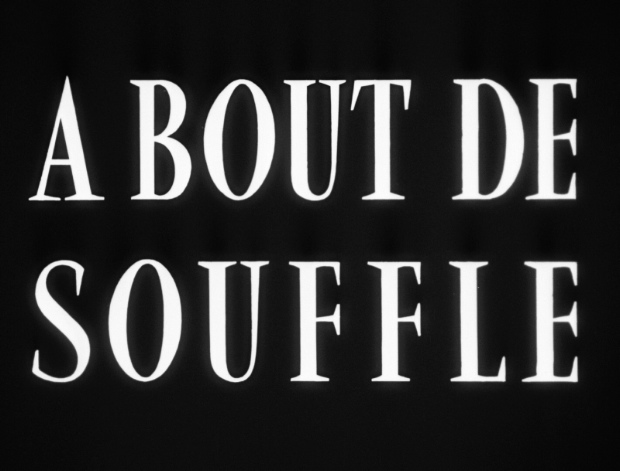
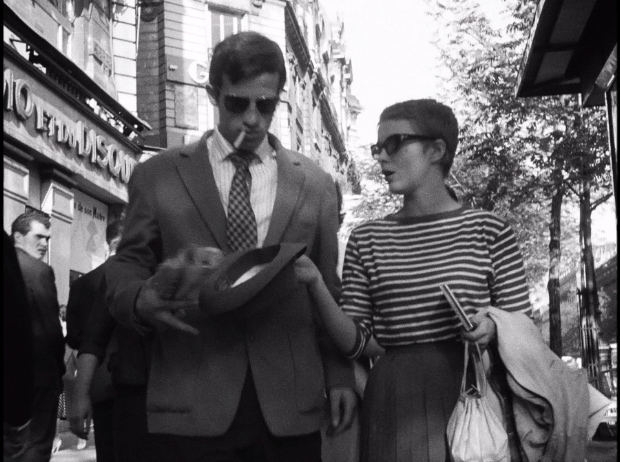
In honor of the fiftieth anniversary of its release, I just watched Breathless again, in the fine DVD version by Criterion.

I first saw it in the mid-Sixties, when I was teenager.  I don’t remember thinking of it as revolutionary, just fun.  In retrospect, this seems odd, because the film was revolutionary in its transgression of the technical norms of telling a story on film.  I was delighted when Belmondo’s character addressed the camera at the beginning and said, “If you don’t like the French countryside, then fuck you,” but somehow it didn’t take me out of the story, which worked as a drama and as a critique of the medium simultaneously.


What this must mean is that film lovers of my generation were already so steeped in cinematic conventions that we were becoming self-conscious about them, at least on some level — Godard’s self-consciousness as a filmmaker resonated with our own perception of those conventions, as a collection of clichés.  We didn’t have to move towards Godard’s radical vision — he was moving towards ours.

The film seems much more revolutionary today than it did when it first came out — because cinema has still not caught up with it.  Visionary filmmakers like Charlie Kauffman and Quentin Tarrantino are still trying to wrench us out of our enchantment with studio-era conventions, without losing sight of their virtues, but they’re using a sledgehammer to do it — screaming about it.

Godard just did it, as though it was no big deal.  Filmmakers appropriated his techniques, like the jump cut within scenes, but only as elements of a style, missing the depth and grace of Breathless as it pointed the way towards a future that we’re still waiting for.

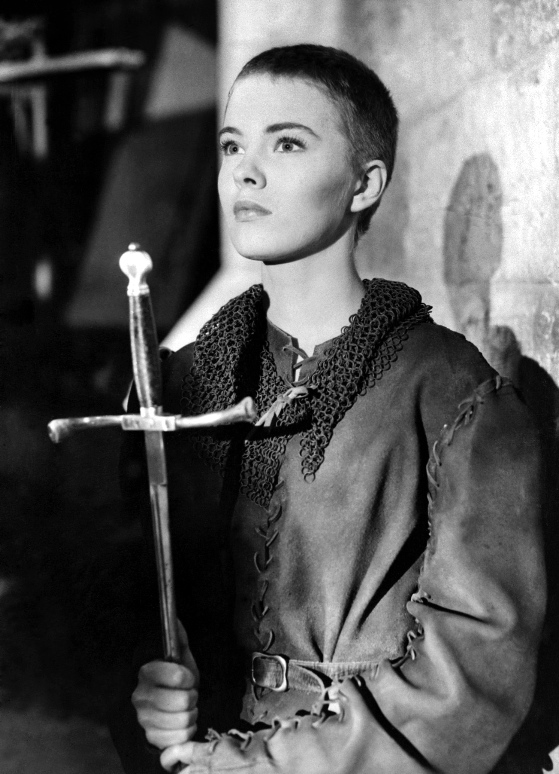
VISIONS OF THE JOAN-GIRL

The writings of Paul Zahl (of The Zahl File) about Jack Kerouac are
among the most insightful I know on the subject of this very complex and often
misunderstood writer.  Recently he came across an extraordinary
letter from Kerouac to Neal Cassady — of which this is the beginning:

Jan. 9, 1951


[Richmond Hill, N.Y.]


Dear Neal,


To continue.  A new experience has touched the foundation of my soul since I wrote you the last words last night . . .


I came into the Cathedral not only to get out of the bitter cold, but because, moments before, I had stood in Grand Central Station looking around with a futile sorrow for a place to sit and think.  All there was — marble floor, rushing crowds, dime lockers, bleak seatless spaces and bright vast corners.  What a thing men have let themselves in for, in this New York! . . .


I hurried out in the cold and cut up 5th Avenue, past the (yes) Yale Club and past Harcourt Brace (yes) and swore and cursed; and cut right by the Doubleday Book store without deigning to go in and see if they had my book on
display . . .


As you know, St. Patrick's is a Gothic cathedral, copied after Rheims or Chartres or whichever, with a rectory in the back, and a big department store across the street on 50th street.  I . . . ducked . . . into the side entrance of the church.

At first I sneered as all the commonplace “renegade Catholic” thoughts came to me in regimental order but soon I was lost in real sweet contemplation of what was going on . . .

I put away all my worries of where to get a job, how to get to California next month, what to do about my poor wife whom I had been torturing in my subtle way lately, and just merely sat thinking in church. . . so that you see . . . my first thoughts were superficial, or let's
just say “aesthetic.”


Frankly, Neal, I don't know when it happened; when it was I began crying . . .

The letter then records a series of powerful epiphanies, which set Paul off on an extended meditation about Kerouac and
women, about the visionary roots of Kerouac's method, about the meaning
of tears in church and tears in general, about the power of images to
expose buried
emotions, about a certain episode of The X-Files.  If you have a place
in your heart for Kerouac, you need to
read it — here:

Visions Of the Joan-Girl (which includes the rest of the letter and Paul's comments on it . . .)