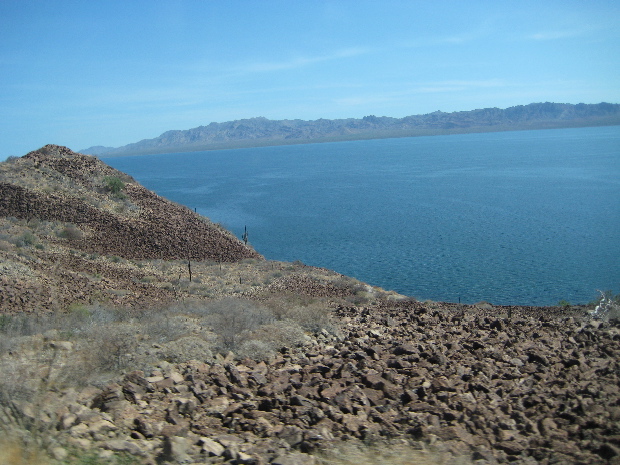
MAR DE CORTES

There
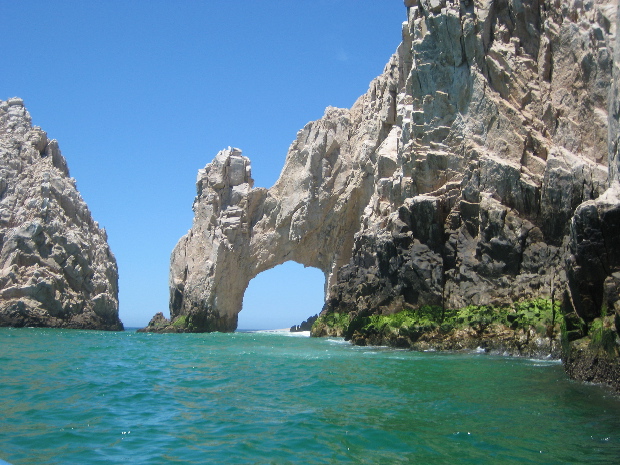
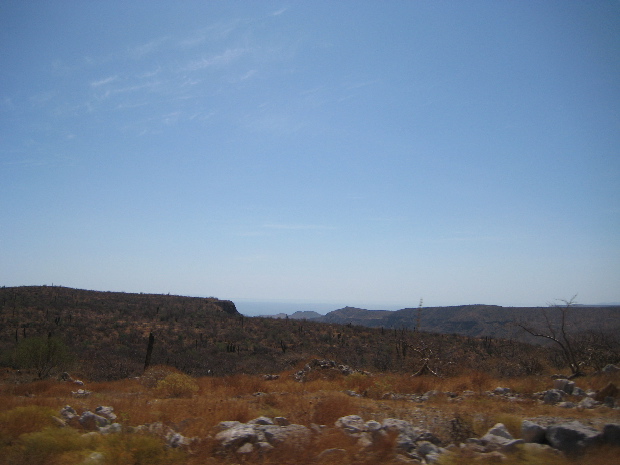
is just no way to describe the coast and the islands of the Mar de
Cortés.  Parts of it remind you of stretches along the coast of Alta
California as it must have been in frontier times.  Most parts of
it seem like a landscape from another planet, or like our own earth
reduced to its purest elements — sea, land, no frills.

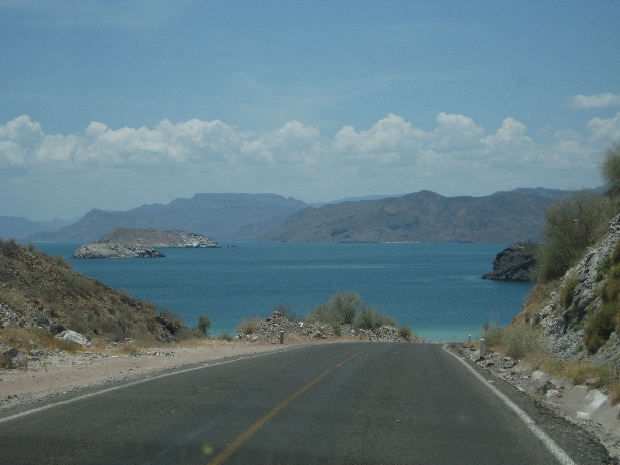
Every mile of Mexico 1 that takes you within sight of the Mar de Cortés is beautiful and inspiring.
Driving east from San Ignacio we hit the Mar de Cortés just north of
Santa Rosalía.  Then we drove south in a state of enchantment to
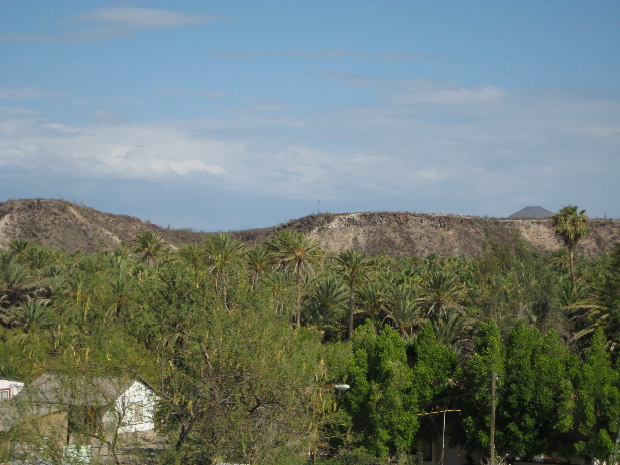
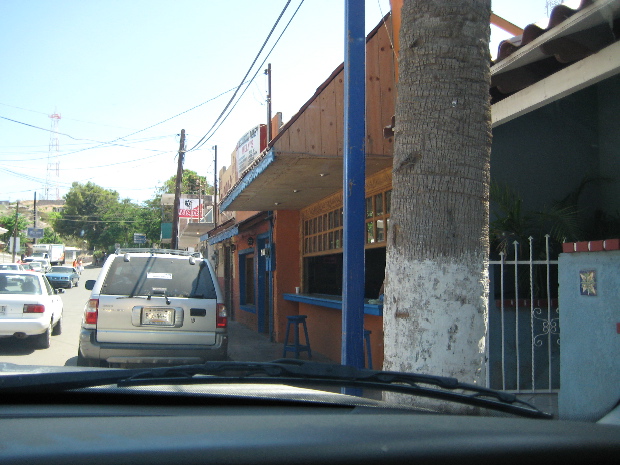
Mulegé, a town built next to a palm-lined estuary, and stopped for
lunch at Dony's taquería,
where we had some fine shrimp and carne asada tacos at a sidewalk
counter.  Then we followed the road down the coast to Loreto,
where we spent the night.

Loreto is rumored to be the “next cool place” in Baja California, which
means that developers are building fancy condo compounds near it. 
The town itself is pleasant enough, though a bit touristy.  It's a
famous place from which to set out on the Mar de Cortés for fishing,
and we found that American fishermen tended to be the most
objectionable tourists in Baja California — mostly white, middle-aged
men with loud voices pretending to be Ernest Hemingway and behaving as
though Mexico was a country populated entirely by domestic
servants.  (We eventually became fishermen ourselves, however, and met some
very nice pescadores among the blowhards.)

The La Pinta inn we stayed at in Loreto was the shabbiest one we
encountered on our trip but it had a big pool right next to the ocean
with an island in the middle of it that thrilled Harry and Nora. 
Nora also had her first piñada here, a pineapple smoothie.  She became an afficionada
of the concoction and had them everywhere, rating their
qualities.  The ones with a cherry and a pineapple slice included
always rated highest, especially if they were served in a large
frosted-glass goblet.

Lee had her first fish ceviche
at the restaurant at the inn, which became an obsession of hers for the
rest of the trip.  All of it was good, but the best was a ceviche made from a trigger fish I caught myself . . . but that's a tale for another time.

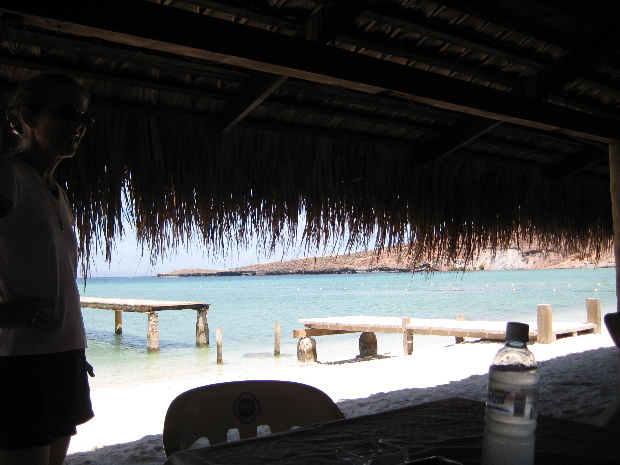
On the Mar de Cortés, sunsets like the one above, at Loreto, which look unreal at first, quickly begin to seem routine — I guess because they are.

For previous Baja California trip reports, go
here.


[Photos © 2007 Harry Rossi]

A BOX OF NIGHT

It's always a cause for celebration when Warner Home Video comes out with a new box set of films noirs
These are first-rate collections of wonderfully entertaining films in
superb transfers, with generally very good (and sometimes genuinely
illuminating) commentaries.

The fourth set in the series was released last month — it has ten
films, as opposed to the five in each previous set, and I'm working my
way through them with tremendous excitement.  I've already
discovered that Act Of Violence, directed by Fred Zinneman, is one of the best of all noirs, and one which exposes very clearly the peculiar strain of post-WWII anxiety that fueled the tradition. 
In the story, two basically decent war vets have their lives ravaged by
the memory of wartime experiences that they can't either deal with or
run away from.  Only the women in the film are strong enough to
try and confront the buried demons directly, but even the women can't
head off the trainwreck that fate has ordained.

I've added the film to my own personal canon of genuine films noirs, and added another film in the set, Mystery Street, to the noirish but not really noir category of police procedurals.

MEXICO 1

Traveling
by car down the Baja California peninsula is one of the world's great
drives.  You pass through ever-shifting landscapes of the most
extreme, surreal beauty — from high desert to low, from mountain to
plain, from the shores of the Pacific Ocean to the shores of the Mar de
Cortés.

The surface of the two-lane highway is very well maintained these days
— the era of the lethal potholes is over.  Gas supplies are
plentiful at the government-owned Pemex stations along the way, though
you'll have trouble finding premium gas, if that's what your car
prefers, between El Rosario and Santa Rosalia.  (Stations do run
out of gas from time to time, mostly depending on how many big campers pass
through them in any given week, but if you fill up wherever possible
whenever your tank drops below three-quarters full you'll never get
into any serious trouble.)

Mexico 1 is a marvel of engineering but most of it leaves you
little to
no margin for error.  Shoulders are rare, especially on stretches
which
snake through high mountain passes with terrifying drop-offs just
inches from the edge of the road.  At every blind curve on such
stretches you just have to pray that oncoming vehicles, especially the
big trucks, will stay in their lanes and leave you enough room to
live.  It's on stretches like this that you want to be thinking
about Nuestra Señora de Guadalupe and not about the drop-offs, though
this is difficult sometimes because of road signs reminding you of the
present hazards with icons of tall trucks flying off the edge of the
mountain.  Often you really do need supernatural aid to maintain
your nerve — as the trucker below, with his Jesus and Mary mudflaps,
clearly knows:

Even when the road cuts straight through level desert it's usually
built up on a high causeway with steep sides, no shoulders and few
turn-outs.  If you had to veer off the pavement suddenly, even
here, you'd probably roll your vehicle, though the roll probably
wouldn't end in flaming death, as it certainly would in the high
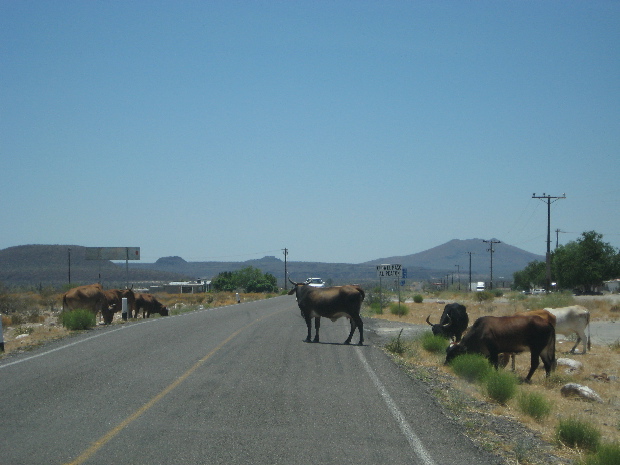
mountain passes.  And this is not to mention the livestock that
occasionally decides to share the road with you.

This is a road you never want to travel at night, or at speeds much
above the 80kph limit.  I mean, don't even think about it.

The road from San Ignacio to Santa Rosalia on the east coast of the
peninsula is one of the most hair-raising stretches of Mexico 1. 
But you're more than rewarded near the end of it by your first sight of
the Mar de Cortés, which is less like a real sea than a sea out of some
ancient legendary tale.  It enchants everything.

For previous Baja California trip reports, go here.


[Photos © 2007 Harry Rossi]
CAMARONES

The
best way to cook shrimp is just to boil it in beer, in the shell, until
it turns bright pink and fills your kitchen with that distinctive
boiled shrimp aroma.  Then you drain it, dump it out on some
newspapers spread on your table, salt it heavily in the shell and get to work — with drawn butter or spicy cocktail
sauce for dipping and plenty of cold beer to wash it down with.  A
better meal than this cannot be had anywhere, at any price.

But if you're looking for something a bit more exotic, or if you're
stuck somewhere dreaming about Mexico and wishing you were there, try
this amazing dish from Rick Bayless, the Mexican food guru — camarones enchipotlados, shrimp in chipotle sauce.  (Bayless' excellent book Mexican Everyday can be found here.)

You need a 15-ounce can of Muir Glen organic, fire-roasted diced
tomatoes.  (This is worth tracking down.)  You need a can of
chipotle chiles en adobo
the La Morena brand is easy to find and excellent.

You need one
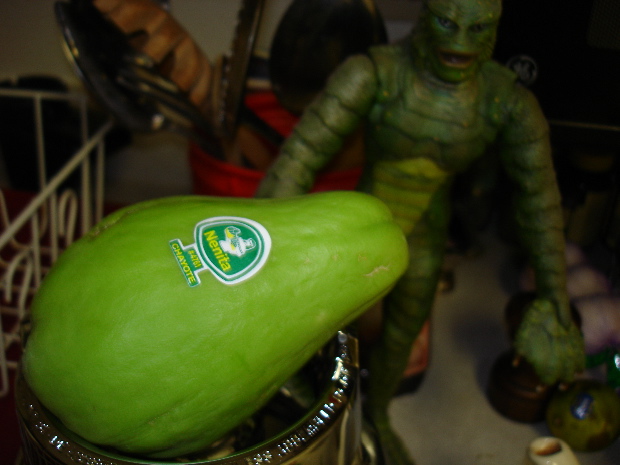
chayote, a kind of Mexican squash — zucchini will also do.  Make
sure you have some fresh cilantro, garlic and olive oil on hand — and
about a pound of fresh shrimp, peeled and veined.  (Some fancy
grocery stores sell uncooked shrimp that's been peeled and veined for
you, with the tails left on, and that's worth the slightly extra cost,
since peeling and veining uncooked shrimp is exceedingly boring.)

Put three tablespoons of olive oil into a large skillet.  Peel and
chop up the chayote into small chunks and sauté it lightly over medium heat in
the oil.  Drain the diced tomatoes, saving the liquid, and put
them into a blender.  Add one or two chipotle peppers and a
tablespoon of their canning sauce and blend until smooth.  Finely
chop or press three garlic cloves and add them to the skillet — wait
about a minute until the garlic is brownish and fragrant, then add the
sauce from the blender, with the liquid from the tomato can.  Cook
this for about five minutes, to let the flavors blend, seasoning it
with salt to taste.  Then add the shrimp.

Cook the shrimp in the sauce, stirring constantly, until it's as done
as you like.  After about four minutes the shrimp will no
longer
be translucent and so ready to eat, but I like my shrimp better done
than that.  You have to keep checking by taste to get it just
right.  Add water or chicken (or fish) broth if the sauce gets too
thick and pasty.

Eat the shrimp, with some roughly chopped cilantro on top for a
garnish.  It's good with rice or just by itself, and great with a
strong beer, like Negra Modelo, served ice-cold.

You'll be astonished at how easy and delicious this dish is — it brings the sea and Mexico to you, wherever you are.


[Original photos © 2007 Lloyd Fonvielle and Harry Rossi]

DATE PALMS

On our third day in Mexico we drove from Catavina, in the center of the
Baja California peninsula, to Guerrero Negro, on the Pacific coast,
where we grabbed some lunch.  Guerrero Negro is a fairly charmless
town whose principal industries are harvesting sea salt and servicing
the tourists who come to whale-watch in the nearby Laguna Ojo de
Liebre.  (Whale-watching was out of season while we were in
Mexico.)  The town has some good restaurants, however, and we had
some great seafood at one of the better of them, the Malarrimo.

Just north of Guerrero Negro is the boundary line between Baja
California and Baja California Sur, where the magic of the peninsula
really begins.  We drove that day only as far as San Ignacio, back
in the center of the peninsula on the way to the Mar de Cortés, because
we were told that the last stretch of mountain road leading down to the
east coast of the peninsula was challenging and not to be driven when
tired.  That proved to be an understatement.

San Ignacio grew up around a freshwater lagoon, which the Spanish
missionaries tapped for irrigation.  What they planted, in great
abundance, were date palms, and so San Ignacio is a most improbable
palm-shaded oasis in the middle of the desert.  The town’s
once-famous dates have been undercut on the Mexican market by cheaper
dates from abroad, so the town has a sleepy, vaguely depressed air,
though it’s still extremely charming, with a central square planted
with tall shade trees and one of the most beautiful missions on the
peninsula.

We ate our first lobster at an old restaurant in town that looked as
though it had seen better days — lobster tacos for me and a whole
lobster for Harry.

The lobster in both forms was a bit over-cooked and over-priced but still delightful.

We stayed at yet another La Pinta inn, one of the few choices for accommodation in
San Ignacio.

When we got to the town it was being spruced up for its annual date
festival, to be held the following week, but there were no dates for
sale anywhere we could find . . . because, we were told, “the date
harvest isn’t until October.”  The mystery of this only added to
the slightly unreal loveliness of the place.

For previous Baja California trip reports, go here.

[Photos © 2007 Harry Rossi]

NOIRISH: THE POLICE OR AGENCY PROCEDURAL

The films below are sometimes called films noirs but they make up such a distinct category that they're almost always qualified with the the sub-label docu-noirs:


House On 92nd Street


The Racket


Call Northside 777


Panic In the Streets


Border Incident


The Narrow Margin
Mystery Street


Naked City


Arson, Inc.


Loan Shark


Fingerprints Don't Lie


F. B. I. Girl


Portland Expose
A Bullet For Joey


In fact they're
all police or government-agency procedurals (or, in one case, a newspaper procedural.)  They usually feature some
highly positive documentary-type footage about the law enforcement
group involved and are sometimes shot within the
facilities of the institutions they depict.  (The newspaper procedural, Call Northside 777,
about a crusading journalist who saves an innocent man from prison, was
based on a real case and shot on some of the locations where the original incidents occurred.)

These films are designed to show the effective functioning of
government agencies or other establishment organizations, and while this sort of reassurance may have
addressed the same strain of post-war anxiety that film noir explored, it obviously did so from a completely different perspective than you find in the classic film noir, where suspicion of all social institutions is part of the general atmosphere of dread.

In the films above, the city may well be a dark and threatening maze,
but we enter it in the company of an upright guide, backed by the full
force of the official society, and we overcome the danger we face there
— we clean up the mess.

These films make up a vigorous genre in themselves and have become
fascinating social documents — but I don't think it makes any sense to
call them films noirs.

[The noir credentials of the films above are as follows . . .
House On 92nd Street
, Call Northside 777
and Panic In the Streets are part of the Fox film noir DVD series . . . The Racket,
Border Incident
,
Mystery Street and The Narrow Margin are part of the Warner film noir DVD series . . . A Bullet For Joey is part of the MGM film noir DVD series . . . Naked City is found on almost all lists of films noirs . . . the rest are included in the VCI Forgotten Noir DVD series.]

TOGETHER

In
Mexico, whenever anyone asked where my sister Lee and her kids were
from she always said Alta California.  This delighted Mexicans,
who probably think all Americans believe there is only one California,
the U. S. state.  In fact there are two others, Baja California
and Baja California Sur, both Mexican states located in the Baja
California peninsula.  Mexicali is the administrative center of
Baja California, to the north, and La Paz is the administrative center
of Baja California Sur.

At the La Pinta inn in Catavina my sister ran into a Mexican woman who
had lived in Los Angeles but had moved back because she didn't have
“the right papers” and didn't feel good about it.  My sister
remarked on how unfortunate it was that papers could keep the
Californias apart.  “I know God meant us to be together,” the
woman said, “but something has gone wrong with it.”  “Maybe we'll
all be one California again,” my sister suggested.  “I think it
will happen,” the woman said, without much conviction.

The woman seemed a bit puzzled about why someone from Alta California
would choose to visit the poorer Californias to the south. 
“Because it's so beautiful,” my sister said, ” and the people are so
wonderful.”  The woman nodded dubiously.

I suppose it's not surprising that the Mexicans' envy of American
prosperity should cause them to be defensive about their own country,
but I don't think money is the root of the issue.  It's more about
children and the future.  Mexicans worship children — their eyes
light up with almost supernatural joy at the sight of niños, even gringo
niños
The poorest of Mexicans will introduce you to their children as though presenting
movie stars.  I think when they head north, to endure the
humiliations and hardships of life in El Norte, it's not to get
flat-screen TVs for themselves but a better future for their kids.

The poverty of Mexico, at least in Baja California, south of the
tourist zone, rarely seems ugly or degrading — the everyday culture of
the nation is rich and humane.  But it's so often frozen where it
is — economic progress is coming but coming slowly.  Looking into
the eyes of their niños, many Mexicans may feel that don't have time to wait for it.

They may not realize how much they stand to lose up north.  The
idea of making grueling sacrifices for one's children is losing
currency in America, and many Americans no longer believe that their
children will have better lives than they've had.  The ragged
Mexican man walking miles through the desert country of the borderlands
to get a back-breaking, low-paying job in the United States probably
has a picture of some children in his pocket.  If you're tempted
to fear and despise him, think of that.  He may have more to give us than we have to give him.

For previous Baja California trip reports, go here.


[Photos © 2007 Harry Rossi]
A CREHORE FOR TODAY

Amy Crehore recently completed the painting above for a gallery show in which artists were asked to create works that evoked a
favorite book — this one was inspired by Nabokov's Lolita
I think it's profound but wouldn't dare to try and analyze it too
closely — the artist might cut off my tongue as revenge for trying to reduce the painting to words.

More of Amy Crehore's images can be seen here.

FROM THE PACIFIC COAST TO THE HIGH DESERT

The
first time I visited Ensenada (above) in the late Sixties it was a
small, dusty
tourist town.  Now it's a big, sprawling tourist town but still
has some charm.  Above Ensenada on the Pacific coast, yuppie scum,
mostly from Alta California, the world headquarters of yuppie scum, has
turned the region into into a nightmare of condos, tourist traps and
perverted, groveling commercialism.  This is where you see the
true face of Alta California, “The Wellness State”.  The influence
of the Great Satan begins
to wear away the further south you go — only to
flare up again like a festering boil at Cabo San Lucas at the tip of
the peninsula.

On our first full day in Mexico we made it as far as Catavina, a tiny
town in a bizarre high-desert setting in the middle of the
peninsula.  (Mexico 1, the only road that goes all the way down to
Cabo San Lucas, zig-zags back and forth across Baja California, from
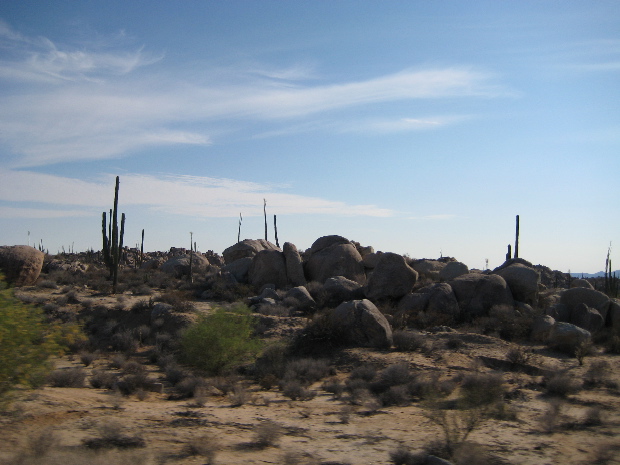
one coast to the other.)  The desert around Catavina is covered in gigantic, car-sized boulders
and tall cactus — like much of Baja California its landscape is
surreal in the extreme, with an effect on the psyche that can't be evoked by
photographs.

In Catavina we stayed at a La Pinta inn.  These are dotted along
Mexico 1, are run by the government and are very pleasant, with a
cantina and restaurant surrounding a small courtyard fountain and rooms
surrounding a larger courtyard with a pool.  Mexicans pay about
$57 (American) a night there — rates for tourists can rise up over
$100 a night, but my sister quickly discovered that Mexican hotel
clerks love
to bargain, especially if the negotiation is conducted with humor, so
we paid well under the tourist rate wherever we stayed.  The
clerks always seemed genuinely delighted when Lee managed to talk them
into lowering their rate, as though they were appreciating a clever
goal from an unlikely player in a soccer game.

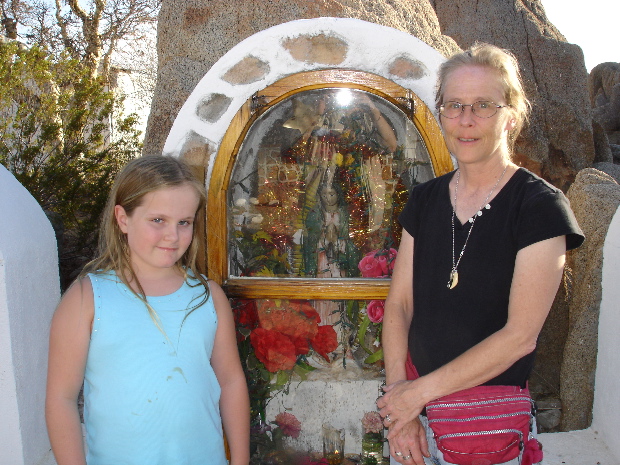
The terrace behind the restaurant at the Catavina La Pinta looks out
over the mystical desert and has a shrine dedicated to Nuestra Señora
de Guadalupe, which puts everything into perspective.  When
driving the roads of Baja California you want constant assurances that La Morenita
is with you, and you want a chance to thank her for getting you to
wherever it is you've gotten.  This is psychologically sound,
whatever you think of the theology of it, because it reminds you to
never, ever
take Mexico 1 for granted.  It's full of surprises, most
delightful but some hair-raising.  I'll write more about Mexico 1 in a later post.

For previous Baja California trip reports, go here.


[Photos © 2007 Harry Rossi & Lloyd Fonvielle]

NOIRISH: FILMS OF INTERNATIONAL INTRIGUE

It's hard for me to imagine why anyone would find it useful to call any of the films listed below films noirs, but people have:


Contraband
Casablanca
To Have and Have Not
Notorious


Macao


I'll Get You


The Man From Cairo

They Were So Young
Mr. Arkadin (Confidential Report)


These are all
thrillers involving romance and international intrigue, where the occasional
disorientation and jeopardy of the protagonists results from being
embroiled in a foreign locale, fighting a foreign system.  The
whole crux of the film noir
tradition is that the disorientation and jeopardy take place on
familiar soil, within familiar systems that have somehow grown alien, bewildering
and malevolent.  Night and the City is by contrast a true film noir,
even though it happens to be set in London
It unfolds in a world its American protagonist knows well (though perhaps not
well enough) — his jeopardy and his doom have nothing to do with the
fact that his surroundings are foreign.

Rick in Casablanca masquerades
as a cynical, even nihilistic anti-hero who believes in nothing —
which gives him at least a superficial link with some film noir
protagonists — but he proves himself to be a knight in shining armor,
willing to sacrifice the most important thing in his life for transcendent
ideals.  If this is film noir, what the hell do you call Gun Crazy or Detour — or Night and the City, for that matter?  Film noir noir?


I guess Macao gets labeled a film noir because it stars film noir icon Robert Mitchum and was made right after His Kind Of Woman, which also paired him with Jane Russell and which is an actual film noir,
or at the very least a comic parody of one.  The rest are mostly
standard spy thrillers involving an innocent American caught in a web
of foreign intrigue.

I think you could make a case that John Le Carré's existentially bleak spy thrillers enter the realm of noir, or neo-noir, but the romantic adventures and thrillers above don't come close.

[The noir credentials of the films listed above are as follows . . . Contraband is included in a film noir DVD box set from Kino . . . Casablanca, Notorious and To Have and Have Not are listed on the Wikipedia “expanded list” of classic films noirs . . . Macao is among the films noirs listed in Nicholas Christopher's Somewhere In the Night . . .  I'll Get You, The Man From Cairo and They Were So Young are included in the VCI series Forgotten Noir.]

LA FRONTERA

On
the first day of our drive to Baja California we got off to a late
start — a miscalculation that led to us having to spend our first
night in Blythe, in Alta California.  I'm not sure what the deal
with Blythe is, but it seemed like a depressed and hopeless sort of
place.  We stayed in a lousy, overpriced motel and were happy to
be on our way again in the morning.  Above is a picture of a
rooster on top of a cafe in Vidal Junction, Alta California, on the
road to Blythe.  The cafe was closed and the only restrooms we
could find in Vidal Junction were some dirty Porta-Potties behind a gas
station, which was also closed.  The sight of a new moon behind the rooster cheered us up immeasurably.

If you drop more or less straight down from Las Vegas you hit the
Mexican border at
Mexicali, but we'd been told that crossing at the smaller town of
Tecate was quicker and
easier, so we veered off westward at El Centro on the I-8, then dropped
down to a smaller road that skirts the border on its way to
Tecate.  (Tecate is where the great Mexican beer of the same name
originated, though it's now brewed in other places in Mexico as well.)

It was fascinating to drive through the Imperial Valley of Alta California, past the huge
Sahara-like sandscape of Imperial Dunes and through the lush cultivated
fields beyond them.  The water that irrigates the Imperial Valley,
and makes it one of the most productive agricultural regions in the
world, comes from the Colorado River, which used to empty into the top
of the Mar de Cortés.  Now only a trickle of it arrives at the
apex of the great sea and the rich delta that used to be there is more
or less a wasteland.

The land above the border on the road to Tecate is well-watered, too,
and very beautiful.  We passed four U. S. Border Patrol cars along
the road before crossing quickly and easily into Mexico at
Tecate.  You need a Mexican tourist visa if you plan to travel
south of the “tourist zone”, or more than about 20 miles into
Mexico.  Lee had gotten hers and her kids' in Los Angeles but the
Mexican consulate in Las Vegas doesn't issue them.  I got one on
the Mexican side of the border in about 20 minutes, with no trouble at
all.  The Mexican border officials were friendly and efficient.

Somehow we managed to find our way through the teeming streets of
Tecate onto Mexico 3, which cuts across the top of Baja California and
hits Mexico 1, and the Pacific, at Ensenada.  The road passes
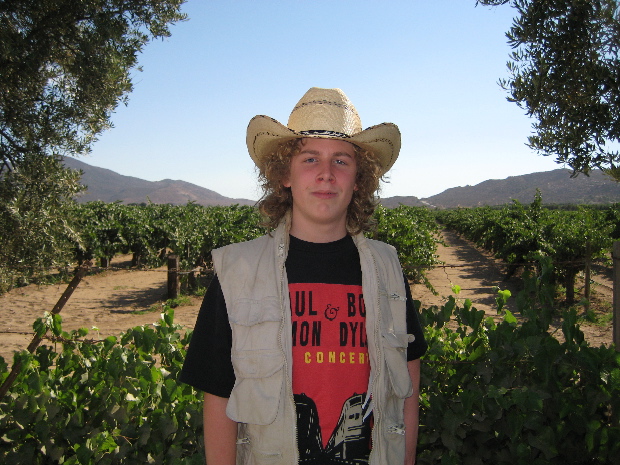
through high valleys where grapes are cultivated and wine made.  We
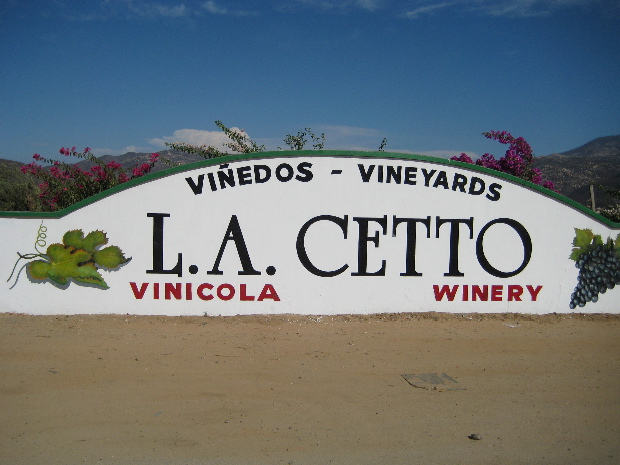
stopped at the largest of the Baja California wineries, L. A. Cetto, a
lovely establishment surrounded by a sea of green vines.

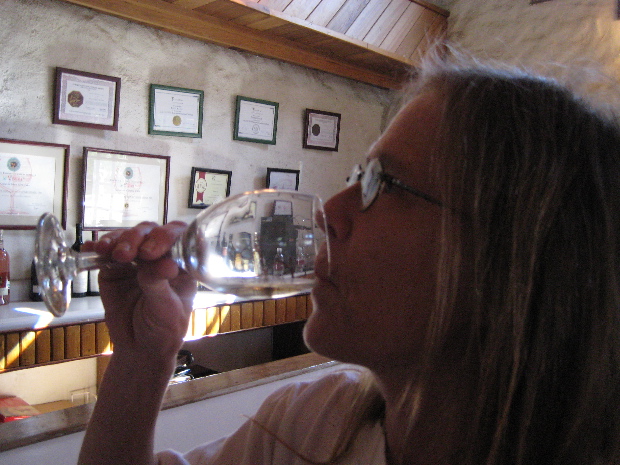
Lee and
I sampled and bought some good, cheap wines there . . .

The kids were
diverted by a pen that held burros . . .

. . . and peacocks . . .

At Ensenada we headed straight for the city's fish market, with its
extraordinary displays of seafood arranged in elaborate, artful piles.  We
had some indifferent seafood tacos at one of the small stalls lining
one side of the market, then cast about for a place to stay for the
night.

We lucked into El Rey Sol, a pleasant motel-like place with a protected
parking lot, a great little bar and a good pool for the kids. 
While the kids swam, Lee and I washed away the dust of the road with
beers and margaritas, talking to a cheerful bartender who recommended
good seafood stands in Baja California Sur, and to other travelers,
including a surfer who'd explored the undiscovered breaks of the
peninsula in his youth and was now revisiting the region with his young
family.

After the motel disaster in Blythe, Lee and I had discussed the
dehumanization of roadside inns in America, contrasting them with the
rich inn culture of Dickens' time, when inns always offered inviting
public rooms where travelers could meet and exchange tales of the
road.  All the Mexican hotels and motels we stayed at had such
public rooms, and they were always in use — just one of the many areas
in which Mexican culture reveals its humane genius and outshines its
“richer” neighbor to the north.

For previous Baja California trip reports, go here.


[Photos © 2007 Harry Rossi]
MEXICO: PARANOIA AND PREJUDICE

Before
setting off on our drive down the Baja California peninsula my sister
Lee and I did a lot of research about traveling there — online, in books
and in conversations with acquaintances who've visited the region by
car.  In the wake of our own journey it's clear that there's a lot
of misinformation floating around about automobile travel by foreigners in Mexico.

With respect to Baja California itself, a lot of this is just residual
mythology from the time when driving down Mexico 1 to Cabo San Lucas
was a wilderness adventure.  The road wasn't paved the whole way
to the cape until 1974 — a fact that thwarted my own first attempt to
drive down the peninsula in the late Sixties in a car with
insufficiently robust shock-absorbers.  For years after the road
was paved it wasn't maintained
scrupulously and supplies of gasoline along the way couldn't be
depended upon.  All of that has changed.

But some of the misinformation is undoubtedly due to plain old paranoia and prejudice.

In the whole course of our journey we were only accosted once by an
aggressive and vaguely threatening beggar.  We only encountered one
incompetent and indifferent hotel or motel clerk.  We only found
ourselves once in rooms with seriously malfunctioning air-conditioners
— rooms whose temperatures were recorded at 99 degrees on the room
thermostats and whose wall units were unfitted to reduce this
temperature very much.

All these things happened in Blythe, California, in the Imperial
Valley, before we even crossed the border.

In Mexico itself we
encountered nothing but cheerful hospitality, casual but
efficient and friendly service and good deals.  In La Paz, we stayed in large, cool,
comfortable rooms with pleasant sea views, at one of the best hotels in
town, for five dollars a night less than we paid for the grubby sweatboxes in
Blythe.

We were careful about drinking tap water but were extremely
adventurous
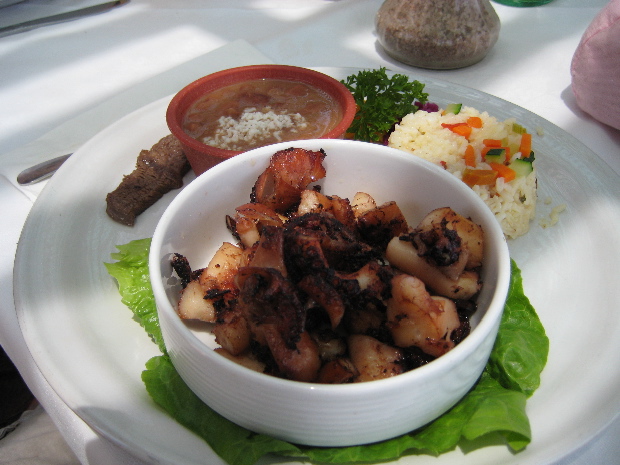
about where and what we ate.  (My nephew Harry, just shy of his
14th birthday on the trip, ate so many strange but delicious things in
Mexico that he kept a photographic record of them, starting with the
bowl of grilled octopus, above, that he ate con mucho gusto in Guerrero Negro on the trip down to La
Paz.)  Each of us experienced brief, mild
bouts of intestinal distress but nothing that could have been the
result of anything more than entering a new microbial environment —
something you might encounter just by visiting a different part of the
United States.

When we got back to Las Vegas we were all jonesing for cheeseburgers
and went out to an upscale burger joint here to indulge
ourselves.  I barfed it all up later that night — something that
never happened to me in Mexico.  I would say that you can get
better, fresher and more delicious food in almost any roadside
taquería in Mexico, however funky it may look on the outside, than you
can find on almost any gleaming stretch of strip
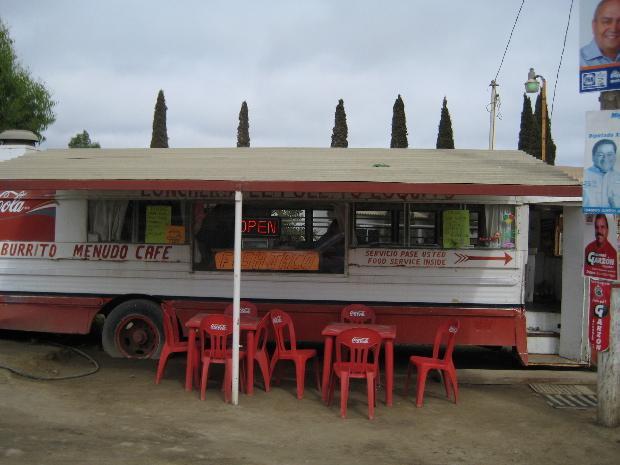
development in almost any American town.  We had really superb
shrimp and carne asada tacos at the improvised diner below, in El Rosario — a place we happened upon by chance:

It would make much more sense for Yankees to warn Mexicans
about traveling here — about the rude, uncaring service, bad deals and
synthetic food — than to listen to the warnings of fellow Yankees
about traveling in Mexico.

For previous Baja California trip reports, go here.


[Photos © 2007 Harry Rossi]

NOIRISH: THE PSYCHOLOGICAL SUSPENSE THRILLER

Below is another list of films that are sometimes identified as films noirs but that, in my opinion, really aren't:


Whirlpool


The Big Clock


House On Telegraph Hill


The Blue Gardenia


Shock


Sudden Fear


Shadow Man
The Stranger


These are all in fact what have come to be known as Hitchcockian
suspense thrillers, because Hitchcock remains the undisputed master of
the form.  In these films, ideally at least, the viewer is seduced
into a strong identification with the protagonist, a damsel in
distress or a man wrongfully accused of a crime, and shares the
psychological suspense of his or her ordeal, which includes feelings of
guilt that may not be rational and are in any case disproportionate to
the jeopardy involved.


I think they're distinguishable from the true
film noir because
they concentrate on the often aberrant psychology of an
individual and don't reflect a sense of society as a whole, or
existence itself, as deranged.  They chart passages through a
moral/psychological disorientation that is more or less resolved by the
end of the film.  The jeopardized innocents of this
tradition are often women, which also distinguishes it from the
tradition of the
classic
film noir, which tends to center on male anxieties.  These films involve an exploration of moral guilt, while classic films noirs involve an exploration of existential bewilderment and incompetence, almost always from a male point of view.


All of the films listed above fall far short of Hitchcock's best work
in the form, primarily because they fail to make us full psychological
participants in the jeopardy of their protagonists.  Their
narratives may be purely Hitchcockian, beat for beat, but their
technique doesn't compel us into a deep and often unconscious identification with
their central characters.


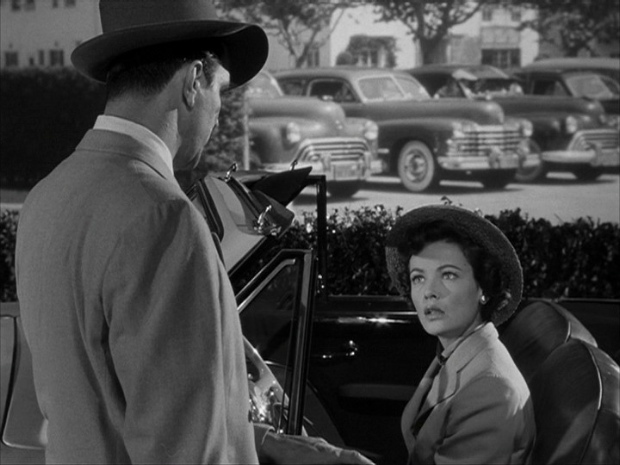
In
Whirlpool, for example, we
first see the Gene Tierney character in a department store where she's
just done some shoplifting — but we don't find this out until a store
detective follows her to her car and seizes the lifted item. 
We're looking at the character from the outside, from the point of view of the
authorities.  In a Hitchcock film, we'd see the theft when it
happened, share Tierney's fear as she tries to exit the store without
getting caught — even find ourselves rooting for her to get away with
it.  With that identification established, we'd
feel her guilt when she's caught, and feel it as our own guilt, because we secretly hoped she'd pull the theft off.


Ben Hecht, who wrote the script for Hitchcock's
Notorious, also wrote Whirlpool
for Otto Preminger.  The latter has all the ingredients of a
classic Hitchcockian thriller — so it's highly instructive to study
why it isn't one.  It all comes down to Hitchcock's genius in
constructing identification with the protagonist, an identification
that can contradict our conscious disapproval of the protagonist's
behavior.  Preminger made one of the best of all
noirs, Angel Face, but on the evidence of Whirlpool he had no gift for, and apparently no great interest in, the Hitchcockian suspense thriller.


[The
noir credentials of the films listed above are as follows — Sudden Fear is included in Kino's film noir box set The Dark Side Of Hollywood . . . Whirlpool, The House On Telegraph Hill and Shock are part of Fox's film noir series . . . Shadow Man is included in VCI's Forgotten Noir series . . . The Stranger is part of MGM's DVD noir series . . .The Big Clock is part of Universal's noir series . . . and the packaging of the Image DVD release of The
Blue Gardenia identifies it as “classic noir  with a feminine twist.”  I don't see any point in calling any of these films noirs unless you're willing to call almost all of Hitchcock's American films noirs — which I think stretches the definition of noir beyond the point of usefulness.]

THERE IS A WAY


Last
month I started off on a road trip with my sister Lee and her two kids,
Nora and Harry, down the length of the Baja California peninsula. 
It was a journey of great adventures but surprisingly easy and
trouble-free, contrary to some stories we'd been told about the hazards
of driving in that part of Mexico.  We ascribe most of our good
fortune to the Ghost (my trusty Lincoln Navigator) and to the kind
ministrations of Nuestra Senora de Guadalupe.


The Ghost is not a car for the 21st Century, due to its high
consumption of fossil fuel, but it is in all other respects one of the
most perfect machines for land travel ever created.  It transports
four people and assorted luggage in extreme comfort and is as reliable
as a burro, though far less truculent.


Nuestra Senora de Guadalupe is a lady for all ages.  The essence
of Mexico's own peculiar understanding of Christianity, she also
embodies the spirit of the nation.  There are improvised shrines
to her everywhere — the one above is just outside the public market in
La Paz.  She is sometimes called
La Reina de Mexico, the Queen of Mexico, and sometimes just La Morenita, the Little Darling.


Mexico has a deeply humane culture, made up of many grave and gracious
courtesies between people.  Just recognizing, however crudely,
that this system of courtesies exists is enough to open the heart of
almost any Mexican to a stranger, even a gringo.


Things
rarely work the way they're
supposed to
work in Mexico, but they work, by a complex system of improvisation
and accommodation that can't be reasoned out, only intuited. 
Traffic signs, for example, are never taken as anything more than
suggestions.  But when you stop at a crosswalk, for example, to
let someone cross the street, as the regulations require, the
pedestrian will almost always pause and nod and salute you for your
consideration, as though to acknowledge that you have not obeyed a law
of man but of God, who asks people to treat each other with dignity and
respect.


The lack
of
apparent logic
in the organization of things could easily drive a Yankee
batty, but that's because he or she would have failed to realize that
Our Lady of Guadalupe travels with them at all times in Mexico, ready
at any impasse to lean in and whisper, “There is a way.”


And there always is.

[Photos © 2007 Harry Rossi]