LEAVE HER TO HEAVEN

[Note — this post contains plot spoilers and shouldn’t be read if you haven’t already seen Leave Her To Heaven.]

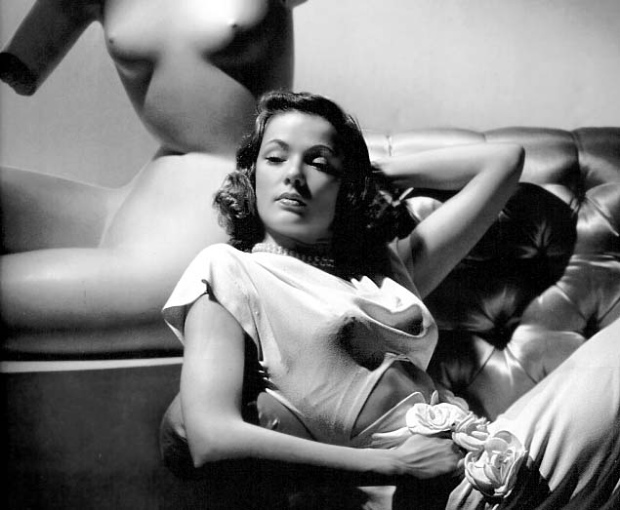
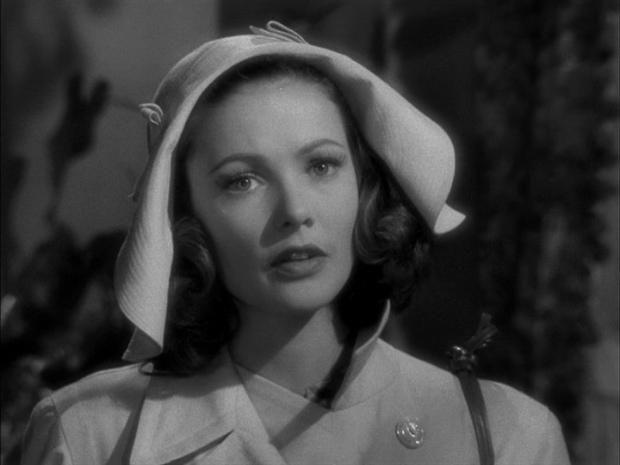
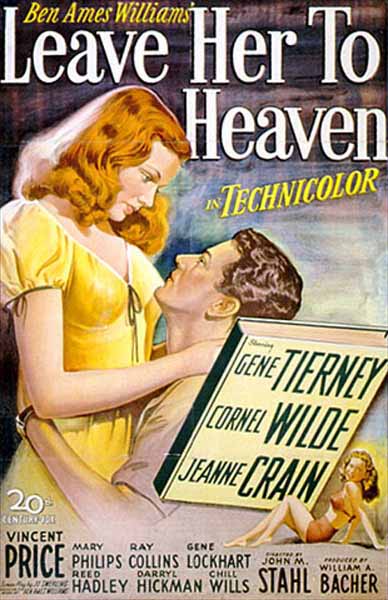
Leave Her To Heaven is one of the strangest films ever made in studio-era Hollywood.  The tension between its text and its subtext is so violent that it can induce mild dizziness.  It’s sometimes called, unhelpfully I think, a film noir.  It’s certainly a dark film, despite its gorgeous Technicolor photography, and it deals with some of the same cultural neuroses that inform the noir tradition, but it comes at them from a different perspective — a female perspective.

At the heart of the film is Ellen, played by Gene Tierney — a
beautiful, narcissistic psychopath.  We’re told early on that
Ellen wrecked her parents’ marriage by her obsessively close
relationship with her father.  The minute we hear this
extraordinary bit of information our perceptions should be alerted that things
aren’t always going to be what they seem in this film — though I
imagine that it’s mostly women who pick up on it, and perhaps only
subconsciously.

Think about it.  A grown man allows his marriage to be ruined by his obsessively close
relationship with his daughter — and the child is blamed.  This
strikes me as a kind of emotional code, alluding to the phenomenon of blaming
women for the psychic and moral failings of men.

Ellen will go on in the course of the film to do horrible things — she
will murder a crippled boy, her husband’s brother, she will induce
the miscarriage of her own unborn child and she will try to frame her
innocent cousin for murder.  She becomes a monster and no rational
consideration can induce us to sympathize with her — but we do.
We do because of the coded text embedded in the overt one.
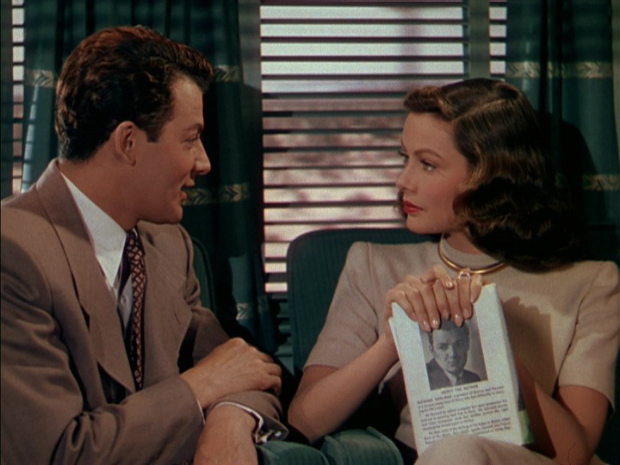
In the film, Ellen falls in love with and marries Dick, apparently
because he reminds her of her father.  Cornell Wilde is
brilliantly cast in the role.  He looks like a hunk but is a kind
of black hole on screen, with a blank face and eyes that express little
more than hurt and bewilderment.  He’s further un-manned in the
narrative, which makes him a fumbler, insecure around Ellen, easily led by
her and only too happy to retreat to the female company of her mother
and cousin, “good” women but good in a bland, smug way.


Dick has a crippled younger brother who comes to live with the
newlyweds — sleeping in the room next to theirs behind a wall so thin
that he can talk to them through it without raising his voice.
Dick doesn’t seem to comprehend why this situation makes Ellen
uncomfortable.  When the brother is finally moved out to a guest
house Dick secretly invites Ellen’s mother and cousin to come visit,
another intrusion on their intimacy, and once again can’t understand why this disturbs Ellen.  He whines out his reasoning — “I thought you’d be pleased!” — without the slightest apparent awareness of Ellen’s point of view, much less her right to be consulted on such things.
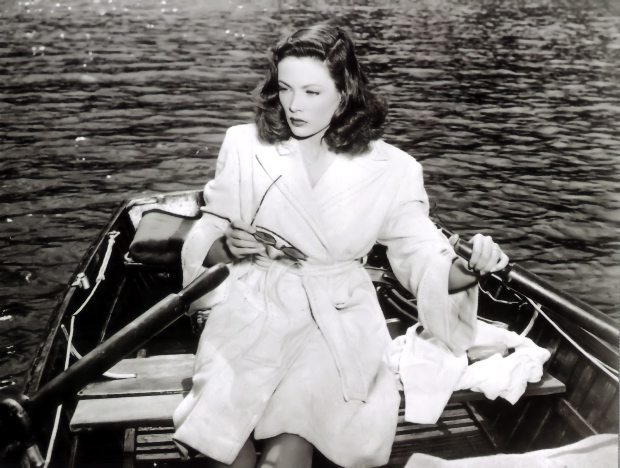
Ellen over-reacts, of course — drastically.  She lets the brother
die in a swimming accident.  But part of us understands why she
does it.  All the people around her are so drippy, so dull and, in
the case of the men, so weak, that part of us wants her to kill them
all.


This is how the deep tension of the film is created — by giving Ellen
real grievances, maddening and suffocating, while at the same time
giving her responses that we can judge as thoroughly
reprehensible.  Men are allowed to righteously condemn a woman who
sees through male weakness, women are allowed a vicarious revenge
against those same weak men.


The film starts on a train and climaxes in a courtroom, but in between
it plays out in a series of glamorous vacation homes, shot in wild,
almost lurid color.  The whole film is like a paean to the
well-decorated second home — a glossy magazine-spread celebration of
bourgeois comfort and excess.  But Ellen makes us feel the
oppression of those homes — they are for her what the urban labyrinth
is to the lost souls of film noir, and they’re lit with the same expressionistic exaggeration.
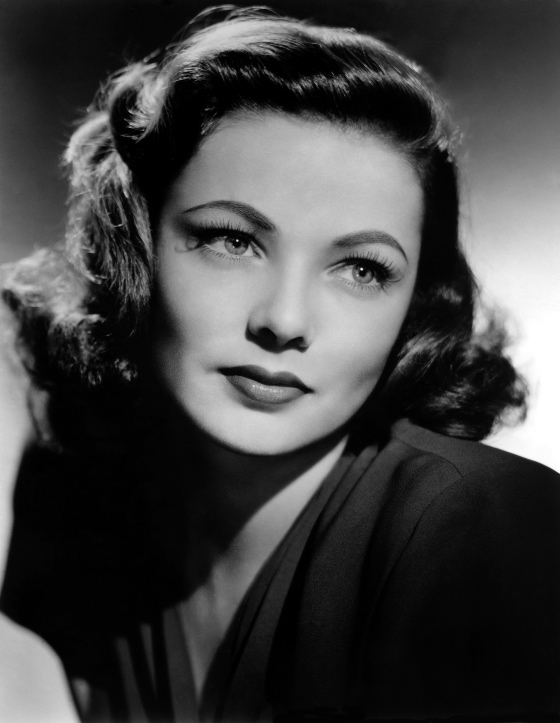
Gene Tierney was an actress of limited range but she turns up in some
of the great films of Hollywood’s golden age, radiant and unforgettable —
this film, Laura, Heaven Can Wait and The Ghost and Mrs. Muir.
She had a unique quality on screen, part aristocratic, part down to
earth, always suggesting a secret that will never be revealed.
That quality, and especially it’s sense of impenetrable mystery, is
what allows us here to project onto her our unconscious approval of her
wickedness.


While not a true film noir the movie fits nicely into a category that might be called domestic noir — along with Shadow Of A Doubt and Double Indemnity,
both made around the same time.  In these films, the nightmare of
moral chaos doesn’t play out on dark city streets but in middle-class
homes . . . yet the existential dread invoked is almost exactly the
same.
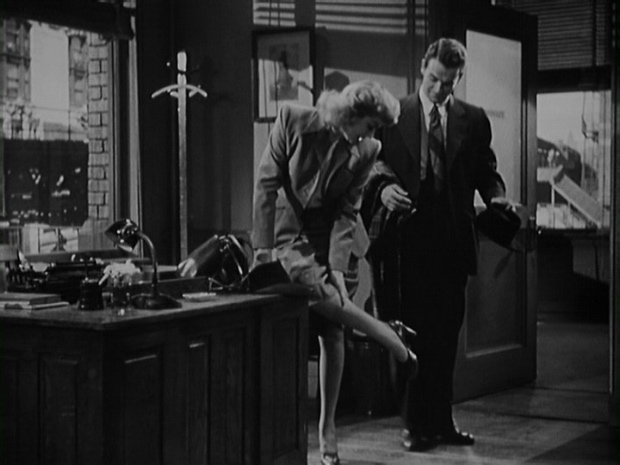
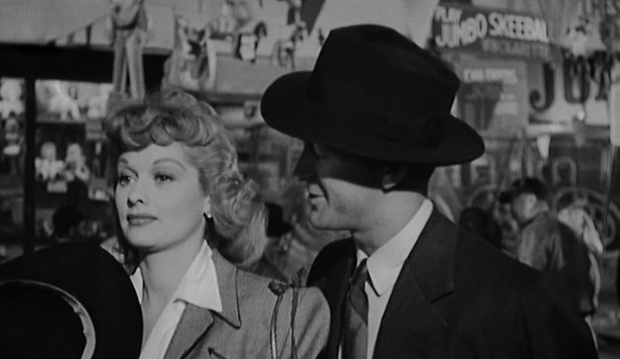
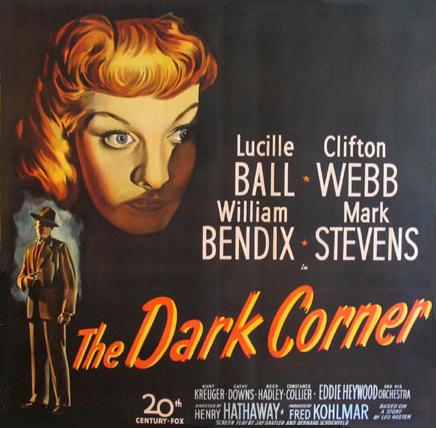
THE DARK CORNER


“I feel all dead inside.  I'm backed up in a dark corner and I don't know who's hitting me.”


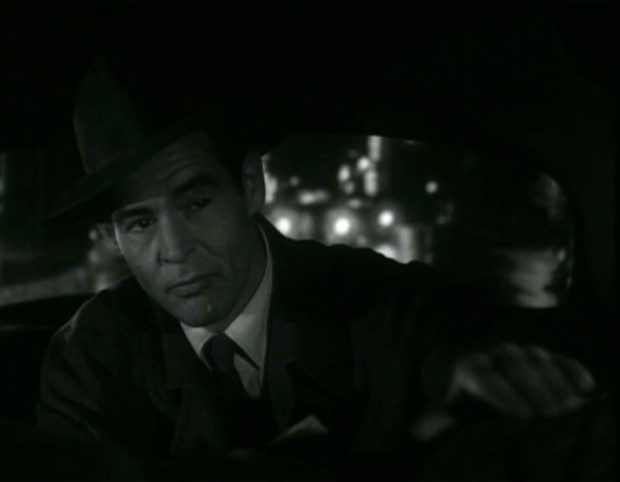
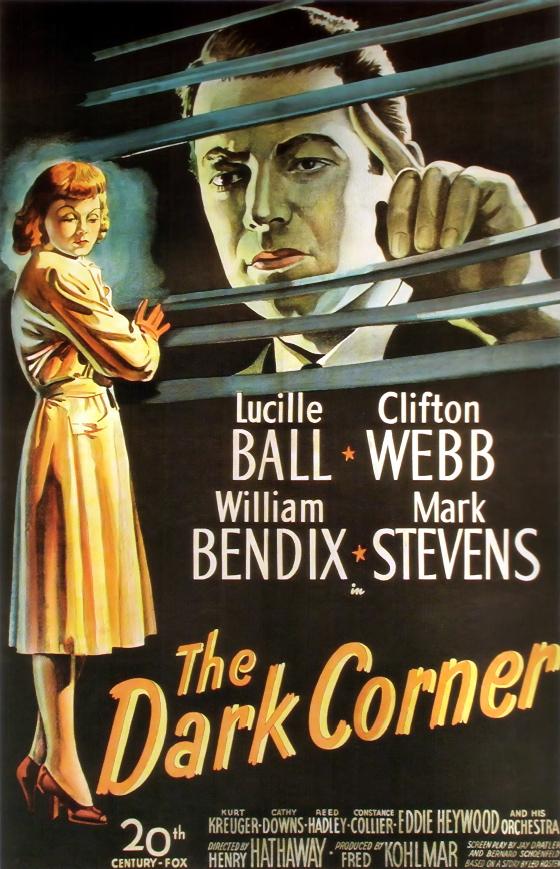
With this little speech, the hardboiled private-eye protagonist of Henry Hathaway's
The Dark Corner, from 1946, leaves the world of 30s pulp fiction where he was born and enters the realm of the film noir
He's lost the romantic nobility of the traditional private eye, summed
up by Raymond Chandler when describing his idea of the hero in a work
of detective fiction —
“Down these mean streets a man must go who is not himself mean,
who is neither tarnished nor afraid.”


The hero of
The Dark Corner, played by Mark Stevens, is
tarnished by a past frame-up for manslaughter, almost unhinged by the
memory of his impotence in the situation, his sense that it will follow
him forever and destroy him in the end.  He's a tough guy, not
afraid of taking his licks but gripped by the dread of a consuming
darkness he doesn't understand and so can't control.  The film
documents what is for him essentially an existential nervous breakdown.


His secretary, played by the still luscious, pre-ditzy Lucille Ball, mothers him,
bucks him up, challenges him to get his act together.  She saves
him — but it's clear enough that she could shatter him, too.  Her
strength is a gift which he can't match.  She has, in other words,
all the power of a
femme fatale — she simply chooses not to exercise it.


The male neurosis and confusion at the heart of the film constitute a
deconstruction of the traditional figure of the hardboiled private eye,
the wisecracking knight errant of Chandler's fiction.  This
private eye is “wailing on the margin of nonentity”, in Blake's great
phrase, held back from the abyss only by Ball's unaccountable faith in
him.  You just have to imagine her losing her patience to project
yourself into the darker universe of even bleaker
noirs like Out Of the Past, where the fatal femmes rule.

ON DANGEROUS GROUND


Nicholas Ray's
On Dangerous Ground is a problematic film noir on many grounds but in an odd way it helps define the genre.  More precisely, it helps us realize that film noir
isn't really a genre at all but a way of identifying a particular
strain of post-WWII dread as it came to infect many different kinds of
film.


This strain was characterized by a sense that the world had gone
hopelessly wrong, that existing paradigms for male identity were
suddenly useless in terms of setting anything right, that women, faced
with the existential nullity of men, were sudddenly in a position to
destroy them at will.


It's this profound and comprehensive existential dread that distinguishes
film noir
from the dark pulp fiction of the Thirties, which investigated the
corruption of American society through the eyes of cynical but
personally incorruptible men like Chandler's Phillip Marlowe, or the
crime thrillers which gave us glimpses of the underworld while still
positing forces which could combat and contain it.


These popular forms took us on a tour of the wild side, the dark side of American culture, but the
film noir suggested that there was no other side.


On Dangerous Ground violates every standard rule of Hollywood storytelling, and eventually most rules of the noir
tradition.  The dream logic that propels the narratives of all
great suspense thrillers is stretched beyond conventional bounds —
just as in dreams sometimes incidents occur which make us realize, even
in the middle of the dream, that we must be dreaming.


Robert Ryan plays a cop on the edge of a total breakdown, overcome by
the sheer meanness of streets which can't be policed effectively except
by adopting the rules of the bad guys.  For his own good he's sent
out to a rural community to help with a murder investigation, but
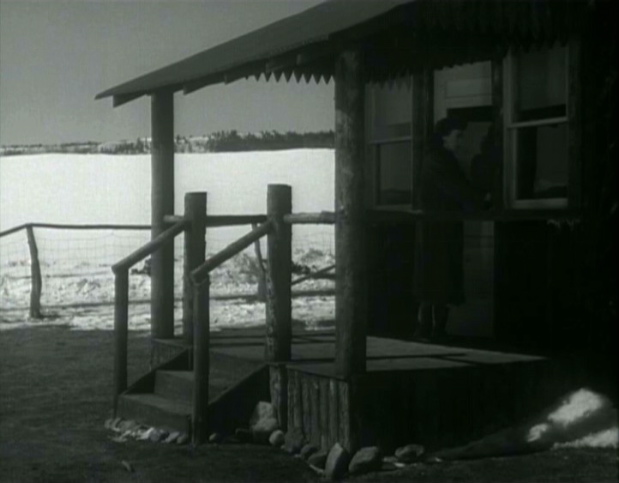
there's nothing redemptive about the country he enters.  Bleak,
snow-covered, peopled by vicious, suspicious, isolated farm-dwellers,
it's just as soul-killing as the city he's left.  It reminds one
of the landscape of Bergman's
Winter Light — a place where the soul shrivels and dies.


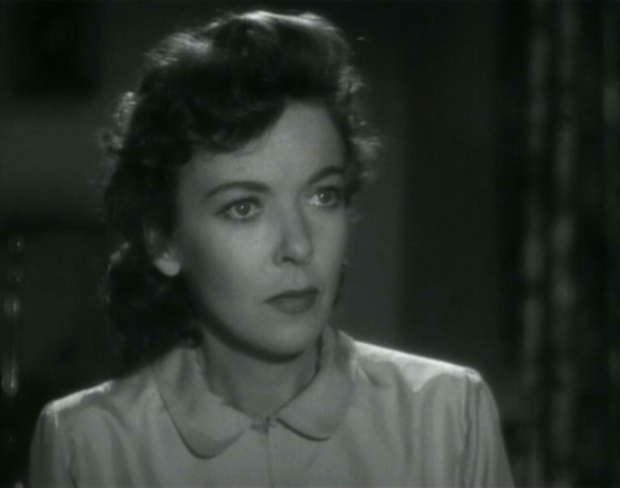
But then he meets a woman, played by Ida Lupino — not the traditional
femme fatale who waits to ensnare and destroy lost men in many films noirs
. . . but a blind woman paradoxically attracted by his distant,
unengaged treatment of her.  His failure to pity or patronize her
gives her a sense of power, encourages her to trust him,
irrationally.  And that trust saves him, gives his existence some
meaning.


The film, made at RKO, was much meddled with by studio head Howard
Hughes, which may account in part for its disjointed tone.  Ray
disowned the film in later years, saying that Ryan's redemption
involved a miracle and that he didn't believe in miracles.


But the film believes in this particular miracle, and that's all that
counts.  And even the miracle fails to violate entirely the dark
vision of the
film noir,
since it presents us with a love that's possible only because both
partners in it are disabled, outsiders, in touch finally with their own
despair because they're able to recognize it in each other.


You could call it a religious film — and you wouldn't be far wrong.

FROM CANVAS TO SCREEN

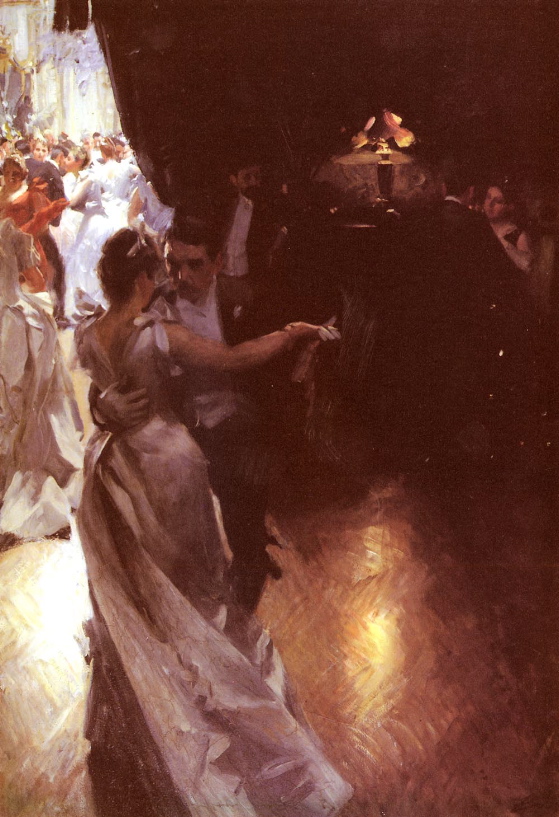
Here is Anders Zorn at his most academic.  The composition offers a dramatic illusion of deep space, with an optical integrity which evokes the photograph — but it’s all inflected with the suggestion of narrative, as we’re invited into the darkened area just off the ballroom where private intercourse is taking place.

And yet for all this we still have Zorn’s delightful treatment of the
surface of the canvas, with its sensual strokes reminiscent of the
Impressionist style, its magical ability to render the subtlest play of light.


The total effect can only be described as cinematic — and wouldn’t it
be nice if cinema offered more images as exciting as this one, visually
and plastically?


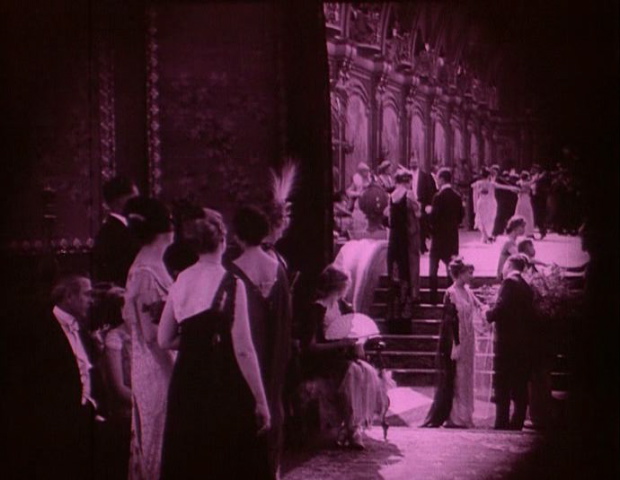
I think it’s possible that this image was in the back of D. W. Griffith’s mind when he composed the shot below from Intolerance, with its own darkened area just off a ballroom that opens up brightly behind it:

As I’ve written before, we tend to see early film as a medium emerging
from the Victorian stage, but Griffith himself wrote this about Intolerance:


“You will see the world’s greatest paintings come to life and move and have their being before your eyes.”

The important thing to remember is that painting itself, even before
the invention of movies, was aspiring to the condition of cinema.
The spatial depth of Zorn’s image, its desire to evoke movement in
space, found a kind of fulfillment in the cinema, especially in the
cinema of D. W. Griffith.

NOIR, NOT NOIR: LAURA


Film noir

is sometimes used as a catch-all phrase to designate any film from the
1940s or 1950s which has moody black-and-white photography, snappy,
cynical dialogue and some sort of crime element in its plot.  In
the process, the term becomes too vague to be really useful.


Gritty underworld crime dramas have been with us since the early silent
era, as has moody expressionistic cinematography, and the private-eye
murder mysteries of the early 40s had plenty of snappy, cynical
dialogue.  But the true
film noir
didn't emerge until after WWII and it brought something new to
Hollywood cinema — a comprehensive vision of the modern world as a
dark, hopeless place, morally compromised at its core.


Underworld crime dramas could be dark, but they always imagined forces
of order and decency ready to do battle with and overcome the forces of
chaos and destruction.  The private eye, for all his cynical talk,
had a kind of nobility and honor that he carried with him into the
shadowy realms in pursuit of truth and rough justice.


Traditional crime dramas and police or agency procedurals continued on
into the post-war era, as did murder mysteries, and though they became
inflected with the atmosphere of true
films noirs they didn't stake out quite the same territory.


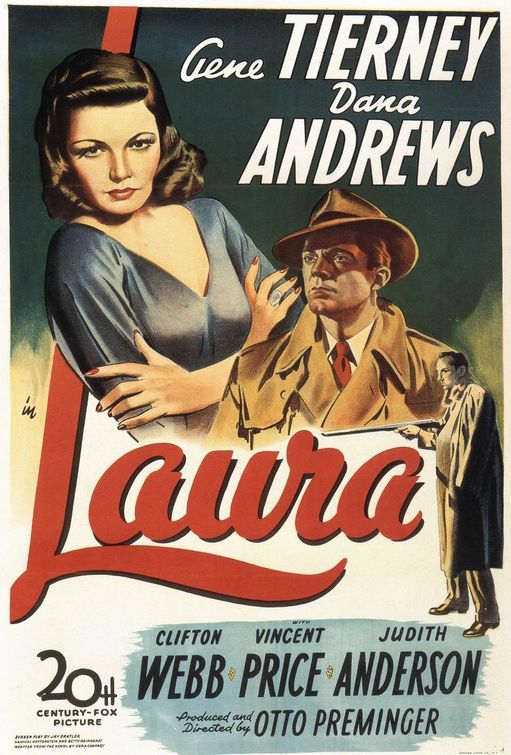
Laura, made during WWII, is
one of the most stylish and diverting entertainments ever concocted in
Hollywood, and it's regularly classed as an early
film noir
— but it's nothing of the kind.  The film believes in romance and
love, in the triumph of justice and the possibility of knowing the
truth about things.  In a genuine
film noir this sort of faith has been lost.


Still, one can see themes emerging in
Laura which will play out more forcefully in film noir
Laura, the film's title character, is an unusually strong and
self-reliant woman, emotionally and financially independent.  She
destroys a weak man who loves her but can't win her — as does the
femme fatale of the post-war noir
tradition.  But Laura's strength is seen as a positive thing here,
not as an insidious threat, and there's a red-blooded man on the scene
who can match her strength.


In the post-war
noir,
something goes wrong with the whole idea of the red-blooded man, who suddenly
seems inadequate to the task of engaging a corrupt world or matching
the strength of a self-possessed woman.  The world, and desire
itself, come to seem like streets that dead-end in disaster and
oblivion.  Some lines from
Two Noble Kinsmen, probably by Shakespeare, who co-wrote the play with John Fletcher, anticipate the realm of the film noir nicely:

This world's a city full of straying streets,

And death's the market-place where each one meets.

SIDESHOW


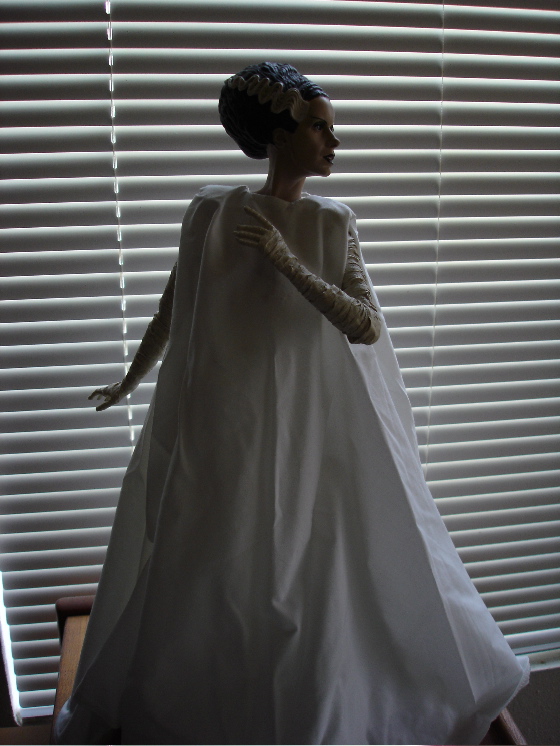
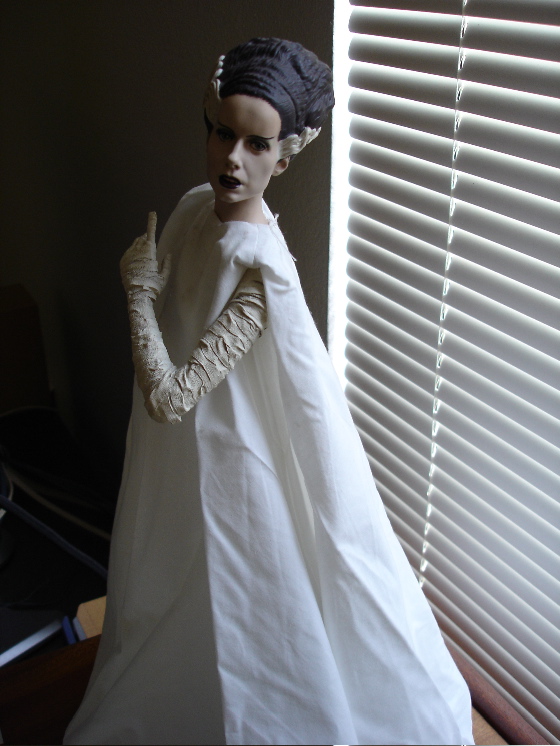
The amazing object above is an 18″ statuette of the Bride Of Frankenstein made by Sideshow Collectibles.


Sideshow
started out as a model and miniature shop for the film business, with a
sideline in design and sculpting for toy companies.  Back in the late 90s, Sideshow
decided it could make better toys, and have more fun, if it got into manufacturing and
so started its own line of 8″ figures of characters from the classic Universal
horror films.


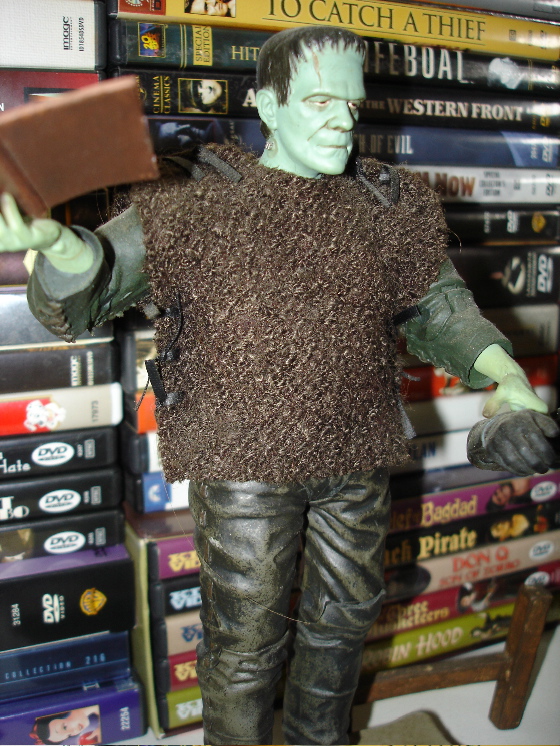
My sister,
shopping for toys for her kids one day, ran into the really
extraordinary 8″ figure they made based on the monster from
The Son Of
Frankenstein
.  She thought I would like it and bought me
one.  I loved it — thought it was head and shoulders above other
Universal figures I'd seen, with its first-rate sculpting and its
attention to details in the acccessories.  It became one of my
prize possessions — one of my
penates, my household gods.


A lot of other
people felt the same way — the 8″ line sold incredibly well and
inspired the company to get more ambitious.  I'd checked out the
other 8″ Universal figures but only really liked the bride from
The Bride Of Frankenstein.  The first 12″ Sideshow figure I saw blew me away, though — Lon Chaney's Erik, from The Phantom Of the Opera,
in his Masque of the Red Death costume.  (See it
here.)  It
remains one of the greatest 12″ action figures of all time.


Again, it was my sister who discovered it and bought it for me. 
Tragically, I discovered that almost everything Sideshow produced in
the 12″ format was brilliant.  I started collecting them
feverishly.  They would sell out quickly in retail establishments
and on Sideshow's web site, so I had to track many down on eBay.


The success of the 12″ line, which came to include historical
figures as well as characters from TV shows, led Sideshow to up the
ante again with their 18″ line.  These were not fully articulated
action figures.  Sometimes they had slightly posable wire
armatures, sometimes they were cast fully in polystone.  The best
of them — like the vampire from Murnau's
Nosferatu — were real works of art.


They were so expensive that, sadly, I had to get more
selective.  I couldn't resist the 18″ Bride, figure, though. 
She's just amazing.


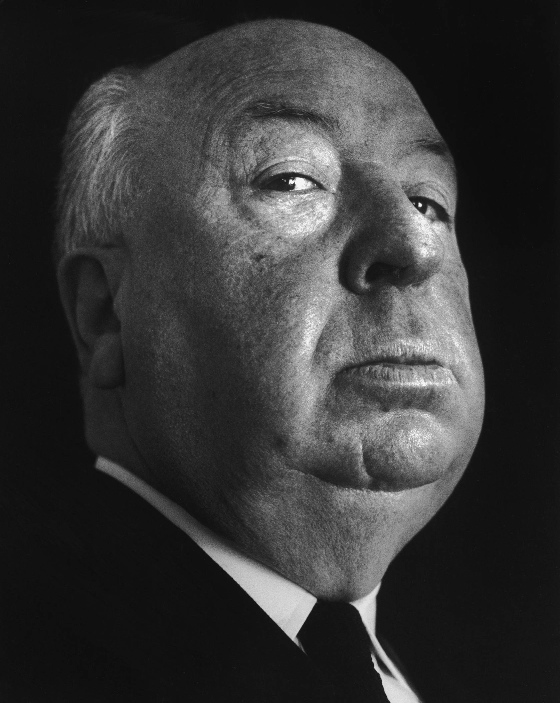
CAMILLE PAGLIA ON ALFRED HITCHCOCK


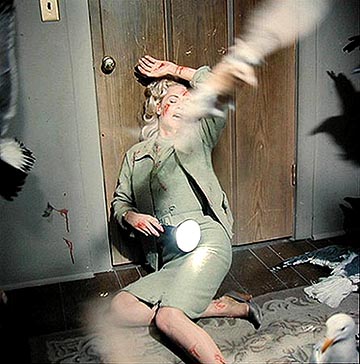
“Space is like an opaque medium that Hitchcock knows how to carve, trim and slice as if it were a side of beef.”


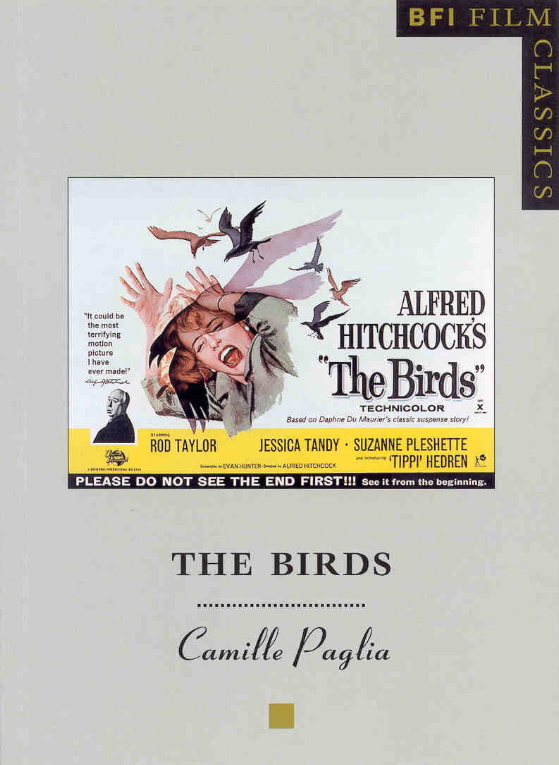
This is from Paglia's book-length essay on
The Birds
— and what she says of Hitchcock is true of all the great directors,
who carve up and reshape space before our eyes, drawing us ever deeper into the
spatial illusion of the cinematic image, the core of its sensual appeal and the
primary medium of its emotional expressiveness.  This malleability
of space,
its ability to be carved and reshaped in cinema, is what places cinema squarely among the plastic arts.

It's a hard concept to grasp, which is why film is traditionally
analyzed in terminology derived from the visual arts, like painting, or
the literary arts, like theater and the novel, even though its most
powerful effects more closely resemble those of sculpture, architecture
and dance.  Albert Einstein said, “Space is not merely a
background for events, but possesses an autonomous structure.” 
Film does not simply create occasions for visual or literary events — it
investigates the structure
of space, associates the structure of space with the structure of
dreams. Orson Welles said that on some level every great film is a chase — which is
just another way of saying that on some level every great film is about space.


[Paglia's short book on
The Birds,
published as part of the BFI Film Classics series, doesn't, to me, get
at the heart of the film's themes, but it's an exhilarating
intellectual
tour de force
with a dazzling range of allusions to other works of art and to the
cultural matrix from which the film emerged.  It's an
indispensable text.]

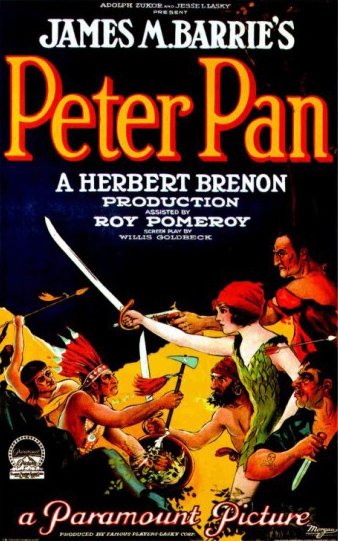
PETER PAN (1924)


The first half hour of Herbert Brennon’s Peter Pan is an extraordinary piece of filmmaking, masterful in a delicate and unusual way.

Almost all of it takes place in the Darling nursery, on a set that is shot
from basically one angle and seems designed to suggest a theatrical
stage. I’m guessing that this was a deliberate strategy, meant to
associate the film with the celebrated stage productions of Barrie’s
play, even though it was somewhat anachronistic for a film from 1924. Brennon,
however, has taken this limitation as a challenge, and in his own
subtle way has mastered it.


The long shots of the set, with a frame that seems to mimic a proscenium
arch, are lit with extraordinary care by James Wong Howe. He achieves a
stunning impression of depth in the way his lights define discrete
spaces within the room and sculpt individual figures within those
spaces. Brennon’s choreography of movement within the constricted
location reinforces the stereometric nature of Howe’s lighting.

Slowly, and with great subtlety, Brennon allows his camera to tentatively
explore this space from slightly different angles — almost like a
tease. We never feel that our general sense of watching a stage play is
challenged — but seem suddenly, briefly transported up onto the stage
for a privileged view of the action, as in a dream.

The lighting shifts progressively throughout the sequence in a decidedly
expressionistic way — from the high illumination of the opening to the
more atmospheric shadows of the room lit by the nightlights. Then Peter
appears, and the gears shift radically. Wendy sews Peter’s shadow back
on in a gorgeous half-silhouette downstage, then Peter dances with his
shadow in a circle of light, shot from slightly above, that seems to
have no logical source.

When Peter teaches the Darling children to fly, our head-on view of the set
is explicitly violated as we see one of the boys flying up towards a
camera placed near the ceiling and shooting in a near-reverse angle to
the one we’ve mostly been watching from. It’s a shocking and magical
shift — echoing the shock and magic of the child’s first flight.

Alas, the rest of the film, in Never Land, is not as magical as this first
act. The Catalina locations, the studio forest and underground lair,
the actors in animal costumes and the actors in human costumes never
quite cohere into a vision, despite many delightful passages. The final
action sequence on the pirate ship is confused and dull — until the
wondrously choreographed sword battle between the Lost Boys and the
pirates lifts it all into magic once again.


The special effects vary in quality, too. Most of the wire-work flying is
well done, but the flight of the pirate ship at the end is
underwhelming, and some of the superimpositions involving Tinkerbell
are poorly executed.


This is a title-heavy film, but the titles are faithful to Barrie’s truly
charming text, tastefully selected and arranged.


The general result is a very uneven but endlessly fascinating film.
Brennon’s vaguely perverse sensibility, always delivered with a
gossamer touch, is evident most especially in his use and appreciation
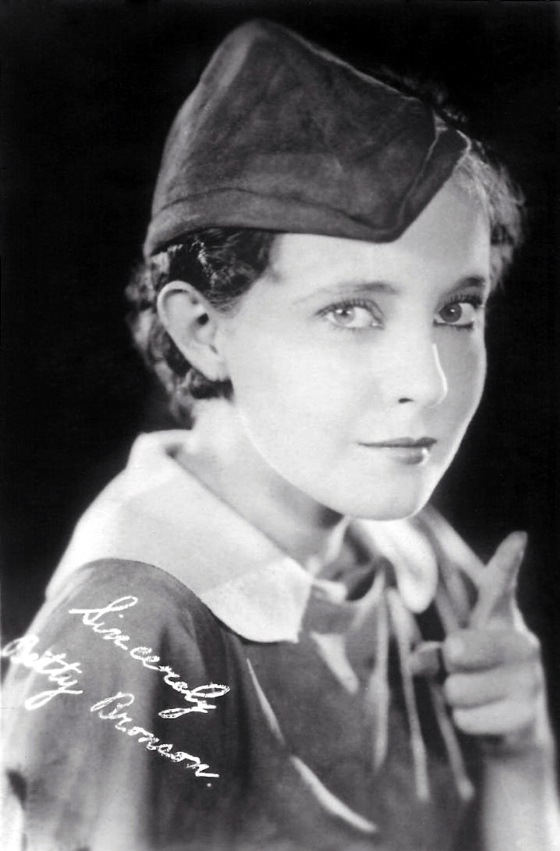
of Betty Bronson in the title role. She dances the part in a frankly
sensual way, and she is unmistakably and delightfully female — which
allows Brennon to exploit an unmentionable eroticism in certain
passages.

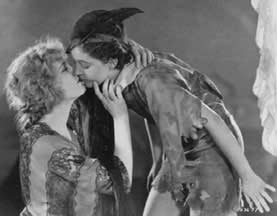
The half-silhouetted shadow-sewing sequence between Wendy and
Peter has the quality of a sexual encounter, and there is nothing
innocent in the numerous kissing scenes — between Bronson and Mary Brian,
Bronson and Anna Mae Wong, Bronson and Esther Ralston.


When Peter lies down to sleep on the leaf bed after Wendy and the Lost Boys have left the underground lair, Bronson is photographed in a languorous and sensual and purely
feminine pose — which gives Captain Hook’s spying on her a wholly different spin than the narrative might suggest. Hook’s hatred of Peter reads as thwarted lust, pure and simple. He knows as well as we do that the creature on that bed is a woman.


Sex in silent movies was a lot more interesting than it is in movies today.

A MCGINNIS FOR TODAY

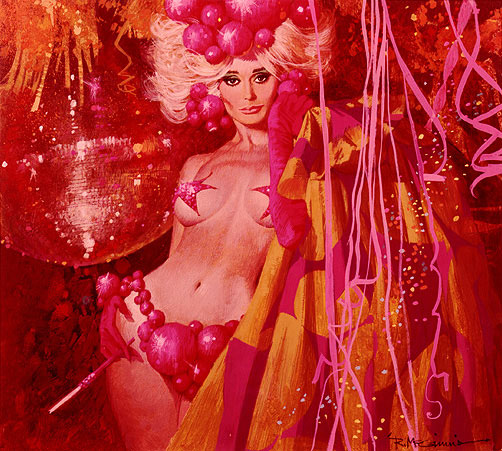
Here’s Robert McGinnis‘s evocation of a Vegas showgirl.  A master of paperback cover art for pulp fiction, McGinnis got the point-of-sale appeal of such covers down to a science.  I’d buy whatever book this painting graced the cover of, even though I knew in my heart that it would never live up to the image’s promise.

MEXICO AND FILM NOIR

Mexico has always had a peculiar place in the popular American imagination.
It has generally tended to represent a kind of mirror world where the
subconscious could emerge into the light — where desire, fear, death,
despair, escape from responsibility and propriety could show themselves plainly.

There is chauvinism involved here, of course, a sense of Mexico as a
primitive country, but also an appreciation of the positive genius of Mexican
culture, its sensuality, its frank engagement with death and violence,
with things that the official culture of America prefers to keep hidden
in the shadows.


WWII exposed those hidden things for a generation of Americans and in its wake film noir began a systematic investigation of the shadow world at the fringes
(and somehow also at the heart) of American culture.  In the
process, Mexico took on a new aura.  It became a kind of shimmering
paradise, the locus of an honesty and innocence that no longer seemed
feasible along the mean streets and lost highways of post-WWII America.


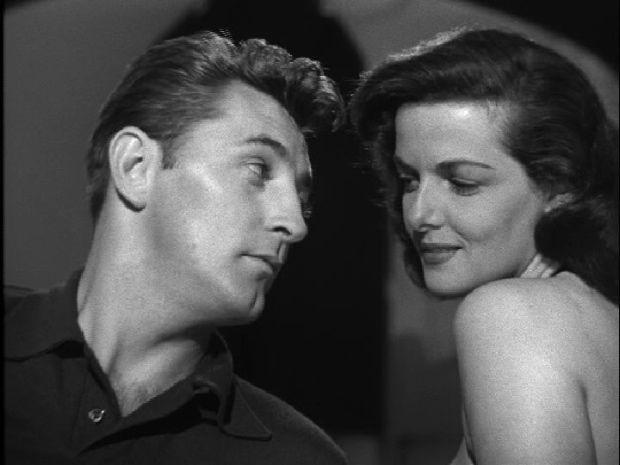
So in Out Of the Past, Robert Mitchum and Jane Greer live out a doomed idyll in Mexico, on the run from a gangster who has his hooks into both of them.  When they try to carry that idyll north of the border, integrate it into a new life there, they’re both destroyed.

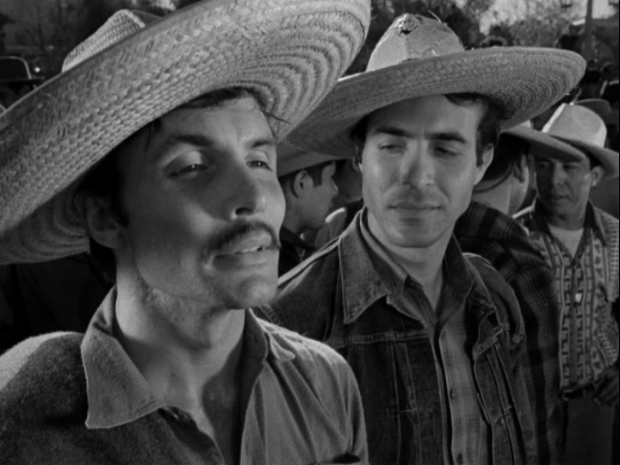
In Border Incident, decent Mexican peasants are exploited and sometimes murdered by powerful American businessmen north of the border who traffic illegally in their labor.  (Border Incident, while it deals with a number of themes from classic film noir, departs from the tradition by positing good-guy government agents as saviors of the peasants, thus violating the cosmic cynicism and skepticism of the true film noir.)


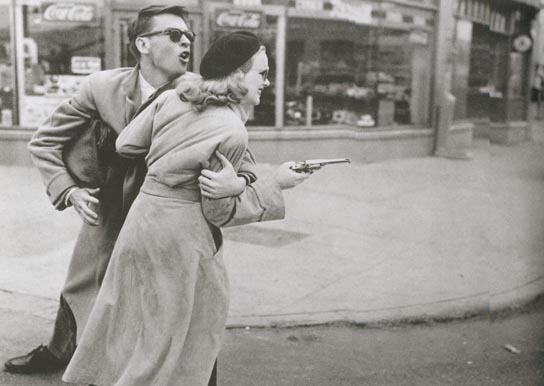
In Gun Crazy, the young couple possessed by a mad love, a love fuelled by irrational violence, are just a few hours away from a safe passage over the border when their crimes catch up with them and send them on a final hopeless flight from retribution and death.

The nuttiest use of Mexico in film noir can be found in what may be the nuttiest of all films noirs, His Kind Of Woman.  The movie starts off fairly traditionally, with Robert Mitchum as a down-on-his-luck gambler who’s hustled into taking a mysterious job south of the border.  As soon as he arrives in Mexico it’s like he’s gone to Oz.  He walks into a dingy cantina about the size of a phone booth and in a back room, about half the size of a phone booth, he finds Jane Russell singing Five Little Miles From San Berdoo accompanied by two Mexican musicians doing cool jazz riffs on guitar and piano.  Things get so nutty after that that the whole noir genre is pretty much deconstructed by the time it’s all over.


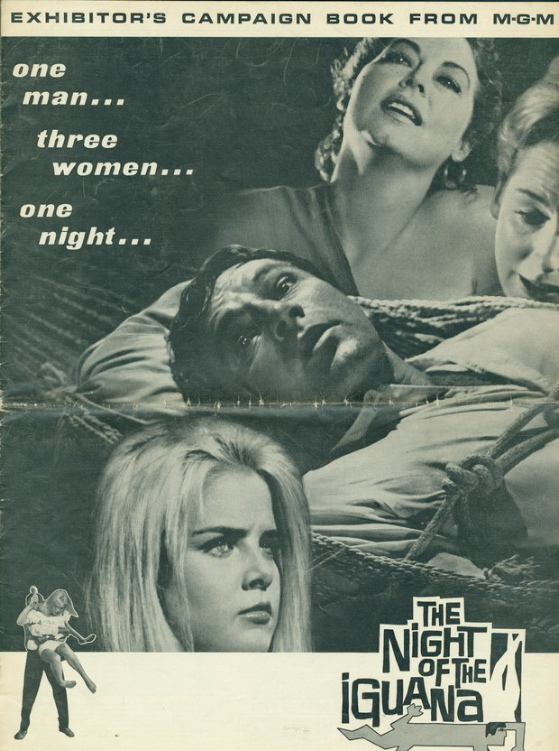
As film noir played itself out in the 50s, the image of Mexico in American art shifted back to a more familiar form.  In the Tennessee Williams play The Night Of the Iguana (and in John Huston’s film adaptation of  it), in Peckinpah’s Bring Me the Head Of Alfredo Garcia, in Huston’s film of Under the Vocano, Mexico became once more a portal of Hell, where lost American souls went to confront their demons — in an unequal contest which the demons were always fated to win.

In the light of this peculiar history, it’s interesting to look at a recent film, the post-modern film noir The Three Burials Of Melquiades Estrada.  There another troubled American soul heads south of the border on a quest for a lost paradise — only to discover that the paradise wasn’t really lost because it never really existed.  And it doesn’t matter.  We realize by the end that the quest itself has redeemed and saved him.  The film was written by a Mexican, who knows that Mexico is neither Paradise nor Hell . . . except in the dreams of lost souls on both sides of the line.

[For more thoughts on Mexico and film noir go here.]

THE CIGARETTE POLICE


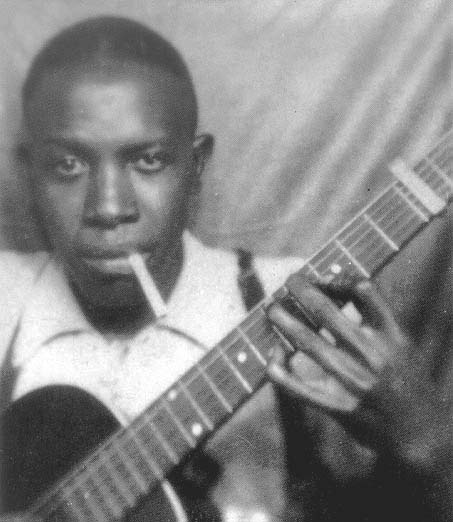
Above is one of the few authentic photographs of Robert Johnson, the
great blues artist.  Having allegedly made a bargain with the
Devil to acquire his almost supernatural musical gift he was probably
not too worried about the health effects of
smoking, but others are worrying on his behalf — and yours.  A
U. S. postage stamp made from the photograph removed the cigarette from
his mouth.

Robert Johnson paid for this photobooth portrait, and
this was how he chose to present himself before the camera's eternal
gaze, with the haunted eyes and the spidery fingers on the frets of his
guitar and the cigarette dangling from his lips.  I wonder if the
bureaucrats who decided to alter his image of himself ever really
listened to his music — ever realized that the hellhounds on Robert Johnson's trail were also on theirs.


Below is a link to a Boing Boing post about the removal of cigarettes from historical images of literary and pop culture
figures:

The Cigarette Police


As
a kid I remember being horrified to learn that the Soviet government
would rewrite the “factual” content of encyclopedias to reflect the
current political climate. Now Western governments and corporate
entities (like there's a difference between the two) are tidying
up history to reflect current policies of social hygiene.


You
may see a big difference between these two forms of historical
revisionism but the phenomena are intimately related in principal —
both involve large state and corporate interests appropriating history and
changing it at will. They are, in other words, staking a claim to the
ownership of history, and by extension reality.

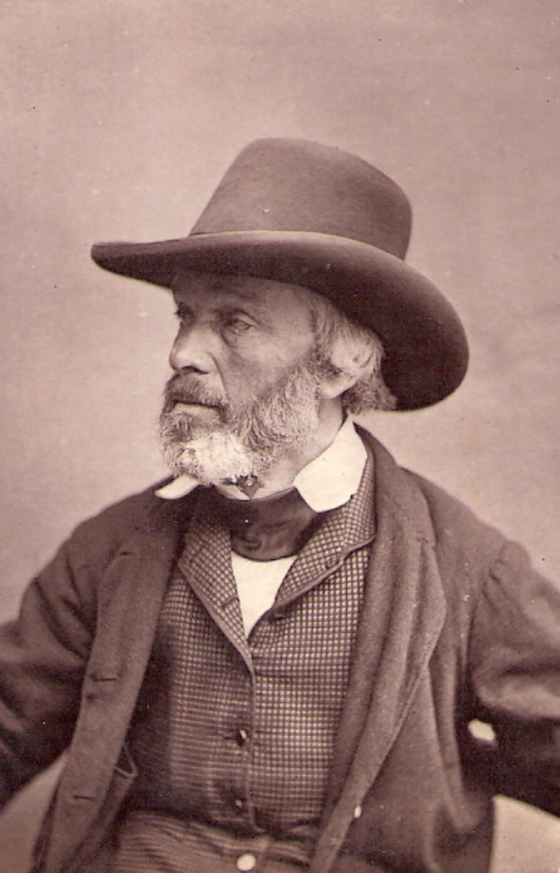
THOMAS CARLYLE ON ALFRED HITCHCOCK


Actually, this is Carlyle (pictured below) on Dickens, but the application to Hitchcock is clear enough:


“. . . deeper than all, if one has the eye to see deep enough, dark,
fateful, silent elements, tragical to look upon, and hiding amid
dazzling radiances as of the sun, the elements of death itself.”


Dickens and Hitchcock both hid within the conventions of popular art,
and one misses a lot, one misses close to everything, if one takes
their disguises too literally.