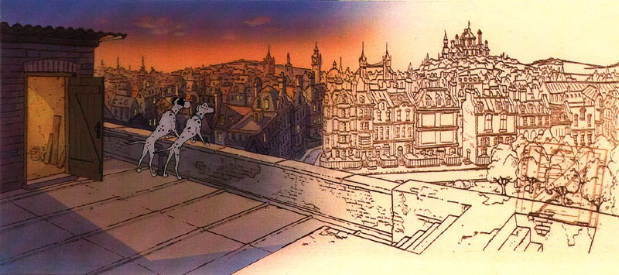
101 DALMATIANS

Above is some beautiful concept art from one of my favorite Disney animated features, 101 Dalmatians.

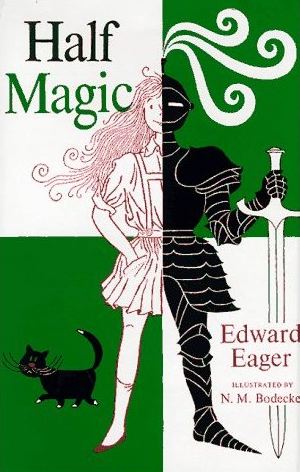
Compared to the classic fairytale epics, this film is almost a chamber piece, with a quiet, cozy, gentle humor — interrupted, of course by the delirious Grand Guignol of Cruella DeVille.  Its modernistic (for 1961) line-drawing style reminds me of the work of the great N. M. Bodecker, who did the wonderful illustrations for the Edward Eager magic-themed children’s books.


Despite its reaching for a newer, more linear style, and the fact that it used Xeroxing to help in the transfer of the artists’ drawings to the cels, 101 Dalmatians has a fully animated look and makes exciting use of composition and animation in depth. It’s the perfect film for a winter’s night by the fire, with some cookies and a cup of hot chocolate.

CINEMA AS A PLASTIC ART: A PREAMBLE


Moving picture images are magical not because they move, not because they can efficiently convey factual or narrative information, and not because they can be composed to produce pleasing graphic effects — although, of course, they can do all of these things.  Moving picture images are magical because they can create the illusion of a space on the other side of the screen into which we look and into which we project ourselves experientially.

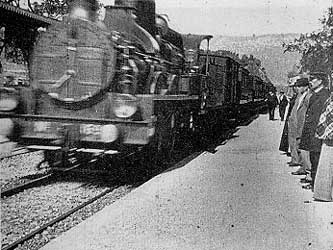
The fascination and appeal of this illusion can be simple, even crude — witness the famous story of the first public projection of the Lumière brothers’ Train Arriving In A Station, in which a train, moving on an angle almost directly towards the camera, caused spectators to duck and scream, as though they thought the train might might leave the illusory space of the projected image and penetrate the real space of the auditorium.


Of course it’s doubtful that people actually felt themselves in danger from the projected image — the reaction was physiological.  When you see something that looks big and solid and seems to be hurtling towards you, you duck first and think later — very much the way a Cinerama traveling shot filmed from the front of a roller-coaster car can cause slight nausea.  The eye tricks the body into a physical response.

Our eyes, conditioned by long experience watching moving pictures, are not as innocent as the eyes of the people who ducked and screamed at the Lumières’ train, but we still react viscerally to the imaginary space on the other side of the movie screen.  Shots which emphasize the illusion of space on the other side of the screen still draw us imaginatively into that space, cause or allow us to participate more fully in the action that seems to be going
on there.

When lighting or framing or camera movement or choreography of action within the frame intensifies the spatial illusion, our attention becomes more focussed, our ability to project ourselves into the action of the film more pronounced.  This is something all great directors have known, consciously or intuitively — as they have known how to manipulate the phenomenon for specific emotional effects.

It would seem that most of the truly great directors understood the phenomenon intuitively.  Griffith’s first film, made in 1908, works hard to create the illusion of spatial depth and to exploit it in every shot — something that was far from routine in films, especially narrative films, of the time.


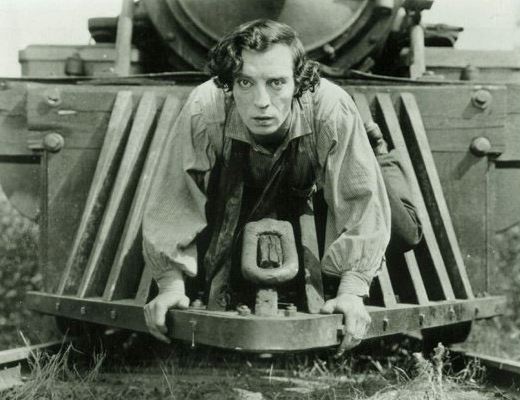
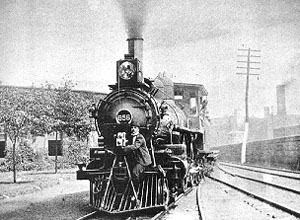
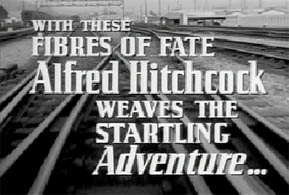
Hitchcock, a child at around this same time in the development of movies, said the first films that captured his imagination were part of a non-narrative series called Phantom Train Rides, in which a camera was mounted on the front of train and simply filmed the unfolding journey, penetrating space and thus emphasizing the spatial illusion of the film image.  (One such film, From Leadville To Aspen, with a brief interpolated narrative plot, can be seen on the More Treasures From American Film Archives DVD box set — and the opening of Strangers On A Train has an exceptionally beautiful shot, used also in the trailer for the film, below, from the front of a moving train that echoes the technique of the Phantom Train Rides.)


Hitchcock also said that when he was a teenager what impressed him most about American movies was their use of backlighting to separate foreground figures from backgrounds, to give the impression of “relief” — spatial depth.

The techniques listed above for intensifying spatial illusion in movies all tend to exploit the basic three-dimensional quality of the photographic image, its optical coherence with regard to perspective, to give the impression of a space which is malleable, filled with potential for movement within it.  They reveal the illusion of cinematic space as something akin to real space, which can be redefined and re-analyzed by movement, molded — as something, in short, which is plastic.

Film images are routinely analyzed for their graphic qualities and for their factual or narrative content, but they are very rarely analyzed for their plastic qualities, even though these qualities are precisely the ones which constitute their power and seductiveness, the ones on which our responses to a film are primarily based.

There needs to be a whole new criticism of film centered on its identity as a plastic art.

A DIRECTOR'S LIFE


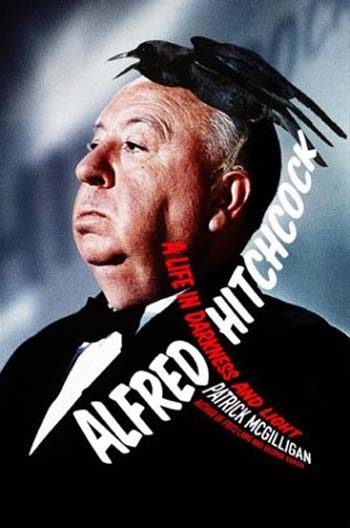
Alfred Hitchcock: A Life In Darkness and Light

may be the best biography of a film director ever written.  Long
and detailed, filled with fascinating information about all aspects of
Hitchcock's life and films, it's also a great read, almost as
entertaining as a Hitchcock film.


There have been two previous full-scale biographies of the director. 
Hitch,
by John Russell Taylor, was published in Hitchcock's lifetime and with
his cooperation — it sets forth the basic facts without delving too
deeply into problematic areas.  Donald Spoto's well-known
The Dark Side Of Genius,
published a couple of years after the director's death, was more
detailed and uninhibited but, as its title suggests, had a somewhat
slanted point of view.  It marshaled evidence and highlighted it
in such a way as to expose primarily the neurotic and malicious side of
the man.


Patrick McGilligan, as his title suggests, tries for a more balanced
view, and specifically challenges many of Spoto's interpretations of
events and sources, while treading fearlessly into territory that
Taylor avoided.


None of the books solves the mystery of Hitchcock's genius and art,
because genius and art are mysteries without solutions, but in
McGilligan one finds a plausible Hitchcock, one that contains all the
complexity and contradiction of the films themselves, the darkness and
the light.


It's a terrific achievement.


[Apologies for the web log's disappearance for a couple of days — it
exceeded its allotted bandwidth     . . . too many visitors!  I think
the problem has been solved, and thanks for the interest!]

ISLE OF THE DEAD

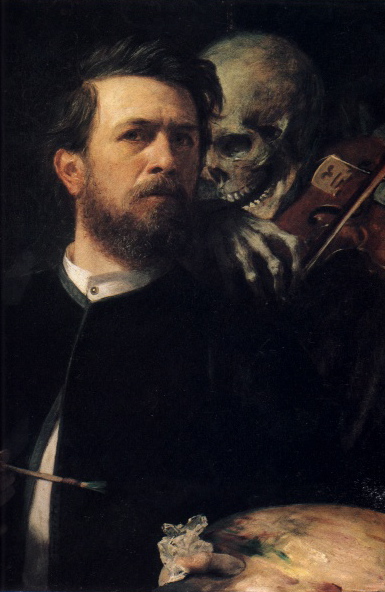
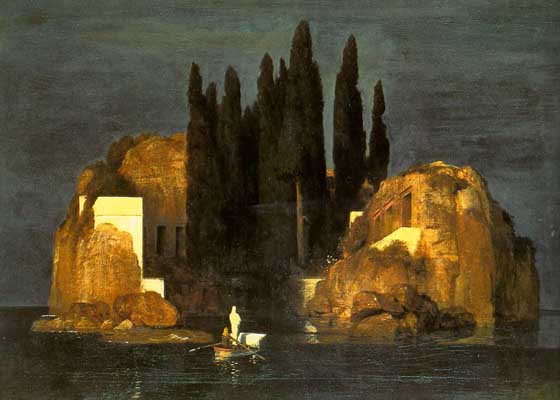
Above is an amazing image by the 19th-Century Swiss symbolist painter Arnold Böcklin — Self Portrait With Death.  I stumbled across it while looking for another Böcklin painting, The Isle Of the Dead, which Hitchcock reportedly used as a visual frame of reference for Vertigo.

The Isle Of the Dead (below) is almost as spooky as the self-portrait, and while it’s not referenced directly in Vertigo, its mood and basic visual strategy obviously informed a lot of the film’s compositions involving Madeleine, the ghostly, morbidly-obsessed heroine, who often appears as a distant, deathly-still figure set against backgrounds of dark trees and the sea.

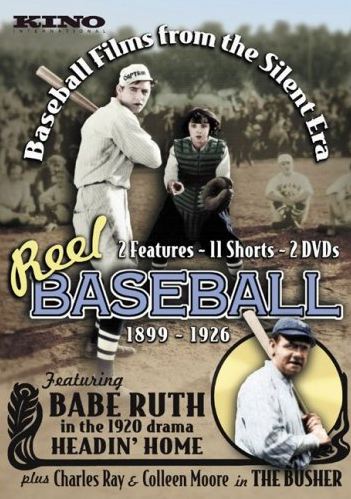
HEADIN' HOME


Unless you're one yourself it's probably hard to
imagine how wondrous and magical it is for a baseball fan to watch Headin' Home — one of the films on Kino's new silent-era baseball
set.

The film features Babe Ruth looking unbelievably young
and unusually lanky.  The year was 1920 and the Bambino had just been
traded to the Yankees — a year later he would have the most incredible
season any baseball player has ever had and probably ever will have. 
(He hit 59 home runs that year — a recent book estimates that under
modern rules and field dimensions the total would have probably been
101, all with the old “dead ball”.)

Ruth looks remarkably composed in front of the camera,
even in the scenes that call for acting — his minimalist style has
aged very well.  But what's really stunning is just watching him move
— you see a physical grace and ease, an elegant self-possession, that
doesn't always come across in documentary footage of his on-the-field
play.

Roger Angell has suggested that a core appeal of
baseball in the urban America of the early 20th-Century was its aura of
the pastoral — its wide greensward, like a big enclosed meadow, and
its easy rhythms reminding transplanted urban dwellers of their rural
roots.  Headin' Home confirms this insight in a way.  It's conceit is
to construct a fictional biography of Ruth as the product of a small
town and small-town values.  This was a far cry from the Babe's actual
childhood on some of the meaner streets of Baltimore and in an
orphanage, but it represents how America wanted to view its baseball
heroes.

It must have been strange for Ruth to enact the
fantasy youth conjured up for him by the filmmakers — choppin' down
trees, carvin' his own bats, eatin' mom's apple pie and goin' to the
church social — but he looks utterly nonplused by the whole exercise. 
(Ruth
had a delightful and quintessentially American matter-of-fact attitude
to everything.  When asked how he felt about making more money than
Herbert Hoover, the President of the United States, Ruth said, “I had a
better year than Hoover.”)

The film appears to have been shot somewhere in
Upstate New York, and it offers delightful images of small-town America
in 1920, including a wonderful recreation of a local ballgame between
rival small towns. 

The film also incorporates footage of Ruth in action
in an actual big-league game — part of a framing device in which an
old fellow attending the game reminisces about the Babe's youth “back
home” with genial if uninspired cracker-barrel wit.

But it's the physical presence of Ruth himself that
enchants, whatever he happens to be doing — it's like seeing
documentary footage of Achilles engaged in some amateur theatricals or
demonstrating his prowess with a spear . . . documentary footage of a
mythological being.

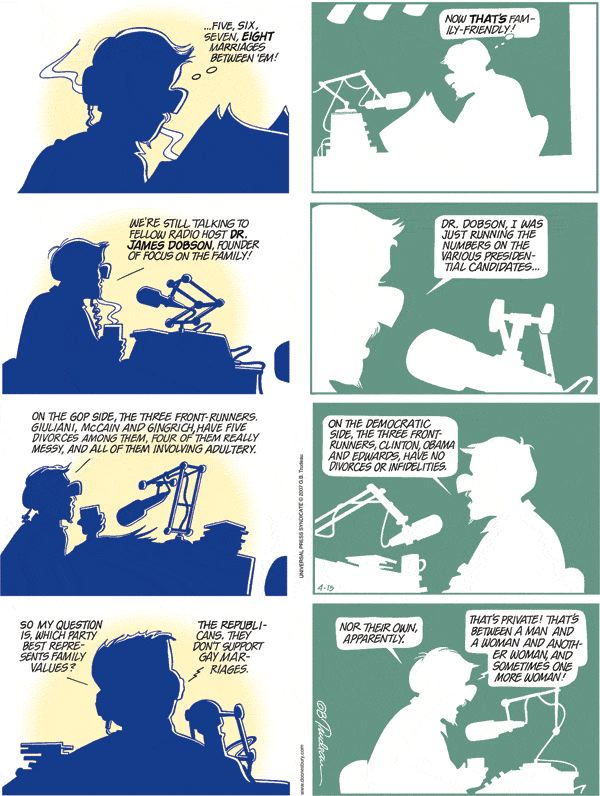
FAMILY VALUES


I'm not a big fan of
Doonesbury,
even though I feel a connection to Gary Trudeau, because he was few
years ahead of me at the New England prep school we both
attended.  His cartoons used to be featured in the school
newspaper, and the title of his comic strip derives from school slang
in the 60s, in which “doon” was a term roughly equivalent to “dork”.


I tend to share
Trudeau's political views, but find his expression of them a bit smug,
a bit self-righteous.  Too preppy, maybe.  Sometimes, though,
he really nails it . . .

JANE EYRE

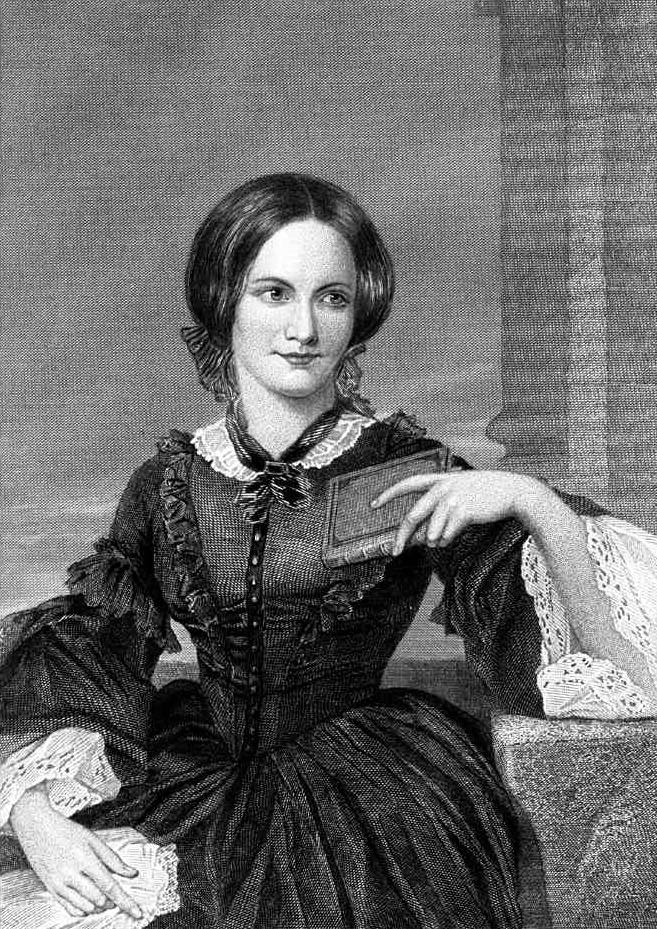
Jane Eyre by Charlotte Bronte (above) is over six hundred pages long, but it’s a page-turner . . . you just can’t put it down. Thackery said that about it when he first read it in 1847 — my experience of it a couple of years ago was no different. Part melodrama, part Gothic thriller, part love story, Jane Eyre is, of all the truly great novels, the most shamelessly entertaining. Wild coincidences, lurid situations, spectacular violence are called upon unselfconsciously to interest and thrill the reader — but nothing in the book is more interesting or more thrilling than Jane herself, Jane’s fearless voice.

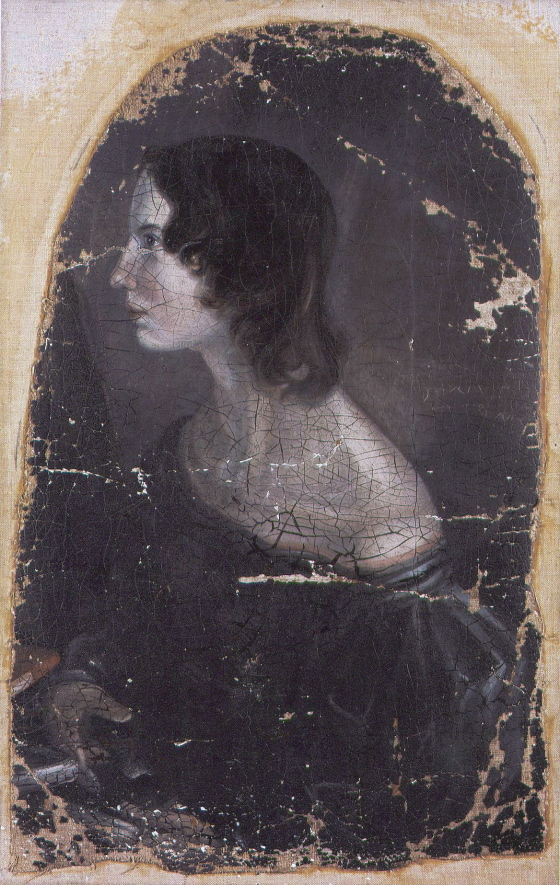
The fierceness of the female soul, the subtlety of the female heart, have rarely been so exposed in fiction, and almost never from the inside, as it were — Wuthering Heights by Charlotte’s sister Emily (below, as painted by her brother Branwell) being one other notable exception.

In Jane Eyre and Wuthering Heights we eavesdrop on a woman’s
conversation with herself. We do the same, at times, with Tolstoy’s
Natasha and Shakespeare’s Cleopatra — but their creators listen for
what men want to know about them. Jane Eyre tells us what’s important
to her, what she wants us to know.


I suppose it’s not surprising that these two Bronte sisters, who grew up
with their two other siblings in a world of their own among the
desolate moors, a world of imagination and intellect unconstrained by
the conventions of the Victorian patriarchy, should have developed such
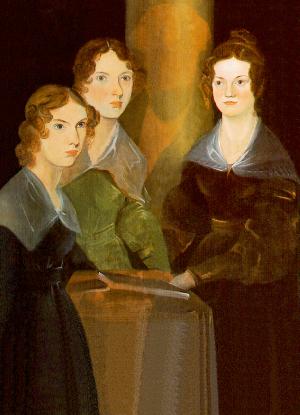
singular and courageous voices. (That’s Bramwell’s portrait of his
three sisters, Anne, Emily and
Charlotte, above.)  And not surprising, either, that their eventual experience of the wider world, where such voices from women
were hardly approved, led to a savage indignation — and a desire to
express it.  (Below is a picture of the Bronte family cottage in Haworth by the edge of the moors.)

The love story in Jane Eyre, however fantastical its setting, is the most
penetrating examination of love from a woman’s perspective ever penned.
In Mr. Rochester, Charlotte imagined an ideal man — ideal not because
he was good, or handsome, or gallant . . . but because he looked at
Jane and knew her, recognized at once her power and individuality. And
these things did not frighten Mr. Rochester — they delighted him.

Byron, writing a bit before Charlotte’s time, said of some current flame, “I
would, to be beloved by that woman, build and burn another Troy.” But
Jane would reply, “Before you set to work on Troy, look at me — know
me.” What was Troy to her? What, for that matter, had it been to Helen?

Mr. Rochester talked to Jane. What is more astonishing, he listened to her. That’s what made him her Achilles, her Hector, her Odysseus.

The uncanny thing about the book is that, in between all the Victorian
reticence and circumlocution, Charlotte’s voice sometimes sounds as
clearly and directly as an intimate friend whispering in one’s ear at a
formal ball. The voice is as alive, as frank, as modern, as the voice
of any 21st-Century girl. Jane Eyre is our ever present sister, here
and now — and we have to hope that, like Mr. Rochester, we have the
wisdom and the humanity to listen to what she has to say, and to love
her for the courage it takes her to say it.

THE BIRTH OF A NATION — PART TWO: A RACISM INDEX


The picture of Reconstruction presented in the second half of
The Birth Of A Nation is entirely bogus, but since it represents the views
of respected historians of the time we need to see it as expressing the
environmental racism of 1915.  That it did express racism, however, is
beyond doubt.  Radical Reconstruction sought to fully enfranchise
Southern blacks and bring them into full political and social equality
with whites.  Its ideals were decent, and ones that almost everyone
today would heartily endorse, but it was undoubtedly unrealistic in the
context of Southern society just after the end of the Civil War.  And
it wasn't only Southerners who were horrified at the notion of treating
blacks as free and equal citizens.  To many, the idea was both
ludicrous and repugnant.


Unwilling to oppose the idea of liberty and equality for all people,
opponents of Radical Reconstruction created a myth about it — that it
was a cynical ploy by unscrupulous Northern whites to maneuver
ignorant blacks into political power and then use that power themselves
to control and plunder the South.  Historians, out of a similar
prejudice against blacks, confirmed the myth as fact.


The myth, and the bogus historiography that seemed to confirm it, tried
to disguise an opposition to equality for blacks, but the disguise
comes apart in
The Birth Of A Nation, where attempts by blacks to
interact on terms of social equality with whites are presented as
outrages almost on a level with political and judicial corruption. 
Henry Walthall's Little Colonel grows steely-eyed when black soldiers
assert their right to walk on the sidewalk in front of his house, when
Silas Lynch offers to shake his hand — his look in those moments is
not so different from the chilling one he gives in reaction to the
death of his sister at the hands of a crazed black would-be rapist. 
Earlier, that same sister had reacted with a look of repugnance when
Stoneman's daughter publicly conversed, on perfectly innocent and civil
terms, with the mulatto Lynch.


In such attitudes we see the ugliest side of casual environmental
racism — the nastiness it could provoke when its assumptions were
challenged by “uppity” blacks . . . that is, blacks who presumed to be
entitled to the common respect and dignity accorded to whites.


Indeed, the pathological racism of
The Birth Of A Nation can be seen
as a kind of justification for this nastiness, by showing where such
presumption by blacks will inevitably lead — to sexual assaults by
black males on white females, to miscegenation.


This connection is established in the very first scenes of the second
half of the film.  In the wake of Lincoln's death and Stoneman's rise
to greater power, Stoneman's maid has now become his social equal,
dressing like a lady and insisting on being treated as one by
Stoneman's associates, though she remains an infantile schemer. 
Stoneman states his intention of elevating his protege, the mulatto
Lynch, to full equality with whites — but we are shown what the
consequences of this will be, which Stoneman can't see yet.  Lynch
stares lustfully at Stoneman's daughter, foreshadowing his future
pursuit and attempted rape of her.  That's what “equality” means to him.


The association of political and social equality for blacks with sexual
designs by black males on white women is carried through the scenes in
South Carolina which follow.  We see blacks displaying signs which read
“Equal Rights/Equal Politics/Equal Marriage.”  The
drumbeats are clear — the progression apparently inevitable.  In the
black-dominated state legislature, the
ignorant, buffoonish black members react with indifference to the
government business being conducted, until a bill allowing
miscegenation is passed, whereupon they direct sexual leers at the
white women in the galleries and then break out in riotous celebration.


A title informs us that this picture of a black legislature was based
on historical photographs, but David Shepard, in his excellent short
documentary on the making of the film, included in the Kino DVD
edition, reveals that it was not — it was based on political cartoons
of the time.  Once again, when Griffith wants to inject an element of
psycho-sexual paranoia into his film he adopts a different standard of
historical accuracy than he applies elsewhere.


Black political power is shown as having no legitimate ambitions.  It
exists only to enrich or enable the white and/or mulatto manipulators
of the black vote, and to sanction sexual relations between the races. 
Even “marriage” is a euphemism here, since blacks are shown as having
no conception of the institution — it just represents a license to
copulate, with or without the woman's consent.


The rise and mobilization of the Klan is presented as a response to the
political and judicial corruption of Southern society by the wicked
carpetbaggers and their ignorant black minions, but its primary
dramatic function is to avenge Gus's attempted rape of the Little
Sister
— by murdering him extralegally — and to save the other white female
principals from attempted rape.  Everything, in the end, boils down to
protecting white females from sexual outrages by black males.


In the finale, as former Union and Confederate soldiers and
their women huddle in a remote cabin assaulted by crazed blacks, we
are told that they have united, not in defense of shared American
values, shared ideals of justice and freedom, but “in defense of their
common Aryan birthright”, granted by the “purity” of their Aryan blood,
which is really what is threatened here.  The women face the
possibility of rape by the animalistic blacks and the men prepare to
kill them rather than allow that possibility to come to pass.  The
“nation” whose birth this film celebrates has almost nothing to do with
the Declaration of Independence or the Constitution — everything to do
with Aryan purity and superiority.  It's racist to the core.


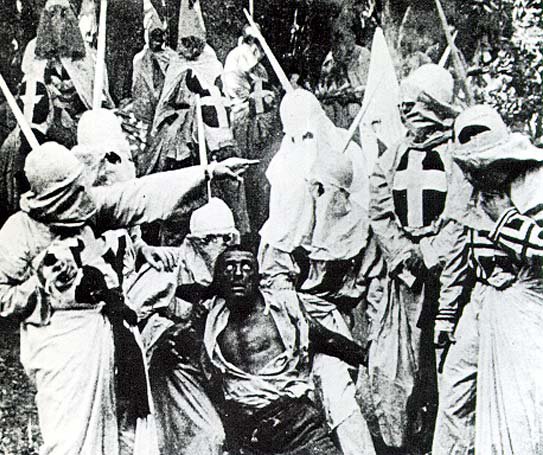
The white sheets of the Klansmen in
The Birth Of A Nation do not
cover idealists riding to right political and judicial wrongs, despite
a blizzard of intertitles which tell us otherwise.  They cover the
beleaguered psyches of 20th-Century males riding to restore their own
insecure manhood.

THE BIRTH OF A NATION — PART ONE: A RACISM INDEX


The environmental, or broad cultural racism in the first half of
The
Birth Of A Nation
finds expression in two ways.  The first is the
general depiction of blacks under slavery as well-treated and happy. 
It can be argued that some blacks under slavery were well-treated,
insofar as anyone held in involuntary servitude can be said to be
well-treated, and that some blacks under slavery were happy, insofar
as anyone held in involuntary servitude can be said to be happy.  But
presenting such blacks as the
only representatives of slavery in a film
with the epic scope of
The
Birth Of A Nation
cannot be seen as merely
an act of dramatic selection.  All the characters in the film are
emblematic of broader social realities, and the view of slavery
presented here, as part of the “gracious” Southern social order that
will be swept away by the Civil War, has an ideological dimension —
and
the ideology is based on a lie.  Whether or not slavery was a
“necessary evil” or a crime against humanity or on balance a benign
institution, it did not even remotely resemble the portrait of it
offered up in
The
Birth Of A Nation
.


The second expression of environmental racism is more complex.  It lies
in Griffith's decision to have all blacks who are presented as
individuals in the film played by whites in blackface.  In this he was
following
conventional theatrical practice.  We know, from his testimony in a
censorship hearing for the film, that he considered the issue before
deciding on the blackface solution, but he probably wouldn't have been
terribly self-conscious about it, so common was the practice.  But its
very commonness raises interesting issues.


On one level, the blackface caricature of an African-American by a
white actor carries its own critique within it.  There is no theatrical
deception involved — the glaringly obvious make-up reveals that the
convention is a convention, and one of the things expressed in the
convention is that whites have appropriated the image of the black,
that whites will control the image of the black.  The image must be,
therefore, on the blackened face of it, constructed.  The convention
announces that whites feel empowered to construct, to control, the
image of the black, but also admits that the image is inauthentic.  It
leaves open the possibility that blacks might construct other images of
themselves, if they had the power to do so — and that they might not
participate willingly in these particular constructions of their
images.  There are more questioned raised than answered by the
convention of blackface, at least on an unconscious level.


The pathological, psycho-sexual racism of
The
Birth Of A Nation

doesn't emerge until about 16 minutes into the film, with the first
appearance of Austin Stoneman's sluttish maid.  Previously, Stoneman
has been
established as a grotesque figure, with a club foot and an ill-fitting
wig.  Suspicions about him have been aroused by revealing that he
spends a lot of time in his library, where his family never visits. 
He's never shown in his own home — his sons even march off to war from
that home when he is not present.  This is Victorian code for the fact
that Stoneman is a creep — at the very least a deeply problematic
figure.  Devotion to the
home was an essential element of male rectitude in Victorian fiction.


With the appearance of Stoneman's maid we learn the dark secret he is
hiding — an illicit sexual relationship with his maid, a mulatto
woman.  Stoneman is a thinly-veiled stand-in for the great anti-slavery
statesman Thaddeus Stevens.  Stevens' radical views on Reconstruction
can be, and have been, criticized as over-zealous and impractical, but
Griffith is suggesting that his polity was the direct result of sexual
perversion, the impulse towards unbridled sexual lust in general and
miscegenation in particular.  The mere fact that his slovenly maid is a
mulatto, the product of miscegenation, sets up the association of black
enfranchisement, even black aspirations towards dignity, with an
undiscriminating, animalistic sexuality.  The maid is offended when a
visitor to Stevens'
library treats her dismissively, as a mere servant — after he leaves
she flings herself to the floor and writhes in anguish, her shoulders
immodestly bared, her hands playing over her breasts.  Her behavior is
not just indecorous — it's positively bestial.


There is no evidence that Thaddeus Stevens ever had an affair with a
mulatto maid, or that he engaged in sexual misconduct of any kind. 
What we
have here is pure, and very bizarre, fantasy, which can only be
explained by the pathological association of black enfranchisement and
equality with the destructive unleashing of the libido.  A title card
announces that we have witnessed in the scenes described above “the
weakness” — Stoneman's lust for
a black woman — “that blighted a nation”.  The entire Civil War and
the complex moral and economic forces that led to it, the entire
abolitionist cause, is reduced to sexual “perversion” in the form of
miscegenation.


Meanwhile, down South, the Civil War has broken out and almost
immediately the Cameron home is threatened by Negroes gone wild. 
“Renegade” black soldiers, in Union uniforms, attack the town where the
Camerons live, and the Cameron home itself.  Griffith concentrates
dramatically on the threat to the two Cameron sisters, hiding out in
their basement.  Any viewer of the time would have recognized the
sexual component of the threat.  The girls are clearly in danger of
being raped by the maniacs assaulting their home.
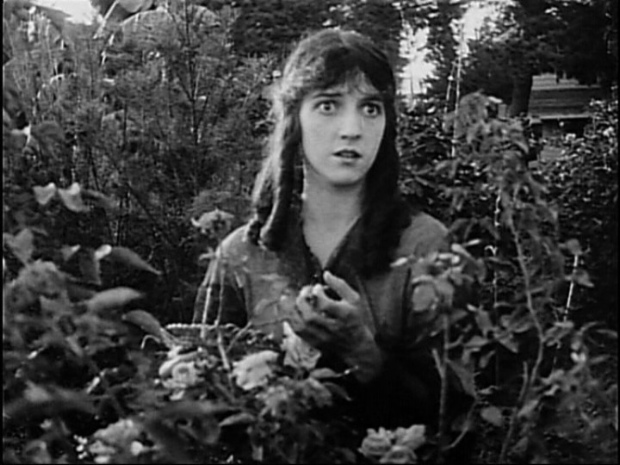

There were, in fact, no bands of renegade black soldiers running wild
in
the South.  A title tells us, misleadingly, that the first black troops
were enlisted in South Carolina, which is true — but none of them
ever behaved the way these blacks troops do, which is what the title
implies.  A title also tells us that the blacks have been incited to
their behavior by an irresponsible white commander.  Griffith often
uses this device in the film to show he's not blaming blacks for their
behavior — only the white trash who spur them on.  But this muddles
what's really being said between the lines.  The bad whites in these
cases have failed to
exercise proper patrician supervision of and control over their black
charges, they have misdirected and unleashed the animalistic tendencies
of the blacks.  The important point being driven home — and it's
driven home throughout the film — is that this potential for
animalistic behavior by blacks is always there and always needs to be
controlled.  This is the white man's burden — his first duty in
protecting the home and its women.


A detachment of white Confederate soldiers rescues the Cameron girls
and their home — white actors in blackface help put out the fire in
the house and embrace these soldiers in gratitude.  But in the course
of the film, the white deliverers
won't always get there on time . . . indeed, their failure to do so
on one crucial occasion will lead directly to the dramatic climax of
the film.
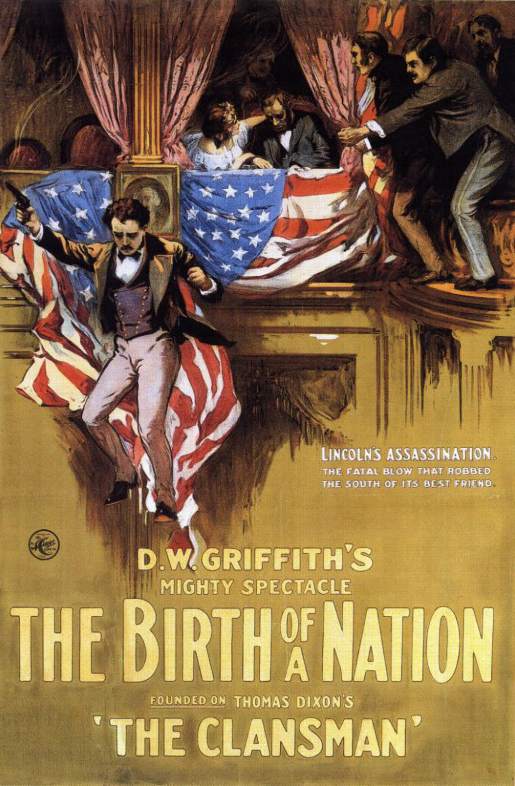


The first half of
The
Birth Of A Nation
ends with the assassination
of Lincoln, dramatically and quite accurately recreated onscreen.  This
assassination has become a tragic, iconic component of America's
national myth, and in the film it is greeted by sorrow on both sides of
the Mason-Dixon line — with one exception.  Stoneman's mistress exults
as she strokes Stoneman's arm lasciviously and tells him he's now the
most powerful man in the country.  Her villainy and inhumanity could
not be
asserted more forcefully — a more direct connection could not be drawn
between the “history” we're about to watch unfold and the sexual
“perversion” of miscegenation.  To this woman, and perhaps to Stoneman,
Lincoln's death only removes the greatest obstacle to the sexual union
of the black and white races.


It's really impossible to fully appreciate Griffith's artistry in this
film without recognizing how skillfully he inflects his national epic
with psycho-sexual themes, appealing to patriotism, nostalgia for a
more gracious age, reverence for the home, in order to set all these
things against the perceived horror of the pollution of the Aryan race
by admixture with inferior blood.


The environmental racism of
The
Birth Of A Nation
is not egregious by
the standards of its day.  It wouldn't even have been egregious by the
standards of 1939, the year of
Gone With the Wind, which simply used
cleverer and more sophisticated means to distract us from thinking too
seriously about the horrors and the enduring moral stain of slavery. 
And in the first half of
The
Birth Of A Nation
, the more disturbing
and
pathological racist element is almost overwhelmed by the lyric beauty
of the film in its celebration of family and home and gallantry and
innocent courtly love.
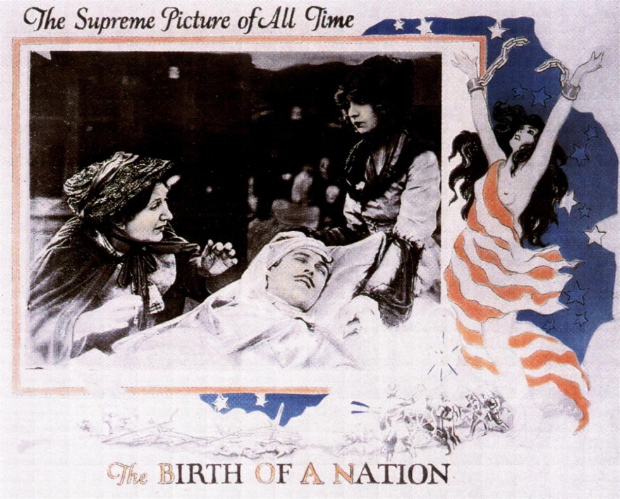

But we will see that the pathological element has been carefully
interwoven into the fabric of the film's first half precisely in order
to set up its emotional ascendancy in the second half — and there is
no question that this strategy was deliberate. 
The
Birth Of A Nation

prides itself on historical accuracy — with some justification.  The
film is historically responsible and convincing in visual terms, and in
many of its recreations of actual events.  The only times it departs
conspicuously from historical accuracy, the only times it unashamedly
distorts and
falsifies the historical record, are in those passages where it seeks
to promote its psycho-sexual racist agenda.  That agenda will come to
dominate the second half of the film, but it was painstakingly and
strikingly foreshadowed in the first half.

THE BIRTH OF A NATION: A RACISM INDEX — INTRODUCTION

There are two kinds, or degrees, of racism in The Birth Of A Nation.  The first might be described as environmental racism, reflecting the conventional racism of the dominant culture of early 20th-Century America.  This centered on the idea that blacks were intellectually inferior to whites, unfitted for social or political equality, and best treated with a kind of benign paternalism.

In 1915 one might hold such views almost unconsciously, so imbedded were they in the thinking of the time, and one might find “scientific” explanations for the inferiority of blacks even in the pages of authoritative reference works like the Encyclopedia Britannica.

Other viewpoints were available, however — other public voices which insisted that blacks were fully the equals of whites and deserved to participate fully in American democracy and American society.  The attitude of the dominant culture did not go unchallenged, and so involved a measure of choice, of moral responsibility.  Moreover, the dominant culture benefited psychologically and financially from maintaining blacks as a permanent underclass and source of cheap labor, so its view of their inherent inferiority incorporated an element of self-serving denial.

In short, there was very little about environmental racism which could be considered morally neutral or benign, even though it could be entertained by people who were in other respects decent and good-hearted.

The second kind of racism in The Birth Of A Nation has a darker undertone.  While it derives from the assumptions of environmental racism it moves into a frankly pathological realm.  It held that blacks were not just intellectually inferior but animalistic, distinctly subhuman, and would, if ungoverned by strict regimentation on the part of whites,
revert to bestial behavior, especially with regard to sexuality, and particularly with regard to sexual aggression by black males against white females.


The social history of race relations in America provided almost no evidence to support this view — quite the contrary.  Historically speaking, sexual aggression and sexual abuse between the races resided almost exclusively in the sexual predation of white males directed against black females within the Southern plantation system.  This was the unspoken scandal of ante-bellum society in the South, as Mary Chestnut confessed ruefully in the original unexpurgated version of her famous diary.

The fictive threat to white womanhood from black males had origins within the psyches of white males — under threat in 1915 from social causes inherent in a rapidly industrializing and urbanizing America.  Males increasingly worked for and at the pleasure of other men far more powerful than themselves, and women had access to incomes from office and factory work independent of male domestic partners.

The male insecurity that resulted was augmented by cultural insecurity as waves of immigrants began to change the face of America, importing “foreign” mores, customs, values and even languages that competed with those of the dominant culture.

In this atmosphere, the casual environmental racism of the dominant white culture took a more intense and programmatic form — it mutated into a defiant celebration of the “Aryan race”, an aggressive insistence on its superiority, and an essentially pathological fear of its dilution, or even overthrow, by lesser races, especially the animalistic “Negro” race.

The great success of Thomas Dixon’s potboiler fiction, which openly promoted this new, more self-conscious and aggressive racism, testifies to its wide cultural appeal at the beginning of the 20th Century.  In his skewed and irresponsibly manipulated version of the historical facts of Reconstruction, Dixon was presenting a prophecy of what might happen to white culture if “lesser” races ever again got the upper hand.  He was quite clear about this.  His introduction to The Clansman, the novel on which The Birth Of A Nation was partly based and under which title it was originally released, described Reconstruction as one of the most important episodes, not in the history of America, but in the history of the Aryan race.

Thinking of the history of America as the history of the triumph of the Aryan race was appealing to many in early 20th-Century America — it bolstered the manhood of white males threatened by new female power and new cultural influences.  It was psychologically seductive.

One of the men it seduced was D. W. Griffith.  It was an ironic tragedy, since Griffith was himself, by all accounts, a benign sort of racist in his dealings with individual blacks, and also a man deeply sympathetic, in his way and within his limitations, to the emerging
position of the “modern woman”.  One can only conclude that the seduction took place on some level beneath the conscious — as it must have, surely, to some degree, for American society as a whole.


I’m not sure the process can ever be wholly understood, but from a distance it can at least be described, and I think there’s some value in that.  In future posts I’ll offer some examples of how the two kinds of racism described above play out in The Birth Of A Nation.

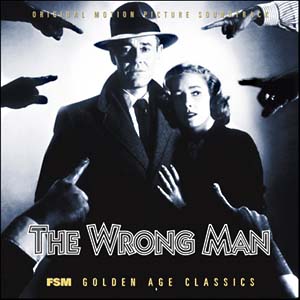
WRONG MAN, RIGHT MUSIC


The 20th-Century notion of “absolute music” tended to
capture the imaginations of composers who wanted to be
thought “modern”.  They generally abandoned the emotional, descriptive
and/or
narrative ambitions of 19th-Century program music in favor of a more
severe system of abstraction.  This marked the end of concert music as
a popular art form but not the end of program music, which went on its
merry way in movies, where it continued to enthrall a large public.

Of course, people didn't pay as much conscious
attention to this music as they used to in the concert hall, but they
could have, with profit.  To prove this assertion all you have to do is
listen to the many classic film scores now available on CD — the
original tracks recorded for the films or later re-recordings of the
scores.  Many of them are magnificent pieces of music in their own
right.  It helps to have the “program” in mind, a memory of the films
this music supported, but it's not absolutely necessary with the very
best scores — like those of Bernard Herrmann, for example.

Hermann didn't specialize in creating memorable
melodies but he was a master
at using the colors of an orchestra to evoke mood and he had a great
and subtle understanding of the dramatic uses of rhythm.  All of his
Hitchcock scores are brilliant, even the less famous of them like the
score he did for
The Wrong Man.  Edgy, dark, minimalist, jazz-inflected, it
perfectly mirrors the bleak and jagged realism of Hitchcock's 50s-era
New York
City, its dehumanizing institutions and its spiritual
chaos.  But it has a lyrical core,
too, that echoes the protagonist's yearning for deliverance.

It's not absolute music, to be sure — but it's
absolutely wonderful.

NORMAN ROCKWELL: CITIZEN


As the art critic Dave Hickey has observed, Norman
Rockwell was inspired by the idea of American citizenship, and he often
portrayed the places and occasions in American life which brought
Americans together in that peculiar comradeship unique to functioning
democracies.

In our polarized age, when the gap between rich and
poor grows positively surreal, when urban environments no longer
function as genuine melting pots, when suburban residential patterns
emphasize the isolation of income-brackets, Rockwell's visions of
community take on a nostalgic glow — but in his own time Rockwell was
celebrating something real, something in the now.

I'm particularly fond of Rockwell's paintings of
people on trains — a now uncommon mode of travel in which people from
different backgrounds met as equals, in an environment that allowed for
interaction.  There was space and time for interaction — as there
isn't, for example, on an airplane, which has no common space, where
moving about is difficult and hardly encouraged.

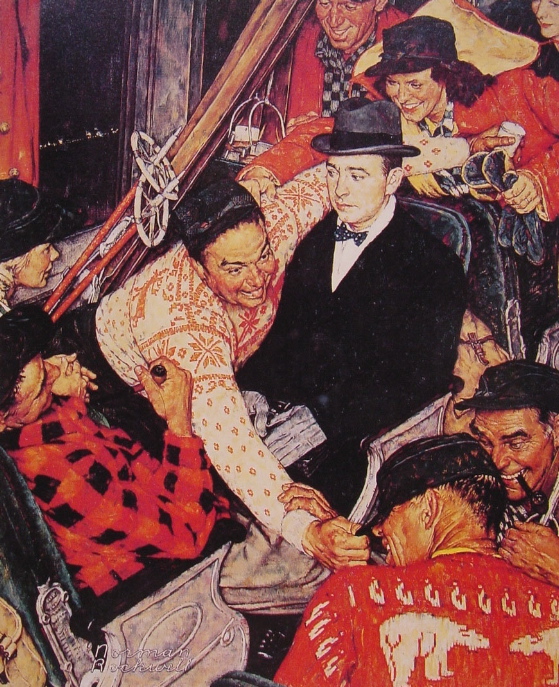
In the painting at the head of this post, democracy rules — a gang of
skiers sets the excited tone of the passenger car . . . the quieter
fellow submits, observes, is perhaps intrigued.  He's temporarily out
of sync, but not out of place.

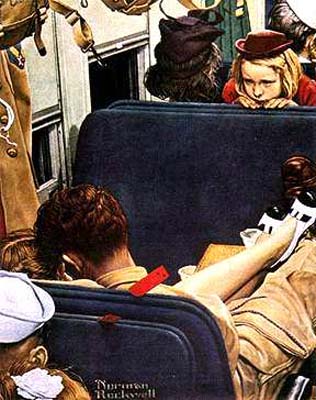
The “Saturday Evening Post” cover below is one of my
favorite images of WWII.  A soldier on leave tries to make time with
his girl, while a kid looks on jealously.  The soldier, the homefront
and the future intersect momentarily on a crowded train in the middle
of a dreadful war, and we see everything that's at stake in the
conflict.


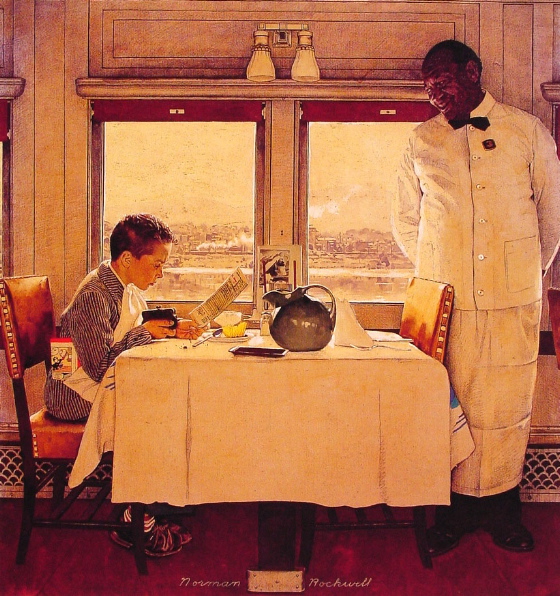
Below, a kid on a train journey by himself is watched
over by a sophisticated professional who's seen it all but still finds
it possible to be amused and touched by the rite of passage he's witnessing,
as the kid tries earnestly to make his way in an adult arena.  The
dining car waiter has a job to do — but so does the kid, and he's
working at it.


Americans
of every background meet
today as citizens, as equals, only at the polls on
election days, or at casinos — there are fewer and fewer everyday
environments and occasions where one can feel the genuine community of
citizenship, and that's partly why one finds such warm fellow-feeling
at polling places and in casinos.  Rockwell was right to be
sentimental
about such places and occasions, and nostalgia is not a sufficient
response to his images of them.  They should inspire us to recover
what's been lost.

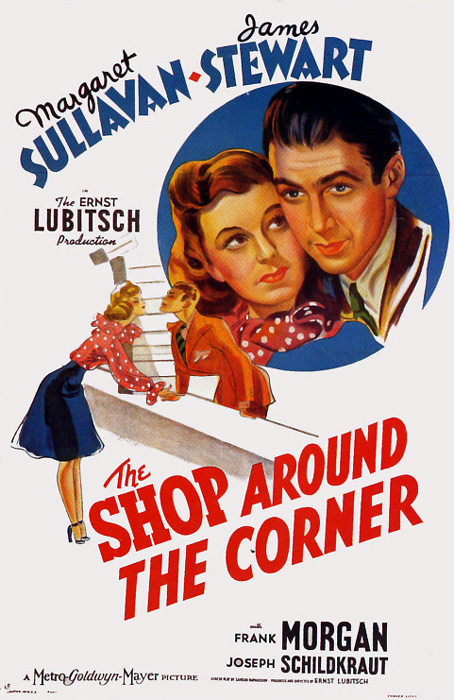
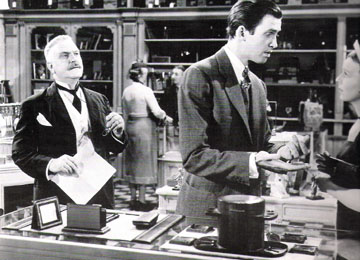
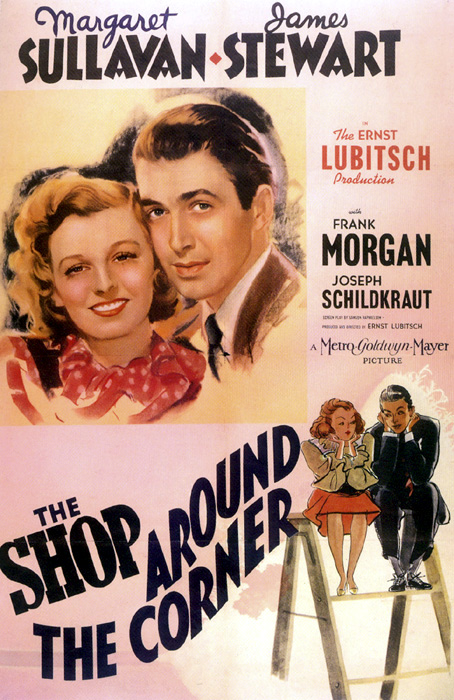
THE SHOP AROUND THE CORNER


When Ernst Lubitsch, in his American movies, looked
back on the Europe he left
behind to pursue a career in Hollywood, he looked back at its glamor
and
sophistication, inflected it with a wry nostalgia, turned it into a
dreamscape.  But he kept his emotional distance from it, precisely
because it was a dream, and he knew it — a world he was never really a
part of, though as a man of the theater and the cabaret stage and
cinema, he got close enough to observe it.

And then came The Shop Around the Corner,
towards
the end of his career, when he dropped his mask of sophisticated
reserve and looked back at the Europe he actually came from as the son
of a Berlin shopkeeper.  The deep humanity and emotion of the film
revealed that his dreamy evocations of high-class European culture were
simply a displaced nostalgia for his youth, and when he engaged that
nostalgia directly, a sort of miracle occurred.  Lubitsch opened his
heart for perhaps the first time ever in his work.

Lubitsch had always been amused by the flim-flam at
the
center of aristocratic charm, and was attracted to characters who
penetrated the
aristocrat's world by imitating the aristocrat's special form of social
theater — much as he had used the theater itself in real life to gain
status and wealth, and with them access to privileged circles.  That
was why he retained a shrewd if affectionate cynicism towards the
people in his movies, a sense that everything they did was part of a
game.  But in
The
Shop Around the Corner
his cynicism mutated into a kind of love —
still clear-eyed about human foibles but with a new sense that affairs
of the heart amounted to something more than delirious and delicious
role-playing.


There has never been a more heartfelt celebration of
petit-bourgeois life than The Shop Around the Corner, not least
because it's so nuanced.  The financial terror involved in losing or
looking for a job, the deceptions of merchandising, the humiliations of
employment, are all engaged squarely — but so are the satisfactions of
running a business, the creativity and sensitivity of salesmanship, the
comradeship of workers engaged in a collective enterprise.

If you've ever known a family-run shop first hand,
or even just worked as a temporary hire during the holidays at a
department store, you will recognize in this movie the magical sense in
which any retail business is a theatrical presentation, with its own
version of the enchantment of being
backstage and then stepping out in front of the audience, its own
version of the
excitement involved in seeing the whole production come together (or
not) in
times of stress.


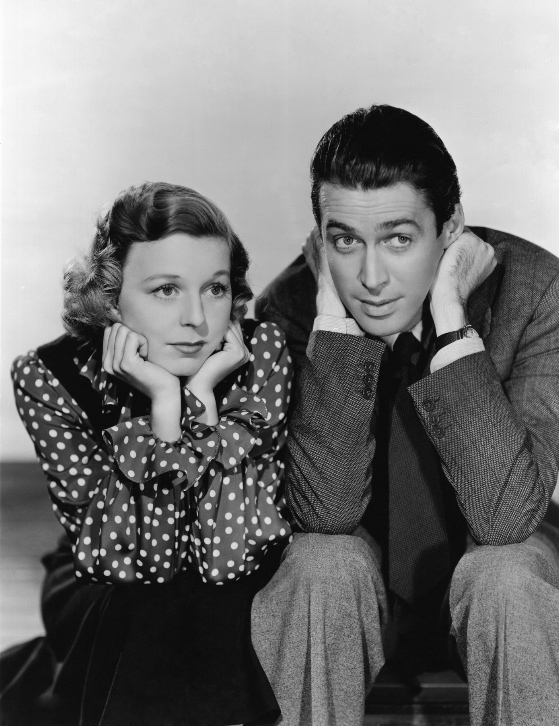
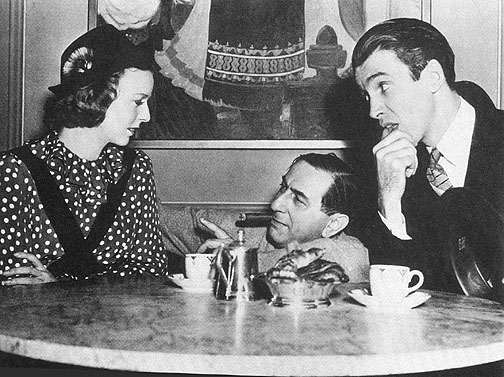
For Lubitsch in this film, the tension between
theatrical presentation and reality is still a central concern — with
the shop and with the romance that develops between Jimmy Stewart and
Margaret Sullavan.  But stage and backstage, appearance and reality,
come together here as they
don't in any of Lubitsch's earlier films.  The workers in the luggage
shop become a real family, not just an amusing parody of one.  The
lovers' pretenses are exposed, and instead of just laughing them off
with a sublime, wistful nonchalance,
as he always had before, Lubitsch discovers a depth of connection beneath
the ruses and fantasies
— a love
that can survive the exposure.

It's all so much more moving than the explicit
sentimentality of
It's A Wonderful Life,
that other great
Christmas
movie starring Jimmy Stewart — because it involves sentiment without
illusion, or rather, sentiment that appreciates illusion but sees an
enduring beauty revealed in it, something that transcends
improvisation, something internalized.  There's no Old Man Potter
in this film
to
threaten the happiness of the young couple and no guardian angel to
restore it — the threat comes from within themselves . . . as does the
leap of faith that saves them.


Ernst Lubitsch's long journey as an artist began above
his father's clothing store in Berlin and reached its pinnacle in a
fake luggage shop built on an MGM sound stage in Culver City,
California.  Even that surreal paradox doesn't convey just what a
complex and profound journey it was — but all of it is summed up and
brought to a magnificent fulfillment in
The Shop Around the Corner.


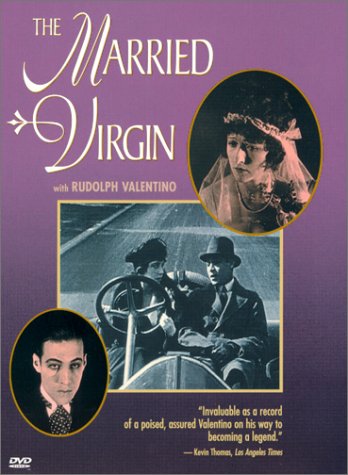
THE MARRIED VIRGIN


I picked up
The Married Virgin just to check out Valentino in one of his pre-star roles and I was pleasantly surprised
by the film — it's a light but very skillful piece of entertainment.


The DVD looks great, despite the fact that this version was cobbled together from a few different prints. Missing title
cards were judiciously recreated for the restoration.


The
DVD liner notes say that this was the director's first film, but that's
hard to credit, since the storytelling is so assured, brisk and
energetic. There are some delightful bits of plastic invention, among
them a fine shot of Valentino and the heroine swimming in the ocean,
framed from above, so you can't tell how far out to sea they are, until
a wave suddenly rises beneath them and sweeps them towards shore . . .
and an equally satisfying sequence with the Valentino character and his
stepmother-in-law/lover (yes, it's that kind of melodrama) driving
wildly along a hillside road.


The
brisk pace of the film is fortunate, since little in the narrative
bears serious reflection. (“Why,” you keep asking yourself, “did
McMillan keep that gun, instead of dropping it down a well?” The answer
is as old as filmmaking itself — “Because then there would have been
no story.”)


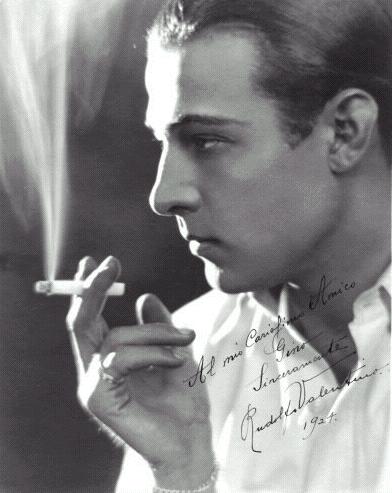
Valentino
is an absolute hoot to watch. Even though he's playing the
sophisticated and cunning Count Roberto, he looks more like a kid
playing dress-up — a little wet behind the ears, but all the more
adorable for that. And wide-eyed as he is, he cuts a sensational figure
in his well-tailored wardrobe . . . in a male-model sort of way. But he
has a dancer's capacity for absolute stillness, and a dancer's
knowledge of how to use this to draw attention to himself.

And
then there are a few moments when his sexuality becomes lethal — as in
his first close-up, when he kisses Mrs. McMillan's hand. There's an
assurance in the act, and a hint of delicious legato, which promise
much. He has at all times a distinctive way of touching women, placing
his hand just so, holding it still, as though it couldn't be anywhere
else, and never will be. Finally, there is a startling shot of him as
he's interrupted in the process of trying to rape his virgin bride. He
has an almost bestial look — as though drugged senseless by lust.


This
film, tied up in court for a couple of years by unpaid crew members,
was released after
Four Horsemen Of the Apocalypse and must have been
terribly frustrating to Valentino's new fans. He plays a cad, and the
heroine, forced to marry him to keep her father from prison, resists
his advances with epic fortitude — thus eventually saving herself for
her distinctly charmless leading man. But what advances they are! One
simply cannot sympathize with a heroine who is immune to them — and in
that utterly amoral but undeniable fact lies the inevitability of
Valentino's stardom.