THE LODGER (1927)

Alfred Hitchcock's silent film The Lodger, from 1927, is wonderfully entertaining, alive with visual inventiveness, with the director's unbridled joy in making cinema.  It's not, however, a terribly successful thriller, and thus not a terribly successful film, since a thriller is what it sets out to be.

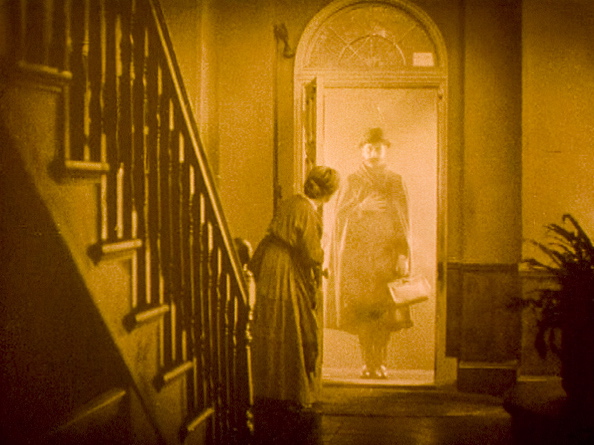
The problem is the presence of Ivor Novello in the title role — or perhaps the way Hitchcock uses him.  Novello was a handsome fellow with a decidedly fey quality.  Hitchcock would eventually find ways of using an actor's ambiguous sexuality to disturb an audience, keep it off balance, but he doesn't seem to be trying to do that with Novello.  He lurches back and forth between presenting Novello's lodger as an almost inhuman visual icon of menace and mystery (see above) and letting the actor present his own impersonation of a matinee idol.  Novello does his best to appear brooding and menacing from time to time but he succeeds only in suggesting a man vaguely distracted and slightly peeved about something.

There's nothing really creepy about Novello's lodger, except that he seems to inhabit a different film than the one Hitchcock is trying to make.  He comes across as conventionally, not pathologically, insecure.  The unhinged desperation we sense in Bruno from Strangers On A Train or Norman from Psycho is nowhere in evidence.  It's really impossible to take Novello's lodger seriously as a suspect in the “golden curls” murders, or as a passionate suitor of the heroine.  At the same time, he can't really secure our sympathy as that archetype familiar from so many later Hitchcock films, the innocent man wrongly accused, since we spend most of the film without any clear information about his guilt or innocence.

Still, Hitchcock constructs his movie with relentless, creative imagination as though it had a real villain or potential villain or wrongly accused villain at its center.  We can admire and enjoy its brilliance but we can't care about its story — which offers only the most perfunctory kind of  suspense, without any subliminal psychological undertow.  The film is aesthetically dazzling without being really engaging on any other level.
DEMOCRACY THREATENED BY CARTOON CHARACTERS

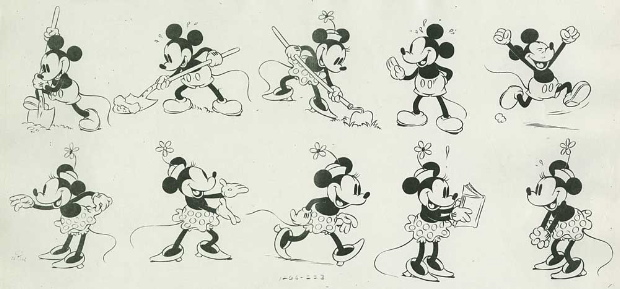
It's been reported that ACORN, a nationwide syndicate of community organizations, has submitted voter registrations for a number of fictional characters, including some, like Mickey Mouse, who are animated figures.  John McCain and Sarah Palin have drawn attention to the serious threat this poses to the American way of life.  “Suppose Mickey Mouse shows up at a polling place in Ohio?” Palin asks.  “Will his vote be counted?  Will a ballot submitted by a cartoon character affect the outcome in this important battleground state?”

When the McCain campaign was asked how an animated character could physically enter a voting booth and cast a ballot, a spokesman directed reporters' attention to the film Who Framed Roger Rabbit?, which demonstrated that cartoon characters could interact with live human beings.

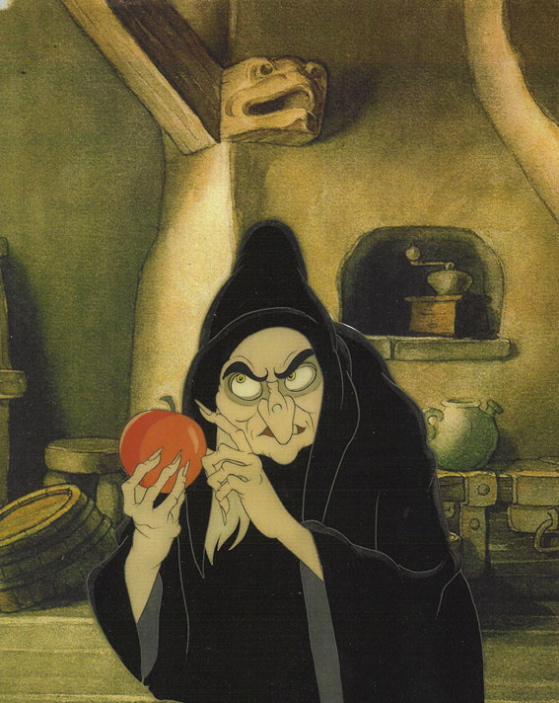
Meanwhile reports have leaked from Sarah Palin's campaign that, if elected, she would urge the establishment of “concentration compounds” for women identified as practicing witchcraft on U. S. soil.  According to insiders, Palin intends to allow witches to leave the country voluntarily — however, if they refuse, she believes they should be placed on large barges which would be towed out to sea and sunk.  Privately, she blames witches for “cursing her tongue” and preventing her from speaking coherent English sentences on the campaign trail.

PROUD AMERICANS

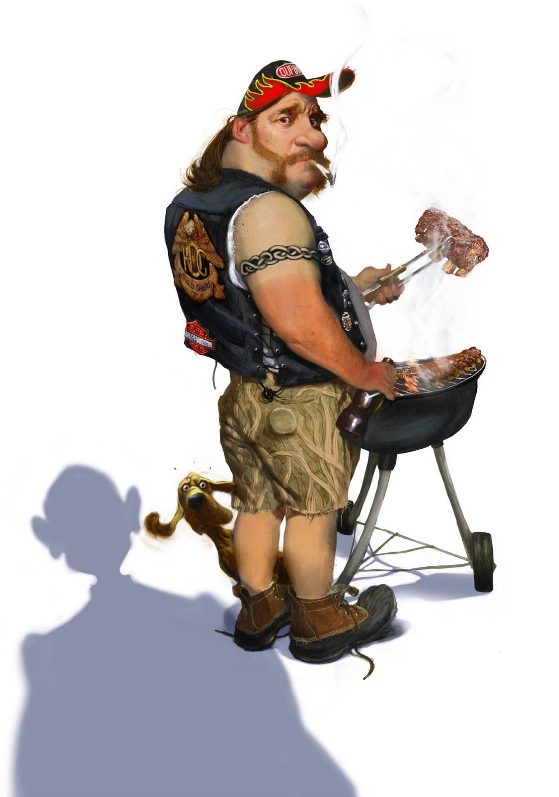
Of course, you and I would never use that kind of language about Cindy McCain, even though she's now gone back to taking digs at Michelle Obama, after apologizing for doing so the first time.  “I've always been proud of my country,” says Cindy, with her cute little Sarah Palin smirk.  Why wouldn't she be proud of a country where a girl can inherit 100 million dollars, bust up a war hero's marriage and become the trophy wife of a pathetic old man who's got a shot at being President?  This is, truly, the land of opportunity — if you're very, very lucky and have no morals to speak of.

I'm sure John was just joking when he used the “c” word about his wife.  The guy has a sense of humor, after all.  Here's a joke he told at a Republican fund-raiser back in the 1990s:

Why is Chelsea Clinton so ugly?  Because Janet Reno is her father.

When you and I hear things like that, we just laugh it off, right?  The phrase “sick, twisted motherfucker” doesn't even enter our minds.


Now jolly John has authorized robo-calls in battleground states reminding people that Barack Obama has “worked with a terrorist”.  I guess most of his supporters will be content to let a McCain administration take the appropriate action against Obama after John is elected President — putting the uppity young buck on trial as an accomplice to terrorism, of the
domestic variety.  Maybe one of those supporters will jump the gun, as it were, and go for some vigilante justice in the meantime — a time-honored tradition in this great country we're all so proud of.

That won't be John's fault, will it?  And it won't make Cindy any less proud of America.  Things happen to that sort when they step out of line.  (Cue cute Sarah Palin smirk.)  We're still the shining city on the hill, no matter how much blood runs down the hillside into the valley below — doesn't affect the view from the top of the heap at all.

MONEY

Early on in the Presidential race I sent a small amount of money to Barack Obama's campaign — in recognition of the fact that, as I believed then, I'd be voting in this election, for the first time in my life, in favor a candidate I really liked rather than against a candidate I hated.  That all changed when Senator Obama voted to grant immunity to the big telecoms for conspiring with the Bush administration to violate the Fourth Amendment to the Constitution.  I swore then that Obama would get no more money from me and I accepted the fact that I'd be voting for him while holding my nose.

That was before Sarah Palin, before she and McCain began their program of coded hate speech against Obama, which has emboldened many of their supporters to echo the vile suggestions implied in their rhetoric and take them to their logical ends — overtly violent speech and overtly violent threats against a terrorist other.  Posing as the leaders of a sheriff's posse bent on cleaning up Dodge they are in fact the leaders of a lynch mob bent on stringing the colored guy up from the nearest cottonwood.

This is not acceptable morally, and will have heinous moral consequences for the nation if their irresponsible tactics succeed in carrying McCain and Palin to the White House.

Consequently I've decided that it's o. k. to send more money to Obama's campaign as long as I make an equal contribution at the same time to the Electronic Frontier Foundation, which is bringing suit to overturn the telecom immunity bill Obama voted for.

You can and should do the same.  Contribute to the EFF here.  Contribute to Obama here.  Do it for the good of the country and the good of your own soul.

[With thanks to the awesome Fluharty for the images above.]

THE VOICE OF PROPHECY

The Biblical tradition of prophecy is not exactly about predicting the future, except in this sense, “If you don't get your act together, God is going to kick your front teeth out.”  It's a gentle reminder of the laws of spiritual physics.

A prophet speaks the words of our ancestors, delivers the collective wisdom of millennia, reminds us of the clear and present consequences of immediate choices.

Prophets channel things, crystallize vague signs that portend changes in the weather.  Strictly speaking, they don't prescribe, or preach, or even condemn — at least not from a personal perspective.  They're just strings that vibrate in the wind.

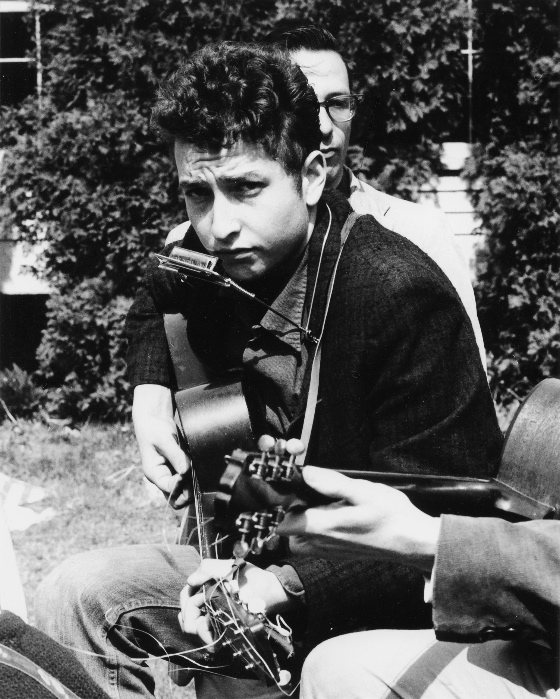
Being a prophet can't be fun — it requires suspending the prerogatives of the self, wandering around homeless, listening to voices no one else can hear.  You have to be a little crazy.  When Bob Dylan sings “There's not even room enough to be anywhere” he might well be describing the plight of the prophet.

It's interesting to think of Dylan's voice as prophetic, in the antique sense.  In 1964, the Beatles told us how much fun the 60s were going to be.  Not long afterwards, in “Like A Rolling Stone”, Dylan told us what the 60s were going to cost us.  Not many people listened.  The song only made sense in retrospect.

Astonishingly, Dylan, who'd helped a generation grow up, stuck around to help that same generation grow old.  Along the way, he kept delivering shocks.  He became a born-again Christian and turned himself into a joke for many.  In this phase he composed a series of modern Gospel songs that we can now recognize as a brilliant contribution to that particular tradition of American music.  In retrospect, again, it seems like a dazzling, moving achievement.

He's never left the road, the hard grind of touring.  There were times when he was so wasted on stage that no one could tell precisely what song he was singing.  Then he'd rebound, rework his old songs so they seemed brand new again.  His last two albums can stand with the best of the work that made his name forty years ago.

At almost every concert over the years he's sung “Blowin' In the Wind” — the song that made it hip for young white kids to support the Civil Rights Movement.  He sings it for people who might only be seeing him that one time, who want to say they've heard the iconic song live.

He may have other reasons, too.  He may believe that people still need to hear the song — to remember all the questions still blowing in the American wind.  Some of them will be answered on 4 November, for good or ill.

In any case, it's a good time to remember where the song came from — an old spiritual called “No More Auction Block”, where Dylan found the general shape of the tune and the inspiration for a new variation on the eternal lament over American slavery and its echoes down through time.

On The Bootleg Series, Vols. 1-3 (actually an official Dylan release) you can listen to “No More Auction Block” sung by Dylan at the Gaslight in Greenwich Village in 1962.  He was twenty-one years-old.  “Many thousands gone,” the song says, speaking of those who died in chains on American soil, and by extension those who died in the chains of an unjust society, those who died fighting the injustice, or perpetrating it.  Dylan doesn't claim to speak for any of them — he's just transmitting their sorrow, their hope, their repentance, just reminding us that their voices are blowing in the wind, and asking us to listen.  You can hear Dylan himself listening as he sings the song.  It's what prophets do.

AN ERIC GILL FOR TODAY

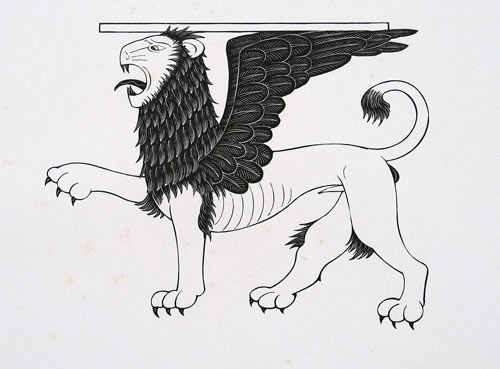
A fine rendering by Eric Gill of the Lion Of St. Mark, still awaiting the Gospel on which his paw is meant to rest.

Gill was a very strange man.  A devout Roman Catholic, he created a lot of superb religious imagery, and a lot of very explicit erotic imagery, also superb.  Some artists can hold those two realms in their imaginations at the same time — like Prince, for example, before he got seriously into the Jehovah's Witness thing, whatever that is, and started censoring the dirty bits out of his early work.

Sometimes, for Gill, though very rarely, the religious and the erotic inter-penetrated in his art, as it were, and he entered the realm of blasphemy — as when he depicted Jesus having sex with an unidentified female saint.  Both wear halos.  There is a place for such images in art, transgressive and shocking as they may be to some, since they record genuine tensions that grip the human heart.

In his personal life, however, Gill got seriously unhinged.  He sexually abused his children, committed incest with his sister and engaged in sexual acts with his dog.  This naturally tends to color one's view of his work, which is a shame, since his work is very good.  He just had a screw loose somewhere — I suppose it could happen to an accountant as easily as to an artist.

SOUTH OF THE BORDER, DOWN MEXICO WAY

Government economists in Mexico City have warned President Calderón that a total collapse of the U. S. economy could result in a mass illegal invasion of Mexico by U. S. citizens looking for work picking crops.

They have pointed out the serious social and economic consequences that would result from such an invasion and have urged the President to begin preparing now to meet the crisis in case it should it occur, which they see as ever more likely.  Their proposals include the start of work on a border-long fence designed to stop U. S. migrant workers from crossing into Mexican territory in the first place.  “Once they're here,” one prominent economist warned, “dealing with them in a compassionate way will become increasingly problematic.”

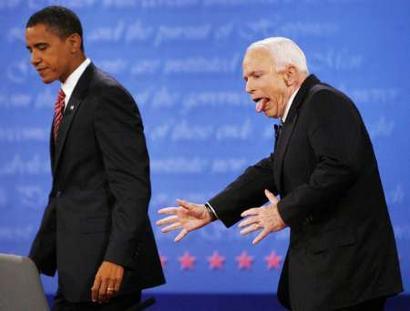
THAT ONE

He's one of them, you know.

(A Negro . . .)

John McCain and Sarah Palin are playing with fire when they try to frame Barack Obama as a terrorist other.  The dark thoughts they're trying to plant in people's hearts might be all that's needed to embolden some nut with a gun to take the next logical step and try to rid the nation of this alien threat.

“That one,” McCain calls Obama, standing next to him — as though he were some creature without a name.  “Who's the real Obama?” McCain asks a crowd.  “A terrorist!” someone answers back.  McCain says nothing.  “He pals around with terrorists,” Palin tells another crowd.  “Kill him!” someone screams.  Palin says nothing.

That cry was enough to get the Secret Service on the case but it wasn't enough to wipe the smirk off of Sarah Palin's face.

The lunatic fringe of the base gets the message.  At another Palin rally, a gang of her supporters taunts a group of journalists, calling a young black technician “boy” and a “nigger”.  We know where this sort of thing leads, where it's led us so many times before — to the strange fruit Billie Holiday sang about, to that motel balcony in Memphis.

If Michelle Obama ends up a widow, the sin won't rest on McCain and Palin alone, but on anyone who supports these despicable demagogues in their reckless and wicked grab for power, even at the cost of their own souls.  The souls of many are on trial here.

The soul of the nation is on trial here.

VOICES FROM THE REAL HEARTLAND

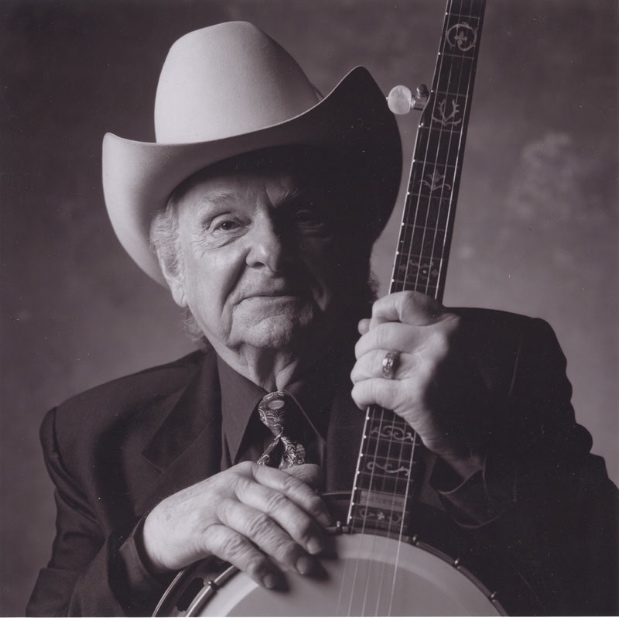
Ralph Stanley, surviving member of the immortal Stanley Brothers bluegrass duo, just did a radio ad for Barack Obama addressed to his fellow citizens in southwest Virginia.  In it he commends Obama as a good family man — something that's important to folks in that part of the world.  I wish the national media could talk more about the issue of (real) family values, which Obama lives and John McCain hasn't.

A few years ago Ralph put out an album of duets with various musicians younger than himself called Clinch Mountain Country.  Ralph's wife said her favorite duet was the one Ralph did with Bob Dylan, “The Lonesome River”, and it really is something — a couple of voices with the bark still on singing from the ageless heart of America.  It's a great track and great album.

Check it out.

SAD OLD SOLDIERS

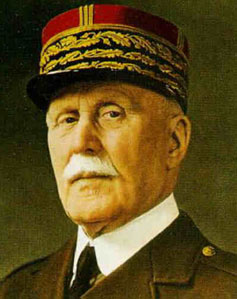
John McCain is starting to remind me of someone — another great old soldier long past his prime who traded his fading honor for a shot at power . . . just not thinking straight, I fear.  At any rate, at this point no American who cares about his or her own honor, or the honor of the nation, can afford to support this pathetic old man on his dark journey to moral oblivion.


THE REWARDS OF VIRTUE

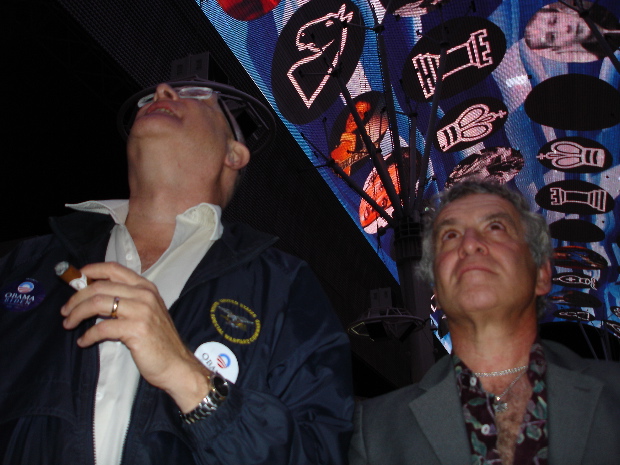
My friends Lily and Cotty (above) flew into town from Los Angeles this weekend and met up with another old friend, Frank, and his pal Bob, who'd driven here from the same place.  They'd all come to volunteer for a couple of days' work going door to door for the Obama campaign, collecting pledge cards and contact information, registering new voters and generally spreading the good word.

They walked (and walked) through middle-class neighborhoods dotted with foreclosure signs (and abandoned homes that will probably soon sport foreclosure signs.)  They did what they could — and Frank (on the left below, with Bob) actually managed to get a new voter to register.  Such things, multiplied many times over, might make the difference in what still looks to be an election of razor-thin margins — with Nevada a crucial battleground in the contest.

Their virtuous behavior was richly rewarded by the gods of chance here in Silly Town.  Lily, who's sixteen, couldn't join us, alas, but the rest of us went off gambling downtown.  We ended up at Binion's, where Cotty and Frank hit the craps tables, Bob took his chances at roulette and I sat down at a no-limit game in the poker room.

I was up $96 when Cotty tapped me on the shoulder and said the gang was ready to head home.  I cashed in my winnings and was feeling pretty smug, until I heard about Cotty's and Frank's run at the craps table.  Without revealing too much specific personal information, perhaps I can say that between them they won about $1500.

They slept, I am sure, the sleep of the just and the sleep of the lucky, a rare but delightful convergence of satisfactions.

VAUDEVILLE SLANG

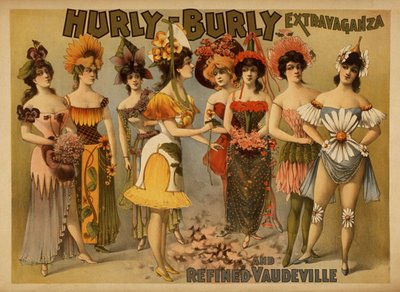
As I've observed before, vaudeville was the premier form of American entertainment for almost sixty years — longer than the era of studio-dominated filmmaking, the so-called Golden Age of Hollywood.  In those years vaudeville contributed a number of expressions to the American language.

“Big time” and “small time” are expressions from vaudeville.  In vaudeville parlance, managers and agents booked “time” — weeks or split weeks in a particular theater or on a circuit.  The higher-paying circuits were the big time — the less prestigious circuits the small time.  Big and small referred primarily to salary levels, with corresponding implications of prestige.  You could also refer to “Keith time” or “Pantages time” — bookings in the Keith & Albee  or Pantages theater chains.


The word “killer”, used in a positive sense, as in “a
killer app”, also comes from vaudeville.  In vaudeville, an act was a killer if it was so good it
killed the audience — ruined it for the next act.  “I killed 'em” or “I slayed 'em” were the ultimate boasts a performer could make, suggesting that he or she went over big but also that they made life tough for the acts that had to follow them on the bill, always an important consideration in the inherently competitive arena of variety entertainment.

You moved up the ladder in vaudeville by becoming “a hard act to follow”.  You reached the top of the profession when you were an impossible act to follow.