FAITH ON THE CAMPAIGN TRAIL

I
personally like to hear a little religion come up in the political
discourse of this country.  Abraham Lincoln, like Martin Luther
King after him, was very good at reminding us that our actions of the
moment have to be seen in the light of transcendent values, and
religion has powerful language in which to frame such ideas.

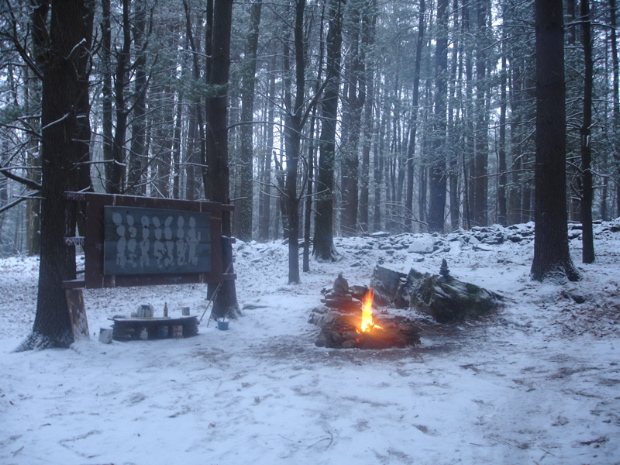
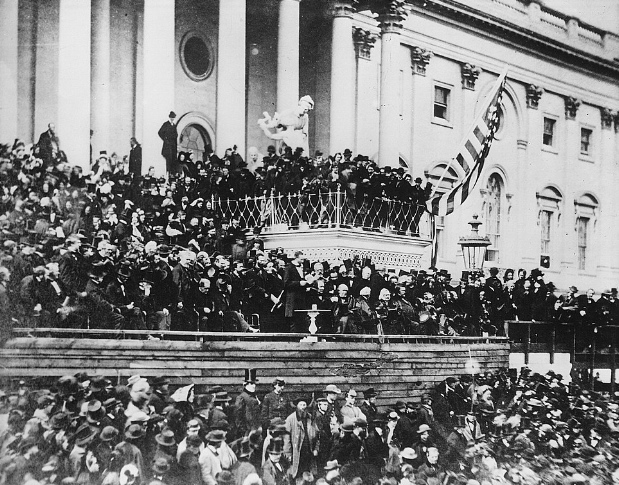
Here's Lincoln on the human cost of the Civil War (spoken at his Second Inaugural, above):


Fondly do we hope — fervently
do we pray — that this mighty scourge of war may speedily pass away.
Yet, if God wills that it continue until all the wealth piled by
the bondsman's two hundred and fifty years of unrequited toil
shall be sunk, and until every drop of blood drawn by the lash
shall be paid by another drawn with the sword, as was said
three thousand years ago, so still it must be said, “The
judgments of the Lord are true and righteous altogether.”

Word up, dude.
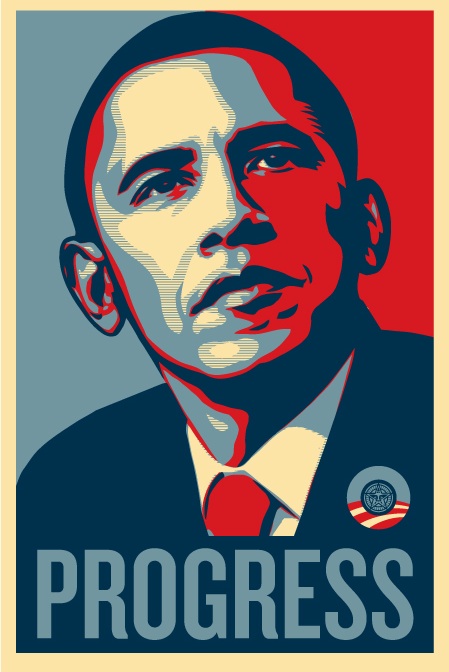


Barack Obama first got my attention in his speech at the 2004
Democratic Convention when he said, in the space of a few lines, “We've
got some good gay friends in the red states . . . and we worship a
righteous God in the blue states!”  It occurred to me that no
other politician on the national scene could say both things with such
fervor and conviction.  I'm sure that Hillary Clinton's faith and
John McCain's faith are sincere, but neither could use the phrase “a
righteous God” with such an unselfconscious sense of joy — and neither would dare to
speak with true affection for gays, afraid of alienating some
constituency or other, regardless of their stated positions on gay
rights.

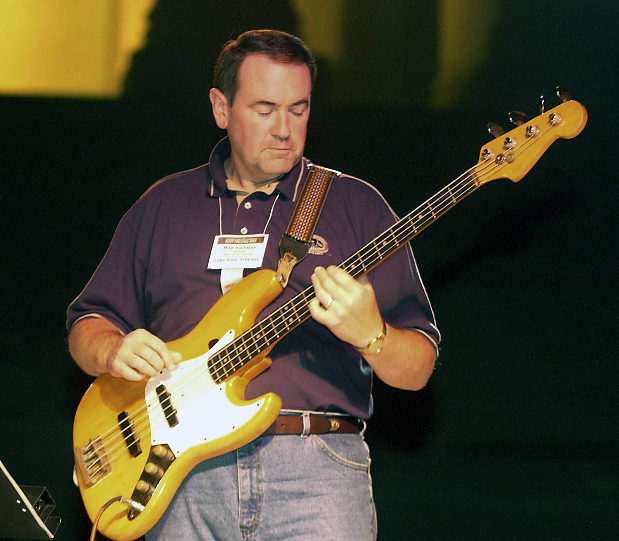
I was really pissed off at the Mike Huckabee campaign ad in which a
bookcase behind him was lit to present the image of a gleaming
cross.  Huckabee later said it was inadvertent.  Right. 
It was a Christmas message, in which Huckabee mentioned celebrating the
birth of Christ — why lie about the cross image?  Was he just too
wimpy to put a crucifix behind him — did he think it would be better
to sneak it in?  Subliminal messages like this, especially when
denied, are very
creepy.  (Have a look at the ad yourself here and draw your own conclusions.)  I also am totally unmoved by mere statements of faith, or
policies defended by scriptural doctrine.  I want the ideas behind
those doctrines to take center stage in the discourse.
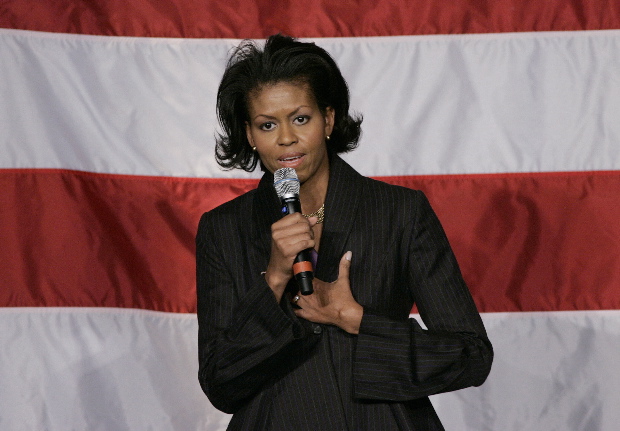
Michelle Obama, who is becoming a truly powerful speaker, said the other day
in California that “our souls are broken”
in this country because we have lost some of
our capacity for empathy with “the least of
these”.  She was using what is essentially a religious argument,
and referencing scripture in the process — these lines from Matthew:


Inasmuch as ye have done it unto one of the least of these my brethren, ye have done it unto me.

That's
one of the most radical statements in the history of human thought, and
a keystone of Christian faith, but Mrs. Obama was using it in the
context of an argument about ideas — about the way a democracy ought
to function.  She wasn't arguing about getting religion back into
public life, with symbols and slogans, she was getting religion back into public life by speaking to (and from) its wisdom.

You don't have to be religious to appreciate the value of religious
language for illuminating complex moral ideas — Lincoln's own
religious faith was a little murky even as he penned the words I've
quoted above.  And even if you are religious, you can afford to be
offended when politicians use the language of faith as a marketing tool.
CLASH BY NIGHT

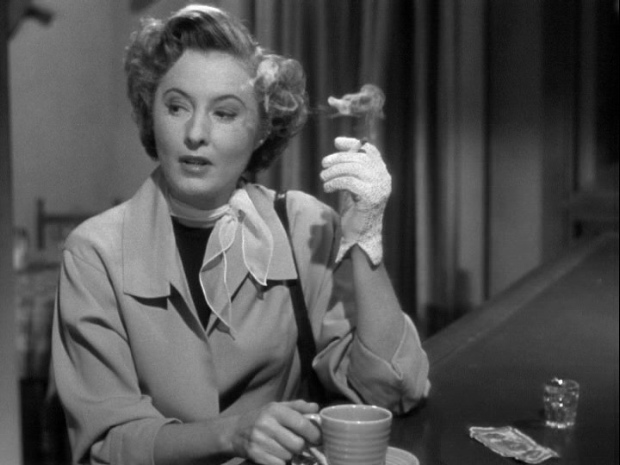
There's a terrific short review of Fritz Lang's Clash By Night, maybe the greatest of all domestic noirs, recently posted on the web site films noir.  It has this sublime evocation of the film's themes — “Sexual abandon and existential entitlement are put on trial and found empty.”

Double Indemnity and Sunset Boulevard are certainly the most entertaining domestic noirs, but Clash By Night offers far more complex insights into the ways post-WWII anxiety corroded relations between the sexes.

Check out the review here.

FLETCHER HANKS

Fletcher
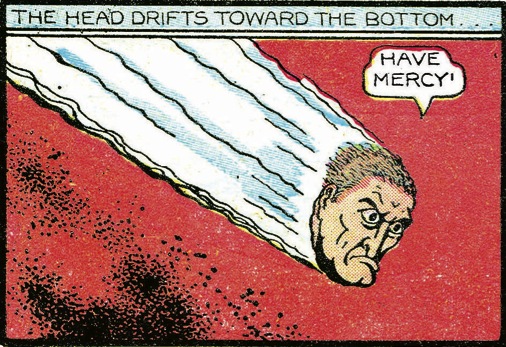
Hanks is sometimes called, with a kind of affectionate awe, the worst
comic book artist of all time — sort of the Ed Wood of the comic
book.  Like Wood, he was bad in an earnest, reckless way that
grips the imagination.

Fletcher's drawing style was crude, his stories simple and
brutal.  They have a way of penetrating straight to the unconscious.

Not much is known about him, except that he was an abusive drunk who
terrorized his family and then abandoned them in 1930, that he stopped
drawing comic books in 1941 and that he froze to death on a park bench
in New York City sometime in the 1970s.

But the work remains, saved by a few collectors of wildly obscure comics and now reprinted in a new book called I Shall Destroy All the Civilized Planets!  It is a cry from a twisted heart and in some weird, unfathomable way both brilliant and important.

HOLE CARDS

Commenting
on the Republican primary in Florida tonight Tom Brokaw used a poker
analogy to describe Mike Huckabee's current position in the race —
“He's holding a pair of twos.”  In other words, he doesn't have a
premium hand, especially compared to what the other players at the
table are holding, but it's still a hand.  What Brokaw was getting
at was that Huckabee, by taking votes from Romney among “values voters”
in the Southern states, could still affect the race in a decisive way
and earn political capital in the process, specifically with John
McCain, who might seriously consider Huckabee as a running mate.

That got me to thinking about what hole cards the other candidates are
holding at present (thoughts that admittedly won't make much sense
unless you know the game of Texas Hold-em.)

On the Republican side, of the three players still in the pot,
Huckabee
has his ducks (a pair of twos), McCain has cowboys (a pair of kings)
and Romney has jack-ten suited — or maybe jack-ten unsuited, or maybe
jack-queen suited, or maybe . . . well, with Romney it's hard to be
more precise — apparently he has a bunch of mediocre cards up his
sleeve which he can play at will.  In any case, McCain has a
made hand and Romney
is on a draw.  Romney has enough chips in front of him to call
McCain down to the river but he's chasing.

On the democratic side, Hillary is holding big slick, ace-king, and
Obama is holding little slick, ace-queen.  If neither hand
improves, Hillary wins.  Obama has to catch a queen and Hillary
has to miss catching another king.  For Obama, a queen would be a
last-minute surge next Tuesday that keeps the delegate count close and
convinces the old-guard Democratic party hacks that he has an unstoppable
momentum which it would be too costly to get in the way of.

We'll see the flop in both games on Tsunami Tuesday.


In the big game, the general election in November, it will be heads-up
(probably).  If it's Clinton against McCain, Hillary will be
holding seven-two off-suit and John will still have his cowboys, his
two kings.  Only a miracle would give the pot to Clinton.  If
it's Obama against McCain, Obama will be holding two queens against
McCain's two tens.  Obama would have the edge, but McCain could
still get lucky, catch another ten and take it down.

Either way, we've got some interesting poker up ahead.

THE FRONT LINES

Participating
in the Nevada Democratic Caucus last week gave me an interesting
perspective on the Presidential race this year — a look at things on the front
lines, where actual votes are cast and recorded.

Prior to the caucus I got a phone call from a live Clinton supporter
who urged me to vote for Hillary (“because she has the experience to
get things done”) and told me where my caucus site would be.  I
got a recorded message from Edwards, inviting me to a meeting of his
supporters in Henderson.  Nothing from the Obama campaign. 
That struck me as odd — I thought perhaps his campaign had decided to
cut back on the expense of outreach calls because of the boost he got from his
endorsement by the Culinary Workers Union.  If so, it was a big
miscalculation.

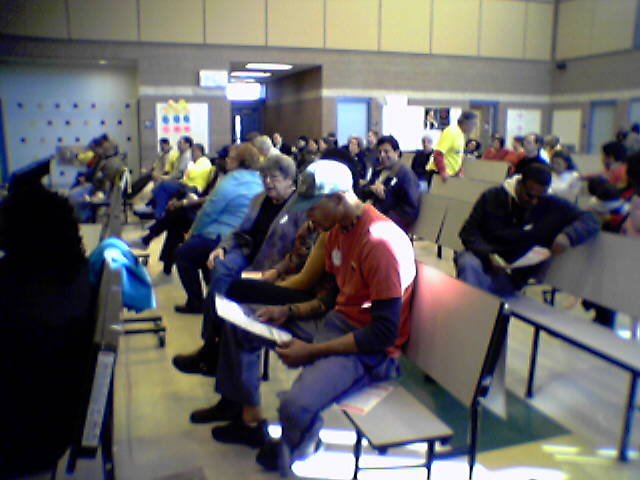
My caucus site was the auditorium of an elementary school a few blocks
from my house.  When I got there, one side of the room was filled
with Clinton supporters, mostly older white women wearing yellow
Hillary T-shirts that the Clinton coordinator was handing out. 
Behind them sat five or six undecided voters.  On the other side
of the aisle were the Obama supporters, mostly blacks of all
age-ranges.  Behind them were a handful of Edwards supporters, and
later in the proceedings a single Kucinich supported identified himself.

I sat with the Obama supporters.  The Obama coordinator had no
T-shirts, just some campaign stickers to put on your shirt front.

There were 55 voters in total present for the caucus.

At one point I overheard two of the Clinton supporters, older white
males, whispering to each other about caucus strategy.  One of them said, “We've got
to make sure none of the undecideds go over to the dark side.” 
They smiled conspiratorially at the phrase, which I didn't feel was a
reference to Stars Wars.

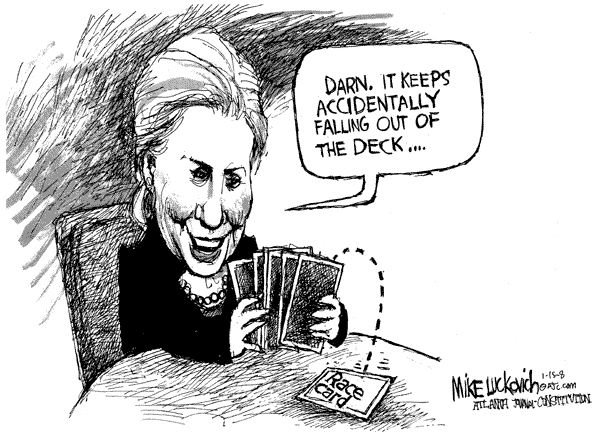
There's a lot more of this sort of casual prejudice abroad in the land
than people might like to believe and I think the Clintons have made a
deliberate decision to exploit it — to position Obama as “the black
candidate” and make people feel o. k. about indulging their sense of
blacks as “other”.

It's pure, cynical Rove-ian politics, morally sickening in itself and
even more sickening because it will probably work, at least as long as
Hillary can make plausible denials about her involvement in the
statements of her supporters, including her husband Bill.  To me,
such denials are not plausible, and I won't vote for Hillary in the
general election if her tactics succeed, unless it's absolutely
necessary to defeat an even more objectionable candidate, like Mitt
Romney.  In other words, John McCain has become my second choice
for President this year.

If the Clinton tactics can so thoroughly alienate an old-time lefty
like me, I hate to think how she would fare with more moderate
Democrats and independents in a general election.  I think we
might see a Democratic defeat of McGovern-like proportions.

At my caucus, there weren't enough Edwards supporters or Kucinich
supporters to make either of them eligible for delegates from our
district.  In the end, all the Edwards supporters and almost all
the undecideds moved over to the Obama camp and the vote ended up very
close to even, with Clinton edging out Obama by a few statistically
insignificant votes, as it turned out.  We awarded 5 delegates to
each candidate.  This mirrored the way things went throughout the
state, with Hillary getting more votes overall but splitting the
delegates just about evenly with Obama.  (The press tended to
report only the vote totals, which gave Clinton the “beauty contest”
win, barely mentioning that in the race for delegates the Nevada
contest was essentially a dead heat.)

When it came time to elect the delegates themselves, most of the
volunteers on the Obama side were undecideds who'd crossed the aisle
that day.  I thought that was a good sign for my guy.

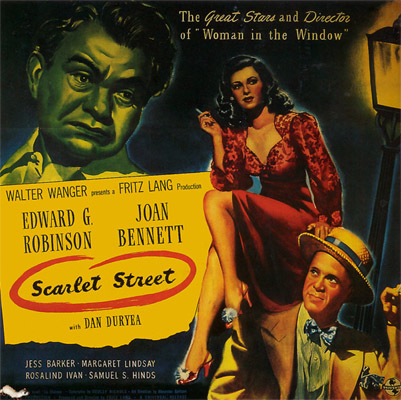
SCARLET STREET

This film by Fritz Lang, from 1945, is essentially domestic noir — the story of an unhappy, ordinary middle-aged married man led into a life of deception and, ultimately, crime by a fetching femme fatale
It was Lang's favorite among the films he made in America and has a
considerable reputation but I find it curiously dead emotionally and
lacking in real suspense.

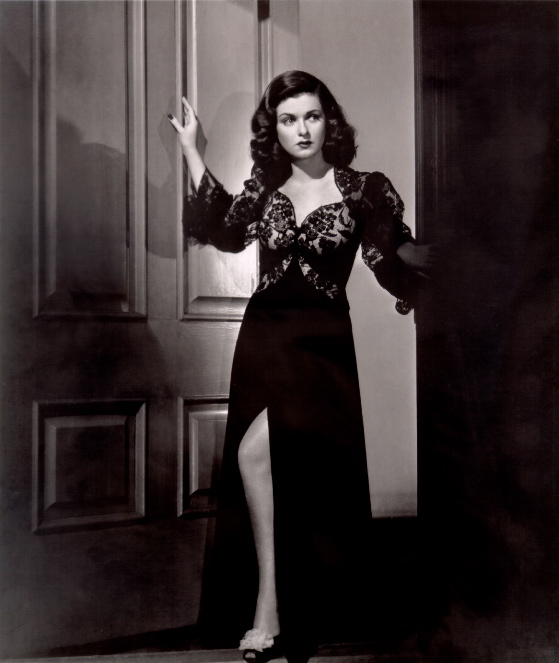
The problem is that the fatal femme
is so obviously on the make, so obviously not attracted to the ordinary
man, so cynical and so dumb, that we feel only pity for the guy, a pity
laced with scorn.  We can see what attracts Walter to Phyllis in Double Indemnity
— the two are hot together — and even if we suspect that Phyllis
might be using Walter, part of us thinks it might be worth getting used
by a woman like this.  This implicates us morally and emotionally
in Walter's transgressions, makes us care about his fate.

It's impossible to care about Chris in Scarlet Street
on that level — watching his life come apart at the seams is like
watching a train wreck from a distance.  It's fascinating and
horrifying but we're not involved.  In Double Indemnity, like it or not, we're passengers on that trolley hurtling towards the end of the line.

The ending of Scarlet Street
achieves a kind of tragic power, because things go so horribly
wrong, and Chris's moral collapse is so complete and so bleak. 
It's not a genuine tragedy, though, because in a genuine tragedy we
could imagine ourselves in Chris's place.  In Scarlet Street we're denied that identification, that implication in his fate.

JAMES SHEEHAN PAINTING AT NIGHT

My
sister Libba Marrian is making a documentary about the wonderful
painter James Sheehan.  I've seen a rough assembly of part of it
and it's fascinating.

You can see a short sequence from the film, James Sheehan Painting At Night, on YouTube here.  The painting and the images recording Sheehan at work on it are beautiful.

You can see more of Sheehan's work here.

TALES OF THE FELT

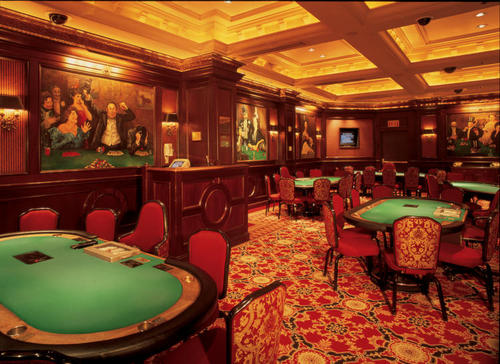
A couple of nights ago I played no-limit Hold-'em for about eight hours at the Monte
Carlo casino poker room (above) — from just before midnight to just before
8am.  This is the optimum time to play poker in Las Vegas because
most of the other players you're likely to encounter then are either
drunk (and getting drunker by the minute) or staying up all night on
their last day in town.  You drink iced tea, play tight and take
their money.

I didn't have a great session financially — I only made a bit over
$70, but that still beats minimum wage.  On top of that, all the
iced tea is free and at the end of the session the card room will give
you a voucher for a free breakfast.  It's also a very entertaining
way to make a little extra cash.

Last night I played with a sales rep for a Mylar manufacturer who sells
to the aerospace industry.  He was in town for a friend's wedding
— Elvis-themed.  I played with a Canadian guy who used to own a
commercial fishing boat but sold it and retired, in order to devote
himself to travel.  I played with a guy from Mexico who's now a U.
S. resident and a successful businessman.  He said what he liked
about America was that he now could afford to have white guys do his
yard work.

I played with a succession of riotously drunk thirty-somethings whose
patter was often fairly amusing.  One guy, who looked about
sixteen, sat down wearing a green pullover and bright green sunglasses.

“Hey, monkey boy — where'd you get the glasses?”

“Monkey boy?”

“Where'd you get the glasses?”

“I got them at the Excalibur — with my kids.”

“You've got kids?”

“No, I don't really have kids.  You see that guy standing at the rail there — he's my gay lover.  His name is Jason.”

“Yeah, I've met him before . . . only he said his name was Jimmy.”

Meanwhile these guys were knocking back the beers, drawing doggedly to inside straights and calling big raises with middle pair.

What more could you ask for at a poker table?

REDISCOVERING PREMINGER

Following
up on a recent post in which I suggested that Otto Preminger was
overdue for a critical re-evaluation, I notice that Film Forum in New
York is hosting a 23-film retrospective of the director's work — which
coincides with the recent release of a new Preminger biography by
Foster Hirsch, which Tony D'Ambra of the films noir site recently
directed attention to here.

The Film Forum site offers this from Andrew Sarris — Otto
Preminger is still the most maligned, misjudged, misunderstood and
misperceived American filmmaker. His films have stood up better
stylistically, thematically and subtextually than I ever imagined they
would.”

Indeed,
Preminger's films are so interesting and so good that all this
attention should lead to the restoration of his reputation in no time
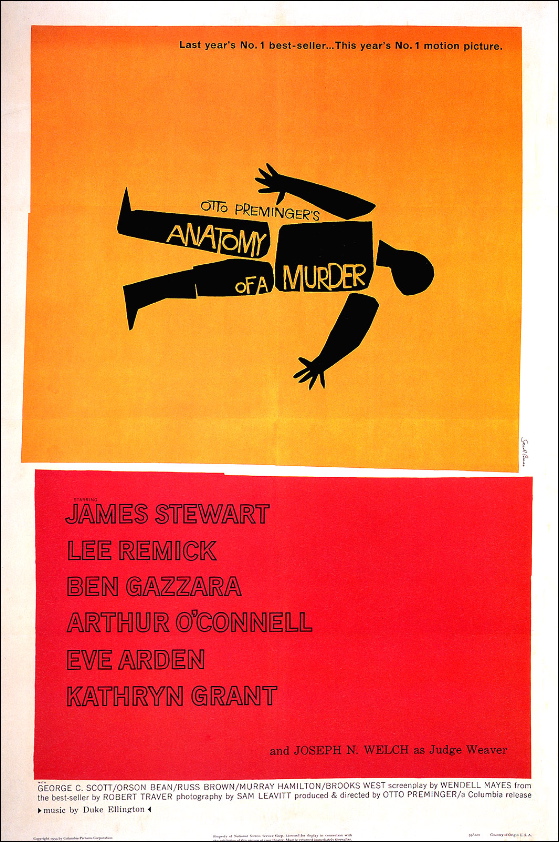
at all.  (Let's hope it leads to a widescreen DVD edition of Anatomy Of A Murder as well . . .)

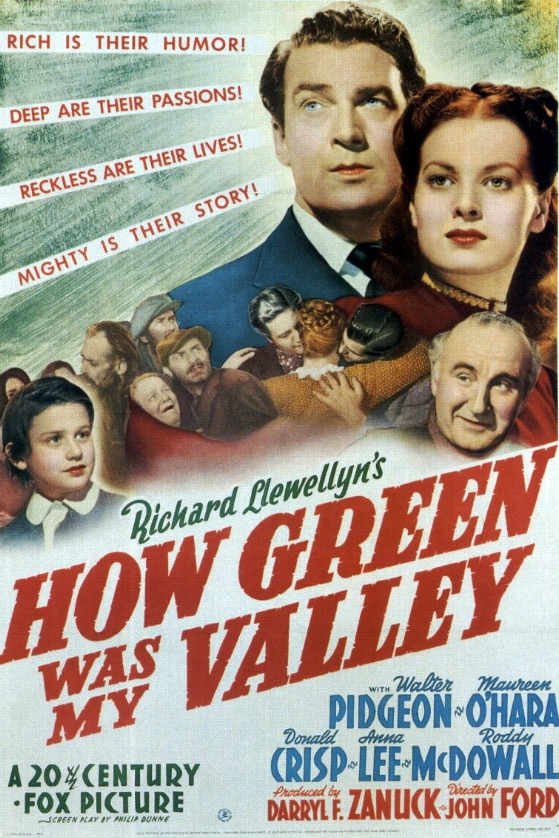
HOW GREEN WAS MY VALLEY

Jean-Luc
Godard once said that every tracking shot is a moral statement. 
This is true and worthy of much meditation.  Another way of
putting it might be “where a director moves his camera, there will his
heart be also”.

It occurs to me that the pacing of a film and the length of its shots
also involve moral choices.  There are vast areas of human
experience which cannot be addressed with the kind of fast-paced MTV
editing that many films today employ, and moral choices come into play
when excluding these areas from popular culture.

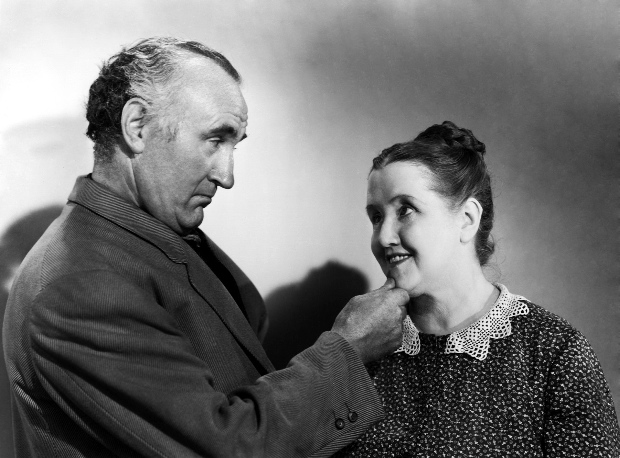
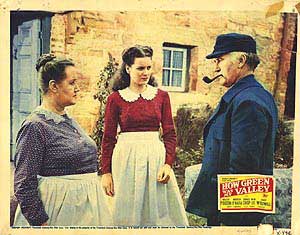
These thoughts are prompted by a recent re-viewing of How Green Was My Valley,
one of the greatest works of American cinema.  The film is not
really slow-paced — it's full of incident and movement — but it's
episodic and it pauses often to record the precise and deliberate way
certain incidents unfold.  It's the story of a particular family and a
particular community but it's also a poem about family and community as
phenomena.  It concerns itself, as Ford's films often do, with
process — in this case the process by which family and community are
constructed, the practical ways they function.

This involves showing the ways that mundane activities are ritualized,
so that everyone's role in them is clear.  It involves showing the
ways that mutual consideration is shown — which might include a rude
jest or keeping one's peace, joviality or silence, singing and dancing
boisterously or slowing down the pace of a social interaction to
accentuate its gravity.

Modern films — which people in Hollywood are fond of referring to as “rides” — can feature families but they cannot be about
family in the way that Ford's films were about family.  Families
can certainly go on rides, but family life is not constructed like a
ride.  Family life is what happens between rides — and so is the
real story of How Green Was My Valley.

The family in the film, like all families eventually, comes apart —
through kids leaving home, disagreements between the generations,
external social pressures and death.  The film's narrative is
almost a litany of
ordinary tragedies.  But these are not the things that sum up the
film in your mind after you've seen it.  It is not a tragedy, nor
a soap-opera ride.  It's a movie about the creation of a miracle,
a work of art — a family.  It's about the deathless essence of
family — the highest achievement of human civilization.

In Hollywood today, moral choices masquerading as aesthetic, stylistic
preferences virtually insure that this subject can never be presented
on the screen — though I would guess that there's hardly any subject modern audiences are hungrier for or more in need of.

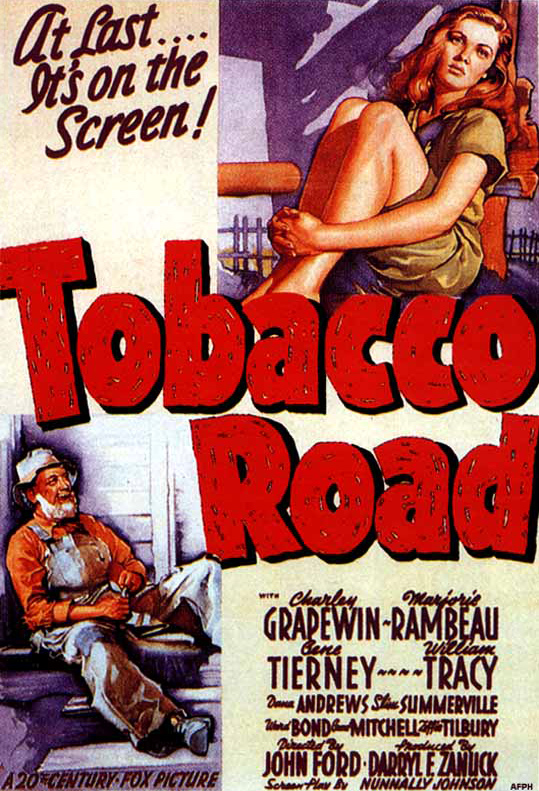
TOBACCO ROAD

In
1941 John Ford, as a contract director at 20th-Century Fox,
made two films for the studio.  One was the sublime How Green Was My Valley.  The other, made right before Valley, was a bewildering misfire — Tobacco Road.

You just have to throw your hands up at Tobacco Road
It's clear why the studio would be interested in the property — based
on a novel by Erskine Caldwell but derived more directly from a
theatrical adaptation which at the time held the record for the
longest-running Broadway play of all time.  The movie pokes
merciless fun at the same class of sharecroppers who were treated as
almost saintly characters in The Grapes Of Wrath, made only a year before. 
The film's humor is extremely broad but rarely funny.  Ford
lets his actors mug and jerk around like puppets — they might as well
be shouting “look at me, laugh at me!”  It's only the occasional
throwaway gags that actually elicit chuckles.  At the end of the hi-jinx Ford tries to summon up some pity for his
rustic clowns, but they aren't real enough to pity.

The film is
beautifully shot and its perversity is impressive if not exactly
entertaining.  (Some might find the whole thing worthwhile just
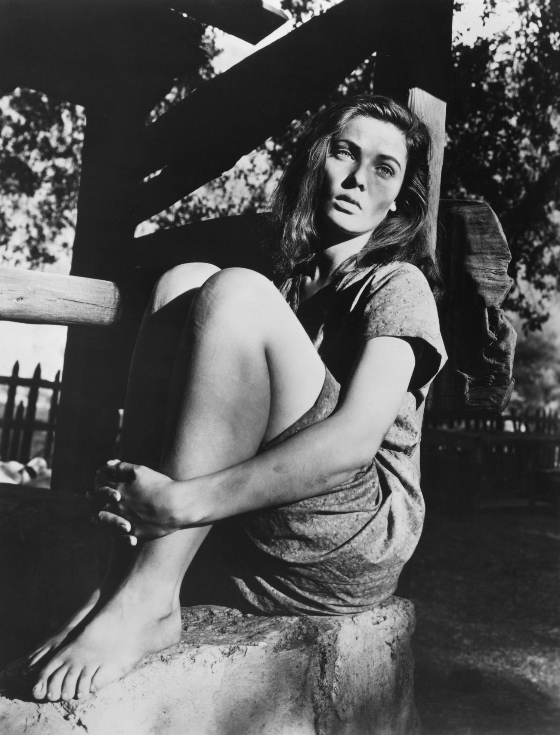
for the chance to watch a scantily-clad Gene Tierney slithering
lustfully through the dirt like a sex-crazed slug — surely the strangest thing she was ever
asked to do in Hollywood.)  It almost seems as if Ford was
indulging his worst
instincts — to get them out of his system before tackling How Green Was My Valley
Apparently it worked — in the latter film he hardly makes a single
wrong move, and takes the poetic possibilities of filmmaking about as
far as anyone ever has.

If he did indeed need to root around for a bit on Tobacco Road to create the miracle of How Green Was My Valley you'd have to say that, on balance, it was a road well-taken, though not much fun to revisit today.

READING JOHN FORD

In the present age of extreme political and cultural polarization, it can
be hard to read John Ford.  He worked in an era when it was
possible to revere military culture with an almost religious fervor and
hate political war-mongering at the same time, when it was possible to
traffic in racial and ethnic stereotypes and subvert them at the same
time, when it was possible to worship the family and family values and
see the oppressive role of families at the same time, when it was
possible to be at once a social conservative and a political
progressive, a deeply religious artist and a man with a profound
suspicion of organized religion.

In our own either/or age, Ford’s complexities can be confusing, with
what seem to be conflicting cultural signals.  This is due partly
to Ford’s rhetorical strategies, in which the obvious pieties of his
stories could be completely undercut by their emotional undercurrents
— and it’s due partly to Ford’s comprehensive sympathies, essential for a great dramatist, which wouldn’t allow him to judge anyone based on an ideological position or
professed beliefs.

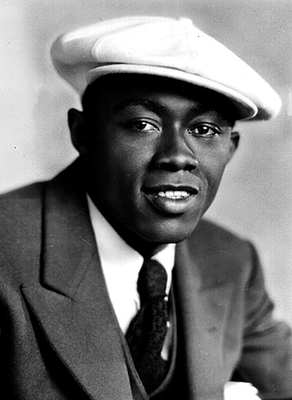
Many people are distressed by the presence of Stepin Fetchit (above) in several
of Ford’s films.  Fetchit specialized in impersonating what was on one level a most objectionable stereotype of the slow-moving, slow-witted African American.  But
he was usually, in Ford’s films, far wiser and cannier than his image
suggested, in itself an interesting comment on the stereotype, with its
inescapable implication that it might be no more than a mask.
(Fetchit was also a brilliant physical comedian and Ford showcased his
art with great care — which has to count for something.)


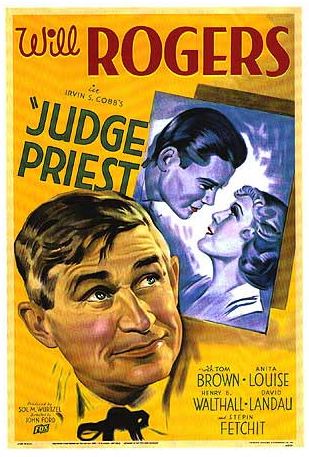
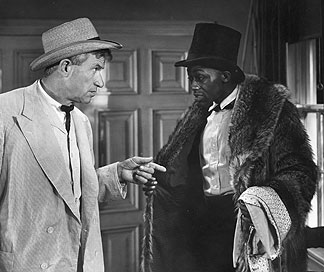
Even more remarkable, in a film like Judge Priest (above), starring Will Rogers in the title role, is the way the Rogers character subverts the stereotype — by treating Fetchit as a
peer, with total respect.  You search in vain in Rogers’ performance for
the slightest hint of paternalism or condescension — it’s simply not
there.  Since Fetchit-like characters were used in large part to justify
paternalism and condescension, Ford is subverting the phenomenon at its
root.


The same phenomenon is at work in another scene from Judge Priest
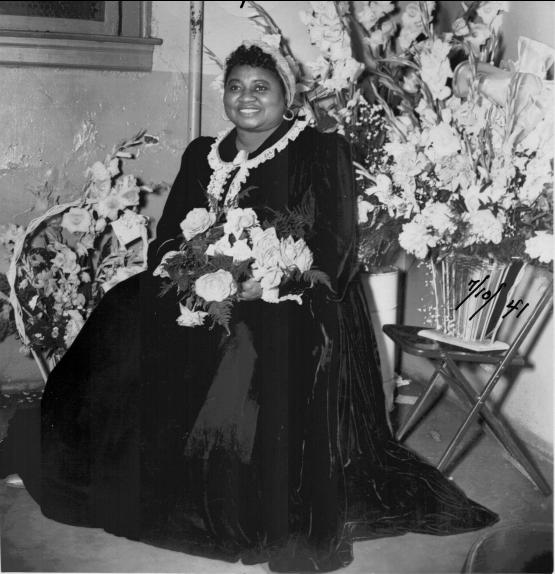
when Hattie McDaniel (above), a “mammy” stereotype, starts singing a silly
song about the judge to a Gospel-sounding tune. The judge chimes in
with heartfelt responses of “Oh, Lord!  Oh, Lord!”, in full,
joyful voice, again without a trace of irony.  He likes the way he
and she sound singing together — he treats her “quaint” musical idiom
as a serious medium of communication, and also as a medium they share
and rejoice in equally.

For the judge, the character we most identify with, to see through the
most extreme stereotype to a real person behind the facade, is radical.
It’s like the way Priscilla sees past the racial stereotypes and
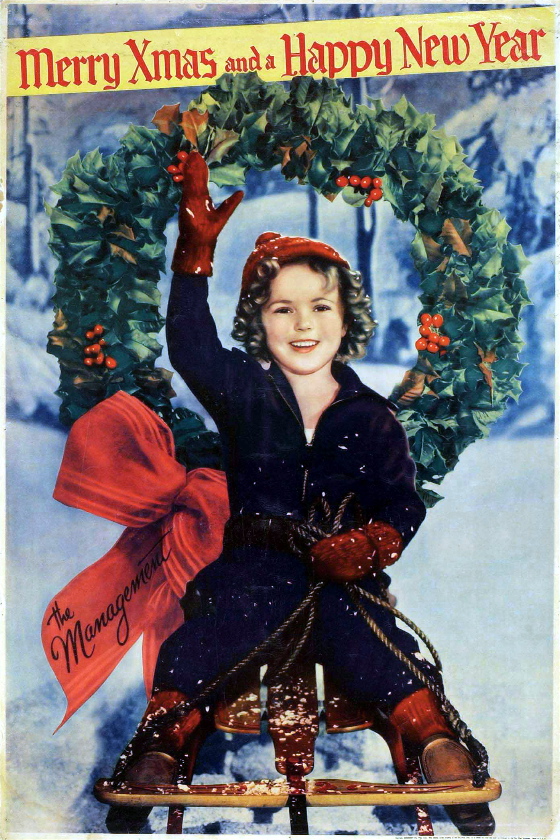
imperialist assumptions in Wee Willie Winkie, the remarkable collaboration between Ford and Shirley Temple.


In a superficial reading of that film one might see it as a celebration of the
British Empire and its mission — unless one remembered that Ford was an
Irishman, with a built-in grudge against the British Empire.  When Khan
laughs hysterically at the idea that Queen Victoria wants to help his
people, he’s probably expressing Ford’s truest feelings on the subject.

Ford was both a subtle artist a wily old son-of-a-bitch — taking anything he does too much
at face value is always dangerous.  It risks missing the deepest meanings of his films.