BABY FACE

In the days before its Production Code got really strict (around 1934)
Hollywood had extraordinary latitude in the subjects and attitudes it
could address.  Turner Classic Movies has just released a set of three
pre-code films, under the title
Forbidden Hollywood, that gives some
startling examples of the freedom that was lost.


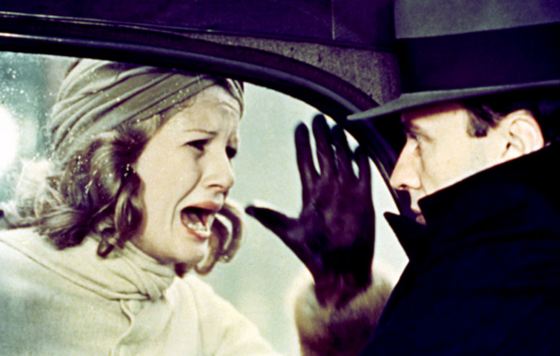
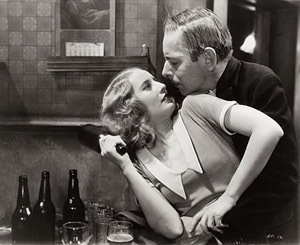
Baby Face, starring Barbara Stanwyck, presents a world-view of
jaw-dropping cynicism — a case study of bimbo feminism that would be
shocking even in a Hollywood film of today.  Stanwyck plays Lily, a
girl who’s been hooking since she was 14, pimped out by her own
father.  She meets an eccentric Nieztsche fan who tells her to use her
power over men ruthlessly, without sentiment or conscience, to get what
she wants.  And this she does — fucking her way to the big city, and
up the ladder of success, until she’s the filthy rich mistress of a
pathetic old banker.


The passion and jealousy Lily arouses in the men she uses eventually erupt in violence, and set up a nifty blackmail opportunity for her, but also throw her into the orbit of a different sort of man than she’s used to, a man who knows all about her past but loves her anyway . . . and she finds a kind of redemption in his arms.
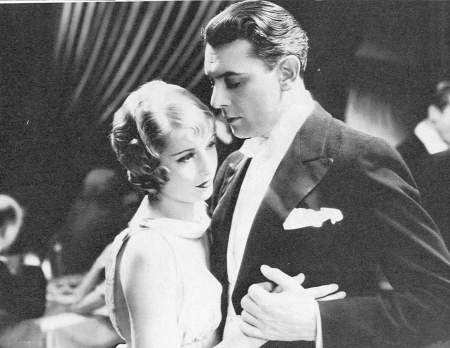
All the men Lily encounters, except for the last one, are slimeballs
and pushovers, and Lily never shows even a flicker of remorse about
exploiting them and destroying them.  The really shocking thing is
that the film doesn’t condemn her for this, any more than her last lover
does — she’s been dealt a bad hand in life, as a woman, and she’s
played it the best way she could.


This is all dizzyingly surreal.  Seeing Hollywood stars and Hollywood
production values deployed in the service of a story like this makes
one feel one has entered an alternate universe — except of course that
it’s closer to the universe we actually inhabit than to the post-code
Hollywood version of reality.


Baby Face is lurid pulp melodrama at its most entertaining, and it’s
something more, too — a vision of what movies might have been if
corporate hypocrisy and totalitarian concepts of social hygiene hadn’t
put them in an artistic straightjacket.


Rush out and get this set, and prepare to be seriously discombobulated.
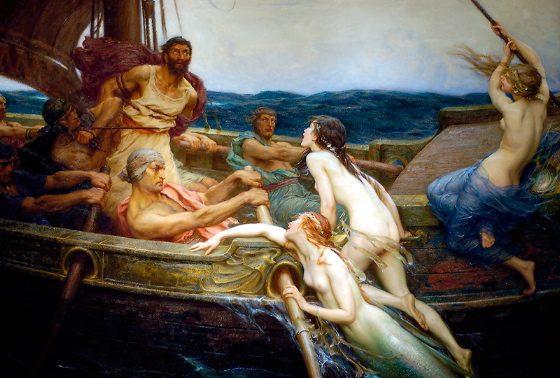
WHAT SONG THE SYRENS SANG


A quote from Urn-Burial, a strange book by the 17th-Century author Thomas Browne:


“What Song the
Syrens sang, or what name Achilles assumed when he hid himself among women, though puzzling Questions are not beyond all conjecture . . .”

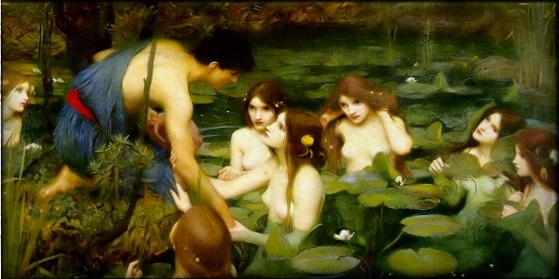
The painting above is by Herbert Draper, a good example of Victorian soft-core pornography.  They were better at it than we are.


The example below is by John William Waterhouse.  The Victorians knew that marrying restraint and indirection to perversity produced a more delirious kind of eroticism.

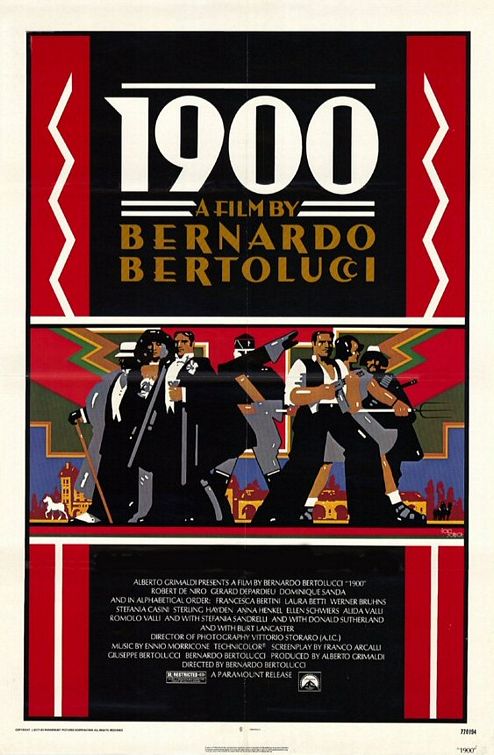
1900

It’s hard to imagine that there will ever be another movie like 1900.  The sheer size of its physical production (as opposed to the CGI resources it deploys) and the care and imagination
lavished on almost every scene, every set-up, every shot, seem beyond the resources and the ambitions of modern filmmakers.

When it came out, in 1977, Pauline Kael said it made every other movie released that year look like “something on the end of a toothpick”.  It makes most movies ever released look that small.

Which is not to say that it’s a grandly satisfying film, that it doesn’t fail on many levels — but it really is a hell of thing to look at and experience.

Bertolucci’s initial cut of the film clocked in at something over five hours — and that’s the only length at which the film makes sense.  There’s no urgent narrative at the heart of it that
emerges when it’s pared down — abridgment just violates the leisurely pace of the film, which asks us to immerse ourselves in images, in recreated eras, in the slow meandering of history.

If you can surrender to its pace, relish its imagery without hurry or anticipation, you are treated to an orgy of cinematic beauty — a pure and joyous celebration of the possibilities of the medium.

You can forget, or set aside, what’s wrong with the film — its programmatic characters, who sometimes come to dramatic life but just as often stayed fixed in their roles as
political archetypes, its naive celebration of the romance of Communism, its cartoonish reduction of history into icons and slogans.

What you will remember are places, times of day, the play of light, the choreography of peasant dances and cavalry charges and duck hunting from small boats.

Afterwards you’ll find yourself wishing the film had been better — but while you’re inside its rapturous, disjointed visions, it’s hard to imagine anyplace you’d rather be.

[A DVD with Bertolucci’s original cut, in an excellent transfer on two discs, has just been released, and it’s well worth owning — it may be the only five-hour-plus film you’ll want to look at again and again.]


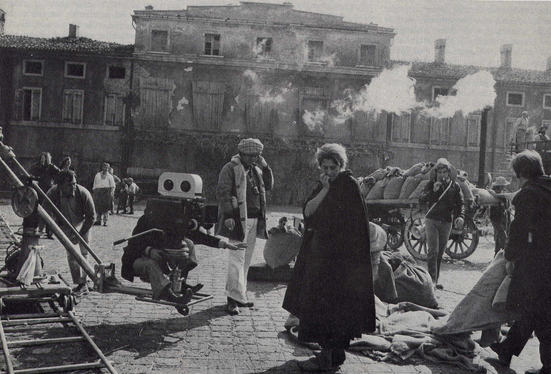
The picture above — showing Bertolucci, in the checked cap, setting up a shot on 1900 — is from a web log that regularly posts great images from film and popular culture.  Check it out here:

If Charlie Parker Was a Gunslinger, There’d Be a Whole Lot of Dead Copycats

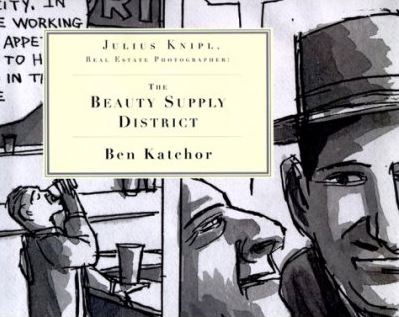
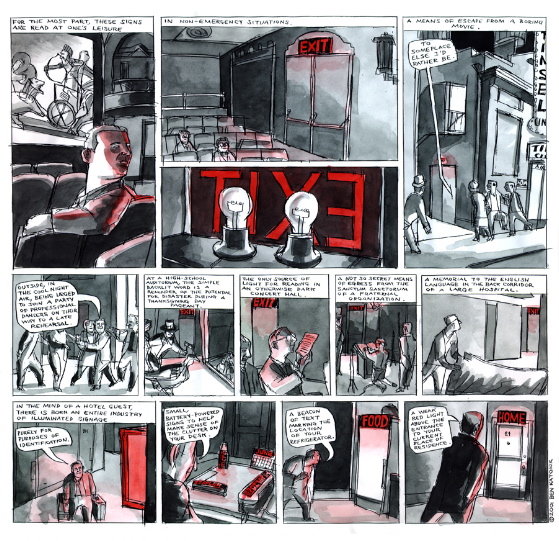
BEN KATCHOR, REAL ESTATE PHOTOGRAPHER


This past November I was delighted to read a notice in the newspaper
that Ben Katchor was going to be appearing in Las Vegas as part of the
Las Vegas Valley Book Festival. Katchor is one of the great fiction
writers at work today, and he happens to work in the medium of the
comic strip, or picture stories as he likes to call what he makes.


His
signature creation is Julius Knipl, real estate photographer, who
wanders the back streets of a disappearing New York, the New York of
the small-time merchants and manufacturers and wholesalers who used to
be the life's blood of the city's economy but are now being moved out
to the fringes of things by the inexorable yuppification of the city,
or at least of Manhattan.


The
disappearance of the small-time manufacturers in Manhattan made
possible my own residency in the city, starting in 1972, when artists
and various other undesirables started renting (illegally) the lofts
vacated by the small enterprises that were becoming economically
unfeasible. Back then, we lived among the remnants and the ghosts of
these vanishing concerns, businesses that made flags and coat hangars,
fur coats and uniforms.


We
were, alas, only the pilot fish for a new influx of urban professionals
who turned the loft districts into fashionable residential areas —
eventually the yuppies would drive us out of the city as they
transformed our Bohemia into the capital of Connecticut. Fair enough.
But Katchor remembers the city we Bohemians displaced, just as someday
someone will remember the city we remade. No one will care to remember
the new city of the yuppies.


The New York I miss most these days is the New York Katchor memorializes — but I missed it even when I was living in
New York. It exists now only in dreams and in art.


Katchor
spoke in a gallery at the Holsum Lofts, a converted bread factory
that is part of a valiant and almost certainly doomed effort to create a new Bohemia in Las Vegas.
It's located downtown, on Charleston Boulevard, near the few places in
the area which still retain the flavor of the dirty old city — places
like Johnny Tocco's, a classic and legendary boxing gym unchanged for
decades.


Katchor
read some of his strips, with the panels projected onto a screen. It
was interesting to see how well they played with the small audience,
which was often, like myself, laughing out loud. Katchor's tone in his
strips is generally wistful and melancholy, but there's a dark humor to
them that makes his visions bearable, and a quiet anger that gives them
great energy. All this could be heard in his voice.


Katchor
was kind enough to sign one of my Knipl books with an illustration of
Mr. Knipl, and to add the date and place of the inscription. Julius
Knipl in Las Vegas — now there's a surreal image. The yuppification of
Las Vegas proceeds apace, and it will soon have the smug bourgeois
vapidity of modern-day New York, but the process will leave
deep secrets buried here, secrets that would certainly reveal
themselves to a dogged,
mystical real estate photographer.


Here's a link to Katchor's site, where you can buy books and cards and prints, and see what he's up to:


Ben Katchor's Web Site


[Click on the image above for a bigger version]

THE CONFORMIST

Perhaps the most exciting cinematic event of 2006 was
the release on DVD earlier this month — finally, and in a terrific
transfer — of Bernardo Bertolucci’s The Conformist.

Few films of the post-WWII era have been as
influential as this one — few films of any era have been as ravishing,
as sensually exciting.

In the freewheeling atmosphere of the time, and with
the final collapse of the old studio system, Hollywood in the late
Sixties was in an experimental mood, though the experimentation often
involved only superficial stylistic gimmicks — the hand-held camera,
promiscuous zooming, elliptical editing, split-screen images.

At the same time a new generation of filmmakers was
coming into prominence which had been schooled in, and deeply loved,
the classic Hollywood films — among this generation were
Coppola, Scorsese, Spielberg and Lucas . . . all of them, except for
Spielberg, the products of film schools rather than of apprenticeship
in the industry.

They were tackling new subjects and ones that were often more challenging
than the old studio system could embrace but they were
developing a style that owed much to the formal elegance of the
cinema of the studio era.

Then, in 1970, The Conformist burst onto the scene,
the work of a young Italian filmmaker who had not only mastered the
formal elegance of the old studio style but was taking it into new
realms of expressiveness and invention.  Indeed, The Conformist had
something of the visual eloquence of the highest achievements of the
silent era, of Murnau’s and Vidor’s films, whose
extravagant poetic imagery had been lost with the coming of sound.

The effect was electric — confirming all the creative
instincts of the American film-school avant garde.  The movie was so
important to Coppola that he, along with a number of other American
directors, personally lobbied its distributor to release the film in
the United States.  He used one of its actors in The Godfather, Part
II
, and its visual style influenced every frame of Coppola’s
masterpiece.

Bertolucci never made another film quite like it.
His visual imagination, his gift for dynamic plastic composition and
choreography within the frame stayed fresh, but was often lavished on
unworthy material and degenerated into mere mannerism.

The Conformist was of a piece because its story and
its visual style reinforced each other.  Bertolucci was, in the film,
breaking dramatically from the severe aesthetic strategies and rigorous
intellectualism of his mentor Godard, indulging himself frankly in the
cinema’s power for sensual seduction — all the while telling the tale
of a promising student who betrays the political ideals of his old
professor and eventually collaborates in the professor’s murder.

The Conformist remains alive with the allure of forbidden
pleasures, tense with the guilt of giving in to them.  The film is
erotic but disturbing — a dynamic that Bertolucci would explore
more explicitly in Last Tango In Paris, but without the organic
emotional coherence of the earlier film.

The Conformist also marked the emergence of its
cinematographer Vitorio Storaro as an artist of international
stature — but that’s a subject for a future post . . .

FATHERS AND DAUGHTERS

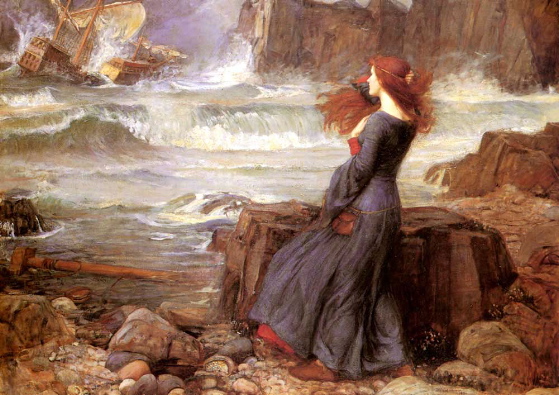
[Miranda, the Tempest, by John William Waterhouse]

Of all the primal bonds, that between father and daughter has been perhaps the least examined by psychologists and by artists . . . with the notable exception of Shakespeare, himself the father of two daughters, one of them the twin of his only son Hamnet who died in childhood.

Father-daughter relationships figure prominently in 21 of Shakespeare’s surviving plays, and they are examined from almost every angle, most of them problematic. In the comedies the relationship is presented primarily through the eyes of the daughters, in the later magical romances primarily through the eyes of the fathers.

Diane Dreher’s Domination and Defiance, published in 1986, was the first book specifically devoted to the subject of fathers and daughters in Shakespeare, and it’s a fine, illuminating study. It’s central thesis is that Shakespeare’s view of father-daughter relationships was both wise, psychologically speaking, and startlingly progressive, socially and politically speaking. Traditional patriarchal domination of the daughter by the father is always seen as destructive in Shakespeare’s plays, harmful to the psyches of both father and daughter, and to the social order itself.

As with all insights into Shakespeare’s work, the book raises intriguing but always unanswerable questions about Shakespeare’s biography. What real-life family dramas informed the clashes between fathers and daughters in the plays of Shakespeare’s early and middle periods? What epiphanies led to the sublime, almost mystical and always deeply moving reconciliations between fathers and daughters in the late romances?

It’s impossible to believe that there were no such connections between the life and the work — it’s equally impossible not to be vexed that they can never be summoned up into the light, except by way of Prospero’s enchanted, phantasmagorical visions.

ANDREW WYETH AND THE SILENT CINEMA

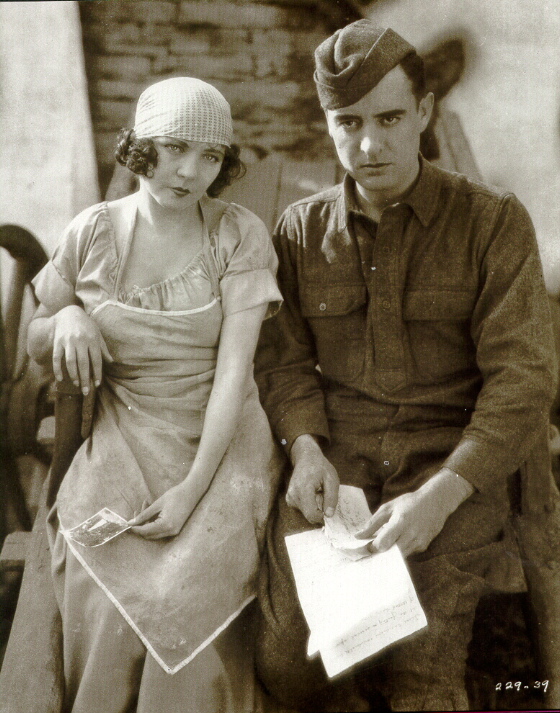
[Renee Adoree and John Gilbert in King Vidor’s The Big Parade]

Reading an excerpt from David Michaelis’s biography of N. C. Wyeth in an
old
Vanity Fair I came across an interesting passage.  Writing about N. C.’s son Andrew, Michaelis says:

“Andy’s conception of army life had been formed by years of soaking up The Big Parade, King Vidor’s silent classic about three enlisted men in WWI, which N. C. had taken him to see as an eight-year old boy. ‘This film,’ Andrew later explained, ‘got into my bloodstream.’
Eventually he came to own a copy and would screen it four or five times a year all through his adult life.  Forever linked to his deepest feelings about his father, certain frames of the film would form, without his realizing it, the basis for some of the most important images in his art.”


As an adult Andrew Wyeth eventually wrote a fan letter to King Vidor and the two men
met towards the end of Vidor’s life.  Vidor made a short film about the encounter, the last film he ever made.  In the film Wyeth remarks that when friends said they didn’t understand why he kept on watching
The Big Parade after seeing it 180 times — literally — he replied, “You don’t understand my paintings, either.”

Two things struck me about this.

Firstly, it’s fascinating that a great artist like Wyeth, used to consciously analyzing visual images, should have created works which were unconsciously influenced by shots in a silent film.  I think this speaks to the powerful ways cinematic images, particularly from silent films, can work on all of us unconsciously.

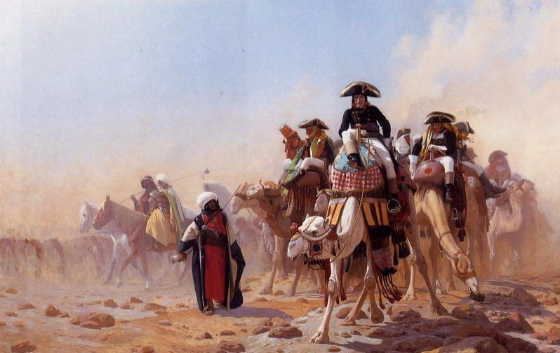
[A scene from Napoleon’s campaign in Egypt by Jean-Leon Gerome]

Secondly, I’ve always been struck by the influence of 19th-Century
academic painting on movies.  The former were centrally concerned with
using spatial effects for dramatic and emotional purposes (again often
experienced in subliminal ways.)  Movies, because they had greater
aesthetic resources in this area — i. e. movement in space by both
subject and camera — almost instantly spelled the end of academic
painting as a popular visual art form, and drove modern painters into
greater and greater abstraction.


The formal connections between 19th-Century academic painting and
movies is a subject that has hardly been hinted at in cinema studies to
date.

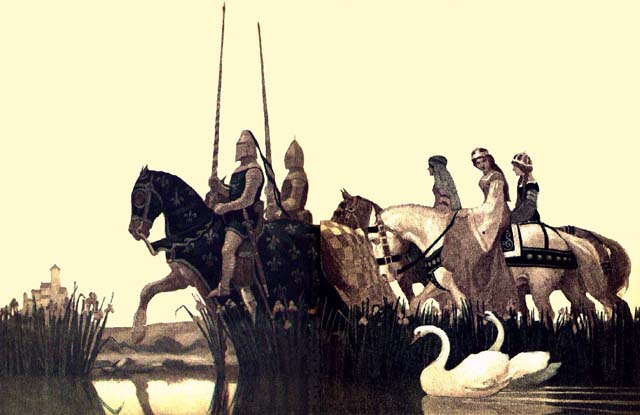
[Book illustration by N. C. Wyeth]

N. C. Wyeth kept the “cinematic” narrative-based academic style alive in
his book illustrations (as did Norman Rockwell in his magazine
illustrations) and N. C.’s son Andrew has been almost alone in keeping
elements of this style alive within the circles of modern “high art”, by
making the narrative element more ambiguous and blending the dramatic
representation of space (which is crucial to his work) with a more
pronounced abstraction of design.

In Andrew Wyeth’s obsession with The Big Parade we have a concrete example of the transmission of these oddly overlooked aesthetic connections.

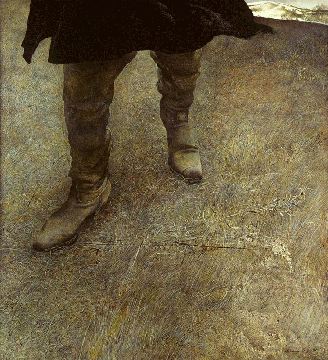
[Trodden Weeds, 1951 tempera — © Andrew Wyeth]

OYSTER STEW

It’s easy to make oyster stew. Here’s how you do it. Get a lot of oysters,
medium sized, the sweetest and freshest you can find (hard on the West
Coast, where they’re most often big and bland). It’s o. k. to get them
in jars, fresh and raw, because you want them out of the shell anyway.


Put some whole milk in a saucepan and start to heat it and when it’s just
barely tepid put the clean oysters, minus their juices, into the pan.
You don’t want the milk to cover the oysters — you need to be able to
observe them.

When the milk starts to steam just the slightest, slightest bit, sprinkle in
celery salt, a fair amount, a dose of regular salt, ground pepper,
paprika and three drops (in the name of God no more!) of Tabasco. Don’t
mix all this stuff in, just sprinkle it on top, well distributed. Then
quickly put in two chunks of unsweetened butter and just when the
butter has all melted, pour the whole thing into a big bowl and let the
pouring itself do the mixing.


Eat it with a light, dry white wine and have lots of French bread handy for sopping, which is sublime.

If the oysters are rubbery, you didn’t get the seasonings and butter in fast enough.

I pass this along from Mary Francis Kennedy Fisher, slightly modified, because it’s a miracle that something so wonderful is so easy to make.

The secret, of course, is the oysters, complicated and strange, bringing
with them such tales of currents and tides and the mysteries of the not
so deep, that they want only a simple setting to recount them in, and a
hungry heart willing to listen.

SILENT SEX

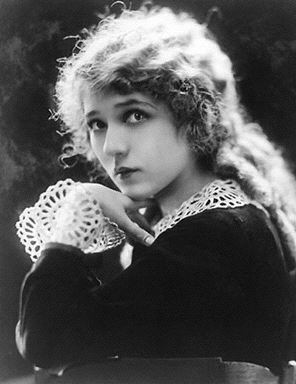
Watching Mary Pickford’s films for the first time I was startled at how sexy she was. Even if she’s not your type, even if the curls make you cringe, it’s hard not to be vexed by her energy, her obvious intelligence, the expressive use she makes of her whole body. I have this same feeling about Lillian Gish. No matter how delicate and virginal a character she plays, she always moves sublimely, communicating subtleties but also controlled power by the very inclination of her body — something a great ballerina can do as well. This sort of thing gives a fellow ideas.

In a sense, the whole medium of silent film is permeated by this kind of frank though innocent sexuality. For adults, communicating emotion and character through the expressive power of the whole body is just inevitably bound up with the idea of sex, which is one reason why dancing has always been suspect in the Puritan mind . . . and great silent film acting is closely related to dance. Keaton is, ostensibly, a clown, and the characters he plays are rarely informed by any conscious awareness of their own attractiveness — but the raw animal lust he seems to inspire in some female silent film fans is impressive.

This may be one of the reasons I’m disconcerted by Pickford’s portrayals of children — Pickford’s sexual persona, which she really can’t lose, seems out of place in a pre-sexual being.

It occurs to me also that this may explain the vague “creepiness” some people feel about Roscoe “Fatty” Arbuckle. He just moves so beautifully, so exquisitely, that perhaps he arouses unconscious thoughts which people, women especially, don’t want to associate with that particular physique.

A more extreme version of this reaction, in a more buttoned-up age, might also explain, on a subconscious level, some of the antagonism towards Arbuckle, the immediate presumption of guilt, when he got caught in a sex scandal. It would be impossible to imagine such a scenario in the case of John Candy or Chris Farley, because they simply weren’t capable of the kind of carnal grace Arbuckle had at his command.

Most modern actors have lost this means of suggesting a complex sexuality by sheer physical carriage, which is why they’re forced to expose themselves, or say naughty things, to grab a viewer’s attention in that regard. Pickford’s little jig in Tess Of the Storm Country got the job done for me.

CHRISTMAS TRIUMPHANT

I must admit that Christmas in Las Vegas threatened to become a bit melancholy this year, as the old frontier town passes into history, as the great experiment of it ends — the notion of preserving a refuge, out in the middle of the Mojave desert, from the shabby, bovine Puritanism of ordinary American life.

The experiment proved too successful, I guess, in the end — the air of freedom from Big Nanny created a vital economy and an exciting metropolis that the shabby, bovine Puritans wanted to move to, appropriate and transform back into the shabby, bovine places they left back home . . . as though they could have the best of both worlds, a vibrant fantasy city that was also tidy, safe and conformist.

American Puritans, the old diehards of the religious right and the new social hygienists of the “progressive” left (just as fanatical and intolerant in their own ways,) never learn.  The bourgeois dullards who want to control the behavior of smokers are the same bourgeois dullards who enacted alcohol prohibition in the last century, whether their smug intolerance derives from moral or “health-oriented” motives.  “The Puritan conscience,” C. S. Lewis reminds us, “works on without the Puritan theology — like millstones grinding nothing; like digestive juices working on an empty stomach and producing ulcers.”  Which suggests that the religious moralists are perhaps slightly more sane than the new secular Puritans.

At any rate, in my wistful state I delayed getting a tree this year, but on Christmas Eve, when I saw that my favorite Christmas tree lot had already closed down, I suddenly realized how shameful it would be not to bring an evergreen into my home.  I found another lot, deserted except for two exhausted lot attendants sitting in folding chairs outside the mobile home they were obviously living in for the holidays.  They could hardly bring themselves to notice me when I walked onto the lot but finally stirred and stood up, prepared to make what would probably be the last sale of the season.  I picked out a big tree, paid almost nothing for it, retrieved my Christmas decorations from storage and set the tree up in my apartment, ablaze with lights.

This changed everything, and shows why traditions are neglected at the gravest peril — they pull us out of passing moods and remind us of an antique wisdom that transcends the
understanding of the moment.

With the lights blinking, a fire crackling, a glass of egg nog in my hand, I communed with Christmases past and Christmases to come.  I remembered my modest but Grace-filled place in the continuity of things.

I looked forward to Christmas in Baja — or wherever the dim-witted Puritan duppies drive me.  It doesn’t matter.  There’s never any guaranteed room at the inn, even if you’ve got what seems to be an ironclad reservation number.  I awoke at dawn on Christmas morning and
the world was born again.

I was happy I’d been reminded to say, once again and just in time, “God bless us — every one.”


IRON GIANT

A merchandising artifact from the film The Iron Giant, released in 1999, this wondrous toy is almost impossible to find today.  I tracked one down on eBay — it was kind of pricey in this pristine boxed condition.

The figure of the giant is about 10″ tall. If you push a button on its chest it speaks a few phrases from the film and its eyes light up.  It would be awesome if the giant’s jaw were moveable — otherwise it’s just about perfectly cool.

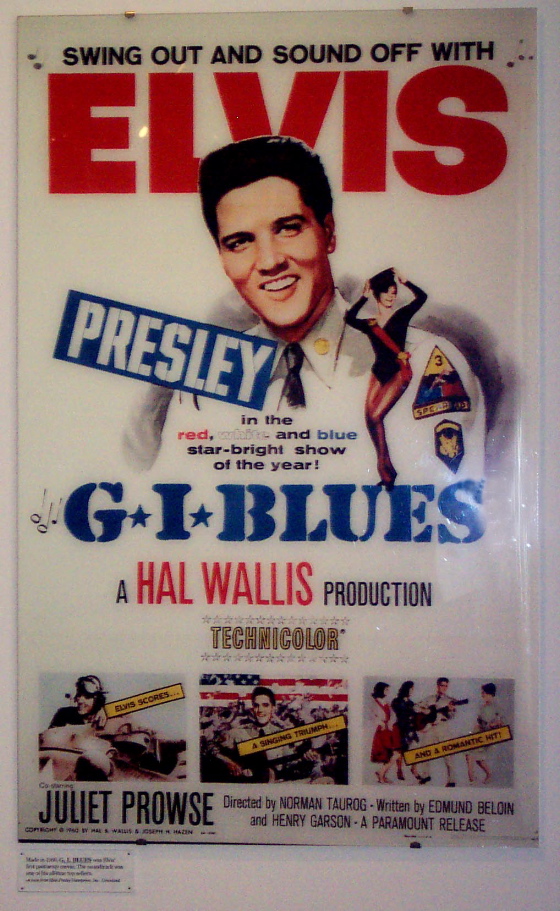
G I. BLUES


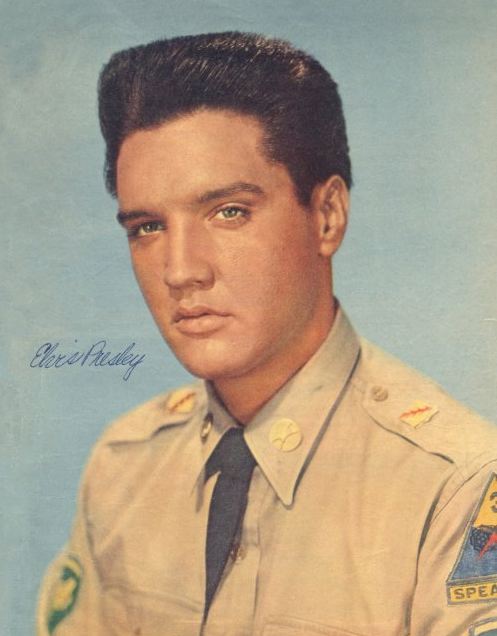
Bad songs plus a silly plot plus Elvis equals . . . movie magic.

Before his management got utterly cynical about the quality of his films, before he himself gave up on Hollywood as a creative challenge, Elvis made some enchanting movies just on the strength of his persona and charisma. He commands the screen the way a star can, without having to work very hard at it, and the very ease of his performances makes them fascinating. His dancing is toned down from his work on stage but it’s still unique and riveting and the commitment of his vocal performances, even on substandard material, is touching.

In G. I. Blues, the surrealism of the overblown sets, the travelogue nature of the location shots (none of which feature Elvis) and the frank artificiality of the production has a delirious effect at times — like Jerry Lewis and James Bond movies.

There was more wit than incompetence or naivete to this style of filmmaking in the Sixties and it seems oddly less dated than the hipper avant-garde approach that eventually overtook the Hollywood mainstream. Elvis’ serenade to the hand-puppet here is sublime cinema — inspired silliness that still manages to be charming and emotionally involving.

Just go along with it and marvel at the mysterious, ever-elusive phenomenon of Elvis Presley.

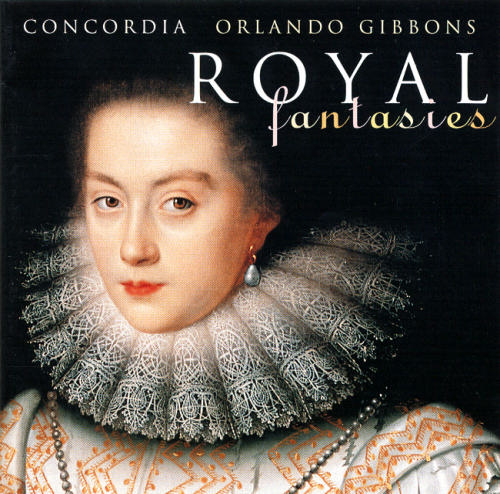
ORLANDO GIBBONS

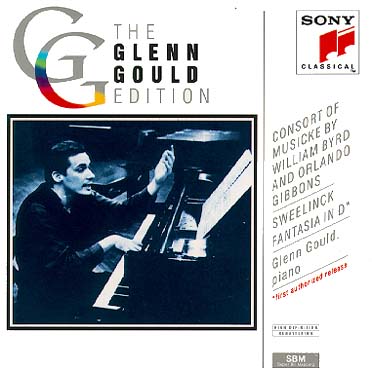
I’ve been reading a lot about Shakespeare recently and somewhere in that reading I ran across a mention of Orlando Gibbons, the other great English composer of the Tudor era (besides William Byrd.)  I decided to check him out, particularly after leaning that he was Glenn Gould’s favorite composer.

Gibbons can be appreciated as a sort of alternative to Bach, with the same logical clarity but more theatricality, whimsy and lyricism.  You can hear the cultural giddiness of Elizabethan England in Gibbons’s work, as you can in Shakespeare’s poetry.

Gould only recorded a few pieces by Gibbons but they’re fascinating performances.  Highly expressive, Romantic even, they violate historical style but somehow evoke the essence of the music, in ways stricter interpretations, on more appropriate instruments, sometimes
fail to do.


There are worse ways to spend an evening than listening to the music of Orlando Gibbons.  If you have a fire and a glass of good red wine and some strong English cheese — an old cheddar or Stilton would do perfectly — so much the better.

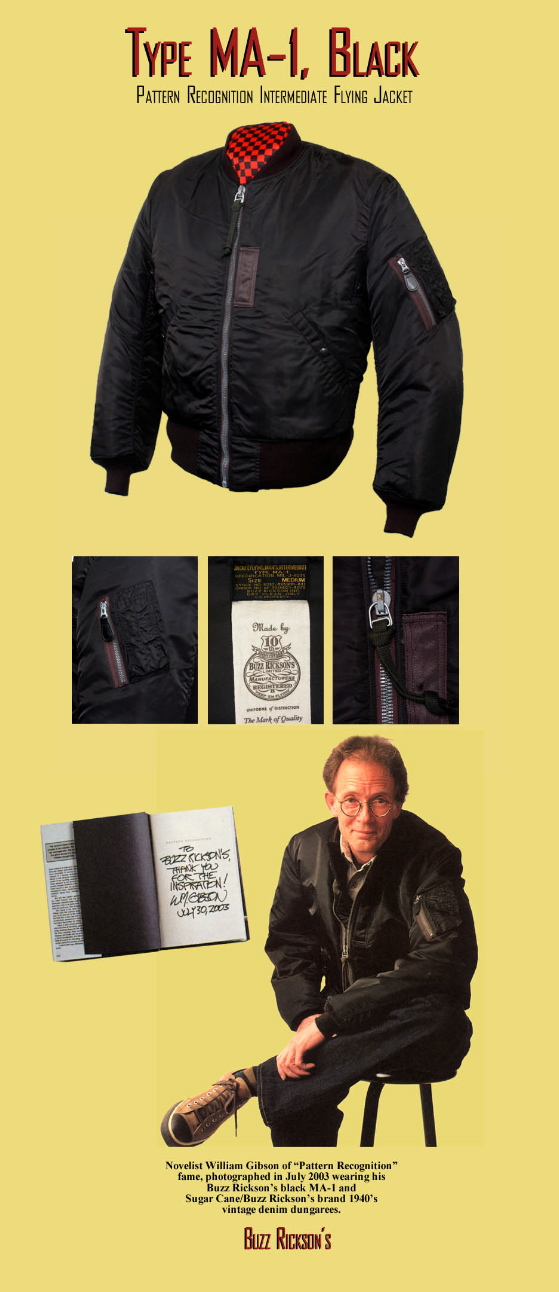
THE BLACK MA-1

In William Gibson’s latest novel Pattern Recognition, the heroine Cayce Pollard, a coolhunter, wears a reproduction MA-1 flight jacket, 1957 pattern, made by Buzz Rickson’s, which Gibson describes as a super authentic recreation of the original — in a sense more authentic than the original because of the fanatical devotion to detail by the manufacturer. He notes that the uneven seams of the original, the result of sewing the new fabric nylon on machines made to stitch cotton, have been lovingly copied, even exaggerated slightly, to make the homage that much clearer.

It turns out that Buzz Rickson’s is a real company, based in Japan, and that it really does make such reproductions, with all the obsessiveness Gibson so admires.

But Gibson made a mistake. He described Pollard’s jacket as black, whereas Rickson’s only produced the jacket in green, since that’s the only way the Air Force ever issued it. When Rickson’s learned about the mistake, it decided to issue a “Pattern Recognition” edition of the jacket in black. Gibson’s fantasy jacket has thus become real.

Two years ago I posted about the jacket on the discussion forum at Gibson’s official web site. A year after that Gibson noticed my old post and responded to it on his blog. I just discovered his response a couple of days ago — you can read it here:

http://www.williamgibsonbooks.com/blog/2005_12_01_archive.asp

This still leaves us with a problem. Do we want to wear Cayce Pollard’s black
Rickson’s MA-1, which is, in fact, unutterably cool-looking, or do we want to wear the original Rickson’s reproduction, which is what inspired Gibson, and Cayce, in the first place?

In the end, I opted for the black model, because of its unutterable coolness and as a tribute to Gibson’s great book.

But it’s a complicated question that each man or woman must decide for his or her self.

Here’s a link to the American distributor of Buzz
Rickson’s jackets — all of which are quite amazing and quite expensive:

Buzz Rickson’s

PANDORA’S BOX

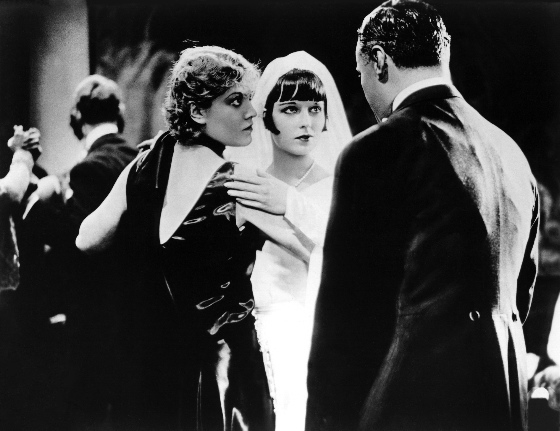
Pandora’s Box, the film Louise Brooks is best known for, is one of the sublime works of cinema, not least because of her performance init.

It is not exactly a film adaptation of the famous play by Franz Wedekind on which it is nominally based — it is better appreciated as what it calls itself, a “variation on themes” from Wedekind’s work.  Wedekind created in his central figure of Lulu an almost mythological incarnation of the terror the feminine inspired in late Victorian men, who simply didn’t know how to relate to women outside the collapsing domestic structures of modern industrialized societies.  Wedekind’s Lulu was a calculating vamp, an anarchic force, unrestrained by the old female roles, and thus could be experienced as an alien and malevolent power.

Pabst’s and Brooks’s Lulu is something else again.  Her destructive power is not defined by her deviance from old female roles but by the utter collapse of manhood around her, by the failure of men to adapt to the new empowerment of women.  The crucial event intervening between Wedekind’s play and Pabst’s film was the cataclysm of WWI, which confirmed not just the collapse but the inherent weakness, the dry rot at the heart of the 19th-Century European patriarchy.  From a post-WWI vantage, Pabst, by instinct or calculation, realized that blaming women was not really an answer or a solution to the failure of modern manhood.

Pandora’s Box shares aspects of an attitude that wouldn’t find its way into American film until after the cataclysm of WWII, specifically in film noir, where a sense of the futility of male power slammed head-on into the contingent terror of the female, the femme fatale.
But Pabst’s film is more mature, ahead of its time even, in making Lulu’s female power innocent, neutral, a mere fact of life, which men simply have no resources to engage on equal terms.

In Pabst’s film men destroy each other and destroy themselves trying to engage Lulu’s existential sexuality.  They try to commodify her, reduce her to images, trade her for money.  They fail at every turn to diminish her.  And yet they must keep on trying, since they can’t have meaningful intercourse with her as she is, and this is a constant reminder of their own impotence.  Early in the film Lulu tells her current benefactor, “The only way to get rid of me is to kill me.”  Her sexuality cannot be dismissed any more than it can be engaged — it can only be destroyed.

This explains the curious ending of the film, in which Lulu meets a contemporary version of Jack the Ripper in London and is instantly drawn to him.  He is in a sense the only
honest man in the whole tale — he worships Lulu, like all the rest of the men in her life, knows he’s no match for her, knows the only way he can deal with her is by killing her.  Which he does — but not before paying touching tribute to her majesty, crowning her with Christmas mistletoe, in images that glow with tenderness and sacramental mystery.

Lulu almost seems to acquiesce in her own sacrifice — a final extension of the detachment she displays throughout the film.  It’s not her job to tell men how to be men — she can only observe the failures of their doomed attempts to figure it out for themselves.  She observes with interest, certainly, sometimes with awe, but never with a sense of personal responsibility.  Compromising her female essence to accommodate the impotency of men is not a solution for her, or for her lovers.

Brooks’s incarnation of this role is brilliant in the extreme, one of the finest pieces of acting in all of movies.  Her work is neither minimalist nor merely naturalistic — just “being herself” . . . whatever that might mean in the utterly artificial, high-pressure context of a film set.  Pabst was clearly drawing on aspects of Brooks’s own personality in the film, but the result is a “created” character of great complexity, one which never resolves itself into any conventional type or relies on any conventional response.  Brooks’s performance has inwardness and mystery, as Shakespeare’s characters do, as Chaplin’s and Keaton’s characters do.

Pabst’s and Brooks’s Lulu is almost unique in modern art — neither a demonized icon of male fear nor an idealized icon of female ambition. She doesn’t want what men have — she wants men to recover what they once had.  She wants partners.  Finding none, abandoning hope, she resigns herself to oblivion, but not before accepting, graciously, Jack’s grotesque and pathetic tribute to what has been lost.