NO LIMIT

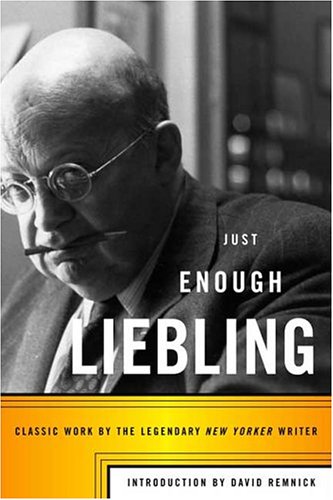
My friend John Sosnovsky was just in town and brought as a gift a copy of Just Enough Liebling,
a collection of A. J. Liebling's writing about food, boxing and
war.  In one of the articles about food Liebling offers an
extended paean to Tavel, the rosé wine from the
Rhône region of France.  It brought back many
memories.  Tavel is a wine often served in the South Of France
with seafood (although Liebling insists it's so good it can go with
anything) and I've drunk it with many fine meals in that part of the world,
usually in restaurants or on the terraces of restaurants with a view of
the sea.

On John's last night in Vegas I tracked him down in the card room at
Caesars around 9pm.  He'd been playing poker all day, with mixed
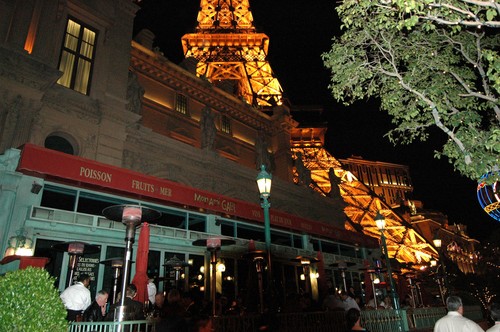
results, and said he was pokered out, so we decided to meet at Mon Ami
Gabi, a terrific French bistro in the Paris, Las Vegas casino. 
Once installed on its very pleasant terrace I discovered that they had
a Tavel on their wine list, and John and I decided to drink a bottle in
honor of Mr. Liebling.  And we decided to drink it with steak, to
test Mr. Liebling's assertion that it can go with anything.
It went exceptionally well with the steak, with the brisk night air and
with our conversation, which kept circling back to the upcoming fight
between Ricky Hatton and Floyd Mayweather, Jr. next Saturday in Las Vegas.  John
is a member of the Fancy and very knowledgeable about boxing, but even
he seemed baffled by the question of who was likely to prevail in this
contest — Hatton, the brawler with heart, or Mayweather, the scientist
with lightning-fast but hardly lethal hands and canny instincts for
defense (or unseemly evasion, as some consider it.)

The best we could surmise was that Hatton had a chance only if he got
inside and ripped Mayweather apart with body shots, shocking him and
breaking his will.  That didn't seem likely, but it seemed
possible.  Such imponderables are what have made this fight one of
the most anticipated in ages.  Mr. Liebling, long since deceased,
would have had much to say on the subject and we missed his wisdom
keenly.

After the Tavel and the beef, John decided that perhaps he wasn't
pokered out after all.  We set off to see what tables might be
going in the Paris' card room.

The night before, at the Palms, John had cajoled me into
sitting down at my first no-limit Hold-'em game in a casino.  (I'd
played a few hands at a no-limit game in the old card room at the
Rancho Fiesta, but it had broken up almost as soon as I arrived at the table.)  I
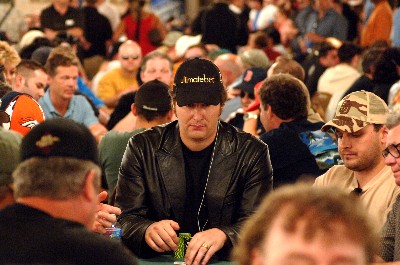
was terrified of playing at the Palms — not least because Phil Helmuth
(below, playing in a tournament) and Layne Flack, two high-profile
high-limit poker pros, were hanging
around my table to watch a couple of their friends play.  It's
tough to make your debut at a no-limit table under the eyes of a winner
of the Main Event at the World Series Of Poker.  (Helmuth won it in 1989 at the age
of 24, the youngest player who's ever done so.)
No limit Hold-'em is intrinsically terrifying.  Any amount of
money can be bet on a hand at any time, which means you can lose every
chip in front of you if you call an “all-in” bet with the
wrong cards in the wrong situation.  On the other hand, you can
use big bets to push your fellow players around — to make them fold
better cards than you have, for example.  It's a wild and
exceedingly complex endeavor.

Miraculously, as soon as I sat down at the table I felt cool and
perfectly in command of things.  I've played endless hands of
no-limit poker for fake money online and I understand the dynamics of
the game — far better than I've ever understood the dynamics of limit
Hold-'em, where you can bet only certain fixed amounts.   I've
always played limit Hold-em because it seemed on the face of it less
risky. 
No-limit Hold-'em for money, however, is a far more logical game,
far less dependent on the random fall of the cards, though the logic is
sometimes the logic of ruthlessness and terror.

I played for three or four hours in this heady atmosphere and walked
away about a hundred dollars
down.  Not good — but not
devastating, either.  You can pay more for a good meal or a rock
concert and not enjoy either half as much or for half as long.
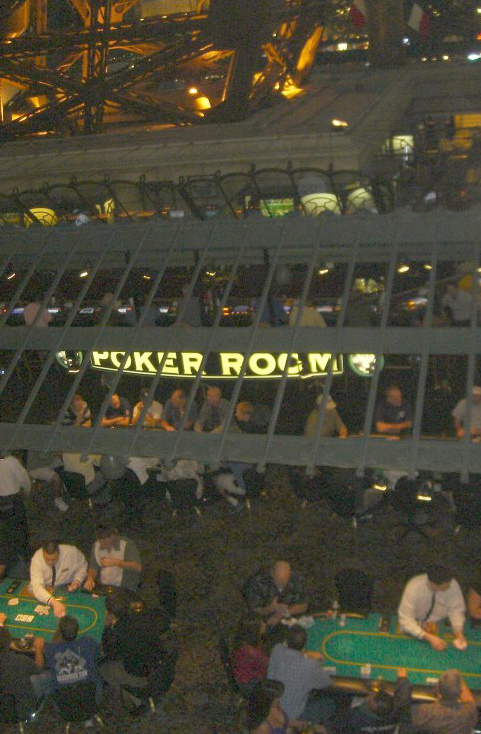
There were no poker pros hanging around the Paris' card room (above) — just a
lot of genial players who seemed like people on vacation
looking for a good time . . . and to say they'd played poker in Las
Vegas.  They weren't bad players but they played too many hands,
eager for action.  I waited for my chances, bet hard when they
came and walked away three hundred and thirty dollars ahead —
by far the most money I've ever won at any poker table.  More importantly, it left me over two hundred dollars ahead for my first two nights of no-limit poker. 

John did even better, walking away over seven hundred dollars ahead — covering the cost of all his poker playing in Las Vegas and his hotel room and
his flight here, with a little left over for celebratory drinks
afterwards.  To say that we raised our glasses joyfully would be
putting it
mildly.

[The snapshot of the Paris poker room above is from a useful web site, vegasrex,
which describes and reviews the various card rooms in Las Vegas and has a lot of other stuff about what's going on in town.]

A GÉRÔME FOR TODAY

Victorian academic painters loved doing scenes set in antique Roman or
Oriental baths — it was a respectable way of showing lots of women in
various stages of undress.  The casual, languorous poses of these
women would have seemed shocking in a modern setting or unseemly in
mythological or allegorical images.  One of the things that was
radical about the Impressionists was their depiction of nudity in
naturalistic ways, in ordinary settings.  The academics had it both
ways — their settings could say, by implication, “Modern European
women don't look or act this way with their clothes off,” but everyone
knew (or suspected, or hoped) differently.  The hypocrisy added a little spice to the
proceedings — wink, wink . . . nudge, nudge.  It seems a bit
silly now, but a bit charming, too.

DRIVE-IN

This
past week, on my friend Jae's last night in Las Vegas, we decided to
have an all-American experience.  We decided to go to a drive-in
movie.  Jae had never been to one — I hadn't been to one since my
childhood.


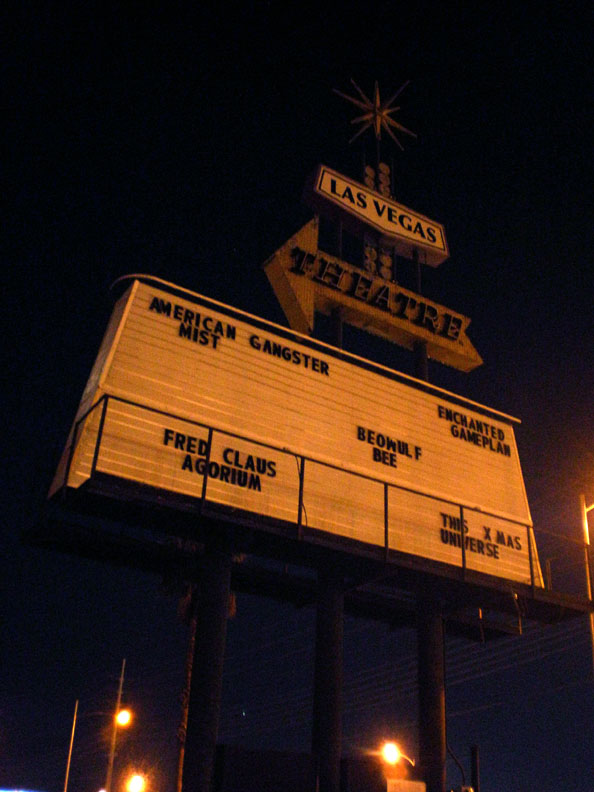
There's a multi-plex drive-in in North Las Vegas.  It sits in
between a casino and a small private airport.  You can see planes
and helicopters taking off and landing behind the screens during the
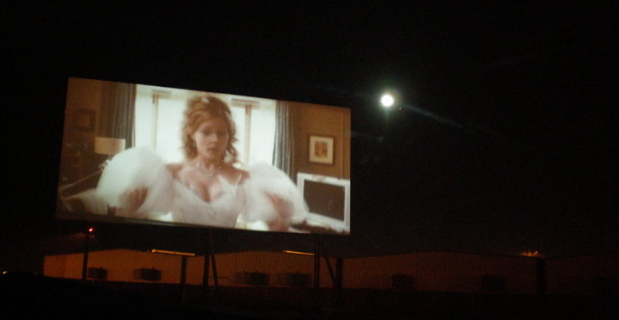
show.  The projection seems to be accomplished by some sort of
video system seriously inadequate to the “throw” involved — the
distance between the projector and the screen.  The resulting
image is very indistinct.  The audio is delivered over an FM
station on your car radio and sounds way worse than normal FM reception.

The whole scene has a quality of desolation.  The experience is
clearly designed for people who just want to say they've been to a
drive-in movie.  I suppose the enterprise could also qualify as
what real estate speculators call “ground cover” — something to bring
in a little income on a property that will be developed more
spectacularly at some future date.

We “saw” Enchanted, which was
fun, even with the fuzzy, washed-out picture and the static-ravaged
sound.  We enjoyed the surreal spectacle of it all.  This is
what seeing movies in Hell will be like — and that's enough to get you
to try a little bit harder to make it to Heaven, where the movie
theaters will probably be almost as good as those at the Arclight complex in Los Angeles.

SNOW DAYS

There's
a chill in the air at night out here in the middle of the Mojave Desert
— a little taste of winter.  There will be no snow, of course —
no snow to speak of.  Las Vegas gets a light dusting of it from
time to time but it melts quickly and seems like some sort of mistake,
like a FedEx delivery gone awry.

shahn, of the lovely web site six martinis and the seventh art, lives
in San Francisco, which is also a snow-free city, and, missing the
stuff, she's posting a series of images of snow from movies on her
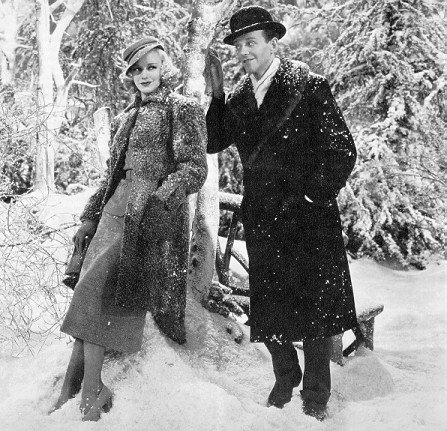
site.  Images of snow in movies are almost always wonderful —
especially, to my mind, the ones tricked up in a studio, as in the “A Fine Romance” number from
Swing Time (above),
which I hope will be represented in shahn's series.  There are so
many other fine images of snow in movies — from Way Down East (real) to Citizen Kane (tricked up in a studio.) 
One can watch them with a glass of egg nog in hand and feel cozy and
warm, protected from the blizzard that's visible through the magic window.

PARIS

I
have no memory whatsoever of my first view of Paris — what I must have
seen of it on a cab ride from the airport to my Left Bank hotel in the
winter of 1983.  I have a vague memory of the view from the hotel
room, a charming chamber up under the eaves of a small, venerable and recently
refurbished establishment near the École des Beaux Arts.  I
looked out over the rooftops of Paris, which reminded me of Paris in
the movies, but I'm not sure what else I saw, besides possibilities.

I arrived at the hotel late at night but my companion, who'd been to
Paris before, knew a restaurant
that was open 24/7, one she was fond of, and we went there.  It
was at the edge of Les Halles, the site of the legendary produce
market.  The market had long since been moved to the outskirts of
Paris and was then
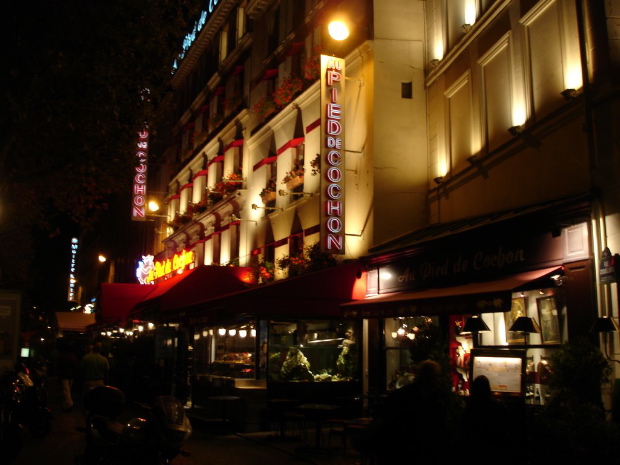
just a ghost of itself, but the restaurant, Au Pied de Cochon,
which had been there in the glory days of Les Halles, remained.  It opened in 1946 and has not closed its doors
since.  Once, obviously, it served the all-night workers and
truckers of Les Halles when it was a functioning market but people
still made their way to it at all hours of the night.  There was a
small crowd there when we arrived sometime after midnight.  I had
a sense that many of them were musicians grabbing some food after an
evening's gig, though I'm not sure at this remove what made me think so.  Perhaps
one of them was carrying an instrument in a case.  Perhaps one of
them pulled out a guitar and sang some snatches of a song.

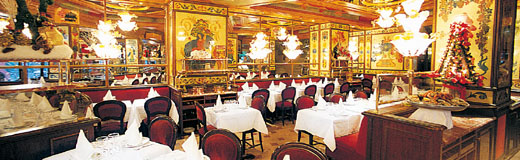
The restaurant was rather plain in those days, even shabby, reflecting
its original working-class milieu.  It has been remodeled at least
a couple of times since then — it has an unfortunate faux-Belle Époque
décor now (see above) but still isn't particularly fancy. 
It specializes, as its name suggests, in pig's feet and other rustic
fare, and also in shellfish, which seems to be de rigeur for all-night
restaurants in Paris.

It had a wide selection of raw oysters, and I ordered a dozen Belons,
the small, tangy oysters of the Breton coast that have a considerable
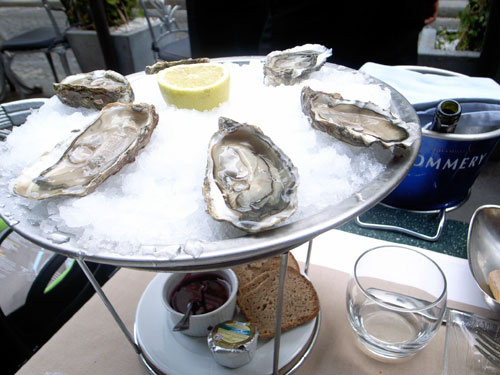
reputation.  When the round tray of them arrived at the table,
they created my first intense visual memory of Paris.  The opened
oysters and some cut lemons were nestled on a bed of ice decorated with sprigs of
seaweed.  The tray was placed on a
wire rack directly in front of me, giving me a good view of and
easy access to the oysters.  On a plate in a holder built into the wire rack beneath the tray was a

small bowl of red wine vinegar and finely chopped
onions, some slices of brown bread and some butter.  The oysters
in the picture below are not Belons — I offer it just to show the
general set-up.


I revere oysters extravagantly.  To see them served in such an
exalted way stirred my deepest admiration.  (I had never seen such
a presentation in an American restaurant, though now it's fairly common
in upscale French eateries.)  They were the
tastiest, most mysterious oysters I had ever eaten.  I ordered
twelve
more.

Several times in the preceding few hours I had thought to myself, “I'm in
Paris!”  But I didn't quite believe it.  Halfway through the
second tray of oysters, I believed it.

Next February, it will no longer be possible to smoke in Parisian
restaurants, so I will most likely never go back to Au Pied de
Cochon.  This is not altogether a bad thing.  The places you
love that you can never return to are also places you can never
leave.  They become part of your own small portion of eternity.

UNSPEAKABLY COOL: LITTLE SAMMY SNEEZE

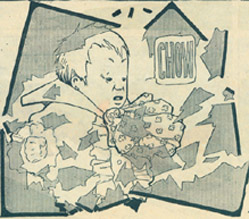
The third of the four coolest books published in the past few years is (I am compelled to report) also from Sunday Press Books — a collection of Winsor McCay’s pre-Nemo comic strip Little Sammy Sneeze.

This book is not a gigantic volume reproducing newspaper pages in full size, simply because Little Sammy did not command a full page on Sundays.  It is, instead, a good-sized coffee-table book — all that’s needed to reproduce McCay’s color Sammy Sneeze strips almost exactly as they were originally published.

Sunday Press’s philosophy in regard to reproducing old color strips is
very sensible.  They use modern digital techniques to correct the
fading of colors and the yellowing of paper, but don’t try to improve
on the colors as they would actually have appeared to a reader of the
time and don’t try to eliminate minor characteristic printing
errors.  What one sees in their books is thus a very close
approximation of the medium the comic strip artists composed for.

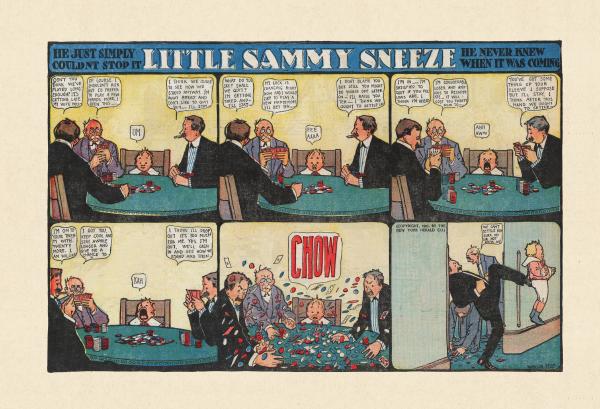
In Little Sammy Sneeze, McCay took a very small idea and made something wonderful out of it. The strips normally employ either six or eight panels, all showing the same location and generally from the same point of view.  Activity proceeds within the space of the location as Little Sammy works himself up to a sneeze, which usually produces catastrophic effects within the location and causes Sammy to be ejected from it angrily.  For some reason, this mechanical formula produces endless delight — much the way simple variations on a  musical theme can produce endless delight.

The drawing, of course, is brilliant, as you’d expect from McCay, and the period detail within the mostly realistic settings has only grown more magical with time.  The strips are in part about time, of course — small segments of time in which many things happen.
Seeing the way static pictures on a page can evoke a sense of the passage of time is intrinsically fascinating.  It’s like deconstructing the process of cinema, with the illusion laid out anatomically before you.

In one instance, McCay deconstructs his own medium, as Sammy’s sneeze fractures the frame of the comic strip panel itself:

If the gag in the strip is always the same, or more or less the same,
it is nevertheless always surprising — or perhaps one should say
always suspenseful.  There’s a psychological phenomenon involved
here that’s at the core of any good joke, which can make you laugh even
if you’ve heard it before.  In part, it’s the shape of the joke that
makes it work — a tension is created that can only be resolved with
the release of a laugh.  The same phenomenon is at work in all
stories, which is why it’s possible to cry every time you read A Christmas Carol — even if you know it almost by heart.

You can obtain Sammy’s sneezes here.

UNSPEAKABLY COOL: WALT AND SKEEZIX

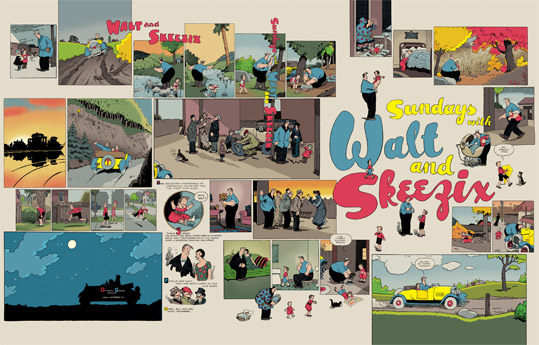
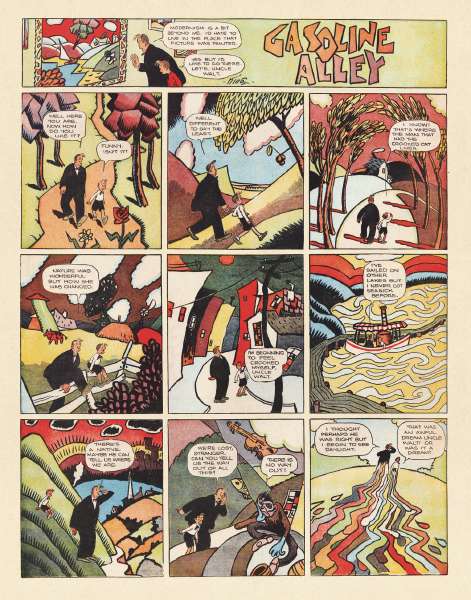
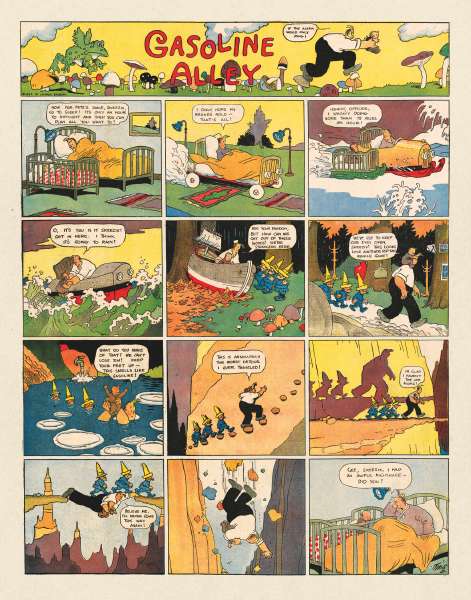
The second of the four coolest books published in the past few years is another oversized volume from Sunday Press Book — Sundays With Walt and Skeezix.  It collects a number of Sunday pages from Frank King’s brilliant long-running strip Gasoline Alley,
one of the glories of American popular art.  I’ve written before about the
series from Drawn and Quarterly Press which is reprinting the entire
run of the daily strip in a succession of handsome volumes — but the Sunday
pages are something else again.

In the daily strip, King created a narrative masterpiece graced with
many flights of visual invention, but in the color Sunday pages his
visual imagination grew much bolder — lyrical, almost abstract at
times.  He looked at the Sunday page sometimes as an arena for the
wildest experimentation — to see just how far the expressive potential
of a comic strip might reach.

In the Sunday Press collection we can see these Sunday strips almost as
their first viewers did — in the same colors and in the same size.
It’s a measure of our culture’s descent into mediocrity and triviality
that no work of such ambition and grace now accompanies any daily
newspaper in the land, and certainly no cable news channel.  It
used to be assumed that the visions of great popular artists ought to
be part of every American’s daily dose of media.  Today only cheap
digital graphics and portentous musical jingles accompany the canned “news”
doled out by the major media outlets.

Americans have never liked being spoon fed “culture” — meaning culture
that somebody decided was good for them.  That was the beauty of
the comic strip — it was an art form so unpretentious, so vernacular
and casual, that Americans could consume it over breakfast or before
dinner without a trace of self-consciousness or social anxiety.  But its
expressive range was almost limitless.  We know that from the work
of artists like Frank King, who in their own quiet but audacious ways
tested its limits to the full.

You could read through these comics and weep that stuff this great used
to be thrown up on the porches of millions of Americans by
paperboys every Sunday morning — and isn’t anymore.  Or you could read through them
and take heart at the fact that stuff this great could ever have been part of
American popular culture — and so might be again.  Why not?

You can buy Sundays With Walt and Skeezix here.

OTTO PREMINGER

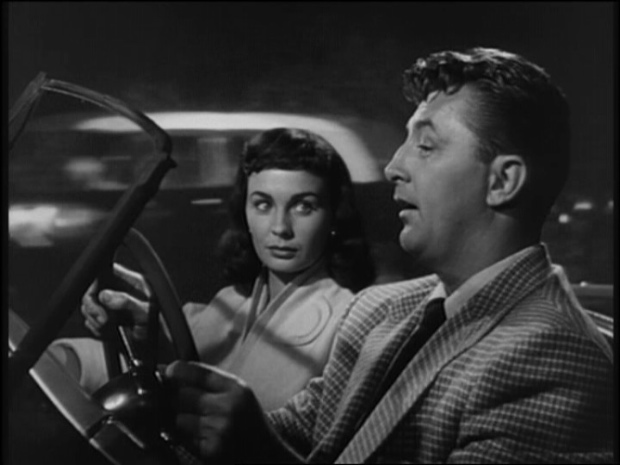
In 1963 Jean-Luc Godard published in Cahiers du Cinéma his list of the top ten American sound films of all time. 
It featured many of the usual suspects — Vertigo, The Searchers — and one film you'd never expect, at least not these days . . . Angel Face (above), a classic film noir directed by Otto Preminger.

Among the French New Wave directors, Preminger was considered one of the
masters of cinema, who could be spoken of in the same breath with
Welles or Ford.  Today he holds a place somewhere between Cecil B.
DeMille and Fred Zinneman — considered a first-rate showman, as an
incarnation of the directorial persona, but otherwise a merely
competent craftsman of studio product.

I really can't explain what happened to his reputation as an
artist.  Perhaps the theatricality and commercial calculation of
his directorial persona cheapened him, made him seem less than serious,
as it did for DeMille and even Hitchcock for many years.  Truffaut
made Hitchcock respectable again, and DeMille seems to be undergoing
reevaluation these days.  Preminger is admired, if he's thought of at all, for his early noirs, and for the noirish Laura.  The major works of his later years are appreciated somewhat less enthusiastically.

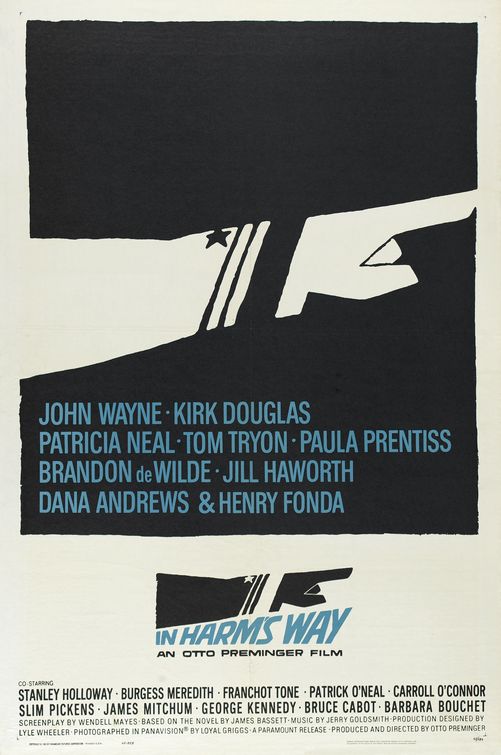
These later films, like In Harm's Way,
for example, have the feel of standard studio prestige pictures of
their time — but in truth they're far more interesting than that,
certainly on a visual, cinematic level.  They are
filled with movies within movies — elaborately choreographed scenes
that often play out in one or two shots with a highly mobile
camera.  These passages are breathtaking — they impart a sense of
being someplace rather than of watching something.

They are, as the New Wave critics might have put it, passages of pure
cinema — examples of the discursive style largely lost to mainstream
movies since the coming of sound.  Ford, also working in the
mainstream, got away with this sort of thing mostly because he worked
in genre — in Westerns we were supposed to sit back and enjoy watching
men ride horses through spectacular spaces.  But the long tracking
shot that contains almost the whole first scene of In Harm's Way,
set at a naval officers' party in Hawaii on the eve of Pearl Harbor, is
very unusual in a big-budget studio melodrama.  It's exceptionally
effective — drawing us into the time and place on a subliminal level,
making us feel vulnerable to the Japanese attack that's unleashed the
next morning.

Almost all of Preminger's films have passages like this and they linger
in the mind, even if the film as a whole is disappointing.  Bonjour Tristesse
is one of the most disappointing of Preminger's films, but its mood and
sense of place were the things Godard riffed on to produce Contempt
— which is almost a formal variation on the visual and dramatic themes of the
earlier work.  (And of course it was Jean Seberg's odd but
compelling performance in Bonjour Tristesse that inspired Godard to cast her in Breathless.)

Preminger is due, overdue, for a comprehensive critical reevaluation.

UNSPEAKABLY COOL: LITTLE NEMO

The
four coolest books published in the last few years all reprint work by
masters of the American comic strip.  These books are so cool,
so unspeakably cool, that when I look at them I can’t quite believe
they’re real.  But they are.

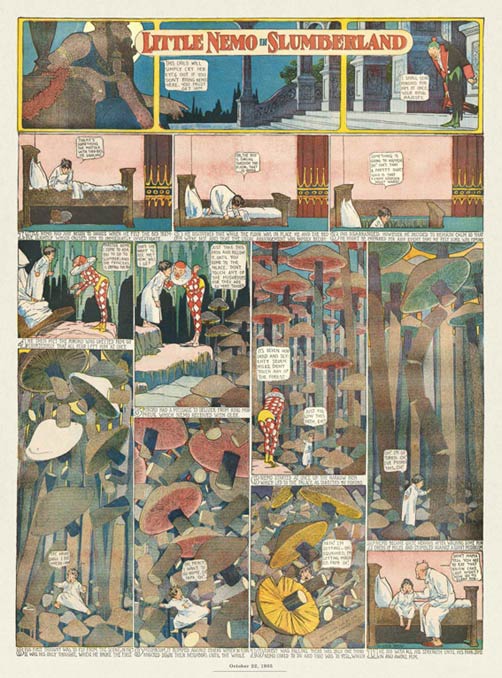
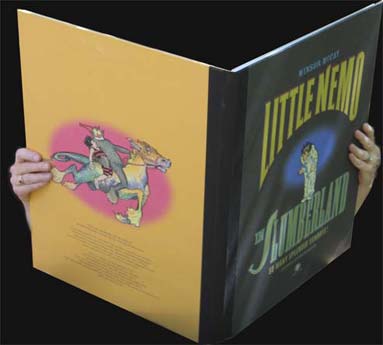
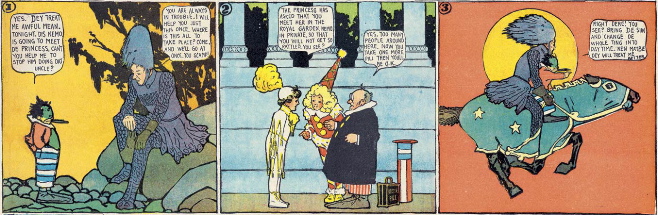
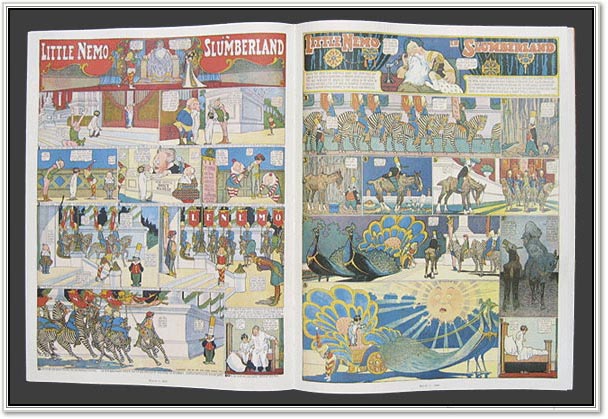
The first of them, Splendid Sundays 1905-1910, is a huge volume that reprints in full size many of the Sunday color episodes of Winsor McCay’s classic strip Little Nemo.
McCay was the most cinematic of all comic strip artists — he created
fantasy worlds that are visually plausible but wildly whimsical,
exploding with dazzling transformations and dynamic movement through
deep spaces.

One should also say that McCay was not by any means the wittiest of all
comic strip artists, nor the best storyteller among them, but the
visual imagination of his strips transcends those limitations.
The strips reveal their brilliance more fully the better and
bigger his work is reproduced.  That’s the importance of Splendid Sundays, which
for the first time in nearly a hundred years lets us see the strips in something resembling the
medium for which they were created — a full-sized newspaper page.

With even small reproductions of the Nemo
strips we can sometimes feel as though we’re falling into the spaces of
Nemo’s nighttime dreamworld.  With Splendid Sundays we tumble headlong into
that world — and it’s a truly magical place to be.  Sunday Press
Books has done a signal service to our culture in creating this huge
and hugely wondrous book.

You can buy it here.

A TISSOT FOR TODAY

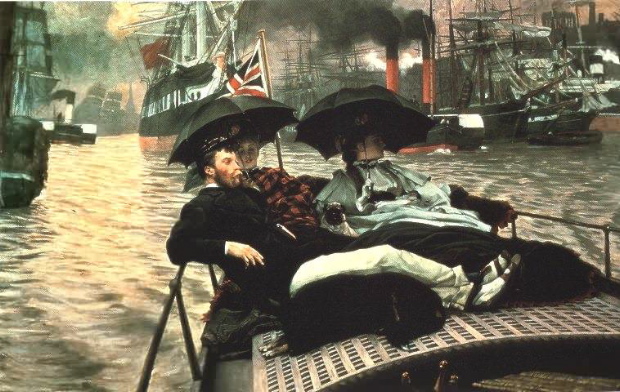
Tissot loved the Thames and its waterfronts — which offered him
endless opportunities for the sort of spatial drama that he reveled
in.  The example above is especially dynamic, with its small boat
moving forward into a space in front of the picture plane as the
taller ships lead our eye backward into the space of the painting, reinforcing the sense of
movement.  The result is a highly cinematic image.

JOKERMAN

Well, the rifleman’s stalking the sick and the lame,
Preacherman seeks the same, who’ll get there first is uncertain.

        — Bob Dylan, Jokerman

To call Bob Dylan the greatest Christian poet of the 20th Century (and the 21st Century so far) is probably to damn him with faint praise.  There just weren’t that many great Christian poets in the 20th Century.  His Christian poetry, however, is more alive and vital than the work of other poets with greater reputations, like Auden and Eliot, who were nominally Christian but whose poetry is less concerned with expressing passionate faith than with charting the ennui of a faithless age.

And Dylan is not quite a poet in the modern literary sense — his words don’t live on the page, only in conjunction with the music that is inseparable, expressively, from those words, and mostly only in his own voice.  Very little of his poetry survives in cover versions of his songs — although it can.  (Hendrix knew how to sing Dylan, and Dylan’s Gospel songs come gloriously alive in the versions of them by black Gospel singers collected on the recent CD Gotta Serve Somebody —  most other versions fail because the artists who attempt them don’t realize how deeply Dylan’s work is steeped in the blues, or have no great feel for the blues themselves.)

Dylan wrote two types of Christian songs, one type that fits more or
less directly in the Gospel tradition, however quirky his take on that
tradition might be, and one type that follows the image-collage strategy of
another American tradition, what might be thought of as Whitman by way
of the Beats.

Jokerman is of the second type.  It’s a powerful evocation of the image of Jesus, or rather the images of Jesus, but it’s hardly a catalogue of familiar icons.  It’s more like a passionate torrent of Dylan’s own various imaginings of Jesus, his own various attempts to comprehend him.  The momentum of the work seems to be deeply personal — not an intellectual or aesthetic meditation but a desperate attempt to record a racing stream of thought in which one image of Jesus is instantly rejected as insufficient, replaced with a corollary or opposing image.  The ultimate effect is a kind of lyrical portrait in the round — but a portrait in which the subject just won’t sit still.

Standing on the waters casting your bread
While the eyes of the idol with the iron head are glowing.
Distant ships sailing into the mist,
You were born with a snake in both of your fists while a hurricane was blowing.
Freedom just around the corner for you
But with the truth so far off, what good will it do?


The first quatrain presents us with the image of an almost pagan figure — a terrible Jesus who stands in conflict with the ancient false gods, the iron gods.  Dylan, too, was born with a snake in both of his fists and did not reject the terror of the predicament.  (Just try to imagine Auden or Eliot with their hands full of venomous reptiles — they would certainly faint dead away, once they realized that the snakes weren’t metaphors.)

But the last couplet jolts us back to a different kind of complexity.  Jesus, the lord of nature, the destroyer of false idols, is not free like the gods of old.  His power is useless in the absence of truth within the hearts of men.  This is the difference between Jesus and the other, older gods.  His power and his freedom count for nothing if they can’t be shared, communicated, translated into the language of simple men.  This fact defines his mission, his incarnation.

Jokerman dance to the nightingale tune,
Bird fly high by the light of the moon,
Oh, oh, oh, Jokerman.

Why “Jokerman”?  Because the paradox of Jesus’s mission is like the paradox of a good joke — too surreal to be taken seriously by a slow-witted humanity.  Many of the climaxes, the final unexpected twists, of Jesus’s parables are like the punchlines of jokes.  Laughter is not an inappropriate response to them.

In Dylan’s recording of the song, listen to the yearning, the hopelessness in Dylan’s voice as he sings the last line of the chorus above.  He is bemoaning the limits of language and music and human thought.

Well, the Book of Leviticus and Deuteronomy,
The law of the jungle and the sea are your only teachers.
In the smoke of the twilight on a milk-white steed,
Michelangelo indeed could’ve carved out your features.
Resting in the fields, far from the turbulent space,
Half asleep ‘neath the stars with a small dog licking your face.

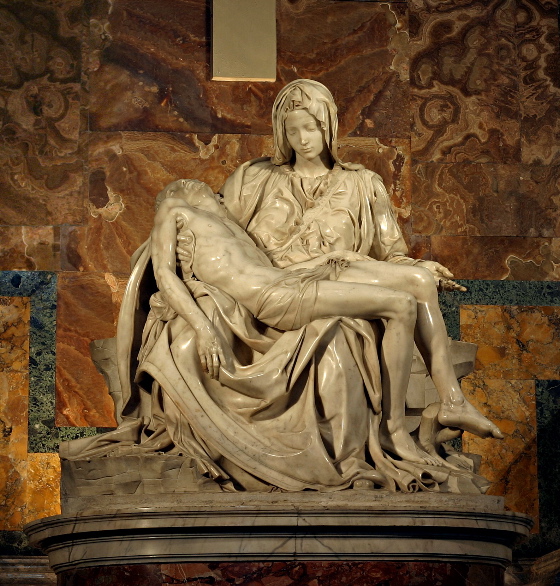
In the first couplet above, the paradoxes are almost resolved.  Jesus has come to fulfill the law and the scriptures, to reconcile them with the laws of nature.  The message of Grace will find unsentimental expression in light of a harsh view of this world and its inexorable destructiveness.  The issues, the stakes, won’t be fudged.   (See the couplet at the beginning of this post.)  In the next couplet above, Jesus is exalted, aestheticized — worshiped as he’s worshiped in art:

But Dylan can’t leave Jesus here — a figure carved in marble.


The last couplet above startles like a bolt of lightning — because
suddenly Dylan is back imagining Jesus as he walked the earth, sleeping
rough, on the road between two villages, as he must have done on so many
nights, getting just a little rest, and alone, probably grateful for
the affection of the little dog who undoubtedly showed up at the
disciples’ campfire looking for a handout.  This is a good man,
the dog senses — he won’t kick me.


All the allegories and all the art fade away.  The image of Jesus
won’t be fixed by any convention.  It always returns to the dust
of the earth and to mystery.  There are no “answers” in
Jokerman
just a question . . . who is this guy, who is this joker?  It’s
the question Dylan is asking himself, and it’s unanswerable.

Lyrics copyright © 1983 Special Rider Music

AFTER ACTION REPORT

My
friend Jae and I supplemented our modest cooking skills with large
doses of improvisation and luck to concoct a truly splendid
Thanksgiving meal.

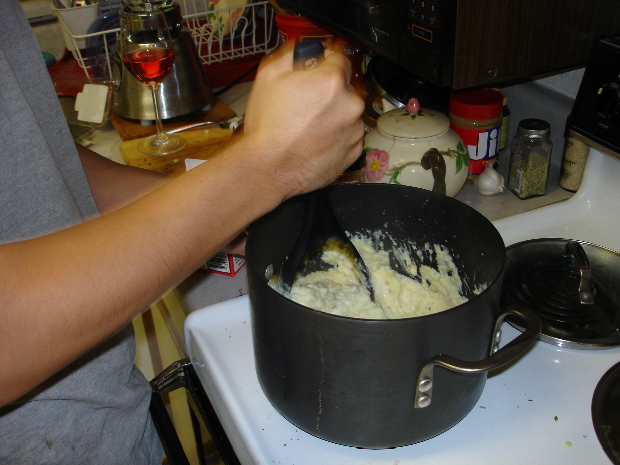
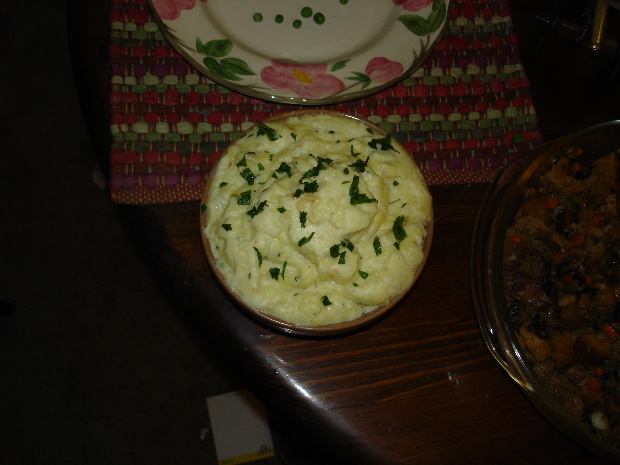
Jae, in an impulse of reckless ambition, decided he would make mashed
potatoes.  “I'm going French with them,” he said, but would not
explain what he meant by this.

In the end he made stupendously
good mashed potatoes and only after they'd been tasted would he reveal
his ingredients.  Half-and-half for creaminess, a large but not
overpowering amount of finely chopped garlic, one single, large
shallot, a small amount of freshly grated Romano cheese and a pinch of
cayenne pepper.  I can't say
what's French about any of this but I can say that the results were
delicious.

Jae made stuffing but added to it at my request some oysters and, on
his own initiative, as likely to complement the taste of the oysters
well, some crumbled fried bacon.  Again . . . delicious.

Our large turkey for some reason did not produce much in the way of fat
drippings, so that late in the cooking of it we despaired of having
enough liquid in the pan to make gravy.  On another inspired
impulse, Jae poured some pumpkin ale into the pan, which made for a
very fine gravy in the end — an improvisation that could well become a
Thanksgiving tradition.

I confess I couldn't savor the meal as slowly and carefully as I might
have, because I started drinking too early in the day, and too many
different things.  A rosé wine, then some of the pumpkin ale,
which had a cheerful, festive taste to it, then some Chimay ale and finally a
Merlot with the dinner.  I was past consciousness even before I
got to the pumpkin pie, which served as a fine breakfast the next day.

Friday was a bit of a blur, sharply focused only by a turkey sandwich and by a viewing of Vertigo, which still yields up treasures after countless viewings in the past.

And so the time of leftovers begins.  From the look of things this should last quite a while.

A WILLIAM BLAKE QUOTE FOR TODAY

. . . the pang of affection & gratitude is the Gift of God for good. I am
thankful that I feel it; it draws the soul towards Eternal life &
conjunction with Spirits of just men made perfect by love &
gratitude—the two angels who stand at heaven’s gate ever open, ever
inviting guests to the marriage. O foolish Philosophy! Gratitude is
Heaven itself; there could be no heaven without Gratitude. I feel it
& I know it. I thank God & Man for it . . .