ORLANDO GIBBONS

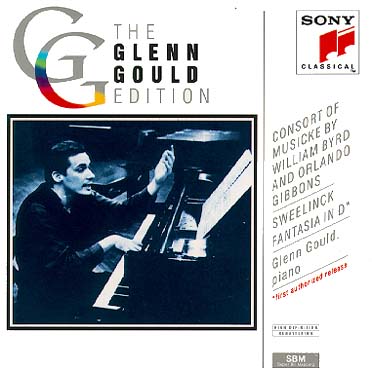
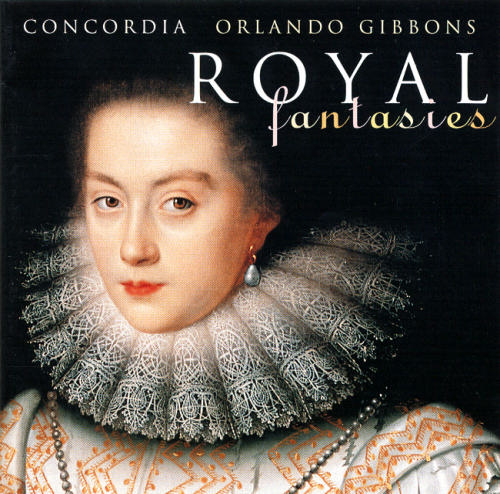
I’ve been reading a lot about Shakespeare recently and somewhere in that reading I ran across a mention of Orlando Gibbons, the other great English composer of the Tudor era (besides William Byrd.)  I decided to check him out, particularly after leaning that he was Glenn Gould’s favorite composer.

Gibbons can be appreciated as a sort of alternative to Bach, with the same logical clarity but more theatricality, whimsy and lyricism.  You can hear the cultural giddiness of Elizabethan England in Gibbons’s work, as you can in Shakespeare’s poetry.

Gould only recorded a few pieces by Gibbons but they’re fascinating performances.  Highly expressive, Romantic even, they violate historical style but somehow evoke the essence of the music, in ways stricter interpretations, on more appropriate instruments, sometimes
fail to do.


There are worse ways to spend an evening than listening to the music of Orlando Gibbons.  If you have a fire and a glass of good red wine and some strong English cheese — an old cheddar or Stilton would do perfectly — so much the better.

THE BLACK MA-1

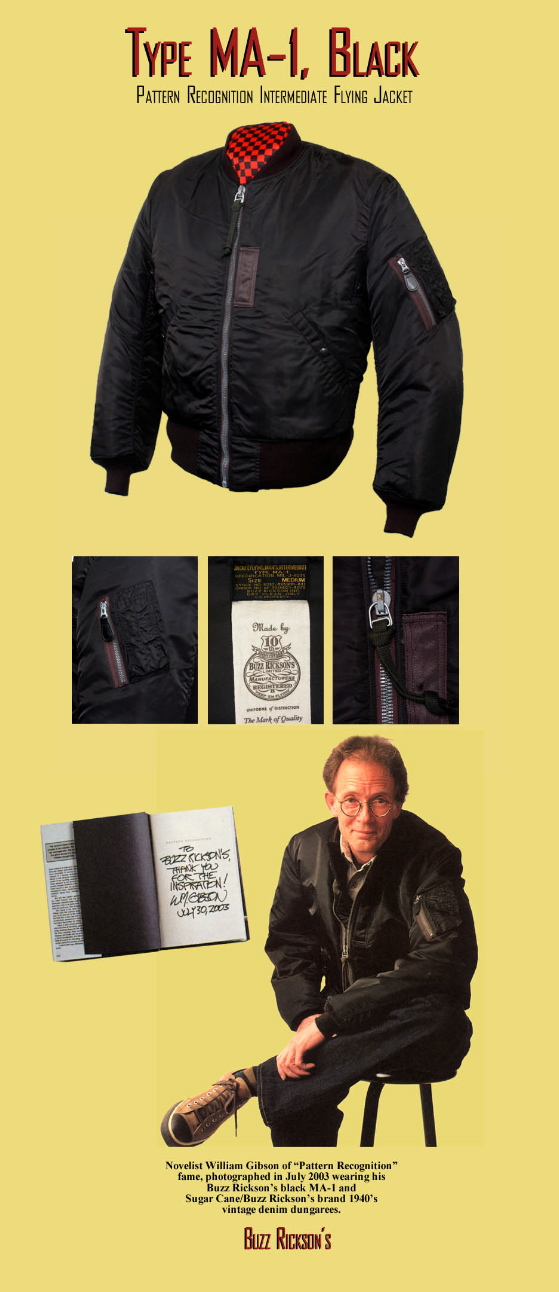
In William Gibson’s latest novel Pattern Recognition, the heroine Cayce Pollard, a coolhunter, wears a reproduction MA-1 flight jacket, 1957 pattern, made by Buzz Rickson’s, which Gibson describes as a super authentic recreation of the original — in a sense more authentic than the original because of the fanatical devotion to detail by the manufacturer. He notes that the uneven seams of the original, the result of sewing the new fabric nylon on machines made to stitch cotton, have been lovingly copied, even exaggerated slightly, to make the homage that much clearer.

It turns out that Buzz Rickson’s is a real company, based in Japan, and that it really does make such reproductions, with all the obsessiveness Gibson so admires.

But Gibson made a mistake. He described Pollard’s jacket as black, whereas Rickson’s only produced the jacket in green, since that’s the only way the Air Force ever issued it. When Rickson’s learned about the mistake, it decided to issue a “Pattern Recognition” edition of the jacket in black. Gibson’s fantasy jacket has thus become real.

Two years ago I posted about the jacket on the discussion forum at Gibson’s official web site. A year after that Gibson noticed my old post and responded to it on his blog. I just discovered his response a couple of days ago — you can read it here:

http://www.williamgibsonbooks.com/blog/2005_12_01_archive.asp

This still leaves us with a problem. Do we want to wear Cayce Pollard’s black
Rickson’s MA-1, which is, in fact, unutterably cool-looking, or do we want to wear the original Rickson’s reproduction, which is what inspired Gibson, and Cayce, in the first place?

In the end, I opted for the black model, because of its unutterable coolness and as a tribute to Gibson’s great book.

But it’s a complicated question that each man or woman must decide for his or her self.

Here’s a link to the American distributor of Buzz
Rickson’s jackets — all of which are quite amazing and quite expensive:

Buzz Rickson’s

PANDORA’S BOX

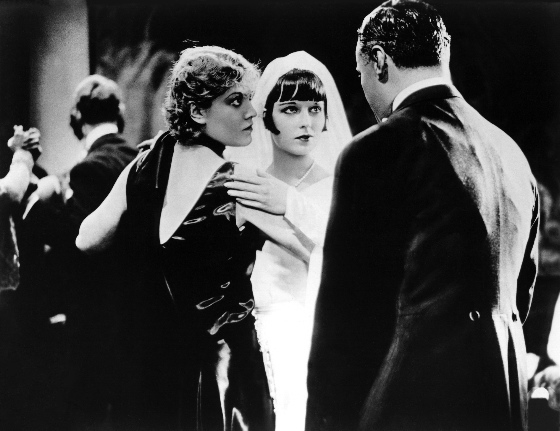
Pandora’s Box, the film Louise Brooks is best known for, is one of the sublime works of cinema, not least because of her performance init.

It is not exactly a film adaptation of the famous play by Franz Wedekind on which it is nominally based — it is better appreciated as what it calls itself, a “variation on themes” from Wedekind’s work.  Wedekind created in his central figure of Lulu an almost mythological incarnation of the terror the feminine inspired in late Victorian men, who simply didn’t know how to relate to women outside the collapsing domestic structures of modern industrialized societies.  Wedekind’s Lulu was a calculating vamp, an anarchic force, unrestrained by the old female roles, and thus could be experienced as an alien and malevolent power.

Pabst’s and Brooks’s Lulu is something else again.  Her destructive power is not defined by her deviance from old female roles but by the utter collapse of manhood around her, by the failure of men to adapt to the new empowerment of women.  The crucial event intervening between Wedekind’s play and Pabst’s film was the cataclysm of WWI, which confirmed not just the collapse but the inherent weakness, the dry rot at the heart of the 19th-Century European patriarchy.  From a post-WWI vantage, Pabst, by instinct or calculation, realized that blaming women was not really an answer or a solution to the failure of modern manhood.

Pandora’s Box shares aspects of an attitude that wouldn’t find its way into American film until after the cataclysm of WWII, specifically in film noir, where a sense of the futility of male power slammed head-on into the contingent terror of the female, the femme fatale.
But Pabst’s film is more mature, ahead of its time even, in making Lulu’s female power innocent, neutral, a mere fact of life, which men simply have no resources to engage on equal terms.

In Pabst’s film men destroy each other and destroy themselves trying to engage Lulu’s existential sexuality.  They try to commodify her, reduce her to images, trade her for money.  They fail at every turn to diminish her.  And yet they must keep on trying, since they can’t have meaningful intercourse with her as she is, and this is a constant reminder of their own impotence.  Early in the film Lulu tells her current benefactor, “The only way to get rid of me is to kill me.”  Her sexuality cannot be dismissed any more than it can be engaged — it can only be destroyed.

This explains the curious ending of the film, in which Lulu meets a contemporary version of Jack the Ripper in London and is instantly drawn to him.  He is in a sense the only
honest man in the whole tale — he worships Lulu, like all the rest of the men in her life, knows he’s no match for her, knows the only way he can deal with her is by killing her.  Which he does — but not before paying touching tribute to her majesty, crowning her with Christmas mistletoe, in images that glow with tenderness and sacramental mystery.

Lulu almost seems to acquiesce in her own sacrifice — a final extension of the detachment she displays throughout the film.  It’s not her job to tell men how to be men — she can only observe the failures of their doomed attempts to figure it out for themselves.  She observes with interest, certainly, sometimes with awe, but never with a sense of personal responsibility.  Compromising her female essence to accommodate the impotency of men is not a solution for her, or for her lovers.

Brooks’s incarnation of this role is brilliant in the extreme, one of the finest pieces of acting in all of movies.  Her work is neither minimalist nor merely naturalistic — just “being herself” . . . whatever that might mean in the utterly artificial, high-pressure context of a film set.  Pabst was clearly drawing on aspects of Brooks’s own personality in the film, but the result is a “created” character of great complexity, one which never resolves itself into any conventional type or relies on any conventional response.  Brooks’s performance has inwardness and mystery, as Shakespeare’s characters do, as Chaplin’s and Keaton’s characters do.

Pabst’s and Brooks’s Lulu is almost unique in modern art — neither a demonized icon of male fear nor an idealized icon of female ambition. She doesn’t want what men have — she wants men to recover what they once had.  She wants partners.  Finding none, abandoning hope, she resigns herself to oblivion, but not before accepting, graciously, Jack’s grotesque and pathetic tribute to what has been lost.
HEY, TURISTA!

In the late 60s, just before or just after I dropped out of Stanford, a couple of friends and I decided it would be cool to drive down the entire length of the Baja peninsula to Cabo San Lucas.  Cabo San Lucas wasn’t an international tourist destination back then, it was just a romantic name and point on the map — getting there seemed to promise high adventure.

We set off from the Bay Area in a banged-up but serviceable car one of my friends owned, camped out on a beach the first night somewhere between there and San Diego and crossed the border at Tijuana.  We didn’t pause in Tijuana but headed straight for Ensenada because we’d heard there was a good beach there.

There was — we spent an entire day hanging out on it.  The wind off the Pacific was fierce and disguised the fierceness of the sun.  We were all horribly and painfully sunburned at the end of the excursion and so headed into the grubby little town of Ensenada for some
anesthetic treatment — cervezas, to be precise.


We quickly drank enough to take our minds off the sunburn — and apparently I drank even more than that.  I’m told I had to be dragged back to the cheap motel room we’d rented because I  kept accosting anyone who looked like an American and screaming “Hey, turista!” at them.  I don’t remember this.

I do remember the motel room.  We could only afford to rent one room and it had only two single beds in it, so one of us had to sleep on the floor.  We flipped a coin and I lost.  The hard linoleum of the floor instantly sobered me up, because there was no way to lie on it without reminding me of the sunburn — each new position shifted the searing pain to a new part of my body.  It was a long night.

In those days the road to Cabo was not paved below Ensenada, but we assumed it would be a decent dirt highway.  It wasn’t.  At a gas station we asked a friendly local if it got any better further south.  He said it didn’t, but didn’t get any worse, either.  He did strongly advise us not to travel at night.  “Why?” we asked.  “Because of the bandits,” he replied, matter-of-factly, as though “the bandits” were a well-known hazard of travel in Baja California.

As it turned out, the road was a greater hazard.  Less than halfway to Cabo we realized that the car’s shocks would never survive several hundred more miles on such a bad surface.  We were losing heart.

We decided to camp for the night on a beach and take stock of the situation.  It was a beautiful beach, and utterly, absolutely deserted — one could look for miles it seemed in either direction and see no other living soul.  This was surreal but exciting, the stuff of romance.  We woke in our sleeping bags at dawn the next day to low growling sounds moving closer and closer to us.  They came from a large pack of wild dogs scavenging along the beach.  They may have just been looking for food but they also had the air of creatures looking for trouble.

We hurried into the car and started north again.  Things had simply gotten too romantic, and the idea of bandits didn’t seem so improbable anymore in the midst of such vast and awesome desolation.

There’s an o. k. paved road all the way down to Cabo now.  Ordinary Americans travel it every day unmolested by bandits.  Ensenada has become a trendy resort town, and Cabo is an outpost of high luxury.

Probably some of the wildness I remember is still there in Baja California, off the beaten track.  I’m going back to look for it, anyway.

If our paths should happen to cross at a remote seaside cantina some night, just raise your glass and scream, “Hey, turista!”

WATTEAU

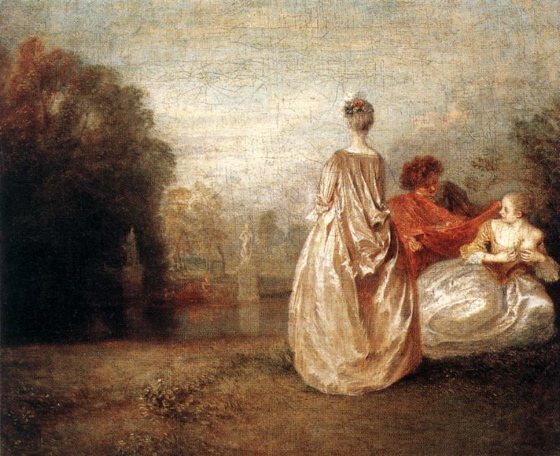
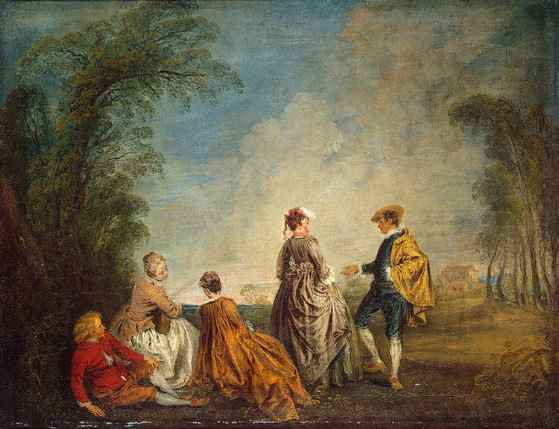
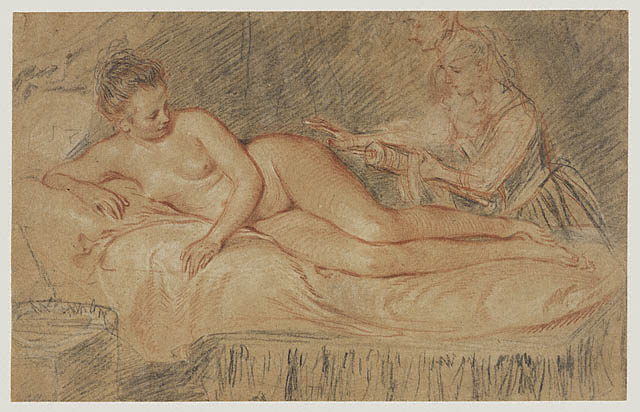
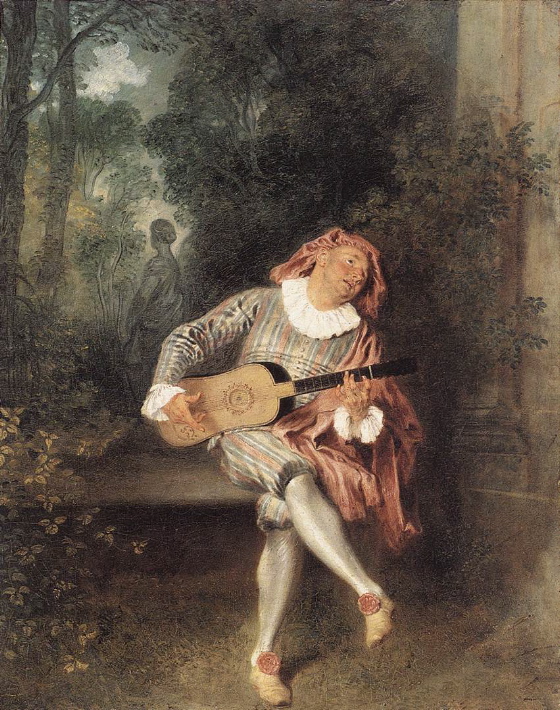
The most erotic oil painting I ever saw — the only one that ever made me . . . tense (as my friend Kevin Jarre used to put it) — was by Jean-Antoine Watteau, the 18th-Century French painter. It was a small, uncelebrated work in a big show of Watteau’s paintings at the National Gallery in Washington in the 80s. It showed a half-clad women sitting on the edge of a bed, seen from behind. Its focus was on the line of her neck and back — the luminosity of her flesh drew one into the space of the painting as one might be drawn towards touching the woman.

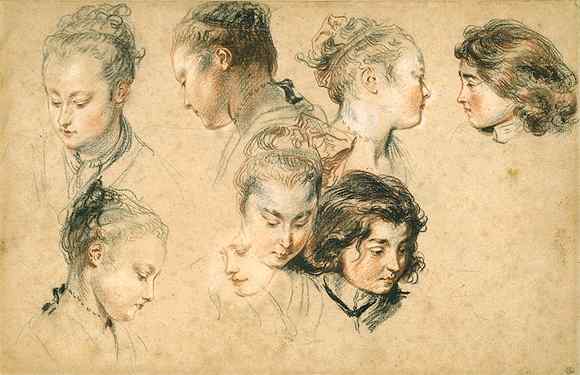
Watteau was the poet of women’s backs and necks — of the half-clad female form. In his portraits of women it is always the inclination of the body which suggests a sexual, an erotic mood. What’s startling about his women is that they do not seem to be posing for men, but responding to inner passions — in a manner that is vexing but never teasing. Watteau’s whole world is invested with this delicate current of inward pleasure, of the small gestures, even in social gatherings, which resonate with sensuality, with foreshadowings of physical abandon.

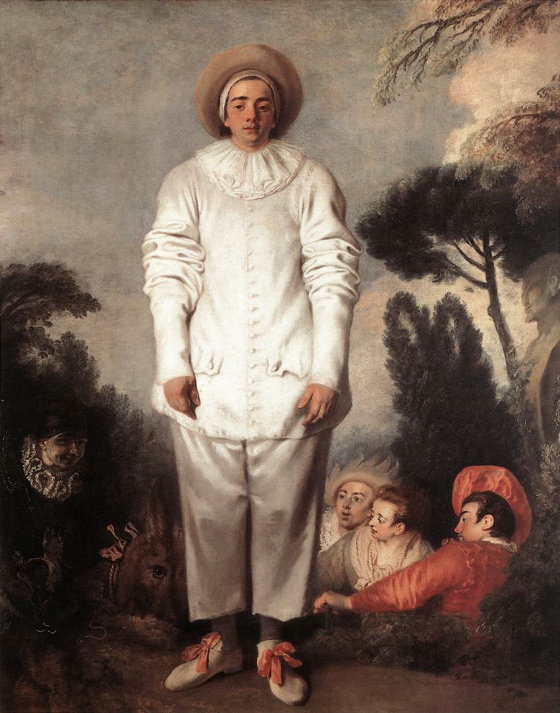
There is no repression in this — just a kind of delicate, subtle foreplay. It has the aura of an exquisite, complicated game. It is theater — both preposterous and sublime. Watteau was interested in the theater, as well as in civilized flirtation, and seemed to see a link between them — but there is a great sadness in his theatrical paintings. His Italian Comedy players, his Pierrots and Harlequins, have a goofy kind of despair — tragic eyes. In this his vision achieves its grandeur and gravity — as he concedes that the sweetest things of life, than which there is nothing sweeter than the line of a woman’s throat, are mortal, will fade, will die, as passion expends itself in satisfaction.

What arouses one about Watteau’s portraits of women is what makes one grieve over them — what makes one see oneself in his bewildered stage lovers and suitors. He is a profound artist, sweet and thrilling and mournful all at once.


AN ELEGY FOR OYSTERS

. . . by the great Irish poet Seamus Heaney:

Alive and violated
They lay on their beds of ice:
Bivalves: the split bulb
And philandering sigh of ocean.
Millions of them ripped and shucked
and scattered.

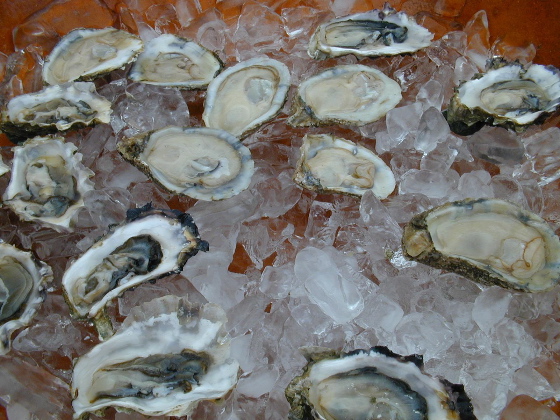
We are eating oysters again, and will be until April, the last month with an r in it until next September . . . but we must remember that each of their alien, unfathomable lives is precious, not to be taken lightly.

THE TAKING OF CHRIST


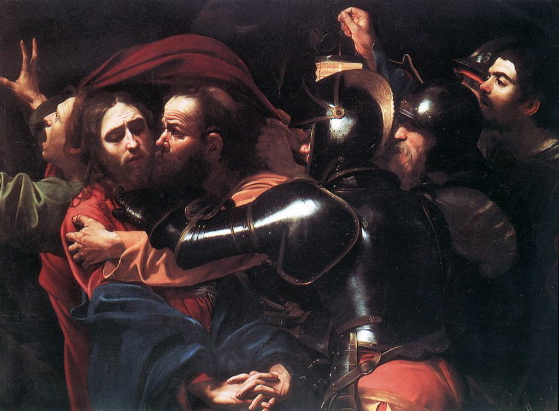
Look at this image.  Just look at it.


It was painted, in 1602, by Caravaggio — at least, that’s the current
wisdom.  It was long thought to be a copy of a lost Caravaggio original
made by a follower or pupil, but in the 90s an art historian made a
convincing case for the attribution to the master himself.


Formally, it’s a dazzling work.  The figures occupy a shallow space but
the picture still produces a strong impression of depth because of the
stereometric modelling of the light, the way the figures block and seem
to jostle each other even in the confined space and the way the centurion’s armor
jumps out at us like a physical assault.  It has, finally, the plastic quality of a relief sculpture.


Caravaggio has placed himself among the dramatis personae here, as the
bearded figure on the right holding the lantern.  This reinforces a
sense of the immediacy of the dramatic situation depicted, as
though it were an incident the artist himself witnessed and recorded
faithfully out of some urgent compulsion.


I personally would trade almost all the painting done in the 20th Century for this one work.  Wouldn’t you?

RADICAL AESTHETICS

Jean-Luc Godard has credited much of the impetus of the French New Wave to the fact that the young filmmakers who created the movement had spent so
much time watching silent movies, courtesy of Henri Langlois, the great
film collector and founder of the Cinematheque Francaise.

Godard believed that the radically alien aesthetic of silent movies allowed
these young filmmakers to see the medium with fresh eyes, freed from
the expectations of current style enforced by the habits and dictates
of the French national film industry and the Hollywood studio system.

Godard also said that the principal idea of the New Wave was to get everybody
out of filmmaking who didn’t belong in filmmaking — to wrest control
of the medium from corporate functionaries and state bureaucrats and
return it to those who actually created movies.

Today, when corporate control of popular movies is nearly absolute, and
forcing its range of possibility into narrower and narrower limits, a
study of silent cinema is even more likely to inspire the sort of
resistance that will be required to rescue movies from corporate
perversion and reclaim them for humane expression on behalf of the
culture at large.

D. W. Griffith once said, paraphrasing Joseph Conrad,  “What I’m trying to do after all is make you see.”

Look.

AMERICAN CLASSICS

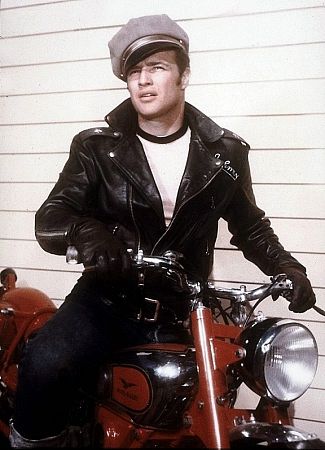
Marlon Brando in “The Wild One”, 1954, wearing a Perfecto motorcycle jacket.
The jacket, originally manufactured by Irving Schott in 1928 and named
for his favorite cigar, was the first motorcycle jacket to feature
zippers. It’s still made by the Schott company, virtually unchanged
since Brando’s day, and is an iconic American classic, an almost
perfect thing. If you buy one, get the original stiff-leather version
and break it in yourself.  There are soft-leather versions
available, but these are for pusillanimous yuppies.

When I wear mine I always think of “Johnny” — the coolest actor of my lifetime.

ROMANCE

Sorting through some old copies of The New Yorker from the 1980s I ran across this by Arlene Croce from one of her dance reviews:

“One hears so much about the death of romance in the relations between the
sexes that whenever an artist manages to make a truly romantic work one
has to ask where he got the material for it. Usually, the answer is
that he got it from the past — the artist has produced a study in
nostalgia. Changing sexual attitudes are imbued with a permanent sense
of loss. How can we really have lost something, though, and kept the
appetite for it? The appetite for romance and all that goes with it —
chivalry, the graces of courtship, the charm of intimacy — is in
itself romantic. So is the idea that we have lost romance.”

I would add that romance is in some ways about loss — it expresses a
fondness for all those things that will not last, for the flight of
time and the transience of the flesh . . . it embodies a kind of
respect and gratitude for the sweetness of life’s passing, in moments
of ecstasy and in the common rounds of everyday experience, and through
that respect and gratitude — all we can offer in the face of mortal
circumstances — it builds a monument of echoes, of faithfulness and
memory, that resists the ruthlessness of time.

I think of some lines from Robert Louis Stevenson’s poem Romance:

“And this shall be for music, when no one else is near,
“The fine song for singing, the rare song to hear,
“That only I remember, that only you admire,
“Of the broad road that stretches, and the roadside fire.”

SANTA TERROR


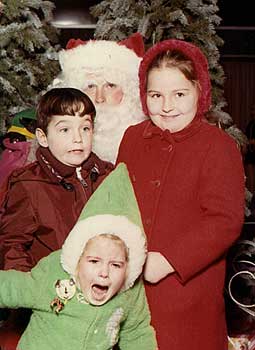
O. k., the drama of Christmas isn’t always gentle.  This picture
is from a series of vintage photographs of children terrified by Santa,
mostly in his commercial incarnations in department stores, where the
true spirit of Christmas is routinely ground down into artificial snowflakes.

WHAT IS THIS?

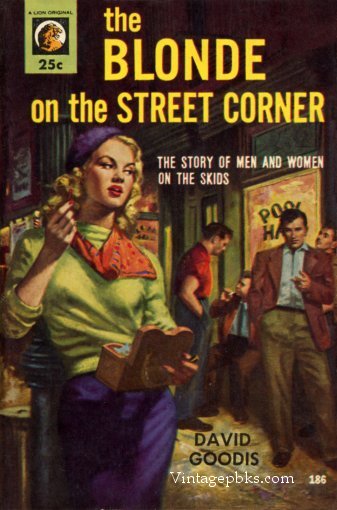
What this is is an excruciating, bitter, brilliant example of pulp noir
fiction from the Fifties. Even though it’s set in the Thirties it
reflects the same post-WWII disillusionment that the Beat writers mined
— but it’s much tougher and starker, much less romantic and
pretentious than any Beat fiction. It makes William S. Burroughs look
like the James Branch Cabell of despair.

Many of Goodis’s pulp novels have been made into movies — Truffaut’s “Shoot
the Piano Player” was adapted from Goodis’s “Down There” — but not
this one. It’s just too grim, I guess, and its eroticism too perverse.
But its jagged broken-glass style and unflinching gaze are also
exhilarating.

[The cover above is from the original edition, but it’s still in print between less lurid wraps.]

EGG NOG


Is there a more congenial day in the whole year than the Friday after
Thanksgiving, when it becomes proper to begin celebrating Christmas?

There should still be lots of turkey left for sandwiches and soup, it
is permitted to play Christmas music incessantly, and the season of egg
nog begins.


A jigger of good Brandy in a glass of store-bought nog will do the
trick — and does for me every night of the Christmas holidays.  Sipped
on a cold night by the fire, egg nog revives the calm and coziness of
childhood Christmases as the gentle suspense of the season built to the dramatic
revelations of Christmas morning.


Later in life one comes to appreciate that Christmas is a celebration
of childhood on every level, as much of the world pauses to honor
the birth of a child, a miracle revealed if only momentarily as a
mystical event, beyond comprehension . . . the very definition of joy.

Cheers!