A CREHORE FOR TODAY


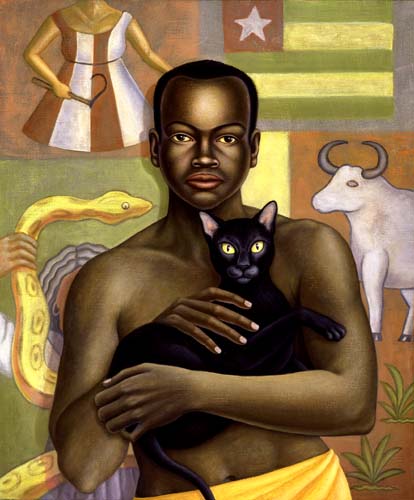
In this imaginary portrait of a boy from Togo, Amy Crehore plays with
space in an interesting way.  The low relief of the central figure is
accentuated by placing him against a flat wall decorated with flat
images.  It's as though he's emerging from the surface of the
wall, entering space, tentatively.

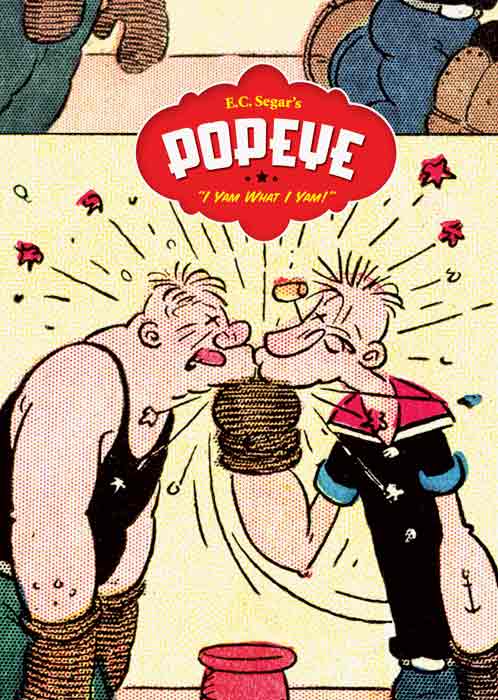
POPEYE


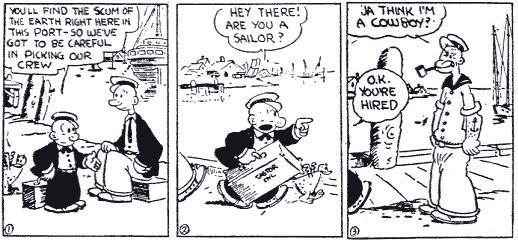
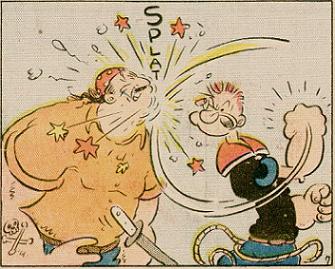
One day in 1929 a peripheral character popped up in a panel of E. C. Segar’s newspaper comic strip Thimble Theater 
and proceeded to take it over.  His name was Popeye.  Below — his first appearance:

Thimble Theater started out as a parody of popular melodrama, but neither parody nor melodrama could contain the anarchic imagination of Segar.  His world was invaded
by supernatural elements, did not conceive of drawing clear distinctions between good and evil, and relished too plainly the energy of rambunctious physical violence.  It was rather closer in spirit to The Iliad than to The Perils Of Pauline.


Popeye at once seemed to offer a kind of sea anchor to Segar’s roiling, restless
sensibility.  Popeye was ever ready to dispense violence, in his
practical, unemotional way — as just another job, like hauling
anchor.  He’d obviously been around the world a few times —
nothing surprised him, or at least not for long.  He was never
heroic but always useful (a far cry from the righteous protagonist he later
became in the Fleischer animated cartoons.)

Seen through Popeye’s eyes, Segar’s world made sense — or rather its lack of sense didn’t seem too disturbing.  With Popeye at the helm, Thimble Theater sailed
on its eccentric way until Segar’s death in 1938, becoming one of the great, dark comic
works of American culture.  Popeye was eventually toned down and conventionalized as his adventures became addressed more and more to kids, but the real character is now available once again in a series of reprints of the original comic strip being issued by Fantagraphic books.


In well-printed, oversized volumes, the first of which is now out, we
can encounter him as he was — part Odysseus, part Achilles . . . the
eye of a perfect existential storm.

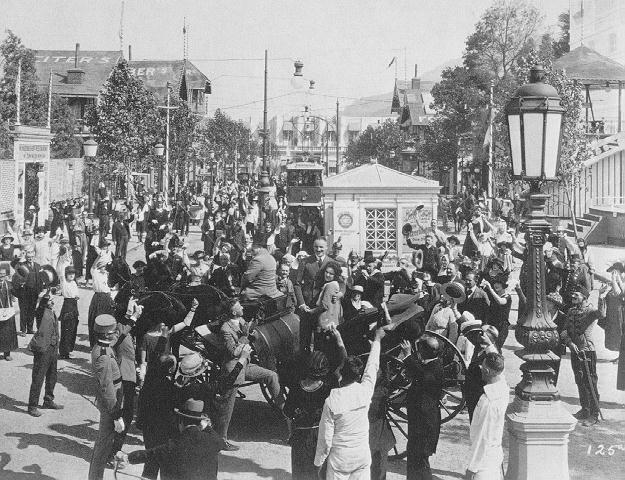
INTOLERANCE

In order to enjoy and appreciate Intolerance you have to watch it the
way you read Dickens — submitting to its rhythms, surrendering to its
asides and narrative diversions.  You simply can’t be too
impatient to find out what happens next in the story (or
stories.)  Dickens and Griffith are more interested in how things
happen, where things happen, to whom things happen.  There’s no
shortage of fascinating incident in either artist’s work, and much of
it is spectacular — but sometimes the incidents are very small indeed,
and no less fascinating for that.


I’ve seen Intolerance many times, and I find I remember small gestures and
glances, brief passages of body language with the same vividness that I
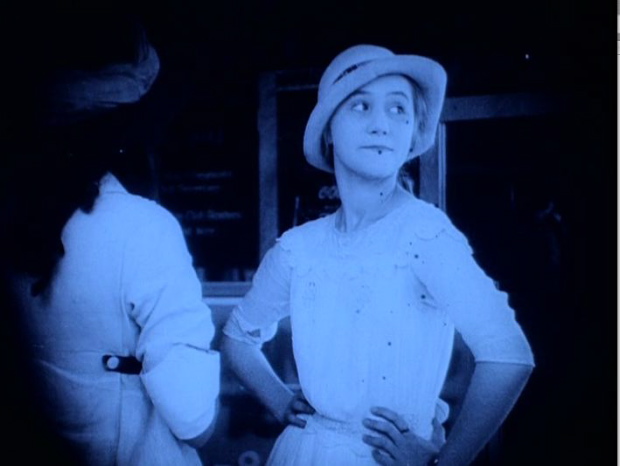
remember great lines of dialogue from talking films.  The flirty
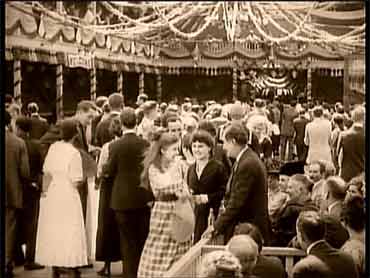
and then dismissive looks the girl outside the dance hall gives the
mill owner Jenkins who’s come to spy on his workers make for an
indelible moment — involving a bit player we never see again.
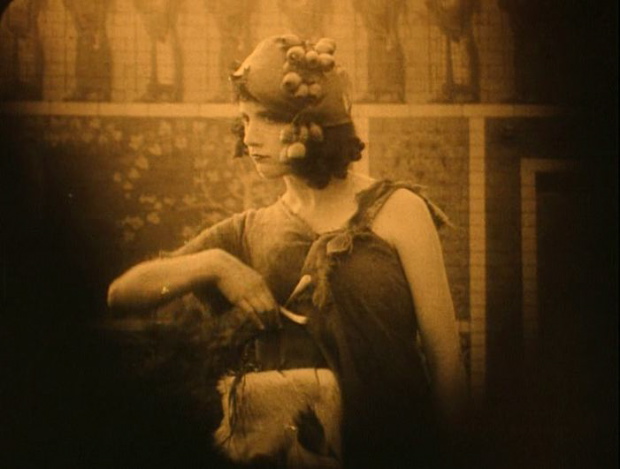
The Mountain Girl’s postures of energy and defiance look in retrospect
like a primer on flapper attitude, years before the flapper even
existed.


It takes Griffith over half an hour to introduce us to all four of the time
periods covered in the film.  We start in the modern story,
proceed to the time of Jesus, then to 16th-Century France — then back
to the modern story before seeing the walls of Babylon for the first
time.


Almost every image in this first half hour is stunning, worth studying for its
dynamic composition involving movement and deep space. The illusion of
depth draws us emotionally into the film just as surely as the
interwoven narratives and the performances.


This effect is most powerful on a big screen, of course, but it’s effective enough on
a decent-sized TV monitor.  When you consider a video screen’s
tendency to flatten any image, it’s all the more amazing that
Griffith’s images retain their stereometric brilliance in that format.


One great virtue of the DVD format is that it allows one to watch (or, one hopes,
re-watch) a film like Intolerance in segments — which is the way one
reads those long Victorian novels originally published serially.
The film reveals much when experienced this way.  There’s almost
no chance in any continuous viewing of the three-plus hours of Intolerance that one could sustain the intensity of attention needed
to fully absorb its torrent of beautiful images in detail.


If you have Intolerance on DVD, go watch just its first half hour — to the end
of the first Babylonian segment.  There’s enough cinematic
brilliance in that half hour to justify, by itself, the whole medium of
movies.


[If you don’t have Intolerance on DVD rush out and get it immediately.  The
Kino edition is generally considered to have the best image quality.]

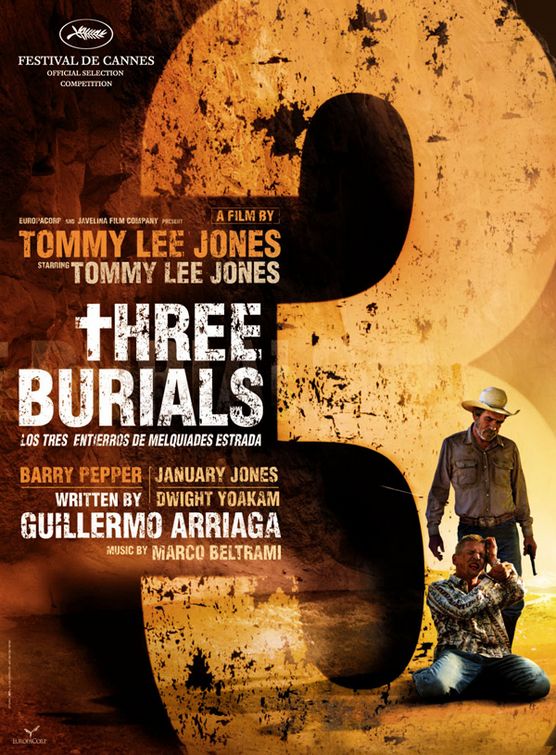
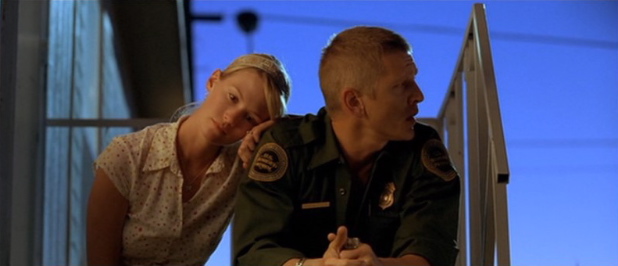
THE THREE BURIALS OF MELQUIADES ESTRADA

Tommy Lee Jones, one of the great actors of his generation, has, with this
film, become one of the most important contemporary directors.
It’s just miraculous.  The wonderful performances by the ensemble
cast and by Jones himself might have been expected — but the brilliant
script and the brilliant filmmaking testify to a sensibility at home within the whole range of cinematic expression.


The sense of place that the film communicates, via Chris Menges’s stunning
cinematography, reminds one of John Ford.  Jones, like Ford when
he was shooting in Monument Valley, is working here in a landscape he
clearly loves and knows well.  It’s important to him, as it was to
Ford, to make us feel what it’s like to be in and move through that
landscape — and he does.


One notes with particular pleasure Jones’s use of horses in the film.  Just watching Jones
sit a horse brings back by itself the whole tradition of the American
Western, in which horses aren’t props but a means of establishing the
authority and conveying the subtler nuances of character.  The horses themselves are
given their own moments — all memorable.  We see a steady old cow
horse try (successfully) to master its hysteria as a man fires a rifle
next to its head.  We see a horse react emotionally as another
horse rides off into the distance — violating the compact of the herd
instinct.  It reminds me a bit of Tolstoy, another serious
horsebacker, who always lets you know how the horses in his scenes are
feeling.


The tale Jones tells, written by Guillermo Arriaga, the author of Amores Perros, is
dark, comic and moving.  It’s set on the Texas border and asks us
to travel imaginatively backwards on the route of the illegal
immigrants — to enter into the memories and dreams the immigrants leave
behind, and so see them more fully as human beings, as opposed to mere
statistics.


The tale is inflected with the sardonic, broadly comic Mexican view of death — Posada’s calaveras ride with Jones here — and the film’s visuals reflect the bold colliding colors of Mexican folk art, all blended seamlessly with the shabby commercialism of American
culture that also defines the world of the border lands — what Carlos
Fuentes calls Mexamerica, in many respects a nation unto itself, which
no wall will ever cut in half, just as no wall could ever really cut Germany
in half.


As in Ford’s great films, the landscape itself finally subsumes human contradiction
and tragedy — infuses a sense of transcendence which expresses itself
as hope.  Irrational gringo optimism and sardonic Mexican resignation transform each
other, merge into one deeply humane vision.

TOY SOLDIERS


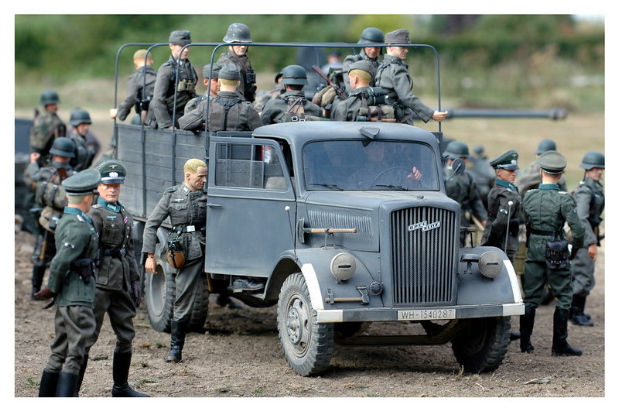
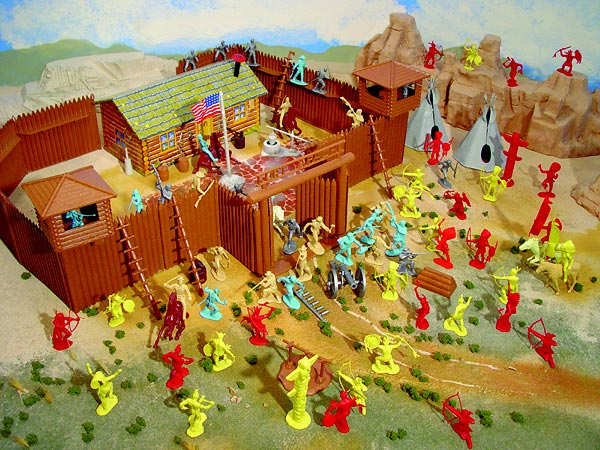
My nephew Harry just acquired his 100th 12″ action figure.  I’ve got a shockingly large number of them myself.  Some people, though, take their fascination with these toys to surreal lengths.


The photo above is just part of a huge diorama using customized 12″ figures and fabricated in-scale props.  It takes me back to the days of my youth when I used to disappear into the minature worlds of toy-figure playsets, like the Fort Apache set I got when I was five or six:


Wanting to possess whole little worlds like this and enter into them imaginatively is closely connected to wanting to make movies, which accounts for the fascination of 12″ figures taken from characters in movies — transported back, as it were, into the miniature realm where they had their imaginative birth.

POP ART


It drives me crazy when people talk about works of Pop Art as though
they somehow belong in the same category as traditional high art — as
though it makes any sense at all to talk about the
oeuvre of Andy Warhol in the same breath as the oeuvre
of Jan Van Eyck, just because they tend to be grouped that way by the academy
and by art institutions.  I actually think it's a sign of clinical
insanity, culturally speaking.


But that doesn't mean that works of Pop Art aren't unspeakably cool.  The Lichtenstein above is unspeakably cool.

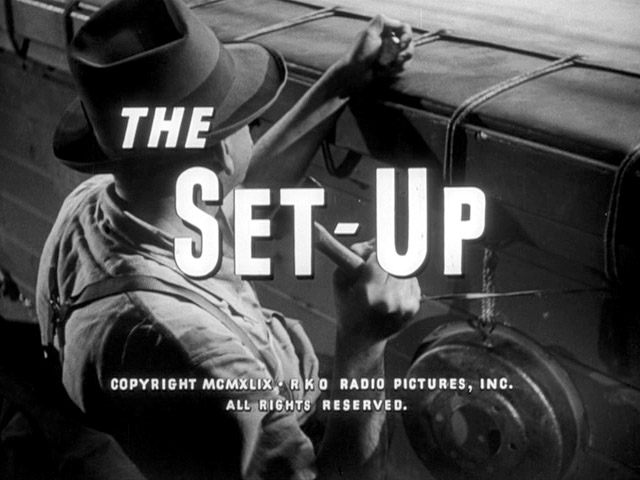
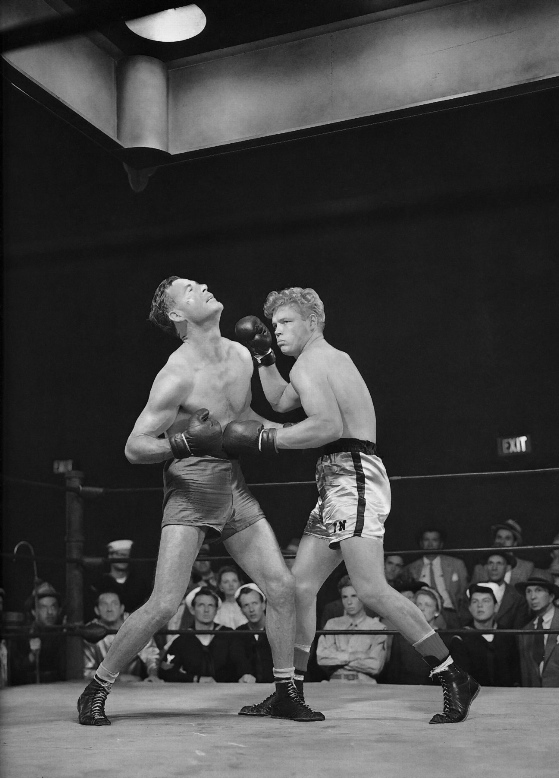
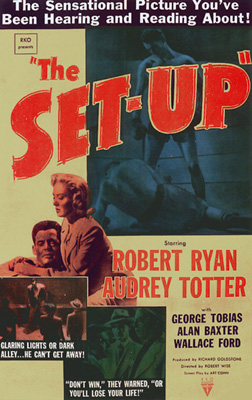
THE SET-UP


The Set-Up
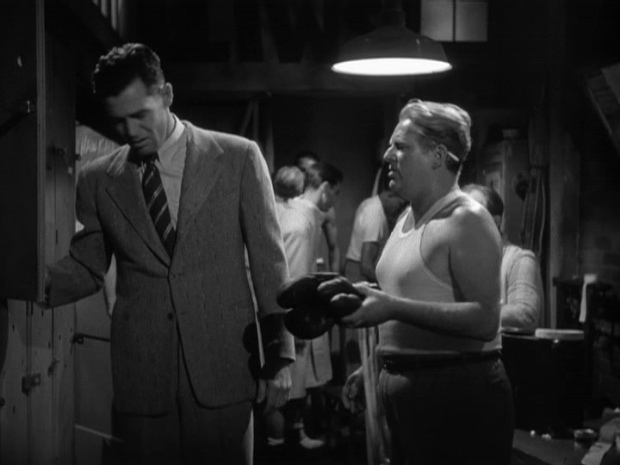
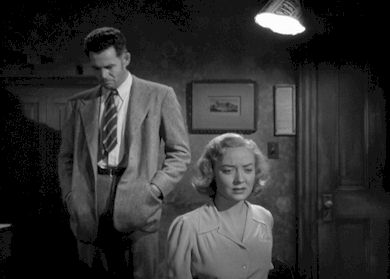
, a classic film noir directed by Robert Wise in 1949, couldn't be more different in many ways from Jacques Tourneur's equally admired classic noir Out Of the Past.  For one thing, The Set-Up doesn't have a femme fatale.  There's no romance, no glamor, no witty hardboiled repartée.  But if you realize that classic film noir is centrally concerned with anxiety and neurosis about manhood, the two films fit neatly together in the noir tradition.

The Set-Up
is about the boxing underworld, the tank-town circuit where
up-and-comers get their chops and has-beens rent themselves out as
human punching bags.  Robert Ryan plays a has-been, a
once-promising fighter who's come to the end of the line.  His
métier is perhaps the most iconic arena for displays of traditional virility — his exhaustion a sharp symbol of its decline.


The fans jeer him.  His own manager takes money to get him to take
a dive but doesn't even bother to inform him, so sure is he that his
fighter is going to lose . . . one more time.  Ryan's
long-suffering wife is about to walk out on him, unable any longer to
watch his steady and inexorable collapse.  Ryan's continued belief
in himself as a fighter is presented as the delusion of a punch-drunk
loser.


But Ryan still has one more victory in him, one last assertion of his
potency in the ring.  The victory, however, is no triumph. 
His wife hasn't even come to the arena to watch it.  His corner
men flee before the fight is over.  The manager of the fighter he
was unknowingly paid to lose to sets his thugs on him and beats him up
in an alley, smashing his hand so he can never fight again.


In a powerful sequence just before the assault in the alley, Ryan runs
through the empty arena, past the empty ring, trying to escape. 
His ritual of manhood has become a shadowplay that nobody cares about,
nobody's watching.

The Set-Up
plays out in real time over the course of one night, creating an almost
unendurable suspense.  The four rounds of boxing shown, again in
real time, are the best evocation of a real fight ever put on
film.  The high-speed meta-narrative that always develops in a real fight,
especially a good one, is both complex and legible, and the combat is
convincingly brutal.  (Ryan was a champion fighter at the college
level and knew what he was doing.)


The ending of the film is satisfying because of the heroism involved in
Ryan's last stand — even though it's meaningless in practical
terms.  It's sort of a glorious farewell to his own construction
of himself as a man.  His wife is still there for him, happy that
he's been forced to move on.  But move on to what?


Film noir never had an answer
to that question, and the resulting tension is what has always constituted the
deep subliminal appeal of the genre.  It posed a question that
modern men are still asking themselves.


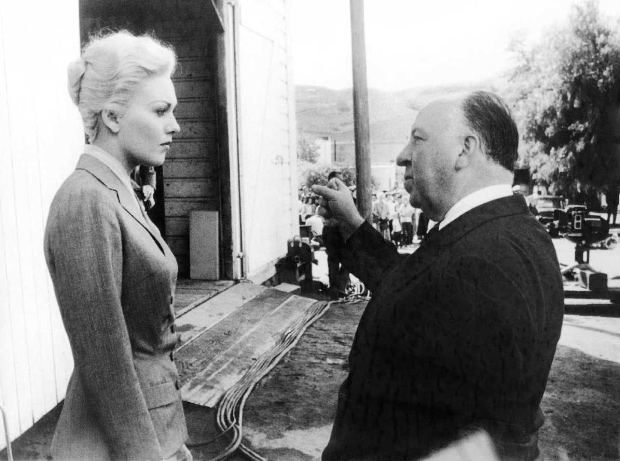
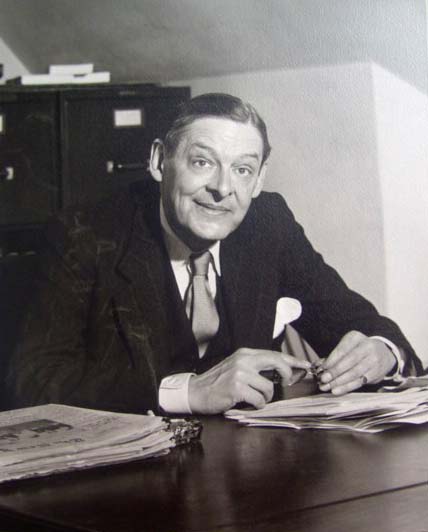
T. S. ELIOT ON ALFRED HITCHCOCK


Well,
not precisely, but this quote by Eliot about poetry offers a key to
analyzing Hitchcock's films, and, indeed, all great suspense thrillers:


“The chief use of the ‘meaning’ of a poem, in the ordinary sense, may
be . . . to satisfy
one habit of the reader, to keep his mind diverted and quiet, while the
poem does its work upon him: much as the imaginary burglar is always
provided with a bit of nice meat for the house-dog.”


In Hitchcock's movies, the plot mechanics, the mystery to be solved, the suspense engendered
by the nominal physical jeopardy of the characters — all this belongs
to the territory of the “maguffin”, the essentially arbitrary device
that sets the narrative in motion.


The truth of the film is experienced on another level — which is one
reason it's so enjoyable to watch Hitchcock's movies over and over
again, why they always seem new.  You forget the plot mechanics instantly —
they don't linger in the mind for even a moment after the film is over.  All you're
left with is the memory of confronting, and surviving, some nameless,
existential dread.


[I am indebted to Ken Mogg's
The Alfred Hitchcock Story for pointing me towards the Eliot quote and suggesting its connection to the Hitchcock maguffin.  The Alfred Hitchcock Story
is a pictorial survey of Hitchcock's films with pithy commentary by
Mogg and other Hitchcock experts.  It's worth tracking down the
British edition, published by Titan Books, since the American
edition is unfortunately and unaccountably abridged.]

MERRY-GO-ROUND


Erich Von Stroheim was above all else a wondrous spinner of tales. His
storytelling mode was, at heart, melodrama, but much modified from its
conventional forms. He embraced all the sensational elements of melodrama, its
reliance on wild coincidence and its stark dynamic of good versus evil
but subverted them to his own ends. He made the erotic subtext of much
melodrama explicit, he used coincidence to serve his own fatalistic
vision of human destiny, and he inverted expectations about protagonist
and antagonist, making the former often weak and foolish and the latter
invariably fascinating and appealing, especially when he himself played
the role.


His
vision of the world was brutal and harsh, but he preserved the romance
and the celebration of virtue at melodrama's core — in the form of his
faith in a pure and spiritual love which could transcend the vagaries
of fate, even if his version of such love often existed outside the
realms of strict propriety.


He was
a popular artist of his time, speaking to audiences in a language they
could understand, even as he extended the expressive and thematic range
of that language. Of the seven films he completed only three were
released to the public in versions close to what he intended, and all
three made money — quite a lot of money. Von Stroheim knew his public
and its taste, and we err when we accept too quickly the judgment of
the studio executives who decided that this public would not have
accepted his four mutilated films in the longer versions he originally
prepared. We will never know for sure, of course, but it's an insult to
a popular artist of Von Stroheim's stature and achievement not to give
him the benefit of the doubt on this score and to accept uncritically
the verdict of the creative mediocrities who vandalized his films.


The
tale Von Stroheim concocted for what would have been his fourth film,
Merry-Go-Round, is perhaps his most romantic — inspired as it was by
his nostalgia for the old Vienna he grew up in, the one that vanished
forever in the catastrophe of WWI. Von Stroheim's participation in this
old Vienna was not what he claimed it to have been — it was part of
his dream world from the start — but it was at the center of his
imaginative life and he seems to have felt its loss just as keenly as
(perhaps more keenly than) the loss of something real.


In
Merry-Go-Round, Agnes becomes a symbol of the innocence and allure of
the dream of old Vienna — one which redeems the deceitful and
hypocritical Count Hohenegg, and by extension the whole corrupt
superstructure of the Hapsburg fantasy. That fantasy was worthwhile,
Von Stroheim seems to say, if it could make a place for dreamy,
waltz-inflected nights at the Prater, and for Agnes, the sweet
incarnation of those lyrical interludes.


When
we think of dreamlike films, or dream sequences within films, we might
be tempted to think of the expressionistic style filmmakers often use
to signal a dream state — but of course real dreams do not present
themselves in that way. We might, in a dream, find ourselves at home
and discover a previously unnoticed door opening onto a previously
unsuspected wing of the house — but that wing is not appointed like
the cabinet of Dr. Caligari . . . it is as convincingly real a place,
in the dream, as the actual house we know.


Von
Stroheim appropriated this aspect of actual dreams to give his
cinematic universe the power of the dream spaces we concoct, with a
similar attention to detail, in our sleep. This was Von Stroheim's way
of seducing us into his dreams, making us take them seriously. It was a
storyteller's strategy — not, as has often been suggested, some kind
of neurotic obsession with “realism”, much less an egotistical
extravagance. While Von Stroheim was obsessing over his “extravagant”
sets he himself lived in an exceedingly modest home in Hollywood, and
led a mostly mundane and largely domestic private life.


Von
Stroheim was the first great director to realize consciously that
movies alone could use this illusion of a coherent and convincing dream
universe to give power and depth and weight and resonance to an
ordinary tale, to overwhelm us with the subliminal power of an actual
dream.

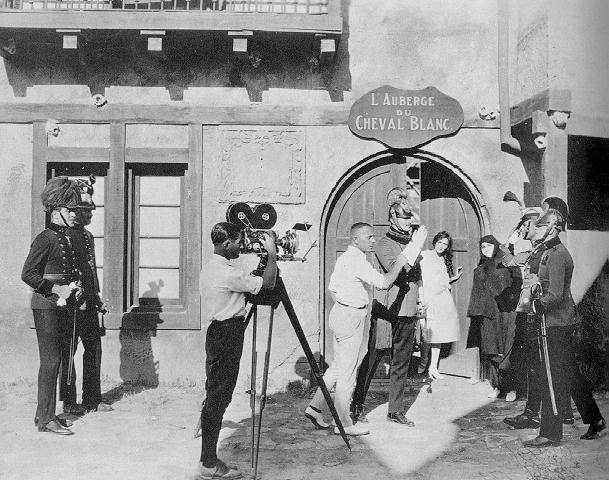
Von
Stroheim was fired from
Merry-Go-Round somewhere between a quarter
and a third into the shooting. The story was rewritten and the shooting
completed by Rupert Julian, a studio hack appointed by the dazzlingly
mediocre producer Irving Thalberg. Enough remains of Von Stroheim's
vision to show us what the film might have been — and there is more
than enough of Julian's work on display to make the genius of Von
Stroheim's method stand out in stark contrast.


Julian's
mise-en-scène is theatrical and uninventive, without a trace of plastic
imagination. He does not place us inside a dream universe but at the
edge of a stage. We don't have the sense of
being someplace but of looking at something. Julian also encourages his actors to act — in an
exaggerated theatrical style that several of them had no training or
capacity for, and that violates in all cases the more naturalistic and
engaging style Von Stroheim knew how to elicit even from novices.


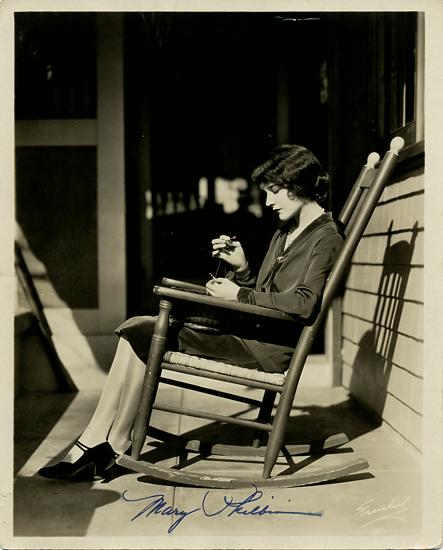
Despite
all that, the performances of Norman Kerry and Mary Philbin are
revelations. Kerry was playing his first important role here, and
Philbin her first role of any kind (apart from a walk-on in
Foolish
Wives
.) Kerry was a small-time actor whom Von Stroheim here elevated
to star status — and we can see in his performance what Von Stroheim
saw in him. He's sort of like a laid-back, less boyish John Gilbert,
with tremendous masculine authority, which seems utterly natural and
utterly appealing in those scenes directed or influenced by Von
Stroheim but which vanishes entirely in those scenes in which he is
called upon to emote in a more conventional (though already
anachronistic) style.

Philbin
was an actual discovery of Von Stroheim's — he'd named her as the
winner of a publicity-stunt beauty contest he judged in Chicago. She
has real charm and power in
Merry-Go-Round, and also a totally
convincing naturalness — except when Julian persuades her to try for
the high style, at which point she seems merely competent. Her
generally undistinguished performance in
The Phantom Of the Opera
must be attributed directly to Julian's cluelessness and bad taste as a
director of film actors, because she was an artist of genuine talent
and potential. (The fact that she became one of Universal's biggest
stars in the Twenties is yet more evidence of Von Stroheim's insight
into the popular taste of his time.)


Much
of Von Stroheim's dark vision of human behavior was removed from the
reworked version of the tale given to Julian to execute, which makes
the romantic idealism that triumphs in the end seem a bit saccharine.
Dimwits like Thalberg didn't understand how dark elements could set off
and energize the positive and redemptive themes always present in Von
Stroheim's work.


Universal
called its prestige releases Super-Jewels. The existing version of
Merry-Go-Round is a Super-Rhinestone — but in it we can see
reflected a great masterpiece, the film Von Stroheim might have made
without the intervention of Irving Thalberg and his all-too-perfect
alter ego Rupert Julian.

DIAMONDS ARE FOREVER


This
is one of the nuttiest of the Connery Bond films and one of the most
enjoyable. Its narrative is borderline incoherent but that hardly seems
to matter to the filmmakers, who are simply using the plot as an excuse
for the sort of dumb/surreal gags that the series is famous for.
Watching this film you realize that
Austin Powers is hardly a parody
at all — just a slight exaggeration of the tongue-in-cheek lunacy of
the early Bond films. This one seems to have been made by people on
some kind of drug that doesn't exist anymore — one part Merry
Pranksters LSD and two parts Rat Pack bourbon. The film is notable
visually for Jill St. John — unspeakably luscious here, performing
increasingly heroic deeds in increasingly fewer clothes . . .

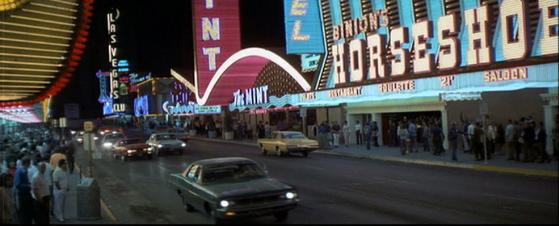
. .
. and for images of Las Vegas in 1971 — from the shocking emptiness of
The Strip (Caesars was the only mega-resort in
existence at the time) to the wondrous dazzling neon of downtown, on
the western end of Fremont Street, before it was turned into a
pedestrian mall.


What's
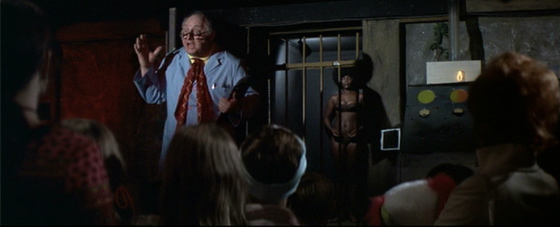
more, Jay Sarno, creator of Caesars and Circus-Circus, and one of the
true visionaries of modern Las Vegas, plays a bit part as a carnival
barker at Circus-Circus:


You
can see Circus-Circus in this film exactly as it was when Hunter
Thompson first visited it in the early 70s and immortalized its
inspired, deranged essence. “The Circus-Circus,” he said, “is what the
whole hep world would be doing on Saturday night if the Nazis had won
the war.”

VISIONS


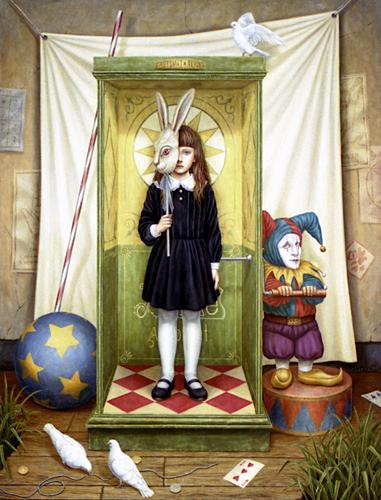
Here’s a
link (via the ever illuminating Little Hokum Rag) to the amazing paintings of Shiori
Matsumoto.  Just go to her site, click on
Gallery and take a tour
through a previously uncharted precinct of Dreamland — east of
Tenniel’s Wonderland, west of the Henri Rousseau Rainforest, just down
the street from Chris Van Allsburg’s grandmother’s house.  (Certain
traveling players pass between this region’s
playhouses
and those on Amy Crehore’s Naughty Wondershow Theatrical Circuit,
exercising the craft and mystery of an art long thought lost.)

[Images © Shiori Matsumoto]

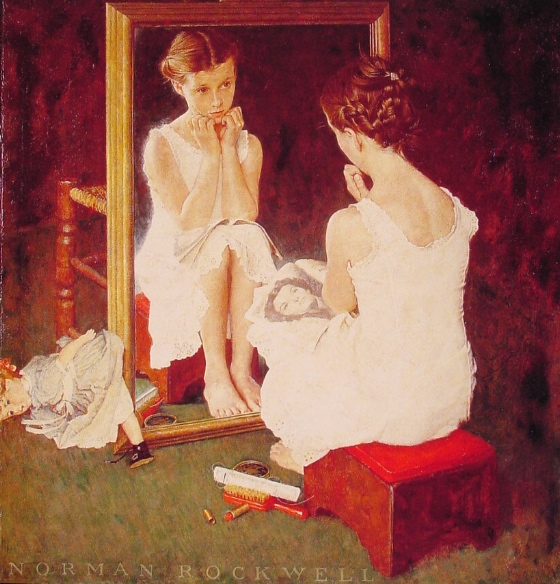
A ROCKWELL FOR TODAY


People who find an image like this excessively sentimental have simply
lost touch with reality — have learned to reject reflexively any work
which appeals too directly to the heart.


The image is contrived, certainly, in posing its subject between the
doll of childhood and the glamorized icon of womanhood, but there is
nothing contrived about the artist's subversive intention here. 
The painting was made for the cover of
The Saturday Evening Post,
which trafficked (at least in its advertising) in glamorous images of
women, like the one that is here filling a beautiful child's head with
doubt about her own attractiveness.


Rockwell's “Americana”, often seen as a sugar-coated lie, had its sharp
side.  If this image doesn't make you just a little bit angry, and
deeply suspicious of a culture that seduces young women into such
self-doubt, then I think you just aren't seeing what's plainly there in front of you.

TASHLIN'S APOCALYPSE


Frank Tashlin's comic critique of American culture was
so anarchic, so all-inclusive — encompassing even the cinema itself,
the medium he worked in — that it's hard to identify a point of view,
a philosophy, behind it.  He just seemed to celebrate the
idea of
transgressive thought.


Still, critics have often intuited a dark side in
Tashlin's work, which suggests that it might not have been as
innocently and cheerfully irresponsible as it seems.  Peter Bogdanovich
wrote, “As comic as Tashlin's movies are, they also reflect a deep
unhappiness with the condition of the world.”

But what might have been the source of this
unhappiness, the perspective on the world which determined it?

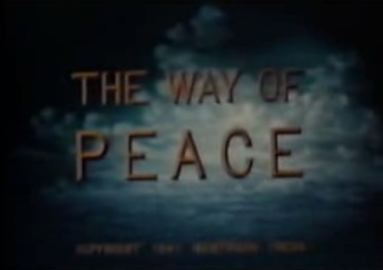
An interesting clue can be found in a short, 18-minute
stop-motion animation film he made in 1947 called The Way Of Peace
My friend Paul Zahl, a distinguished Anglican theologian, recently
tracked down a copy of this obscure film — which is surprising, even
startling.

Tashlin started out in the world of animated cartoons,
and a few years before beginning his career as a live-action feature director
he made
The Way Of Peace — which was, as far as I can
tell, his only foray into stop-motion puppet animation.  The
stop-motion work was done by Wah Ming Chang, who later did the
stop-motion effects for The Seven Faces Of Dr. Lao and The Time
Machine
.  The film was narrated by the actor Lew Ayres.

But
here's the startling part — the film was made for
the Evangelical Lutheran Church Of America, and it's an unabashedly
religious, Christian work.  Most of it is concerned with the
destruction of the world by nuclear holocaust, presented as an
inevitable consequence of abandoning Christ's “way of peace”.  (A
Lutheran pastor provided the “story conception” for
The Way Of Peace, but
Tashlin wrote the script and clearly devoted a lot of care to the
inventive, often beautiful, often terrifying images of the film.)
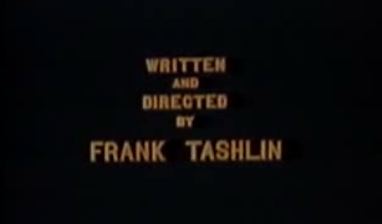

One might think, given the puppet-cartoon medium it's
made in, that it was a film addressed to children — but the
apocalyptic destruction it portrays is very dark and disturbing.  At
any rate, it's probably not something you'd want to show to very small
children — the natural audience for animation of this sort.

It turns out, however, that Tashlin wrote a number of
picture books for children which are far more explicit in expressing
his fears for human civilization than his Hollywood movies ever tried
to be.  Tashlin's fears were founded on a dread of nuclear war but also
on the spiritual decline of civilization through materialism —
something he satirized mercilessly in his films.
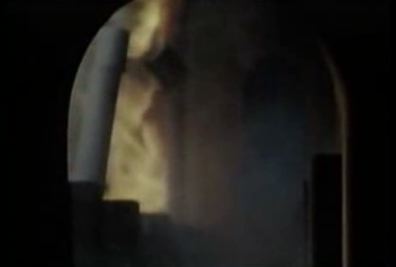

Tashlin being Tashlin, of course, his critique of the
modern world did not preclude a critique of the church — he was no
apologist for organized religion.  A church is shown being obliterated
in the finale of
The Way Of Peace, and one of his children's books, The World That Isn't, criticizes churches for their complacency.

I think all of Tashlin's work needs to be re-examined
in light of
The Way Of Peace and his children's books.  The Way Of Peace even offers a clue as to Tashlin's oddly affectionate, even
celebratory style of satire.  The short ends with a quote from John's Gospel:
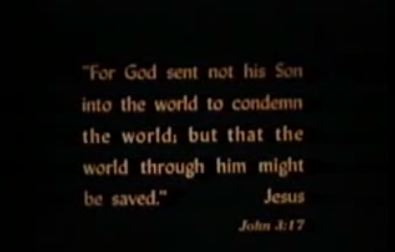

Paul
Zahl points out that there is Tashlinesque irony in the quote, since
we've just witnessed the destruction of the entire planet — but the
theology is sound enough from a Lutheran perspective, and perhaps from
Tashlin's. God hasn't destroyed the world for rejecting Jesus, the
world has destroyed itself by rejecting Jesus's “way of peace”.  There
is no judgment involved, per se — just a kind of spiritual physics that reflects a very grim view of human nature.

Tashlin's mainstream Hollywood work never passes judgment on anyone or anything (The Girl Can't Help
It
!) . . . but was it meant to save sinners, instead of just tweak them
for
their follies?

Tashlin, along with his disciple Jerry Lewis, was
probably the most eccentric director of comedy in 50s and 60s
Hollywood.  Was he perhaps even more eccentric than we've imagined —
and more profoundly serious in his deconstruction of American
civilization?  In The Way Of Peace he
portrays a puppet world on the brink of annihilation.  Was that
perhaps what he was trying to do, between the lines, in his live-action features as well?

Another of his children's books offers an intriguing image which might be the best clue to the real Tashlin and his methods — The Possum That Didn't
In it, a happy possum hanging upside down has his smile mistaken for a
frown.  A bunch of do-gooders take him to the city, where he's
unhappy, but his upside-down frown there is mistaken for a smile.

To
me this sounds an awful lot like a warning directed at anyone inclined
to take Tashlin's topsy-turvy comic vision at face value.  At the
very least it should make us question whether his smile is ever quite
what it seems.
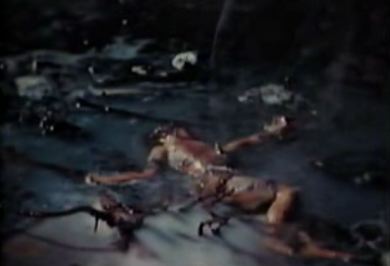

[The Way Of Peace can now be seen, in a somewhat
fuzzy online version, at the web site of the Evangelical Lutheran
Church Of America, which holds a copy of the film.  It's really a
remarkable and provocative piece of work.  Thanks are owed to that
organization for putting it up, and to Paul Zahl for tracking it down
there.]