THE SHOW

Jae
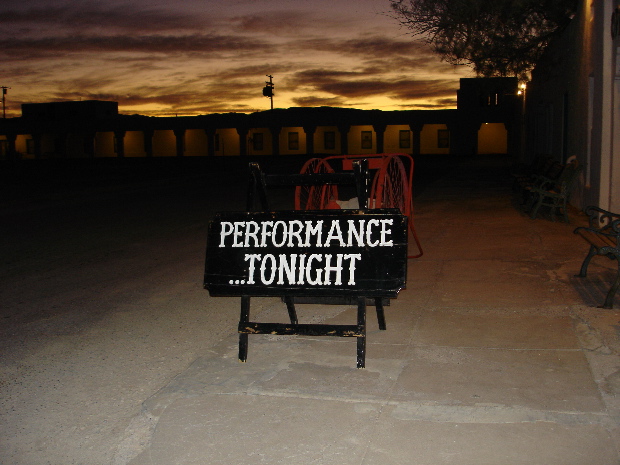
and I headed back to Death Valley Junction from our dinner at the
Longstreet Casino coffee shop with plenty of time to spare before the
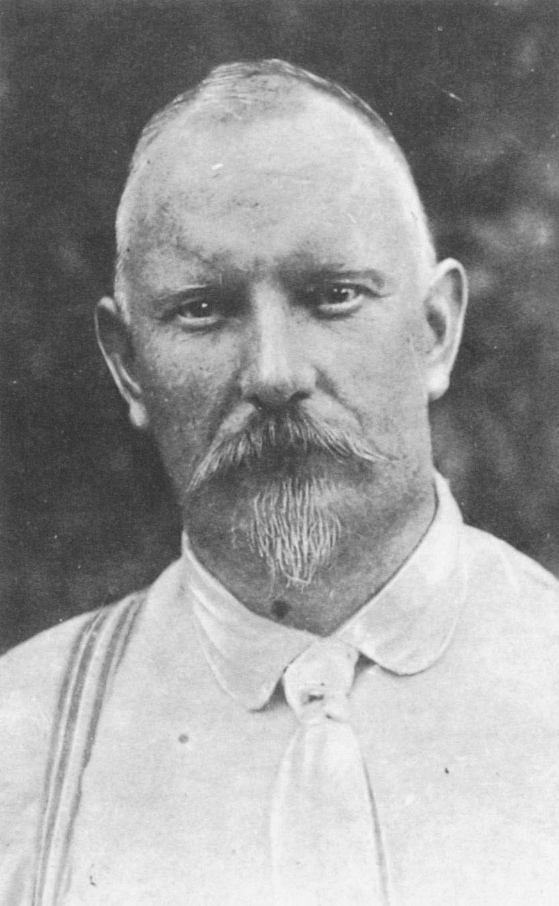
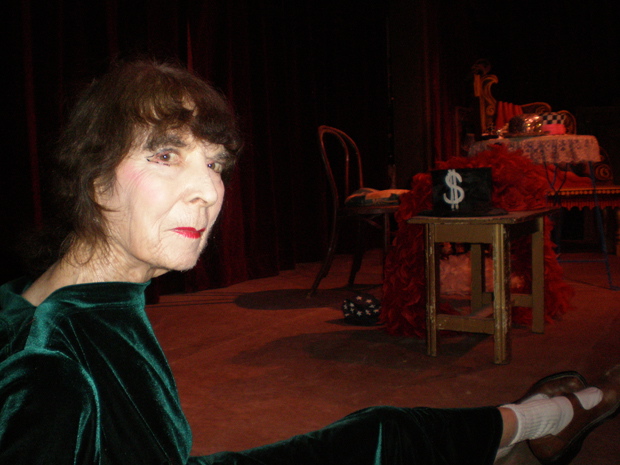
performance by Marta Becket (above) at her Amargosa Opera House.

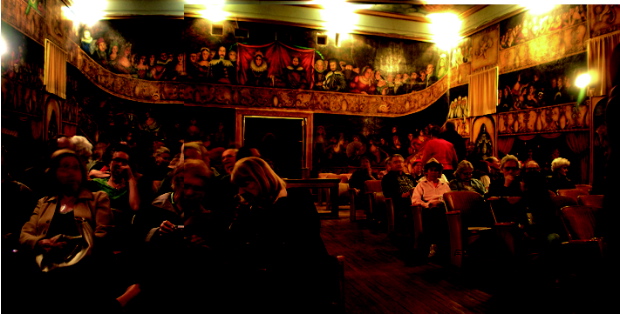
We were amazed at all the people who'd showed up — the little theater
could hold about a hundred people and it ended up nearly full.

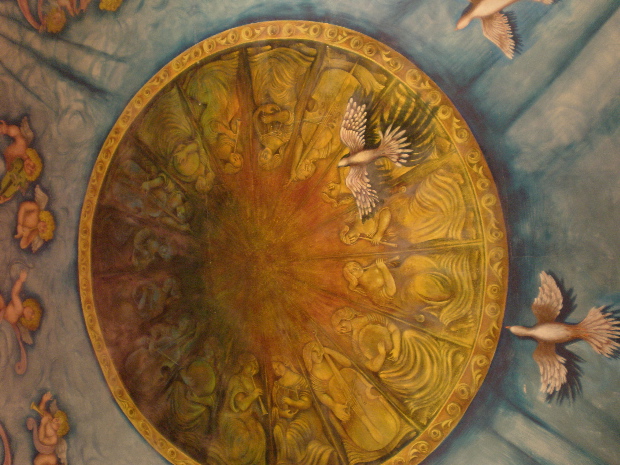
The place is a hoot — all its walls and ceiling painted by Marta
herself to resemble the inside of a Baroque opera house.  It took
her four years to complete the job.
Today she is frail and birdlike, but still carries herself as a
dancer.  She walks out onstage, sits in a chair and talks and
sings for about an hour.  She has great presence, partly
diva-like, partly girlish.  You come away from the show, from the
whole phenomenon of the Amargosa Opera House, with a swirl of questions.

Is it silly or sublime to be the biggest star in Death Valley, where there
are no other stars?  Is it heroic or preposterous to create your
own world out in the middle of nowhere and dare the rest of the world
to ignore you?

All of the above, I guess.  Marta's world is part David Lynch,
part Fellini, part senior high school play, part good old-fashioned
show-biz, utterly disciplined and professional.  Once she
bought a ghost town and brought it back to life — now she's a bit of a
ghost herself, but right at home in the spotlight.
What's profound about it all, I think, is the reminder that all theater
deals in the presentation of spirits, not quite flesh and blood, not
quite illusion.  She painted an audience for herself on the walls
of her theater, and every Saturday night at 8 o'clock between November
and May she conjures a real audience out of thin air, there on the edge
of Death Valley — she conjures us out of thin air, and we become part
of the ghostly goings-on.  We lose some of our solidity in the process and feel
that we know what it's like to dance on air.

[Photos © 2007 Jae Song]

DEATH VALLEY NIGHTS

On
our visit to Death Valley my friend Jae and I decided to attend a
performance at the Amargosa Opera House in Death Valley Junction, just
outside the boundaries of the national park.  The opera house sits
at one end of a large u-shaped arcade built in 1923 by the Pacific
Coast Borax Company as a kind of company town.  It incorporated
living quarters, offices, a hotel, a dining room and a community
center, which is what the opera house started out as.

When New York City dancer Marta Becket and her husband chanced upon the
complex in 1967 it was a deserted ruin, but Marta imagined the
community center as a theater in which she could exercise her
art.  She and her husband leased it, renovated it and gradually
bought up the rest of the complex, reopening the hotel and presenting
shows in the “opera house” every year from November to May, all
starring Marta.

She's still at it, though at 84 she can no longer dance.  She
gives a seated performance these days, in which she reminisces and
sings songs of her own composition.

While waiting for curtain time we drove seven miles north to the
Longstreet Casino, Hotel and RV Park.  Like everything else in
these parts, it's in the middle of nowhere.  As I learned from a
bartender there, the casino's fortunes rise and fall with the numbers
of RV campers who stop in on tours of Death Valley and the American
West.

There only seemed to be locals on hand when we visited.  “Why do
people live out in places like this?” I asked myself.  The answer
came to me after a while — “There are no yuppies here.”  It
was refreshing.

Jae and I had some decent burgers at the casino's coffee shop, and I won 57 cents at a slot machine.

Then we headed back to Death Valley Junction for the show.

A NEW LOW


My friend Jae is in town, visiting from New York, and yesterday for
some reason we decided to drive to Death Valley, which is about three
hours away.  It was like a journey to another country.

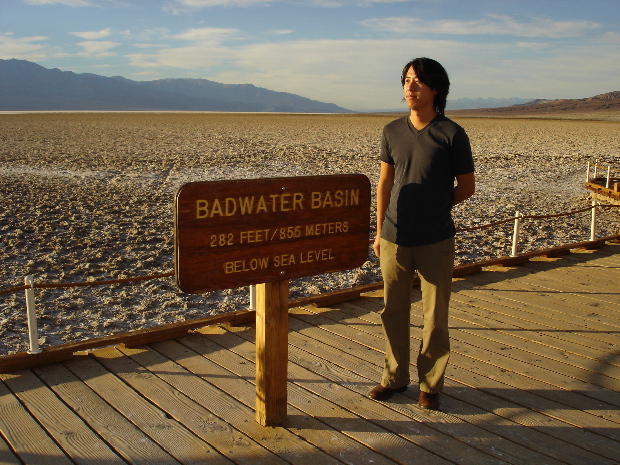
We headed straight for Badwater Basin, the lowest point in the Western
Hemisphere — 282 feet below sea level.  It was amazing to think
we'd sunk so low.


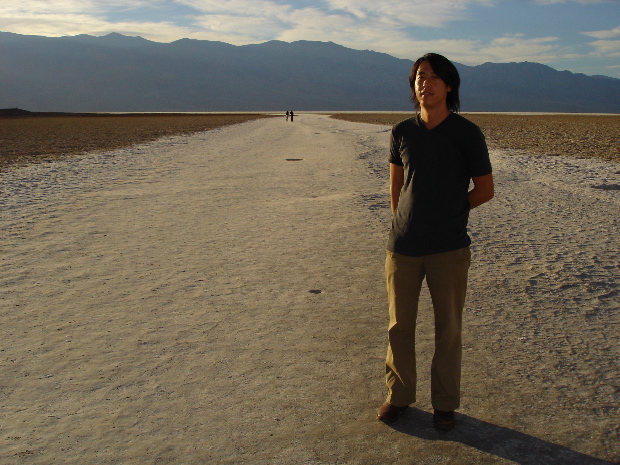
There was a broad pathway from the parking area whose surface was
packed salt.  As you walked out into the valley on this pathway
you could see other figures walking far in the distance.  It made
you feel like a pilgrim on some supernatural highway leading to the end
of the world.

The good news was that the only way we could go from Badwater Basin was up.

A ZORN FOR TODAY

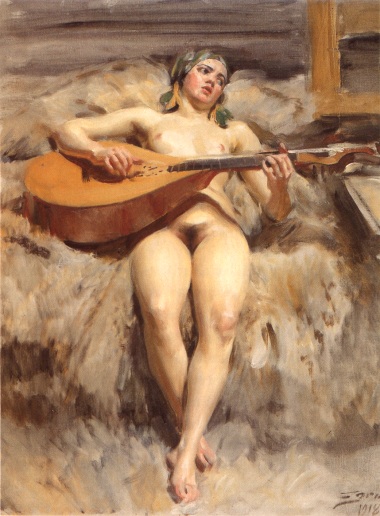
Like Renoir, Anders Zorn seemed to be intoxicated by female flesh — the sensual surface of his canvases seems to be a sexual response to the female nude, whose aura radiates outward to affect her surroundings, which take on her sensual properties, as in the painting above.  The whole world seems made of flesh.  Renoir said, “I paint with my penis,” and the same can almost be said of Zorn.

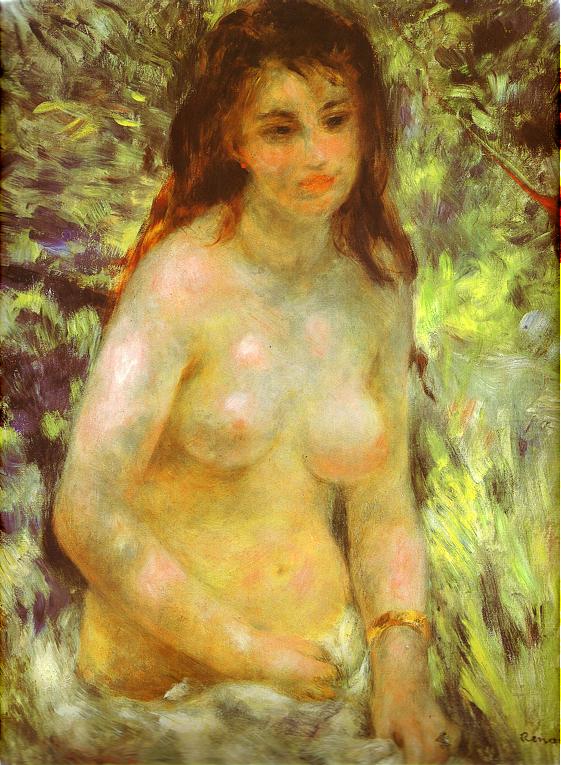
Renoir’s world sometimes seems about to melt in the sexual delirium but Zorn kept a stricter control over his draftsmanship and his sense of modeling, of space — he was more academic in that sense.  The tension between the sensual surface and the precise rendering of forms makes Zorn’s work more interesting to me than the late Renoir nudes, which always seem to threaten to dissolve into goo (see above.)  They become more and more about Renoir’s mood and process, less and less about real women.

WINSOR MCCAY AND THE CINEMA

The
influence that went on, back and forth, between the cinema and other
visual arts has often been noticed but rarely studied in detail. 
Writers on cinema have produced tome after tome about the influence of the
stage and literature on movies, but the visual side of things has
rarely been subjected to rigorous investigation.

Partly this is because the two principal visual influences on movies,
comic strips and Victorian academic painting, have had little prestige
in the scholarly culture, and partly it's because these two forms have
been hard to study themselves.  First-rate reproductions of even
the most important comic strips have been difficult to come by, and
Victorian academic painting tends to languish in storage in museums, to
make room in the galleries for the junk creations of “modern art”.

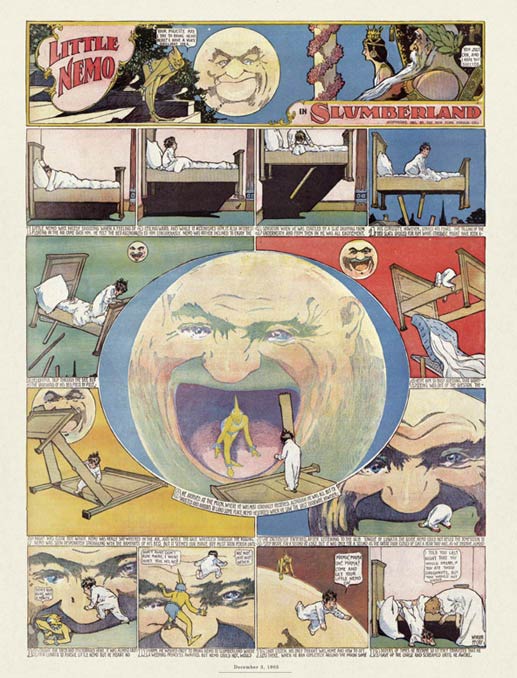
With respect to comic strips, things are changing.  Splendid reproductions of seminal strips like Popeye, Gasoline Alley and Terry and the Pirates
are becoming available in ongoing series, and Winsor McCay is getting
spectacular treatment in large over-sized volumes which do full justice
to his amazing visions. (See here and here.)

New revelations about the connection between comic strips and movies should
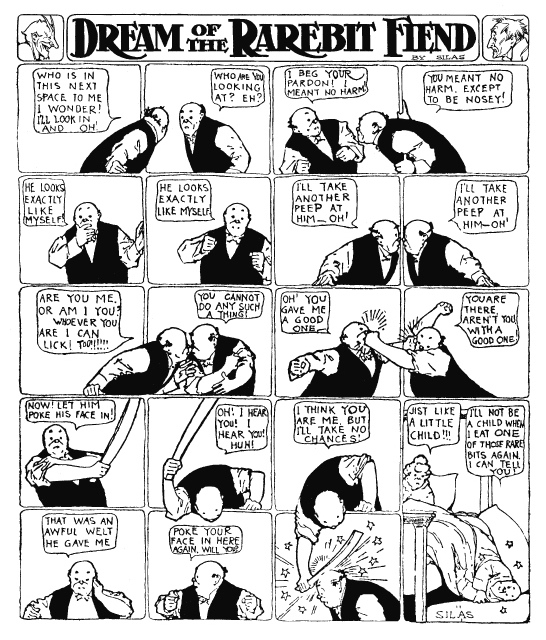
follow.  Here's a brief slideshow (via Boing Boing) created by a critic at the Boston Globe
which surveys some of the most obvious ways Winsor McCay's work has
influenced the iconography of movies.  It's based on observations in a new collection of McCay's strip Dream Of the Rarebit Fiend.  More complex issues of
narrative technique and composition will surely come to the fore in the
future.  [McCay created some of the earliest animated cartoons, so
his influence on film animation has long been appreciated, but his
influence on movies in general was far more comprehensive, as the
slideshow suggests.]

If you want to contemplate the connection between cinema and Victorian
academic painting you will just have to settle at present for my
passing observations in the essays collected here.

D-DAY

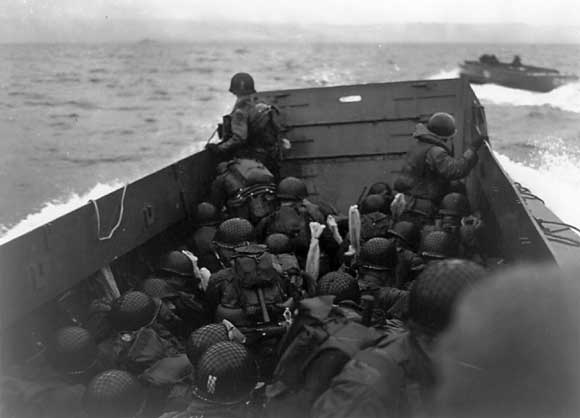
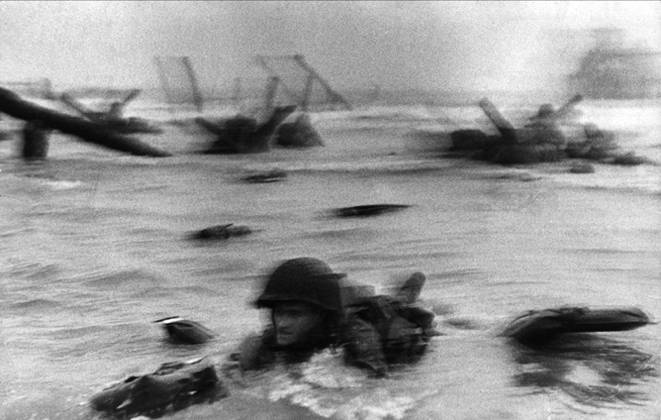
This picture has an aura and authority that may become harder and harder to
appreciate.  It was taken by Robert Capa, who went into Omaha Beach
with the first wave on D-Day, 6 June 1944.  Omaha Beach was, as it turned
out, the most hellish sector of the invasion, where the most casualties
occurred.  Even before that became known, Capa would certainly
have been aware that he was risking his life to record the moment on
film, that there was a good chance he’d never return from France, even
if he managed to get ashore there.  But he knew how important the
invasion was — what a visual record of it would mean to everyone
praying for its success, and to future generations.

In modern warfare, there would probably be video cameras attached to
the landing craft, capable of transmitting live images to a command
center somewhere, but in Capa’s time a real live human being needed to
be there with a camera to bring back pictures of the assault.  A
life had to be put on the line for it.

Capa could assume, too, that his pictures would have a built-in
authority as proof of his witness.  Today, in the era of
Photoshop, when photographs can be faked almost beyond detection, the
photographic medium has lost some of this authority.  We have to
think retrospectively to summon up what the image above and the one below meant to Capa and his contemporaries.

There was a tragic but somehow fitting end to Capa’s experiences at
Omaha Beach.  He survived but most of the photographs he took did
not.  A nervous lab assistant back in England tried to dry Capa’s
rolls of 35mm film too quickly — and all but eleven of the images were
destroyed.  But this just served to make those eleven images more
precious — to remind us of all that was lost on D-Day, all the lives
of young American soldiers that ended on the invasion beaches.

The eleven images that do survive are miraculous things.  It’s
like having photographs of the last day at Thermopylae, of the battle
on Bunker Hill, of the furthest advance of Pickett’s charge.  The visual
records of future wars will be more extensive and more useful to
military planners, but they won’t have quite the human dimension, the
spiritual dimension, of Capa’s pictures.  They may make us shudder but they won’t make us cry — as Capa’s do, or should.

MA VIE

Here's a poem in French by Henri Michaux, Ma Vie:


Tu t'en vas sans moi, ma vie.

Tu roules.

Et moi j'attends encore de faire un pas.

Tu portes ailleurs la bataille.

Tu me désertes ainsi.

Je ne t'ai jamais suivie.

Je ne vois pas clair dans tes offres.

Le petit peu que je veux, jamais tu ne l'apportes.

A cause de ce manque, j'aspire à tant.

A tant de choses, à presque l'infini…

A cause de ce peu qui manque, que jamais tu n'apportes.

Here's a rough translation:

You're going away without me, my life.
You're rolling on.
And I'm still waiting to make my first move.
You've taken the battle elsewhere.
You've deserted me.
I never followed you.
I've never seen anything in what you offer.
The little I want you never bring me.
Because of this I want so much —
So many things, almost everything . . .
Just because of this pittance I lack, that you never bring me.

A NEW CREHORE

This new painting, Deja Vu Waltz,
by Amy Crehore was just completed for a show at the Robert Berman Gallery in Santa
Monica, California, opening on 17 November.  If I were in the Los Angeles area I'd rush
right out to see it.  It's awesome.

The devil would like to turn all this gossamer sensuality into
something else, but he can't — he's under severe restraint.  The
naughty dream will just go on and on.

THE WAR

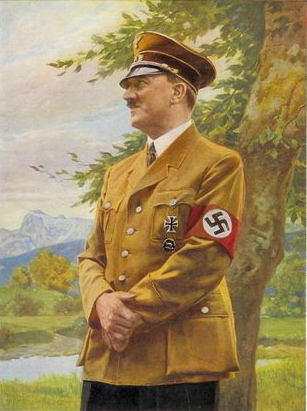
Reading Hitler's War,
David Irving's massive, exhaustive study of WWII as seen from Hitler's
perspective, is riveting but spiritually exhausting.  We will
never have a more sympathetic portrayal of Hitler and his motives, at
least not one consistent with the purely factual record, but what vapid
company the Führer turns out to be.  Even the glamor of evil can't
redeem him and his henchmen from their utter banality, from the sheer
colossal mind-numbing stupidity of their fear of and paranoia about “world
Jewry”.  As they grow in power their puny souls seem smaller and
smaller — consistent with the bunch of clever, fanatical, provincial
hacks they were.  It will be to Germany's eternal shame that it
consented to be led in momentous times by such mediocre shadows of men.

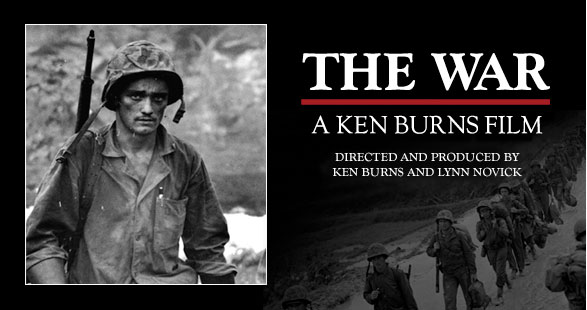
A useful specific for the soul-sickness induced by Irving's book is Ken Burn's 15-hour documentary The War
It's not without its passages of moral self-congratulation, but its
greatest value lies in its willingness to confront the darkness that
the war summoned up in the victors, especially in the young men who had
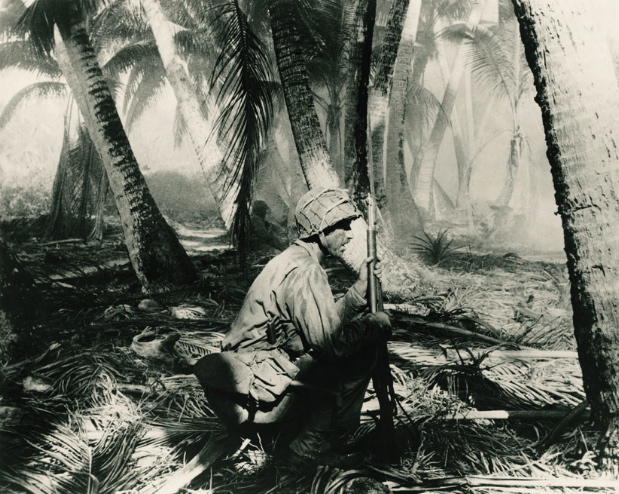
to fight it on the front lines.  In the filmed interviews, the American combat
survivors — old men looking back on the war after more than half a
century — still tremble when they recall what they had to do, still seem
mystified that they could do it.

Like the Germans and the Japanese, the good guys in this war learned to
kill without mercy — even to kill defenseless civilians and unarmed
prisoners.  And sometimes they experienced an exhilaration in
killing.  The experience shook their souls and by the evidence
they never really got over it.  The fact that they won a “good
war”, or a “necessary war” as one of them prefers to call it, didn't
heal the wounds within.

Hitler, and the Japanese warlords, sought to glorify the merciless
killing of war — sought to embrace it as a given of nature.  The
soldiers of the great democracies may have recognized it as a given of
nature, but their refusal to glorify it, to accept it willingly as a part of who
they were, even in a just cause, makes for a startling contrast to
the supposed “realism” of a man like Hitler.  It gives the heart a
little breathing space in a heartless world.