DIXIE


My sister Lee sends this interesting meditation on the song
Dixie:


In
1985 I went to see Doc Watson perform at Thalian Hall in Wilmington,
North Carolina.  When summoned for his encore, he announced, “Now
I’m going to sing America’s second national anthem.”  And he began
to play
Dixie.  The
audience went insanely wild, feet stomping, hysterical cheers.  It
was thrilling.  I was totally swept away.

And for years after, it continued to bother me.  Why was it so
thrilling?  What did it mean?  I just couldn't figure it
out.  The Civil War seemed to be so simple for Northerners, and
still so complicated for the rest of us.  So I forgot about Doc
Watson and
Dixie,
felt embarrassed by it, and rather guilty too, and chalked it up to
another mysterious, uncharted connection to my “country.” Then, last
summer, after leaving the Civil War battlefield of Chancellorsville with Lloyd, my mom and my two
kids, with my head full of ghosts, and a vision of Robert E. Lee
swinging his hat over his head, his eyes gleaming with victory, I asked
Lloyd if his miraculous i-pod contained within it the song
Dixie, and if so, to play it.  It did, and he did . . .

Read the rest here . . .


DIXIE


From my sister Lee:


In
1985, I went to see Doc Watson perform at Thalian Hall in Wilmington,
North Carolina.  When summoned for his encore, he announced, “Now
I’m going to sing America’s second national anthem.”  And he began
to play
Dixie.  The
audience went insanely wild, feet stomping, hysterical cheers.  It
was thrilling.  I was totally swept away.

And for years after, it continued to bother me.  Why was it so
thrilling?  What did it mean?  I just couldn't figure it
out.  The Civil War seemed to be so simple for Northerners, and
still so complicated for the rest of us.  So I forgot about Doc
Watson and
Dixie,
felt embarrassed by it, and rather guilty too, and chalked it up to
another mysterious, uncharted connection to my “country.” Then, last
summer, after leaving the Civil War battlefield of Chancellorsville with Lloyd, my mom and my two
kids, with my head full of ghosts, and a vision of Robert E. Lee
swinging his hat over his head, his eyes gleaming with victory, I asked
Lloyd if his miraculous i-pod contained within it the song
Dixie, and if so, to play it.  It did, and he did.


Since then, I have located Bob Dylan’s version of
Dixie
And I play it a lot.  But I’m careful to close all of my windows,
so that no one can hear it.  My neighbors are
African-American.  I like them, and I’m worried they will think it
is racist to listen to this song.  I pause it when the mail man is
close to the house.  It’s like a dirty secret.  And this
gnaws at me.


So I did some research into the history of the song
Dixie,
and, like the song itself, I found it both comforting and
disturbing.  The authorship is generally attributed to Daniel
Decatur Emmett, of Turkey in the Straw
fame, an Ohioan who allegedly wrote the song in 1859 while living in New
York City.  A competing account tells us that the song was really
an old African-American tune revived by the black musician brothers Ben
and Lou Snowden, whose joint tombstone proudly declares “They taught
Dixie to Dan Emmett.”  Either way, the song was a smash hit, particularly in the North.  


When Abraham Lincoln first heard the song in Chicago, he shouted “Let’s
have it again!  Let’s have it again!”  By all accounts, it
remained one of his favorite songs, before, during, and after the Civil
War.  “I just feel like marching, always, when that tune is
played,” he said.  When the war was over, he made a special point
of requesting it at public events.  “That tune is now Federal
property and it is good to show the rebels that, with us in power, they
will be free to hear it again…I insisted yesterday that we fairly
captured it..and that it is our lawful prize.”


It is unconscionable that almost a hundred years later, psycho white supremacists used the song as a sparring partner for We Shall Overcome
during the Civil Rights Movement,  associating it (really, I
believe, for the first time) with institutionalized racism.  It
was a despicable and cowardly answer to Lincoln’s generosity.  But
if “possible use by psychos” is a litmus test for a thing’s viability,
then we shall have to throw out a good many things, the Christian
church and our own government for starters.


In my research, I stumbled on this quote from Howard Sacks, and despite
the fact that he is an academic, I quite liked it.  He says, “What
[
Dixie]
tells us is that black, white, male, female, southern, northern, slave,
free, urban, rural–these aren’t separate realms.  The story of
the American experience is the story of the movement between these
realms.” 

Which, naturally, brings Elvis Presley to mind.  Clearly, it was
no accident that Lloyd’s astoundingly brilliant Navigator preceded our
tour of Chancellorsville with a visit to Graceland.  Elvis sang
Dixie,
and if there was ever any American who was not a racist, it was
Elvis.  His heart and his instincts on that score were pretty near
perfect.  


So here’s what I’m wondering:  If Abraham Lincoln claimed
Dixie
as his prize of war, why can’t we reclaim it as a prize for our
heartbreak?  Heartbreak that we ever tolerated slavery in our
country for even a nanosecond,  heartbreak that we ever took up
arms against each other and heartbreak that all too often we let
Lincoln down.  I don’t see why we can’t do that.


Dylan's version of Dixie can be found on the Masked and Anonymous soundtrack album.


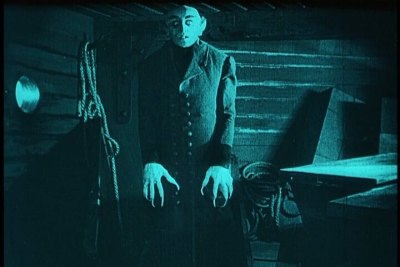
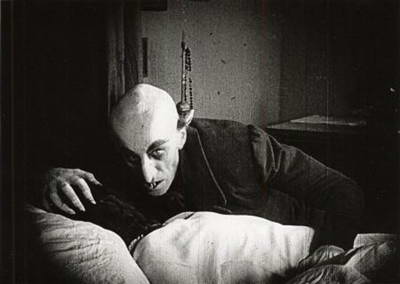
NOSFERATU (1922)

Max Schreck’s Count Orlock shares a distinction with Lon Chaney’s Phantom,
Charlie Chaplin, Buster Keaton and Rudolph Valentino — he’s an icon
from the silent era that’s still alive in the popular imagination. Kids
who couldn’t tell you the difference between John Barrymore and Lillian
Gish know Nosferatu.


Partly this is because Orlock is such a powerful icon, visually, and partly
it’s because anyone who has ever seen even the shortest clip of the
vampire in “Nosferatu” simply cannot forget it, so powerfully is Orlock
presented cinematically in the film. Orlock is the heart and soul of
the film — the part of it that inspired Murnau’s genius. Scenes
without him can be visually conventional, and the storytelling in
general can be clunky. (Murnau was still feeling his way as a
storyteller in 1922.)


The acting is very exaggerated, which suits the tale, but runs the usual
risk of highly stylized performance — if it isn’t executed brilliantly
it can seem silly. (But that’s the thrill of it, too — it’s the
thespian equivalent of trapeze flying without a net.) The young
protagonists of the tale are not terribly skillful here, and don’t seem
to have interested Murnau very much, so their expressions of marital
bliss, and later angst, can seem unconvincing, even icky. The actor who
plays Knock, however, a borderline nut-case who travels a long way
across that border in the course of the film, is sublime — he’s like a
genuinely insane person imitating a silent film actor and the result is
thrilling, funny and ghastly all at once.


The only featured player who doesn’t go over the top in the film is Max
Schreck. He moves in an exaggerated (sometimes supernatural) way, of
course, but it all seems organic — this is just Nosferatu, an
admittedly strange creature, being natural, being himself. He never
leers or threatens or grimaces — he just kills, like the Venus flytrap
or the carnivorous polyp he’s compared to visually in the film. And
there is a softness in his eyes suggesting loneliness, even shame —
qualities which Klaus Kinski exaggerated pointedly and too crudely in
Herzog’s remake of the film, to engage our sympathy. But Schreck’s
inhuman humanness wouldn’t be affecting, wouldn’t be terrifying, if he
used it to appeal to us. He’d just be a character, an actor in some
great make-up. It’s no wonder people have imagined that Schreck was a
real vampire — that’s how great and subtle his performance is.

Nosferatu incarnates the poetry of death, its cool, elegant efficiency and power,
which has a kind of awesome beauty. His face is the face we most fear
— an image of anyone, of ourselves, as a corpse — yet can’t resist
looking at. It is Murnau’s genius, and Schreck’s instinct or craft,
which let us experience the deep fascination of that face and remind us
of its familiarity. It’s one we will all have someday — and perhaps
that is why a little part of the human heart goes out to Nosferatu.

WAR OF THE WORLDS


Hollywood
has now managed to absorb on a conscious level that the failure of
fatherhood is a central issue of our culture, and that people are
desperate for stories which address this issue and offer images of
fatherhood redeemed.


It's a
subject that has always attracted Spielberg, at least on an intuitive
level. He's always said that
E. T. was about divorce — about the
ways a child scarred by divorce and an absent father can use fantasy to
survive. The knowledge came from his own personal experience with the
phenomenon as a youth.


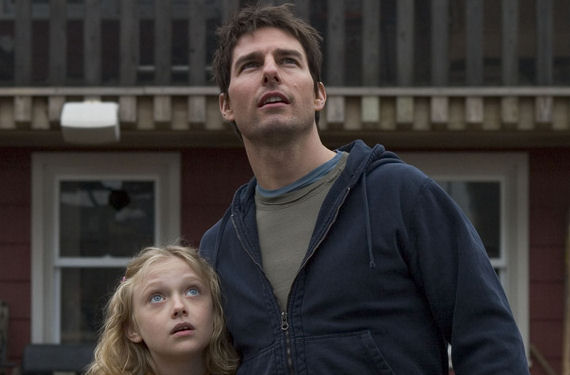
In War Of the Worlds he takes on the subject from the father's, not the
child's perspective — and that may reflect his own maturity and
experience as a father. It also takes us closer to the crux of the
crisis.


Phenomenally
successful films like
The Lion King and The Sixth Sense dealt with
the effect of fatherlessness on sons and, like
E. T., offered coping
mechanisms, images of transcendence.
War Of the Worlds deals with the
source of the pathology — the emotionally self-indulgent and
incompetent father himself.


As I
say, Hollywood knows the appeal of the subject — one finds it
“layered” into otherwise conventional spectacles like
The Day After
Tomorrow
, where it has the feel of a perfunctory marketing ploy.
Spielberg, as usual, goes deeper.


Taking
as his model the 50s-era sci-fi film, which exploited our fears of
nuclear holocaust and alien (i. e. Communist) invasion, Spielberg taps
the post-9/11 malaise for the subliminal terror of his tale. Alien
sleeper-cell creatures erupt from within to devastate our civilization,
and in the crisis our assumptions about everything are tested.


For
Spielberg's protagonist, Ray Ferrier, a self-centered lifestyle, in
which he has neglected the children of a failed marriage, who now live
with their mother and her new husband, is shattered when he's forced by
unimaginable disasters to step up to the plate and protect them. And to
protect them, he needs to know them — something he's failed so far to
do.


It's a brilliant scheme, which places Ray's failure as a father center stage, and makes it far more unnerving and devastating
than the lethal space invaders and their horrifying acts.


The
greatness of the film is that it doesn't posit absolute redemption for
Ray — he has lost more through his failure as a father, and his
children have lost more, than his last-minute heroics can ever restore.
But he has come face to face with his failure, and has grown up in the
process — and that is more affecting, more real, than any contrived
feel-good catharsis could ever be.


Ray
remains a tragic figure, a reminder that the true lost souls of
post-WWII America are not the children betrayed by feckless fathers,
but the fathers themselves, who surrendered the deepest meaning of
their lives for a transitory, an illusory freedom.


GET BEHIND ME, SATAN

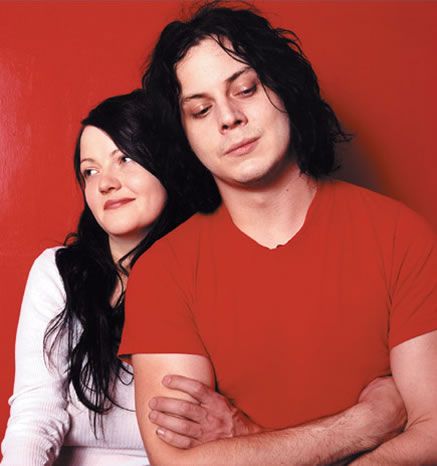
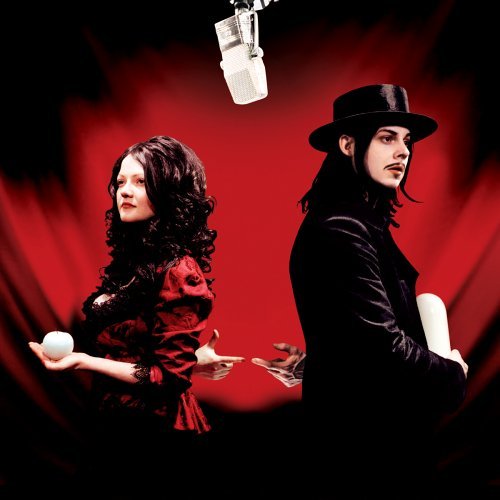
Amazon’s resident critic says that Get Behind Me, Satan
is the White Stripes’s strangest and least focused
album but also their finest — and that’s not a bad summary. As with a
lot of great Bob Dylan albums it gives the impression of someone
rummaging around in the attic of American music and American culture
looking for answers to some desperate personal problems — and even if
the answers aren’t always forthcoming, there’s still the consolation of
realizing that there are a lot of cool and scary things up there.

Jack White on this album bumps into a lot of ghosts and has a disturbing
encounter with Rita Hayworth as he deconstructs his garage band style
and inflects it with deranged pop and country interpolations. He’s
always done this sort of thing musically, tying it all together with
his strong blues-based guitar — but this time nothing gets tied
together too neatly. It’s almost as though he’s thinking out loud in
the studio and letting us eavesdrop on the session.


The result is raw and silly and powerful and eloquent by turns, defying the slick sound and off-the-rack attitude that homogenizes most bands these days, even those in the neo-rock movement the Stripes have spearheaded.

Jack and Meg are simply continuing their conversation with every tradition of
American popular music — powered by the blues but ranging
far beyond them . . . on a spiritual and anguished search for the soul
of the times. In his liner notes to the album Jack rails against the
sarcasm and irony of pop posturing today — he wants us to face the
terror squarely. The White Stripes, like the great bluesmen that
inspired them, are taking on the devil himself — determined to get at
least a few steps ahead of him before it’s too late.


Here’s a link to the music video of one of the album’s best songs:

Blue Orchid

THE DOMESTIC THRILLER

Eyes Wide Shut has never been far from my mind since I saw it, twice, on its first release.

I was kind of astonished by it then.  Not at all what I expected, a very small film, a chamber piece you could say.  So much of it is about the experience of being in rooms, and the intimacy of New York streets at night . . . something I’ve never really seen captured on film before.  Even Scorsese’s claustrophobic streets have an epic quality by comparison.


It’s also the best movie about marriage I’ve ever seen.  It makes Bergman’s Scenes From A Marriage seem like the platitudes of a first-year psychology student.  It makes Woody Allen’s musings on marriage seem like the delusions of a child molester.  In fact, I kept wondering what someone who hasn’t been married, for a long time, would make of this film.

And, yes, Nicole Kidman naked is irrefutable proof, in itself, of the existence of God.  But what an odd, self-involved sexuality she has — you get a feeling she could be having sex with Tom Cruise, a donkey, a broom handle, and it would all be just the same.  And how wonderfully Kubrick uses this quality in the film.  She’s so “fuckable” and yet so impenetrable.

But part of the subversion of Eyes Wide Shut is that it always makes you pay for your voyeuristic pleasures — there’s always a twist that makes you self-aware and uncomfortable.  There is something intrinsically misogynistic (or at least dehumanizing) about male arousal through purely visual means, and Kubrick draws painful attention to this in the film.
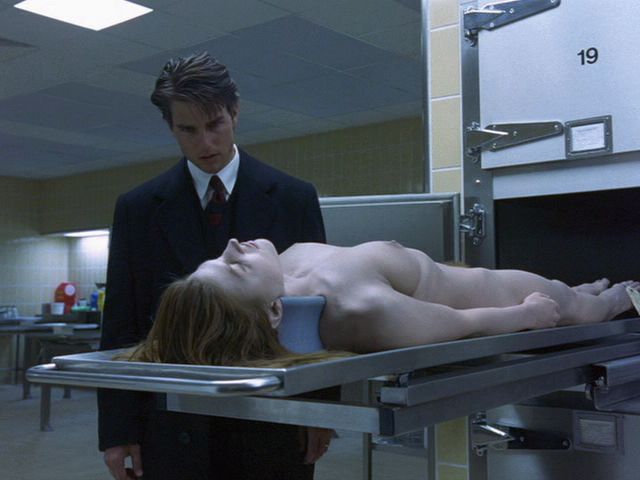


He toys with visual arousal but always undercuts it (shockingly, sometimes, as in the scene above) — because pure, impersonal, meaningless arousal, the goal of most visual pornography, is the threat to the marriage from Cruise’s side of things.
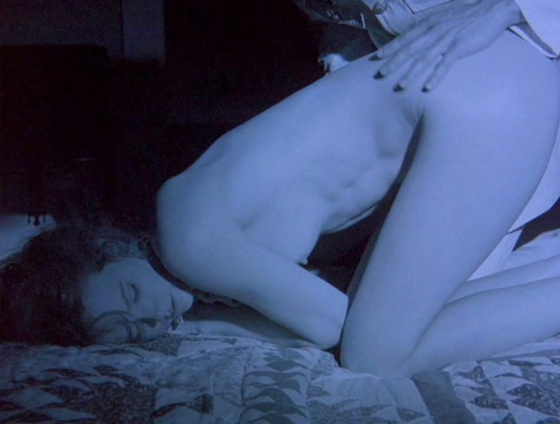


It’s very important that there are no flashbacks to the Naval officer scene when Kidman describes the incident, because her temptation there is more elemental.  She feels that Cruise is taking her power as a woman lightly, so she wants to use that power to destroy everything.  The flashbacks come only when Cruise thinks about the incident — he reduces it to a visual image of intercourse, of a “one night stand”, whereas what Kidman had in mind was more like Armaggedon.
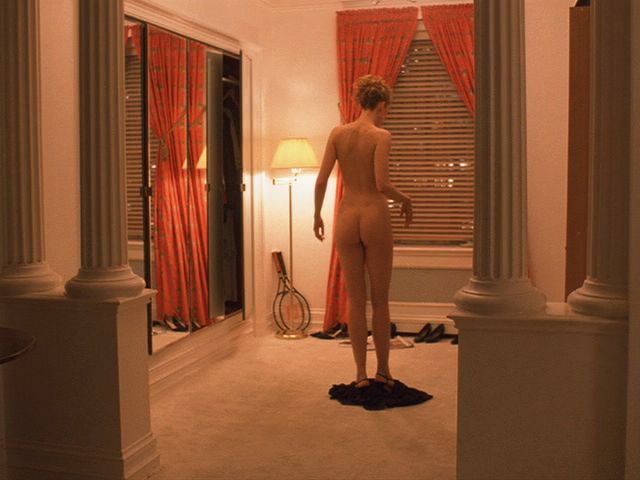


Several things struck me even more deeply me on a second viewing of the film.  One is how brief the Kidman nudity is, contrasted to what I remembered.  It’s still startling, mainly I think because you see the whole woman at once.  There is no teasing involved.  This is very
unusual in a modern film.  I have always believed that any nudity which can be done by a body double is by definition pornographic and degrading — it’s about women as body parts.


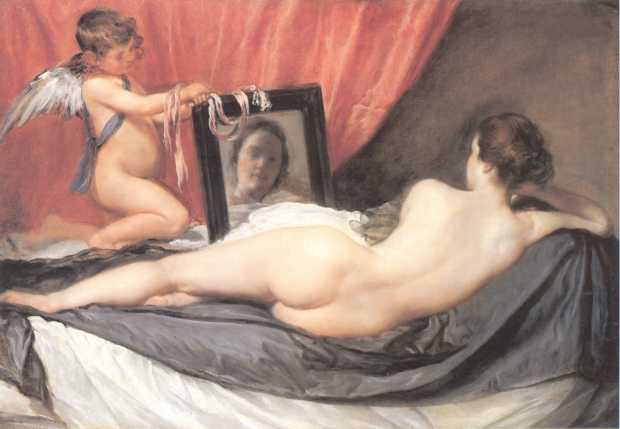
Kidman is also shot from slightly below, from behind, in very soft light, and her hair is always up.  There is an iconic connection to several nudes by Watteau, who was the poet of women’s backs and necks, and to the great nude Venus by Velasquez, at the National Gallery in London, also seen from behind, her face visible only in a mirror.


These shots are contrasted to the Naval officer flashbacks in Cruise’s mind, where you get flashes of nudity, as in a modern movie sex scene.
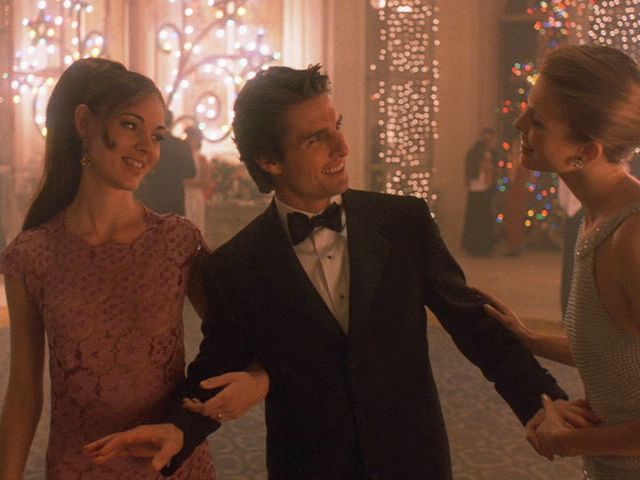


The Christmas tree motif got clearer.  Always warm light, the big old-fashioned colored bulbs . . .

We see the tree in the first scene, when Cruise and Kidman venture out of the home.  Thereafter we see it everywhere Cruise goes.  At the Zigler’s party, the Sonata nightclub, the coffee shop, the hooker’s apartment, his office at night.  And whenever he comes home there is the long tracking shot through the apartment until the tree is revealed.  But the last time he comes home, when we see the mask on the pillow, Cruise turns the tree lights off.  And in the aftermath of his confession, the unlighted tree is behind him in the living room.
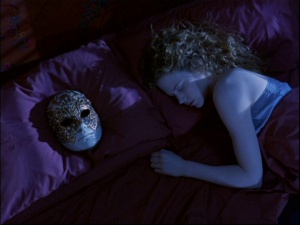


The tree is like a beacon of home, an unheeded reminder everywhere he goes, connected to the daughter — locus of the gifts of home, and symbol, at least theoretically, of the celebration of the birth of a child.


Not an accident that the final reconciliation takes place in a world of Christmas presents, which the child has led them to.  “Old fashioned,” says Kidman about one of the “presents”, a baby stroller, which their daughter admires.  Yep.


I also realized, and felt really dense not to have spotted it the first time, the significance of the password.  The title of a Beethoven opera, but also derived from the Latin word for fidelity.  The test at the orgy scene thus becomes very suggestive.  Dr. Harford knows the “password for entrance”, but he doesn’t know the “password for the house”.  Except that he does, he just doesn’t realize it.  Fidelity — the entrance (into marriage) but also the only way of safety for the house, the home.


My friend Andrew Schroeder, then a graduate student in film at NYU, wrote to me about the film:


“What is Cruise’s impulse, when they pull off to the side in FAO Schwartz to talk hushed between themselves?  The promise of forever, that he’s learned his lesson, that he’s a changed man and he’ll never go back.  Most films would accept that.  They’d let him off the hook and say that the ‘happy ever after’ we thought we’d glimpsed in the film’s opening sequences might be waiting just beyond the celluloid lip.  Not Kubrick, and not Kidman either.  She refuses to talk about ‘forever.’  She refuses to let Cruise off the hook.  It’s as if she’s telling him, without saying it in so many words, that the Other must be re-encountered at every turn.  The second you think it’s over, and you can just cruise on your expectations and your memories, is the second that you approach Armageddon at top speed.”


That’s an excellent summary of the denouement, I think, and it’s connected to a sense of some absolute limit to intimacy that haunts Kubrick’s film.  No matter how many barriers you bust through, and you bust through a lot in a long marriage, there is always one more, and it’s always different from the last one, and bewildering, and apparently insoluble.  It’s not just about the Otherness of the opposite sex, it’s about the Otherness of any other human being, and when you get right down to it, the Otherness of yourself, the insubstantiality of the self.


We need the illusion of a substantial self in order to function, but it is an illusion, as life keeps proving, so how do we keep on functioning?  In part it’s by accepting a certain loss of control over our own identity, and in part this is made bearable by submission to a “higher” order, the social context, the family context.


The child in the film is very important, though it’s wonderful and courageous that Kubrick makes no overt appeal to this aspect of things.  The closest he comes is when the child asks for a dog for Christmas.  “He could be a watch-dog,” she argues.  She feels the threat to the home that is happening, but her terror is beyond articulation.


Marriage, existential marriage with a perpetual Other, thus becomes an avenue for the survival of identity — the larger identity that can be sustained because it is not rooted in the chaos of personality, but in an idea, of fidelity, and in the flesh of a child that somehow shares the identity of the Other.


It is one way of addressing Nietzsche’s notion that the ability to make and keep a promise is the only thing that makes us human.  But it has to be a transcendent promise, unto death  — like the sacrifice of life for a cause, the sacrifice of sexual freedom, of autonomous identity, for a child.  Nietzsche would argue, of course, that such servitude is the only freedom there is, such as it is.
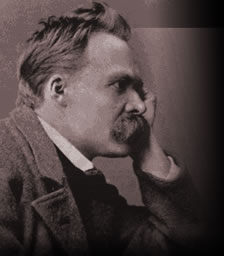


Kubrick doesn’t draw any simple moral from his tale.  Kidman won’t say “forever”, since “no single night, much less a single life, can be the whole truth about anything”.  Like Nietzsche, Kubrick looks at the actual forces at play, describes the stakes unflinchingly, and leaves us to our terror at it all — though perhaps a little better equipped to play the game.


Kidman’s last line may be deeper than it seems.  In fucking, the metaphor of blurred, surrendered identity is constantly reestablished, the consolation and the terror of it constantly renewed.


All of Eyes Wide Shut, from the title onwards, echoes with such suggestive ambiguity.  For example, the soundtrack of the film is interesting to play on its own — it really captures the creepiness and off-centered mood of the whole film.  It occurred to me that, for all the visual references to Christmas in the film, there is no Christmas music at all until the last scene — a Muzak version of Jingle Bells.  Another of those subliminal calculations that keep us, and the
world of the film, off balance.


Most of Kubrick’s work has always left me cold.  It strikes me as exhibiting a sort of puerile moral nihilism.  There is little at stake in Kubrick’s films — unless he is being funny — except a passing frisson, and maybe some self-pity.
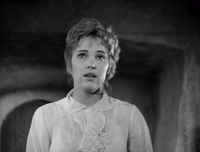


Paths Of Glory is a partial exception to this rule.  It’s worth remembering that the actress at the end of that film, in the scene (above) which is offered as a kind of counterbalance to the moral abyss we’ve just been gazing into, the single note of humanity and hope, is the woman Kubrick would marry soon afterwards . . . and whose subsequent life with him must have inspired, or at least informed, his last film.

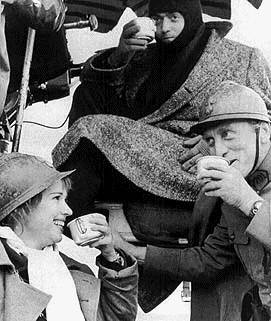
Below is Kubrick’s wife to be, Christiane, on the set of Paths Of Glory, with Kubrick and Kirk Douglas:


Eyes Wide Shut
is the only film he made based on something he had first-hand experience of — a 40 year marriage.  His reclusiveness, and this film, suggest to me that this marriage, his family, were the only things he ever found meaning in.  (And by meaning I don’t mean happiness.)  This is an idea he was far too skeptical to state lightly or prematurely, and there is something exquisite in the fact that he died the day after he delivered the film.  He had to, in a way.
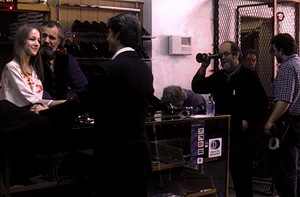


Kubrick’s will, and life, and actual life’s blood are on the screen here.  He killed himself making the film — he cared himself to death.  That is the only absolute conclusion we can draw from it, and that is the resonance in it we respond to.  Let a better filmmaker put something better in its place, make something with more resonance — more “meaning” — on the subject of men and women and marriage.

Certainly, up until now, no one ever has.

I’m still in shock that Kubrick made a movie like this — one of the few from my lifetime which will survive far into the 21st century.  What a way to go out.

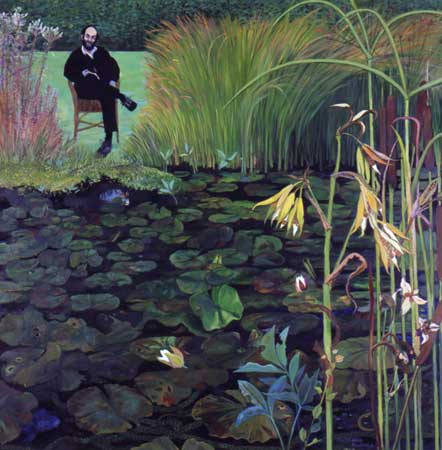
Below is a painting by Kubrick’s wife, called Remembering Stanley:
HE WHO GETS SLAPPED

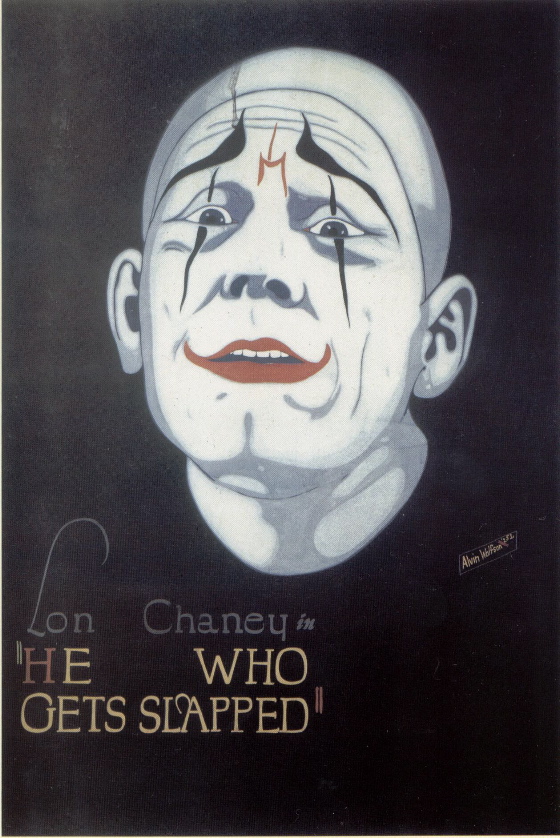
As art forms go, the silent feature evolved with lightning speed. Barely two decades passed between the commercial inauguration of film as a peepshow attraction and the magisterial eloquence of The Birth Of A Nation. Less than fifteen years after that the silent feature was gone, apart from what Donald Crafton has called the pyrrhic victory of
Chaplin’s sound-era silents.


The speed of its evolution and the brief span of its dominance meant that it was always a medium in transition. One of the excitements, and sometimes one of the frustrations, of watching silent films is the frequent collision of artistic strategies within a single work. He Who Gets Slapped is a perfect illustration of the phenomenon.

First, you have the play on which it is based — an apparently serious lyric tragedy of the sort that would have perhaps struck readers of the old Saturday Evening Post as highbrow. Derived from this you have the film scenario itself, a wonderfully preposterous and unapologetic piece of Grand Guignol, in the best Theater of Blood tradition. And then you have director Victor Seastrom’s treatment of this scenario, an exaggerated and stylized but basically straightforward narrative presentation of the Grand Guignol element, interspersed with metaphorical visual interludes designed to remind us of the work’s
original pretensions.


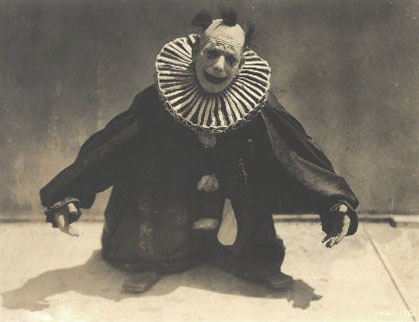
Finally, at the center of it all, unifying if not quite synthesizing the disparate elements, you have the very great plastic art of Lon Chaney, supported by several other players — Norma Shearer, John Gilbert and Tully Marshall in particular — who can inhabit the world of Chaney’s eloquent pantomime.

It’s the power and force, the unprecedented aesthetic phenomenon, of a great
silent film actor like Chaney which by its nature confounds the conventional artistic strategies of the piece. The flowery poetic intertitles, which I suspect derive from the play, and the interpolated visual metaphors, are so inferior to Chaney’s performance that they stop the narrative dead. They seem to be apologizing for the sensational nature of the story, the outrageousness of the purely narrative images.


But the purely narrative images are astonishing and fine, pushing an apparent naturalism just a little too far — into the demented dreamscape of the story itself. The odd, mournful swaying of the clowns’ dance, the fantastic dappled sunlight of the Gilbert-Shearer picnic, even the obviously faked inserts of Gilbert and Shearer “riding” the horse, achieve a perfect balance between plastic beauty and a coherent representation of a convincing screen place.

There have been other arts which, in times of rapid transition, displayed this same sort of aesthetic discombobulation. Titus Andronicus, for example, mixes the brutal, grotesque vision of Marlowe with the more ambiguous and humane treatment of character with which Shakespeare would eventually modify Marlowe’s great innovations in theatrical form.
But not yet having internalized Marlowe’s lessons, Shakespeare simply apes Marlowe’s shock tactics and tries to present them in his own voice. The result is disconcerting and perpetually strange.

Seastrom’s arty gloss on the great cinematic achievement that lies at the core of He Who Gets Slapped has the same flavor of insecurity — of lessons not yet internalized, of forces not yet appreciated. John Huston once told James Agee that film can’t be used metaphorically, since filmed reality is by its nature already a metaphor. There is something in Lon Chaney’s eyes, in the way he moves under that clown make-up and clown costume, which is beyond the range of literary expression, beyond the range of metaphor.  “He” is a dream image — and dreams always get diminished by conscious interpretation.

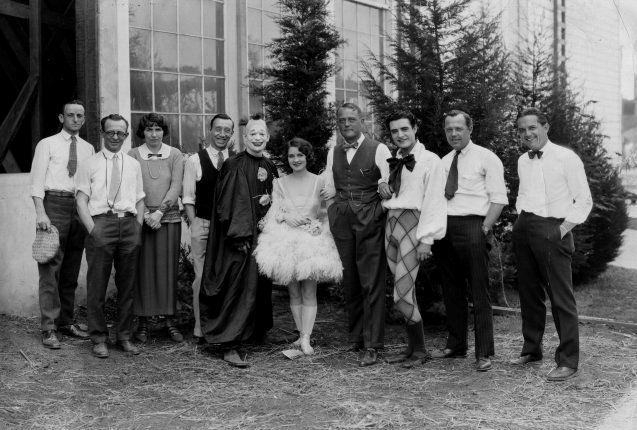
[Above is the principal cast and crew of He Who Gets Slapped — that’s Seastrom in the vest and bow tie standing between Shearer and Gilbert.]

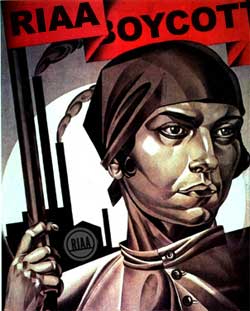
THE RIAA BOYCOTT


Please
join the RIAA boycott in March.  Just for the month of March don't by
any music released by the major record labels represented by the RIAA. 
It will be good for your soul.


The
RIAA is one of the biggest, richest and ugliest of the corporate
organizations trying to keep a stranglehold on the conversation of
culture.  The RIAA has spent millions of dollars taking kids to court
for sharing copyrighted music over the Web, essentially trying to
criminalize an entire generation, and is now trying desperately to shut
down local wireless hot-spots by promoting a bill that would make any
wireless network provider legally liable for any activity that occurred
over that network, including the sharing of copyrighted work — which
would effectively end local wireless service.  No local provider could
ever hope to match the RIAA's legal and financial resources — just
responding to one of their lawsuits, even a groundless one, would put the provider out of business.

I
don't advocate piracy but the RIAA is trying to create a world in which
the state enforces a monopoly distribution system owned and controlled
by large corporations.  The willingness of the record labels
represented by the RIAA to destroy local wireless service in its
infancy is a sign that they've become some of the most vicious mad dogs
of corporate tyranny — blind to any values or any new technology which
might interfere with their desire to perpetuate outdated business
models and gain total control over the distribution of culture.

What
does the boycott mean?  Well, at its worst, for one month you don't buy
any Bob Dylan albums, since Sony belongs to the RIAA — but you can
still go see him in concert.  At its best it means that you can buy all
the White Stripes albums you want, because they don't release through
an RIAA affiliate.  Go Stripes!


At
its very best it means that you can look for and buy new music by
artists who reject the madness of the corporate distributors . . . on
MySpace or at Internet music distributors like
eMusic.

If you want to find out what music is covered by the RIAA just go to RIAA Radar and do a simple search.

It's only a month, it won't bring the RIAA to its knees — but it's a start.  Do it and tell everyone you know about it.

For more info on the RIAA and the boycott, go here.


GALLANTRY

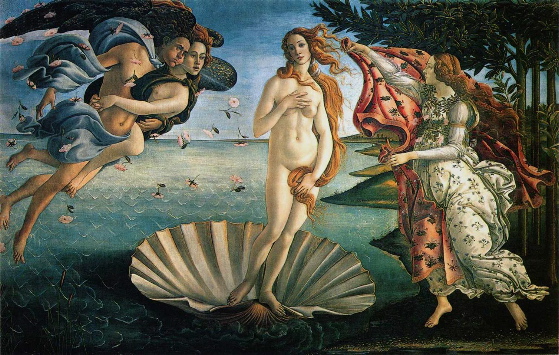
The word gallant once meant beautiful, even as applied to a woman. Now rare in that sense, as the dictionary says, except when referring to horses or ships. The Greeks understood the logic of this association of ideas around the word gallant. Aphrodite was born out of sea foam (an event familiar from Botticelli’s famous painting above) and Neptune was the God of horses as well as of the sea.

The triad of women, horses and ships represents the irreducible
grandeur of this world, and the sea somehow speaks for them all.


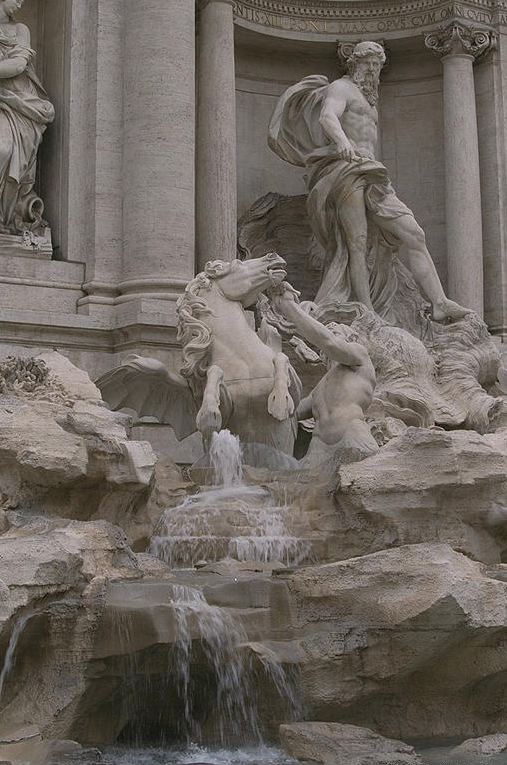
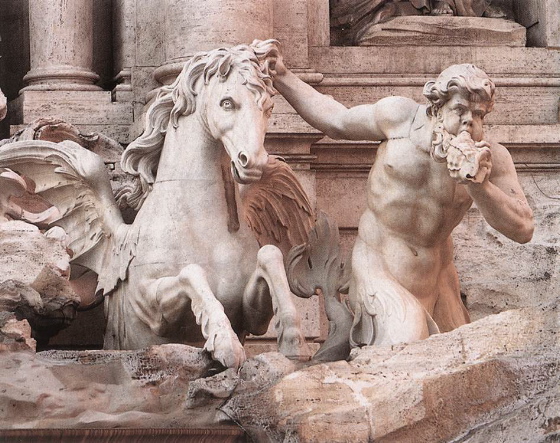
Probably the most famous work showing Neptune with his
horses is the Fontana di Trevi in Rome, in which we see two of the sea
god’s minions, the Tritons, leading the animals up from the deep.

The other minion:

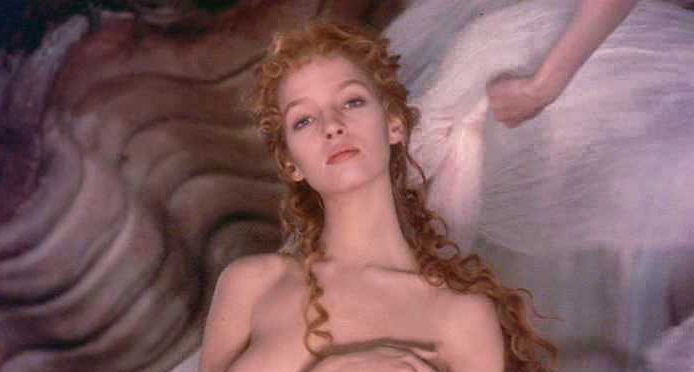
Below is Uma Thurman as Aphrodite in The Adventures Of Baron Munchausen, with a seashell behind her — the best we can do these days but not bad, considering:


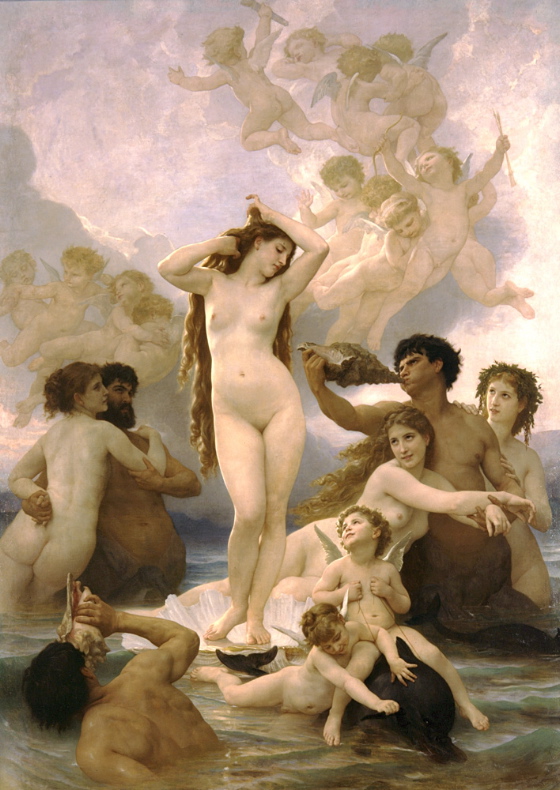
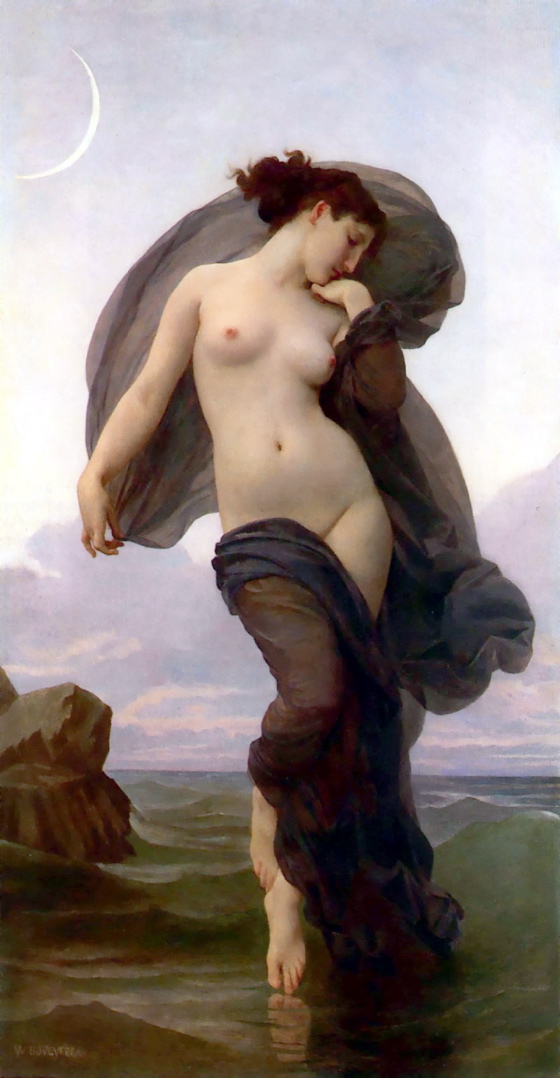
Somewhere between Botticelli and Gilliam lies the potent 19th-Century strangeness of Bourguereau, who saw the birth of Venus this way:

MEXICAN COKE

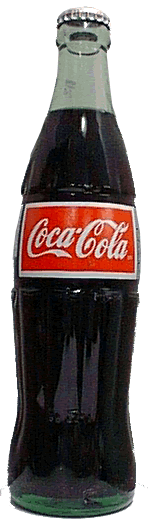
Mexican Coca-Cola, like Coke in most parts of the world, is still made with sugar, instead of vile-tasting and hard-to-digest corn syrup. Real sugar in a Coke makes for a different drink altogether, and one delightfully familiar to anyone who grew up in the Fifties or Sixties, before government-subsidized corn crops made fructose the more economical sweetener for soda makers in the U. S.

Mexican Coca-Cola costs about twice what regular neo-faux Coke costs, but it’s more than twice as good. It can be tracked down in most areas of the U. S. which have any significant Latino population — which is to say that it can be tracked down most anywhere. Well worth the effort.

[Update — now that Mexican Coke is so ubiquitous, its price has fallen dramatically.  I can get a case of it at a local supermarket for less than $20, down from the $34 dollars I used to pay at a small Latino market, which was the only place I could get it by the case when I first moved to Las Vegas.]

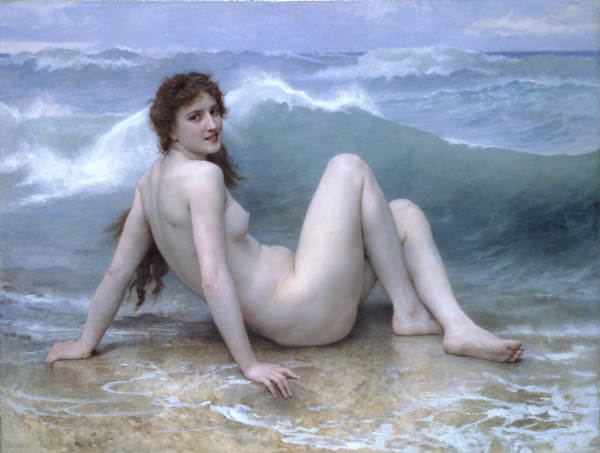
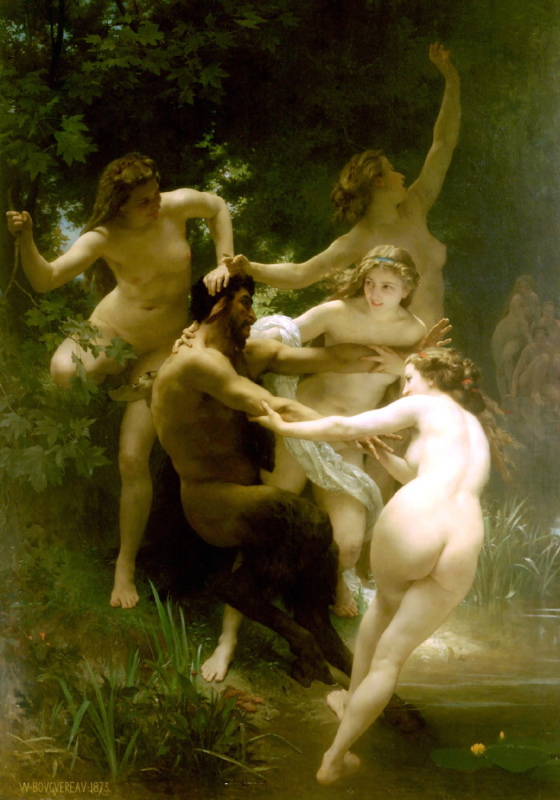
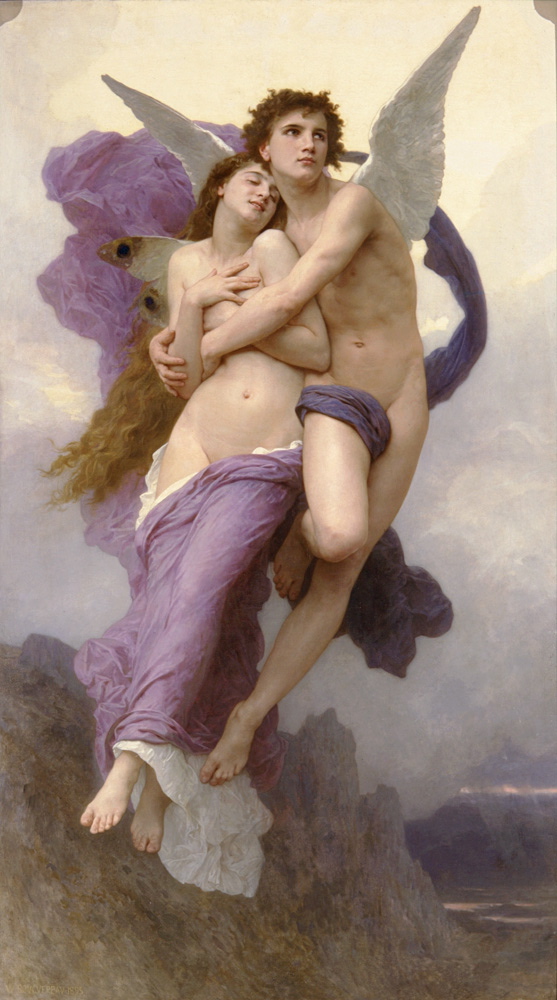
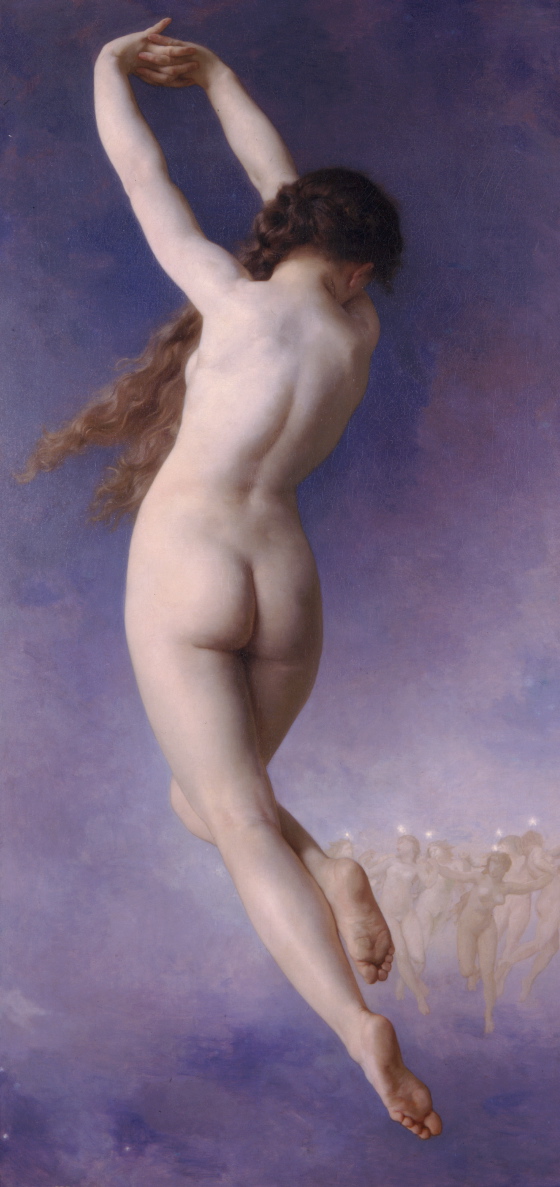
BOUGUEREAU AND THE UBER-PHOTOGRAPH


One objection commonly made to Victorian academic art is that it’s too “photographic” — that it tried for a kind of photorealism which the camera had made redundant.


I think this objection is misguided on two counts.  The first is that
the “photorealism” of the Victorian academics far exceeded the capacities
of the 19th-Century camera.  The academic painter could achieve color
effects which film stocks wouldn’t be able to record until late in the 20th
Century.  The Victorian academics could also capture motion in ways the
still camera could not until the early 20th-Century, with the advent of
faster film stocks and shutter speeds.  The Victorian realist painter
was in fact developing his aesthetic in precisely those areas where the
cameras of the time were deficient.


More importantly, photorealism is not an aesthetic fault.  Painters
since the Renaissance have often striven for hyper-realistic effects,
and have sometimes used proto-photographic technologies, like the camera obscura, to that end.  The fact that Van Eyck and Vermeer might possibly have used the camera obscura as an aid in draftsmanship is surely not in itself a fault in their methods.  And many artists now seen as post-academic, like Degas, used the camera itself as an aid to composition, and the photorealistic aspect of their work constitutes a strong element of its appeal.


The Victorian academic painter, however, was doing something new in the
wake of the invention and widespread popularity of photography — he
was conducting a conscious dialogue with the camera.  He was
incorporating a new standard of visual authority introduced by the
camera, and doing it on purpose.  He knew that the experience of
viewing photographs had introduced a new relationship to visual reality
in the mind of modern man.  The Victorian realist painter didn’t try to
ape the photograph, and he could exceed its resources in many areas,
but he always paid homage to its authority — and he tried to construct
a new visual aesthetic based on that authority.


His effort in that regard was the basis for the magic of Victorian
academic art, for it popularity at the time and for its enduring
appeal.  Apologists for the Victorian painters often try to downplay
this aspect of the academic style, try to reconnect them to the art
that had gone before them in an unbroken tradition.  But they were
radical — the photograph made them radical.


So Bouguereau wanted to show us nymphs and satyrs, wanted to show us
figures floating in mid air, but wanted us to receive the visions as
having the authority of photographs — and not just the photographs
that an actual camera of the time could make but ideal photographs,
recording the subtlest effects of light, capturing the most fleeting
nuances of gesture.  He wanted to make us feel that we were
looking at an über-photograph.  (Bouguereau’s fantastical work is the best
place to start in a study of the über-photographic aesthetic, because,
unlike much Victorian academic art, it takes as its subjects things
which could not be observed or staged in real life and thus could not
be photographed.  It’s therefore doing something far more complex
than imitating contemporary photographic practice.  If we can
locate the über-photographic aesthetic here, we can isolate it as a
purely conceptual strategy.)


And so one has the utter strangeness of Bouguereau — decidedly
corporeal figures hovering above the ground, mythological figures with
the sex appeal of naughty photographic postcards, because they seem to
represent actual naked men and women with unimpeachable authority.
Some people find Bouguereau’s nudes pornographic, and on one level they
are.  Bouguereau has used his virtuosic technique to portray these
naked men and women as though they were real people recorded by a
camera, not visions transmitted through an artistic sensibility.  They
have that hint of indecency, of violation, that always attaches in some
measure to photographs of naked people.


This is not something to object to — it’s what makes Bouguereau cool,
exciting, new, radical.  It’s why his paintings are still alive for
people today, objects that rivet the attention, whatever judgment the
mind may be passing on them as works of art.  How much more
complicated, courageous, inventive, witty was Bouguereau’s response to
the photograph than that of the modernist rebels who simply walked away from
it, turned to abstraction in defiance of the photograph’s power.


That power has not diminished over time — indeed much of our
conception of the world we live in today is determined, overdetermined,
by the photograph.  Which is why on some level Bouguereau speaks to us
more deeply than the abstractionists do.  Bouguereau draws us
into that same dialogue with the photograph that he himself conducted,
and in transcending its power — by seeming to carry it farther than it
can ever actually go, even in the age of Photoshop — he places it in a truer
perspective than the modernists could ever have conceived.

A distinguished museum director has observed how difficult it is to
hang Bouguereau in a modern museum — discerning a disconnect not only
between Bouguereau and 20th-Century modernism but also between
Bouguereau and the great high-art tradition his work seems to
inhabit.  That is precisely because Bouguereau’s work strove for a
transcendent synthesis of painting and photography — something
no art before him could have done and no institutionally-sanctioned art
after him has chosen to do.  His work is thus profoundly modern, more genuinely modern in some ways than the work of the 20th-Century abstractionists.  It may be, in fact, that Bouguereau is so modern, so radical, that for some time to come he will need a room all to himself.


[I think the concept of the über-photograph is a useful way of distinguishing the style of the early pre-Raphaelites from the mainstream of Victorian academic art that emerged after them. Rossetti had a fundamentally painterly aesthetic with a strong bent towards the stylized and decorative, a bent developed most conspicuously in the work of William Morris.  The academic painters of the second half of the 19th-Century departed from both in adopting a photo-authoritative strategy, however fanciful their subjects.  Burne-Jones was a key transitional figure in this process.  Though he held onto many of the painterly and decorative elements of Rossetti’s style one begins to see in his work a shift towards the photo-realistic — mainly in his strict stereometric modeling of forms and figures, which gave his paintings a sculptural quality.  It was the quality of relief-sculpture, however — he rarely pursued the bold evocations of deep space that so preoccupied Alma-Tadema, Lord Leighton, Tissot and Waterhouse, to take a few examples.  Their strategies with regard to spatial illusion were closely connected to the über-photographic aesthetic.  By the same token, the idea of the über-photograph can be used to distinguish the project of Victorian academic painters from the sterile photo-realism of some modern painters, who are consciously evoking and aping the photograph and not trying to transcend its limitations, not trying for a new visual synthesis.]


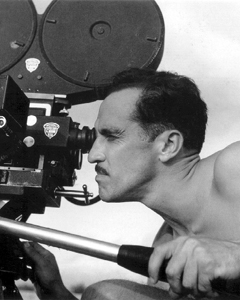
GABRIEL FIGUEROA

There are some cinematographers, like Greg Toland and Vitorio Storaro, who are
auteurs in their own right — it’s worth watching anything they shoot,
whether the film is good, bad or indifferent, for the superior art and
craft they bring to each assignment.


Gabriel Figueroa, the great Mexican cinematographer, is in their
class.  He studied with Toland and his style is reminiscent of
Toland’s — with a concentration on stereometric lighting and deep
focus that gives his images a sculptural quality.  (I’m speaking
here entirely about his black-and-white work — I’ve never seen a
Figueroa film shot in color.)


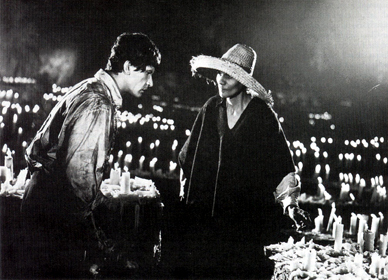
Figueroa worked for the top directors in Mexico’s fabled golden age of cinema, in the 1940s and 1950s.  He shot Macario for Roberto Gavaldón, in 1959, which was the first Mexican movie ever nominated for a Best Foreign Film Oscar.  Macario is a fascinating fable based on a novella by B. Traven (who wrote The Treasure Of the Sierra Madre.)  Set in colonial Mexico, the film is sort of an existential morality play about a poor man who meets a supernatural figure in the forest
(the Devil . . . Death?) who gives him a jug of healing water.  The consequences of the gift are not quite what the poor man, or we the audience, quite foresees. 
The film is filled with ravishing images of daily life in old Mexico, including some great footage of a Day Of the Dead celebration.  A
lot of the footage is reminiscent of Tisse’s photography on Eisenstein’s aborted epic
¡Que Viva Mexico!


Figueroa shot most of the important films directed by Emilio Fernandez,
the celebrated master of the Mexican golden age — one of the most notable
being
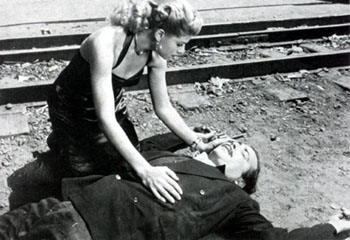
Victims Of Sin, a noirish vision in a peculiar Mexican genre, the cabaret dancer
film.  These films concentrated on the heroic efforts of lower-class women to rise above the exploitation and misery of street life, mainly by working in cabarets run by sleazy underworld
thugs.  There is almost nothing like these films in American cinema, though some of their themes are echoed in the
films noirs starring Joan Crawford in the 40s.  They have a frankness about sexuality and a brutality that still startle.


Even more startling, perhaps, is the fact that many of the greatest Latin singers
and musicians of the time make appearances in the cabarets around which
the stories of these films revolve — creating an almost surreal
contrast with the sleazy ambiance.  The films are strange but
wildly entertaining.


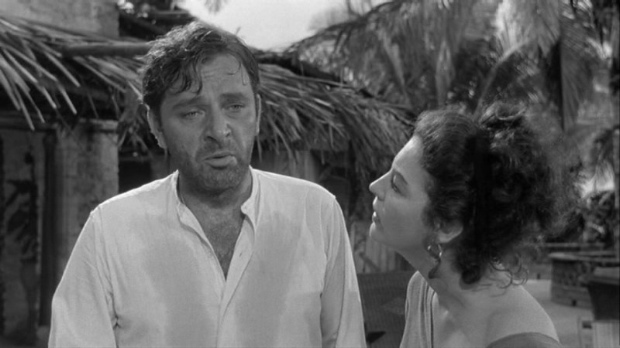
Figueroa sometimes worked for American directors making films in Mexico — John Ford on The Fugitive and John Huston on The Night Of the Iguana (below) for example.


It’s hard to find films from the Mexican golden age on DVD in this country, harder still to find ones that are subtitled — but they’re well worth tracking down.  (The two mentioned above, Macario and Victims Of Sin [Victimas del Pecado] are available here in subtitled versions.)  Any one of them shot by Gabriel Figueroa repays the closest attention.

FRENCH ONION SOUP


Everybody
talks about French onion soup — it comes to mind unbidden on cold
winter nights, or in the middle of a bad case of the flu — but almost
nobody does anything about it. My sister Lee is a notable exception.
One day after much wheedling and outright begging I got her to pass
along her recipe, modified from a rule in
The Joy Of Cooking with her
own refinements. She would not actually send me the recipe, thus
committing it to writing, but gave it over the phone while I took
notes.


Then I did something about it.


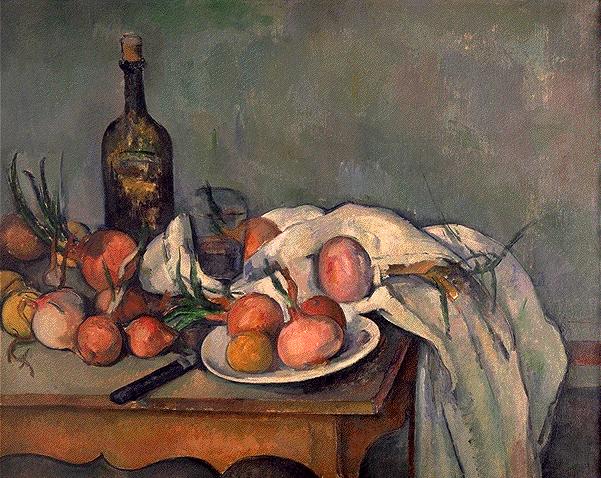
To
make this soup you first slice up three moderately large brown onions,
as thinly as possible — don't chop the slices up. (Now is the time for
your tears.) Put three quarters of a stick of butter into a big pot
that can hold six cups of liquor, plus the onions, and melt it.


Now,
as my sister explained, in hushed tones, a terrifying game of chicken
with the onions begins. Your goal is to sauté them slowly, patiently in
the butter until they turn a dark, a very dark brown. When they have
turned the darkest brown possible they will be just seconds away from
burning and turning black — at which point all your slicing, all your
tears, will have been in vain. The onions will try to fool you, by
leaving black deposits on the side of the pot, so you will think they
are as brown as they can possibly get — but they aren't. Not yet — not
quite yet!
Bonne chance, mon vieux!


When
the onions are browned to perfection, remove them from the heat and add
into the pot six cups of beef broth. Beef broth can be over-salty,
especially the cubed kind, so it's good to use a mixture of low-sodium
broth with the regular stuff. I used two cans of low sodium and one of
regular broth. Grind some fresh pepper into the pot.


Simmer this slowly for about half an hour, adding a dash of sherry at the very last moment if you want.


To
serve, place the soup in an oven-safe bowl. Take thickish slices from a
baguette of French bread, toast them lightly and then float them on top
of the soup, grate Gruyère generously over the surface of all this and
bake it in the oven until the cheese melts.


Eat it
with a strong, simple red wine and feel the flu, the chill of the
night, the melancholy of the day recede. Rejoice in the fact that, by
following this recipe, you will have plenty of soup left for the days
and nights ahead, when it will only taste better.

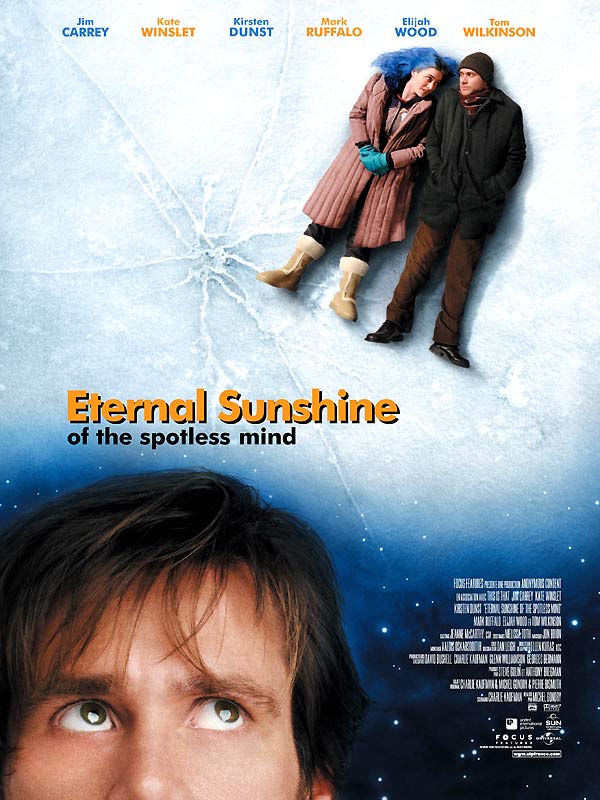
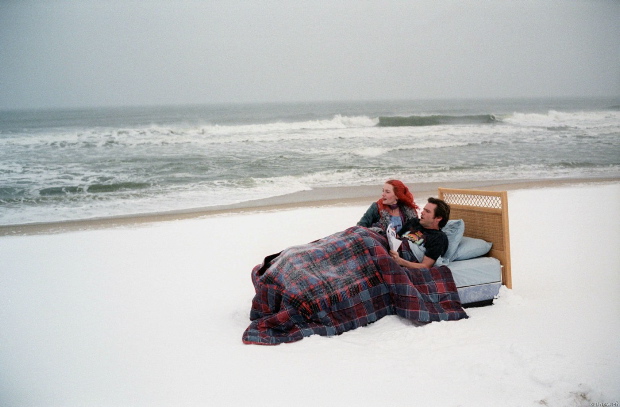
ETERNAL SUNSHINE OF THE SPOTLESS MIND


One
of the best movies ever made about sexual love, about the intoxication
of falling in love and the toxicity of a break-up. It's beautifully
observed, beautifully written, beautifully played — it features Jim
Carey's best performance ever on film, brilliant and pitch-perfect —
and it's directed with magical, lyrical, demented invention by Michel
Gondry. It's funny and romantic but it's not a romantic comedy — it's
far too real and too devastating to enchant us the way that genre can.
In deconstructing one particular romance, Charlie Kauffman is also
deconstructing the kind of movies that feed our delusions about love —
and he's offering something to take their place, a profoundly felt
sympathy that is honest, humane and inspiring. The movie is a miracle,
plain and simple.


JAMES TISSOT: A VICTORIAN ARTIST YOU SHOULD KNOW

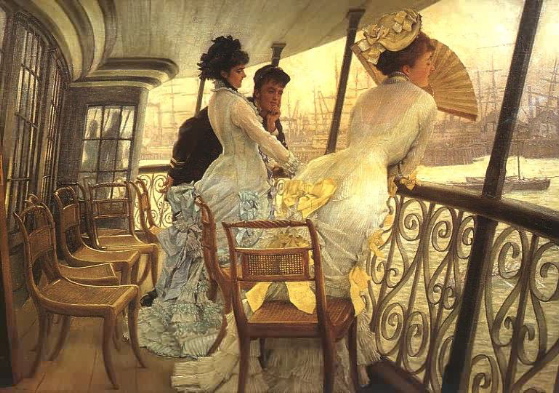
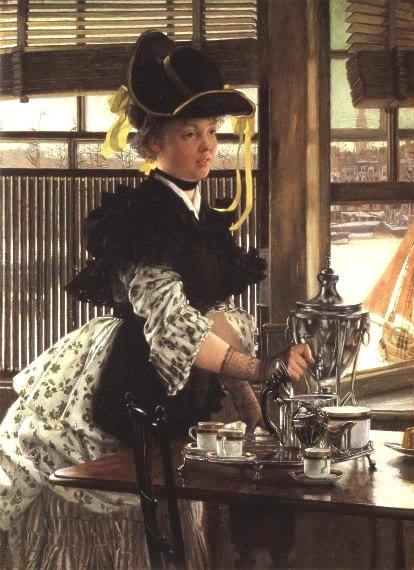
James Tissot was known for two things — his immensely popular Bible
illustrations and his paintings of contemporary Victorian society.


My friend Paul Zahl says that the Bible illustrations influenced the
iconography of the early Hollywood Biblical epics, and he may be right,
but I’m not a big fan of these works, aesthetically speaking.
They’re drawn in a looser, more impressionistic and decorative style
than his easel paintings, and to me don’t have the same power.


The easel paintings strike me as downright stunning.  In them the
use of an almost photographic draftsmanship and sometimes subtle but always highly
dramatic evocations of spatial depth result in works that utterly
enchant me.


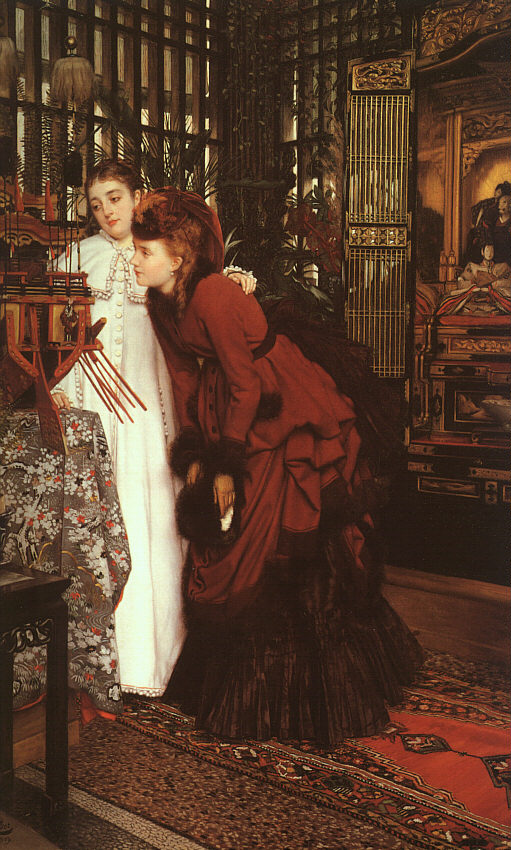
Tissot had a number of compositional strategies for producing an
impression of spatial depth.  The most characteristic was the
depiction of semi-enclosed spaces with portals onto wider spaces
beyond, which cause the eye to come to rest momentarily in the
foreground space and then to explore the background space, which
reveals itself almost as a surprise, a release.


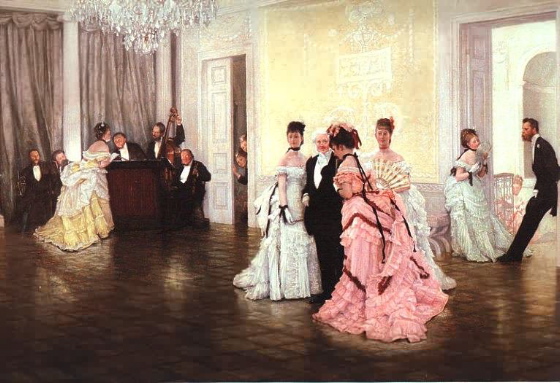
Tissot also had a knack for compositions involving larger groups in a
public space, like a ballroom, in which the empty areas of the scene
suggest the potential for action within it.  The strategy is very
explicit in the painting below, Too Early, in which the future of
the evening unfolds like a ghostly vision around the few early arrivals
waiting for the festivities to begin.


This is a perfect example of how visual space can be charged with
emotion — we populate the half-empty ballroom with future dancing, just as
the early arrivals do . . . we enter into the emotional anticipation of
these folks who’ve arrived a little too soon.


Tissot’s genius at suggesting depth through composition and modeling
also allowed him to produce canvases which shimmer with surface colors,
like the canvases of the Impressionists, but almost simultaneously draw
our imaginations irresistibly into the space depicted — something the
Impressionists were rarely concerned to do.  The effect is
magical, and one that movies would soon learn to achieve in more
spectacular ways than the academic Victorian painters had at their
command.  Their most potent charm was appropriated, and their
school of painting faded into history.


But when we look at Tissot’s paintings today, when our imaginations are
drawn into the spaces of his world, we can achieve a remarkable sense
of intimacy with the Victorian society he observed, we can share the
concerns and sometimes even the emotions of its long-vanished
inhabitants . . . and there’s an enchantment in that which will never
fade.