THE ULTIMATE CUBA LIBRE

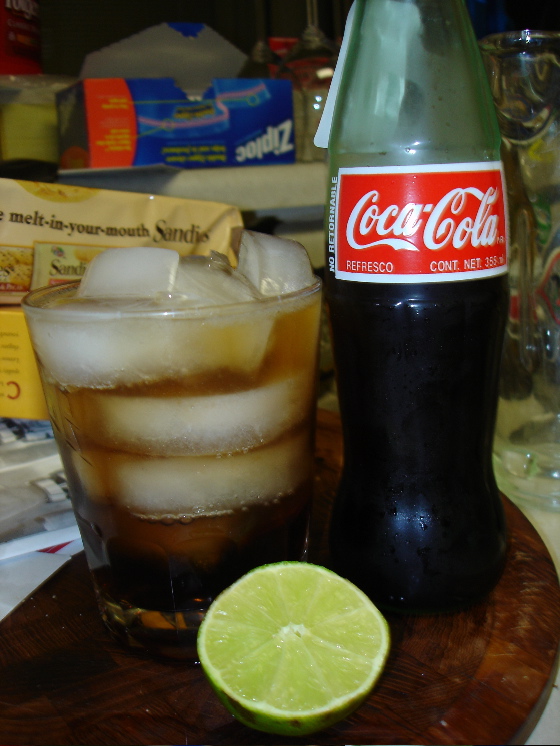
The cuba libre,
rum and Coke, always seemed like a pop cocktail to me.  I guess I
associated it with early drinking in college, when it was the only
mixed drink anyone knew how to make and seemed like a painless way
to ingest a lot of alcohol.

But that was before I tried Ernest Hemingway's recipe for a cuba libre,
which is something else again.  The key to this recipe is getting
hold of a Mexican Coke, which is still made with sugar, as it was in
Hemingway's day.  You want to taste the rum and its parent
cane
sugar all at once.  (If you can't find Mexican Coke, forget I ever mentioned the cuba libre — corn syrup has no place in it.)

Squeeze half a lime into a cocktail glass.  Pour in a jigger of
Bacardi white rum, add the remains of the squeezed lime and plenty of
ice and pour the Coke over it. 
The result is not too sweet and not too sour and it has an exhilarating
freshness.  After a couple of these you'll be imagining
you're on a tropical beach somewhere . . . and after a few more you'll
be
convinced you really are on a tropical beach somewhere.

At that point, just relax and listen to the sounds of the surf and the wind rustling the palm fronds.

WHAT STAYS, WHAT GETS AWAY

Above
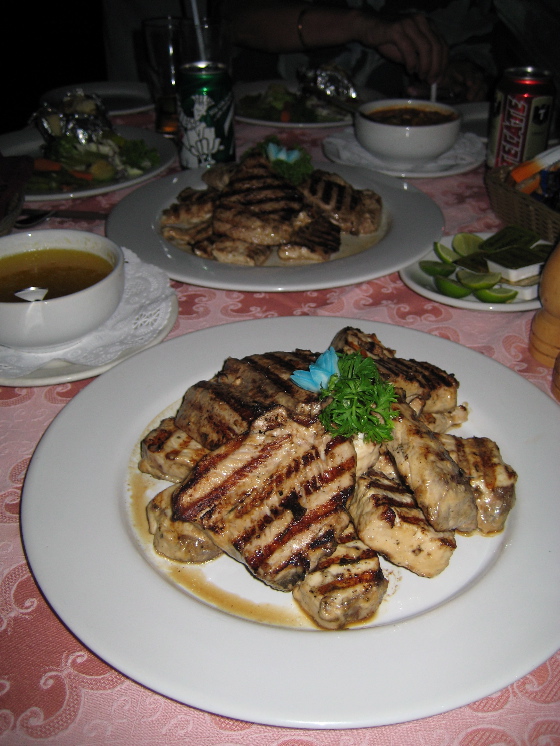
are the fish we took away from our fishing expedition on the Mar de
Cortés — all good for eating.  We ate some of the catch in La Paz before
we left, the rest made it, frozen, to Las Vegas and Los Angeles, where
it served for a couple more wonderful meals.

We caught other fish on our expedition — including a few bonito, all
but one of which was thrown back.  The biggest of them was saved to
serve as shark bait for a friend of our captain.  We caught
several needlefish — nasty looking things with long pointed snouts
which are no good for eating.  “Banditos” our captain called them,
disdainfully, because they steal bait.  If one got hooked, the
captain had to beat it senseless with a wooden club before he removed the hook, to avoid
having his hands lacerated by the needlefish's sharp teeth.

Nora watched this procedure with burning eyes.  “I almost can't
stand to look,” she said.  “But it's also kind of exciting.”  This struck me as a very Spanish response, with the
appeal of the bullfight in it.

In any fishing tale there's always the part about the one that got away. 
Just before we headed back to shore, with our bait almost used up, I
hooked a huge fish.  It felt like the big bonito I'd caught
earlier — maybe heavier.  It kept wanting to sound and came up
slowly, when I could move it towards the boat, like a massive lead weight at the end of the line.  When I got it to
within four or five feet of the surface we could see, in the dappled sunlight rippling through the water, that it was a gigantic
yellowfin tuna.  The captain was very excited — this was
a stupendous fish.  I was too excited.  I jerked the line a
little too hard and the hook slipped out and I watched the amazing
thing swim away again into the depths.  I was sad but also oddly
moved by the encounter.

Below, pelicans feed on the remains of our fish, after the captain had filleted them:

After I dropped our catch off at the restaurant at the Los Arcos I went
up to the bar for a beer.  I was exhausted from the long drive to
and from the beach and the hours out on the water, all on far too
little sleep.  But my nerves were singing.  I knew I had
experienced something extraordinary.  There was no way I could go
to sleep.

That's the moment I come back to when I think about Baja California —
the way the cold beer tasted, and the image that kept going through my
mind of the big tuna swimming away into the Mar de Cortés, its
silver sides and yellow fins flashing a few times before it disappeared
into the deep blue. 
Part of my heart went with it, and is still there — lost at sea.

For previous Baja California trip reports, go here.


[Photos © 2007 Harry Rossi]

DRIVING IN MEXICO: A POSTSCRIPT

I recently came upon a term, “risk homeostasis”, which I think helps explain why driving in Mexico feels safer, and may in fact be safer, than driving in the U. S.

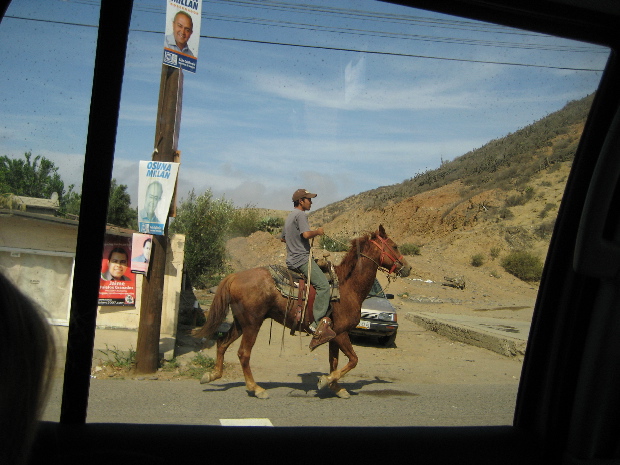
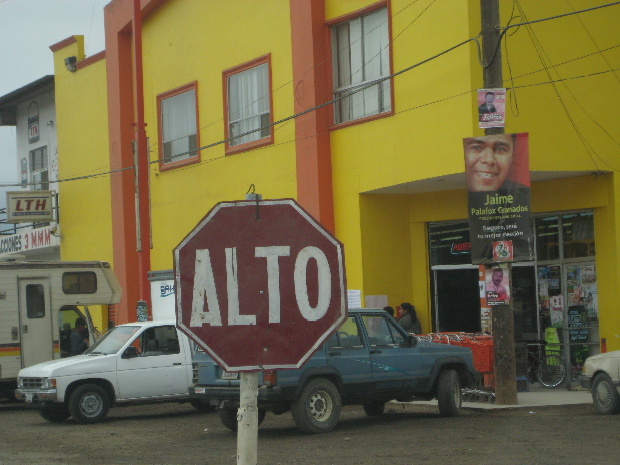
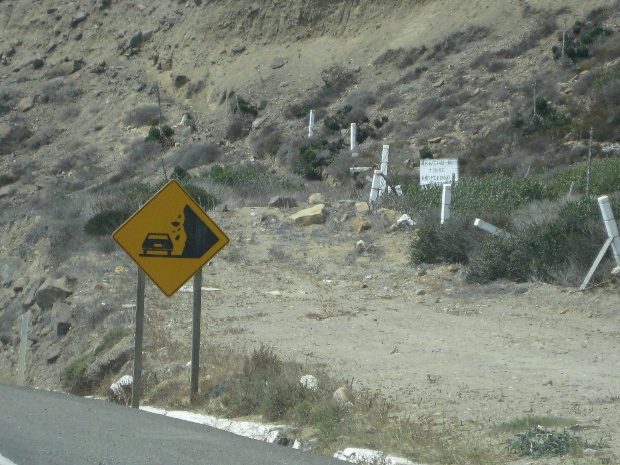
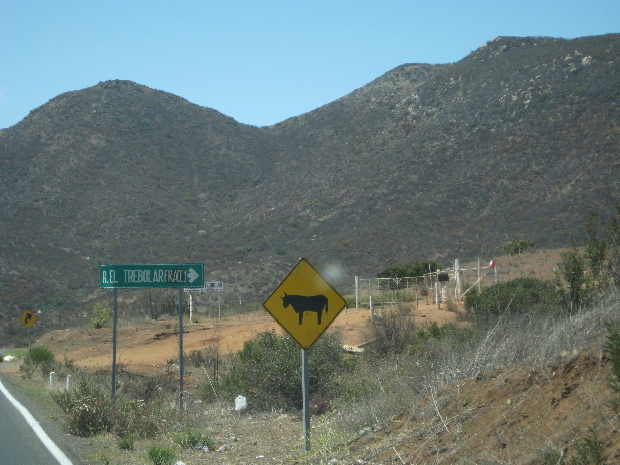
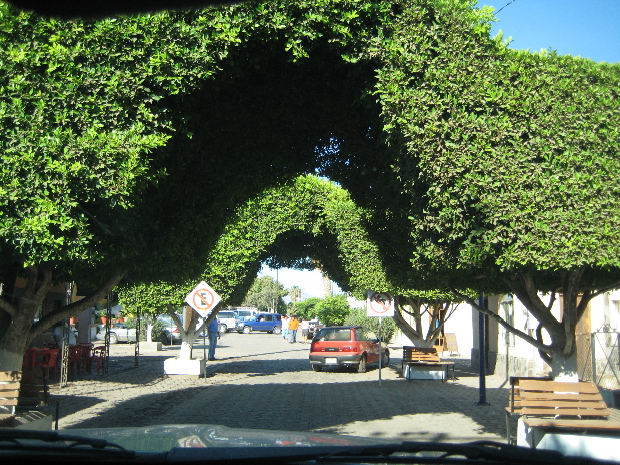
Roads and streets in Mexico tend not to be as well-maintained as they are in the States, lanes tend not to be as well marked (or respected when they are marked), traffic signs are treated very casually — in La Paz, many stop signs are completely obscured by foliage.  (You quickly learn to come to a full stop at every bushy tree near the corner of an intersection.)

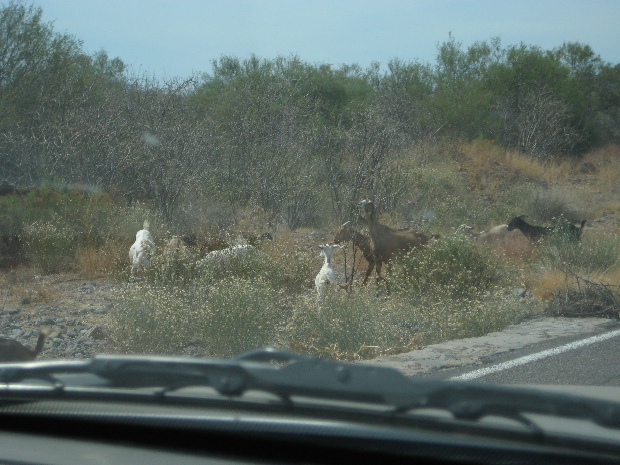
The result is that Mexicans are forced to drive with greater care, greater attention to the behavior and greater respect for the prerogatives of other drivers — not to mention pedestrians . . . and goats.

In the States, where road and street surfaces tend to be impeccable, lanes are clearly marked, traffic signs prominent and logically placed, livestock properly penned, people rely on these things to allow them to drive more carelessly — while talking on a cell phone, for example, with very little attention given to immediate traffic conditions around the vehicle.  They assume that the markings and the rules will keep them out of accidents — but based on that assumption they feel free to expose themselves more to the hazards of unpredictable incidents.

This is “risk homeostasis”, a phenomenon observed in all security systems — people “consume” improvements in security and use them to justify taking more risks.

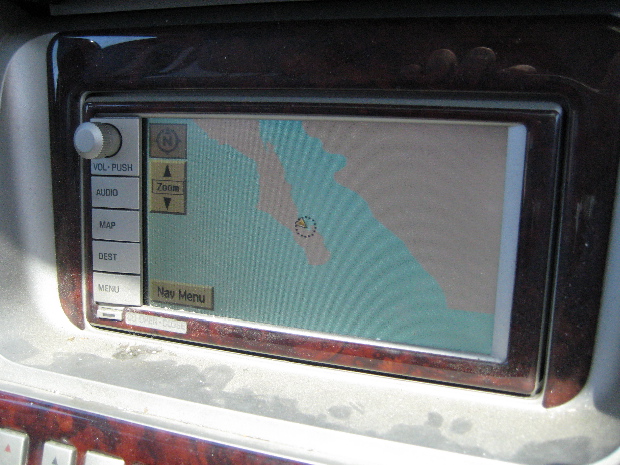
The result can be paradoxical.  Here in the U. S., more pedestrians are killed in clearly marked crosswalks than in unmarked crosswalks — the bright white solid lines give them a false sense of security and lessen their attention to the actual behavior of drivers.  (The GPS system in my car, above, has no detailed map data for Mexico — it only told me roughly where I was on the Baja California peninsula . . . all the rest I had to figure out for myself.)

My sister was terrified by the idea of driving in Mexico — because it all looked so anarchic.  But it wasn’t anarchic at all — just the opposite.  Almost all drivers were following one basic rule, which transcended all the other less basic rules — pay close attention to what your fellow drivers are doing and don’t run into them.


It’s the one basic rule that no improvements in traffic systems can
promote, and that many improvements in traffic systems can actually
undermine.  It’s against the law in Mexico to drive while talking on a
cell phone — but it’s something you wouldn’t be likely to do anyway.
You wouldn’t feel safe.  You may feel safe driving while talking on a
cell phone in the U. S., but you very likely aren’t.

By directing so much of your attention away from the traffic around
you, you have essentially “consumed” the advantages the U. S. road
system has over the Mexican road system.

For previous Baja California trip reports, go here.

[Photos © 2007 Harry Rossi]

MOVIE DREAMTIME


When
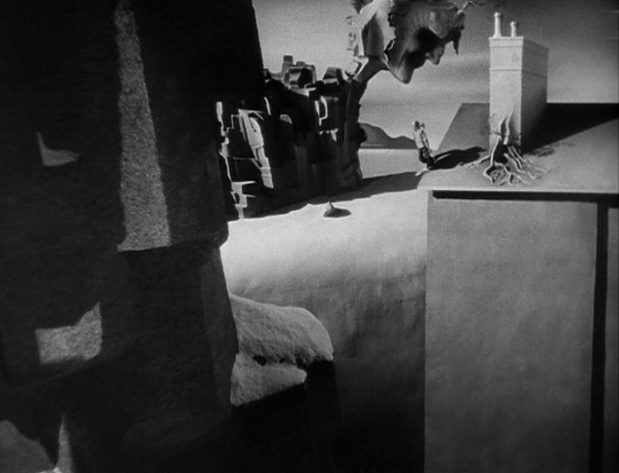
we think of dreamlike films, or dream sequences within films, we
inevitably think of the expressionistic style filmmakers often use
to signal a dream state — but of course real dreams do not present
themselves in that way. We might, in a dream, find ourselves at home
and discover a previously unnoticed door opening onto a previously
unsuspected wing of the house — but that wing is not appointed like
the cabinet of Dr. Caligari . . . it is as convincingly real a place,
in the dream, as the actual house we know.


A PLACE FOR PEOPLE

One
of the sweetest aspects of traveling in Mexico is experiencing a
society that has not been thoroughly corporatized.  Big U. S.
corporations have infected Mexico on a large scale, but you only see
the manifestation of this in localized areas of big cities — the strip
developments on the outskirts of towns where Wal-Mart and Office Depot
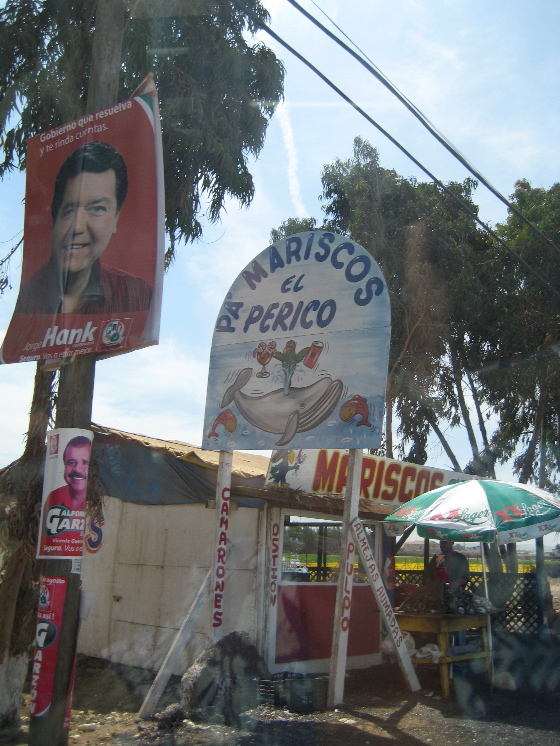
rule.  There's a Burger King and an Applebee's on the malecón in La Paz, but they still seem anomalous, like unsightly trash dumps in a vacant lot.

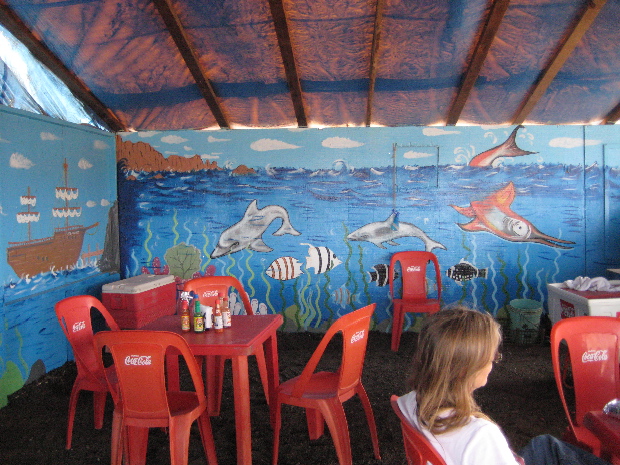
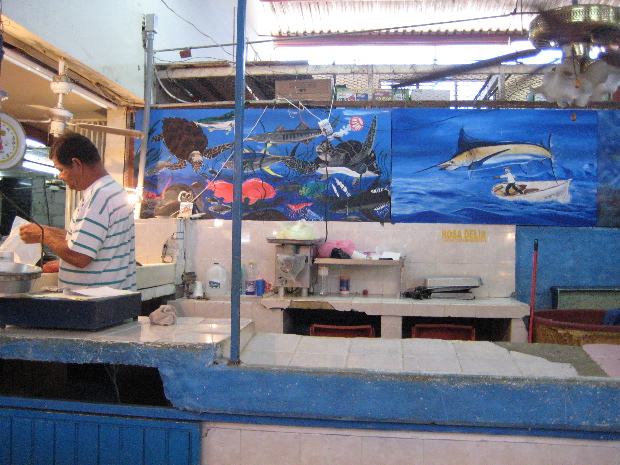
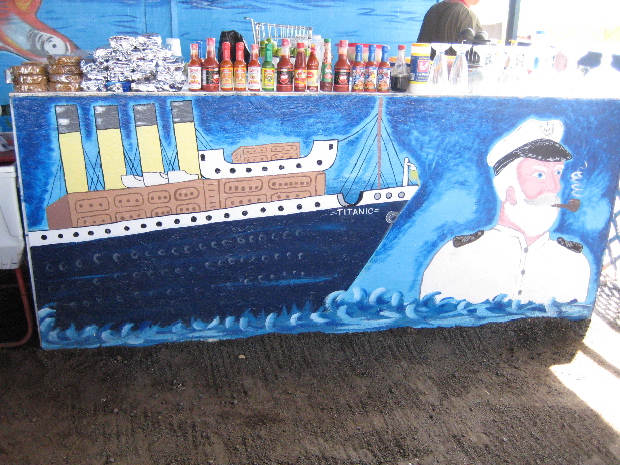
Everywhere else, businesses seem to be run by, stamped
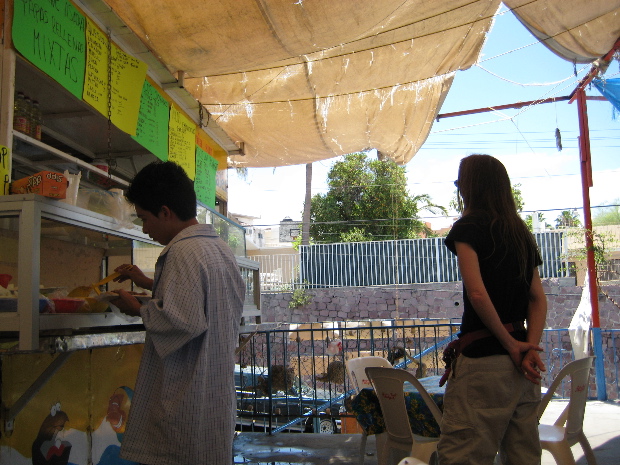
with the personality of, actual human beings.  Restaurants and taco stands
are decorated according to the eccentric tastes of the
proprietors.  You visit them not to find some standardized form of
service and decor, originating in some distant corporate headquarters,
but to have the adventure of meeting and interacting with the individuals who have personally organized these enterprises.

Las Vegas knows the advantage of this sort of eccentricity —
restaurants here, like casinos, have quirky themes, promise to be
“experiences” . . . but it's all professionally designed, the product
of artful concepts rather than of individual obsessions or
passions.  It's better than nothing but it's a far cry from the
organic expressiveness of
everyday Mexican culture.


For previous Baja California trip reports, go
here.


[Photos © 2007 Harry Rossi]

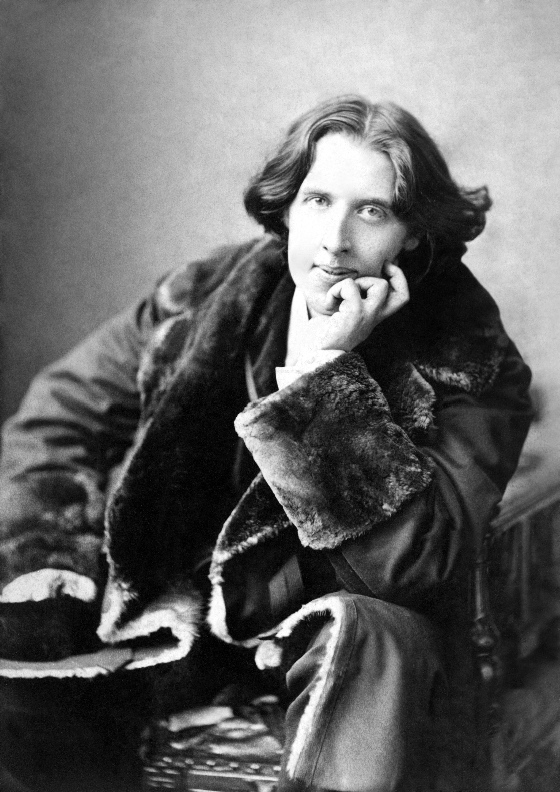
RICHARD ELLMAN ON OSCAR WILDE

While the ultimate virtue in Wilde’s essays is in make-believe, the
denouement of his dramas and narratives is that masks have to go. 
We must acknowledge what we are.  Wilde at least was keen to do
so.  Though he offered himself as the apostle of pleasure, his
created world contains much pain.  In the smashup of his fortunes
rather than in their apogee his cast of mind fully appeared . . .

     Essentially Wilde was conducting, in the most
civilized way, an anatomy of his society, and a radical reconsideration
of its ethics.  He knew all the secrets and could expose all the
pretense.  Along with Blake and Nietzsche he was proposing that
good and evil are not what they seem, that moral tabs cannot cope with
the complexity of behavior.  His greatness as a writer is partly
the result of the enlargement of sympathy which he demanded for
society’s victims . . .

    
As for his wit, its balance was more hazardously maintained than is
realized.  Although it lays claim to arrogance, it seeks to please
us.  Of all writers, Wilde was perhaps the best company. 
Always endangered, he laughs at his plight, and on his way to the loss
of everything he jollies society for being so much harsher than he is,
so much less graceful, so much less attractive.  And once we
recognize that his charm is threatened, its eye on the door left open
for the witless law, it becomes even more beguiling . . .


He occupied, as he insisted, a “symbolical relation” to his time. 
He ranged over the visible and invisible worlds, and dominated them by
his unusual views.  He is not one of those writers who as the
centuries change lose their relevance.  Wilde is one of us. 
His wit is an agent of renewal, as pertinent now as a hundred years
ago.  The questions posed by both his art and his life lend his
art a quality of earnestness, an earnestness which he always disavowed.


            — Richard
Ellman


            from his
biography Oscar Wilde


A FEW MORE TIPS FOR TRAVELING IN MEXICO

In Mexico, when
referring to the U. S. State of California, don't call it California,
call it Alta California, thus showing that you realize there are three
Californias — the U. S. state and the two Mexican states, Baja
California and Baja California Sur.  Mexicans are so unaccustomed
to gringos using the term Alta California that they will sometime laugh
when they hear it, but it's a laugh of satisfaction and approval. 
I'm sure I don't have to encourage anyone not to refer to Cabo San Lucas as “Cabo”, but by the same token, don't refer to Baja California as Baja.  Baja
just means “lower”.  It's sort of like saying, “I'm going to
North,” when what you mean is, “I'm going to North Dakota.”

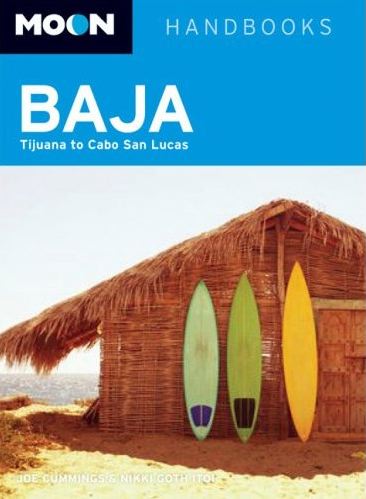
In spite of the above, get hold of a copy Baja in the Moon Handbooks series.  It offered the most sensible advice about traveling in Baja California and the most reliable
recommendations about hotels and restaurants.  We carried the
2004 edition, which was already outdated in some respects, but there's
a new edition coming out this month (see above.)  Also, be sure to
carry the AAA road map of Baja California, the best one available north
of the line.

Take along some chewable Pepto Bismol tablets.  These handled all
the (very mild) stomach upsets we suffered in Mexico.  Take along
some Benadryl, in case of wasp and bee stings.  In the desert
environment of Baja California, bees and wasps will appear out of
nowhere, in the midst of the most barren wasteland, if you expose so
much as cookie crumb, or open a container of anything liquid.  If
you keep items made with sugar wrapped and stuff tissue paper into the
tops of open soda or beer containers, they vanish just as quickly.

But accidents can happen.  On our fishing expedition, a fellow
passenger in our van popped open a beer when she got back to the beach
after her time on the water.  Within about two sips, and without
her realizing it, a bee got into the bottle.  She swallowed it and
it stung the inside of her throat on the way down.  We were at
least an hour away from any kind of medical facility, and if my sister
hadn't had some liquid Benadryl in her fanny pack, the situation could
have been dangerous.  As it was the Benadryl reduced the swelling
in the woman's throat, allowing her to breathe freely, and some Advil
(which my sister was also carrying) helped her manage the excruciating
pain

I have no idea why my sister was carrying Benadryl in her fanny pack —
just as a general precaution, she claimed, though I suspect that
Nuestra Señora de Guadalupe put the idea into her head precisely for
the emergency in question.


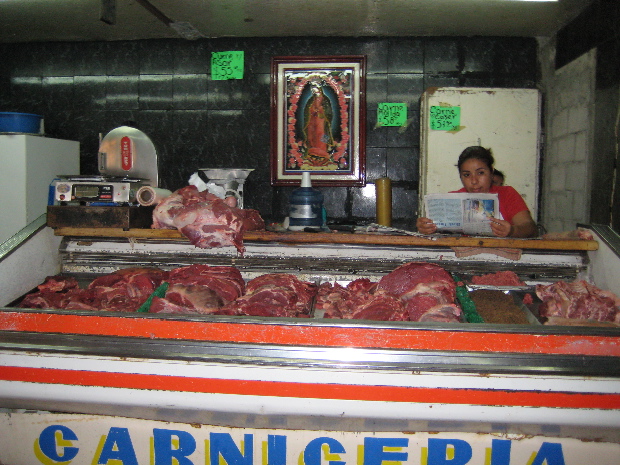
This brings me to my final tip — always listen to the promptings of La Morenita.  She will never steer you wrong.

For previous Baja California trip reports, go here.


[Photos © 2007 Harry Rossi]

POST-TRAUMATIC STRESS DISORDER AND FILM NOIR

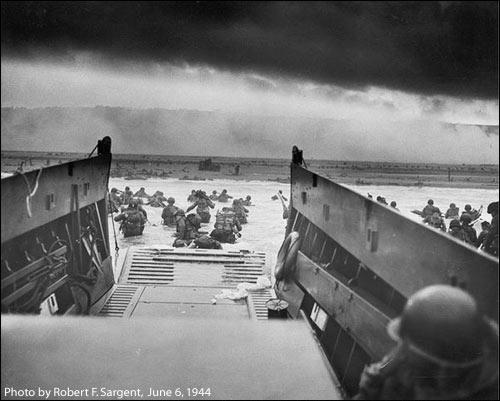
World War Two was a “good war”.  America and its allies pulled together
and destroyed the Axis powers.  On balance, and in retrospect, it
has to be considered one of the great achievements of
humane civilization.  But human beings don’t live on balance or in
retrospect, particularly where war is concerned.  They live inside
the horror of it and it takes a toll on individuals and on societies
which can never be fully measured.

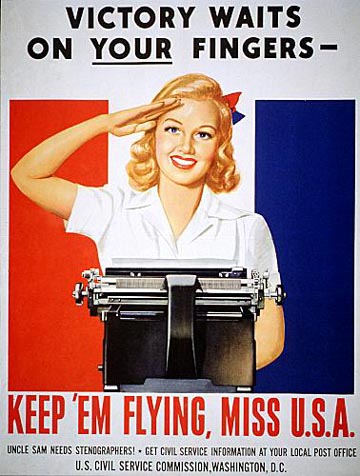
The upbeat spirit of American propaganda during the war, and the
genuine satisfactions of victory, veiled the true experience of the war
for millions — not just for those who fought it on the battlefields of the
world, but for those at home who lived in terror that their loved ones at
the front might never return . . . and of course, most especially, for those at home whose loved ones didn’t return.  On a broader level, anyone who simply witnessed
the spectacle of total war on a global scale, from whatever distance, had
to have experienced a soul-shaking anxiety about the fragility of all
social structures and cultural norms.

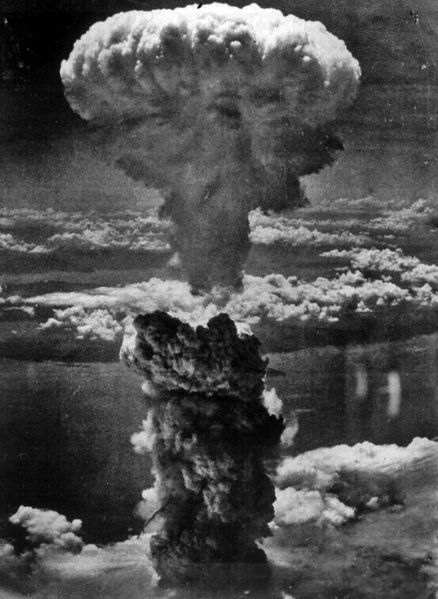
After WWII, the whole planet experienced post-traumatic stress disorder
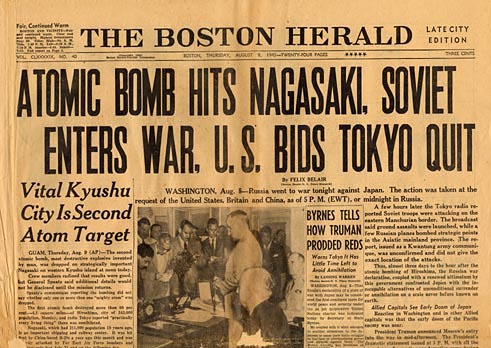
— localized in this case by the fact of the atomic bomb, which ended
the war but left the world with a paradox that wouldn’t go away.
It took an act of colossal horror to finally “win” this good
war.  And the prospect of this horror being again visited on the
world was far from unimaginable.

We now know a lot more than we used to about post-traumatic stress
disorder and the ways it can be treated.  In the immediate post-war era, the
phenomenon was more elusive, and often unrecognized.  We made
meaningful social restitution to the veterans of the war, with measures like
the G. I. Bill — we reconstructed the devastated nations we
conquered.  But that just scratched the surface.

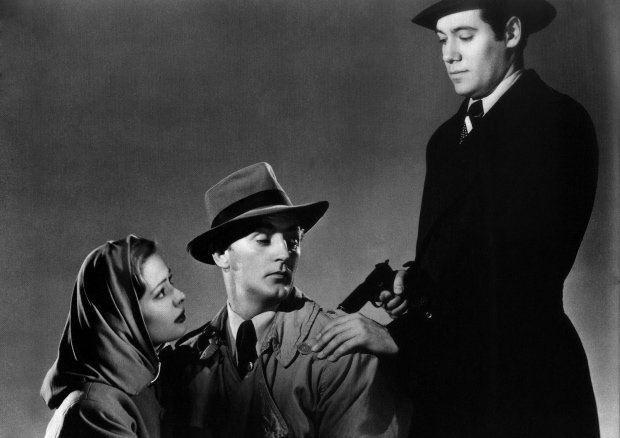
It was in art that the true psychic cost of the war was exposed and explored — nowhere more pointedly than in film noir.  The sort of trauma that engenders PTSD is identifiable by several characteristics — a sense of being out of control and confused, a
sense of terror, a sense of being outside the normal realm of human
experience.  Is there a better description of the usual
predicament of the protagonist in a classic film noir?

PTSD on a broad cultural and societal level is what best explains the phenomenon of film noir, which on its surface is so mysterious.  Why should a triumphant
nation, after a great collective victory in a good war, have been
gripped by that mood of existential dread which informs so many Hollywood films of the post-war era?  Why should the most spectacular achievement of American arms have led
to a crisis of manhood, a sense of impotence, a fear of powerful women
incarnated in the morbid fantasy of the femme fatale?

Film noir was a dream landscape where the buried costs of WWII could be recognized, reckoned and mourned, as a prelude to psychic recovery, or at least psychic survival.
Veterans of combat often report the difficulty of dealing with people
who have not shared their experience of it — people who can never
really know what it’s like.  Film noir, far more than the WWII combat film, was one of the few arenas of American life where the true legacies of war, its lingering moral and
psychological dislocations, could be engaged without apology or shame.

MORE TIPS FOR TRAVELING IN MEXICO

First
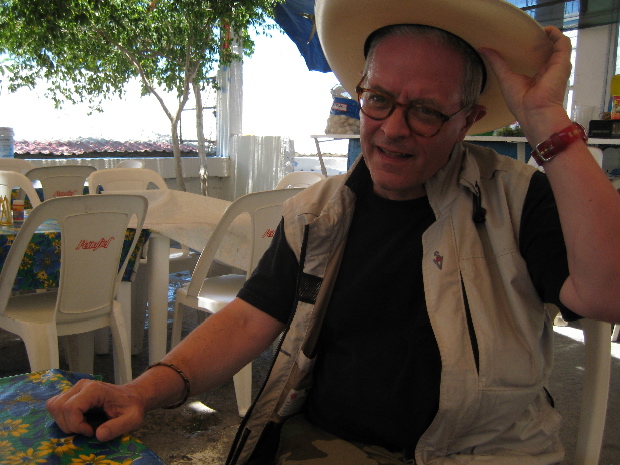
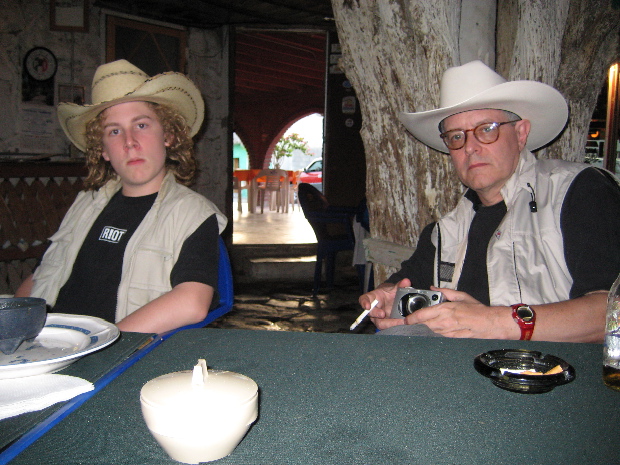
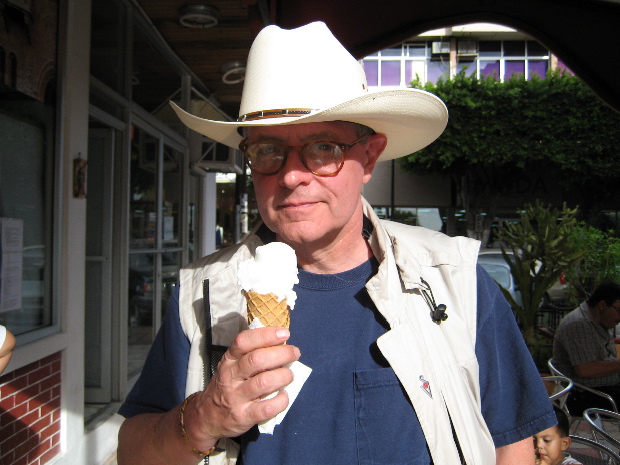
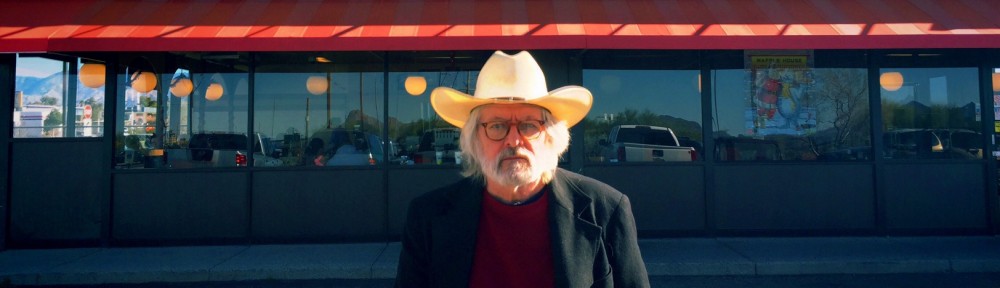
tip — if you’re a guy, wear a straw cowboy hat.  I don’t pretend
to understand the full cultural significance of the straw cowboy hat in
Mexico, but I do know that it has replaced the sombrero as the national
headgear, though it’s not nearly as ubiquitous as the sombrero used to
be.  The sombrero has become ceremonial, part of a costume used on
festive occasions and by theatrical mariachi troupes.  The bands
of strolling musicians who play in restaurants, for example, wear straw
cowboy hats.

Hip young kids in Mexico don’t wear straw cowboy hats, nor do
sophisticated professionals, and the baseball cap is making strong
inroads everywhere, even in rural areas.

The straw cowboy hat
seems to have something of the significance of the cowboy hat in
America, a sign of solidarity with the nation’s rural roots and the
romance of the ranchero.

The important thing is that Yankee tourists don’t usually wear straw
cowboy hats.  My three traveling companions, all blond, were
usually taken at once as Yankees, but people sometimes expressed
surprise to find that I wasn’t Mexican.  Even when I was taken as
a gringo, the hat seemed to confer on me the benefit of the doubt,
especially at the ubiquitous army checkpoints where they stop your car
to look for drugs.  (They have stepped these up recently at the
urging of the U. S. government, so don’t blame Mexico for the resulting
inconvenience.)  We were usually ushered through these with
only the most cursory of inspections, while other gringos were being
searched rigorously.  I attribute this to the formal and
respectful greetings I offered to the soldiers — and to the hat.

I live in a U. S. state that still considers itself Western.
Wearing a cowboy hat in Las Vegas doesn’t arouse any special curiosity
outside of the fancy casinos or yuppie enclaves like Summerlin . . . so
I didn’t feel that wearing one in Mexico constituted any kind of
charade.  The hat seems to mean more or less the same thing on
both sides of the border.  Maybe that’s the point.

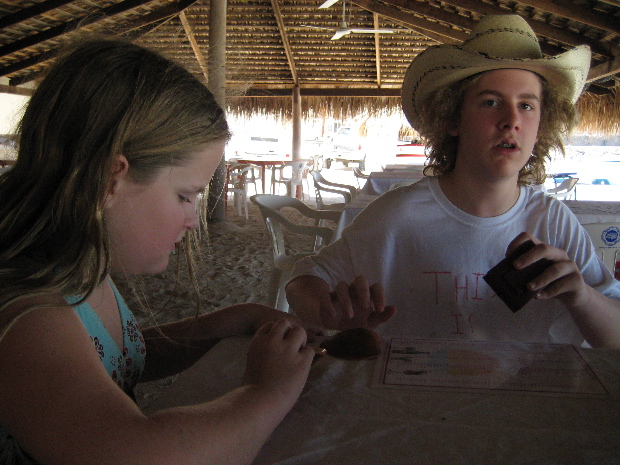
Second tip — travel with kids.  Mexicans have an instinctive
reaction to kids that instantly dissolves all linguistic and
cultural barriers.  They like having them around.  They like
you for bringing them around.

Third tip — avoid the Pacific coast of Baja California above
Ensenada.  Even if you’re motoring down from San Diego, go east
and cross at Tecate.  The Pacific coast above Ensenada offers a
vision of the future of Baja California, as more and more Yankees
retire or build vacation homes there.  The vision will make you
ashamed of being a Yankee and depressed about the future of Baja
California.

Fourth tip — go!  Just go.  Below Ensenada, and outside the
city limits of Cabo San Lucas, Mexico is still there.  Its
gracious and humane culture has much to teach and many ways of
enchanting its complacent neighbors north of the border.

For previous Baja California trip reports, go here.

[Photos © 2007 Harry Rossi]

DIEGO CORRALES

This
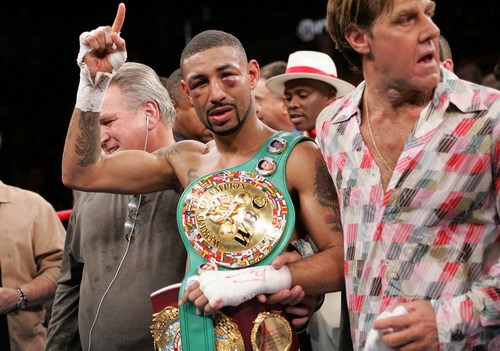
past May, boxer Diego Corrales (above) died in a high-speed motorcycle crash
here in Las Vegas.  He’d been drinking and was driving without a
valid license — trying to outrun his demons, I guess, whatever they
were.

Exactly two years to the day before his death he fought one of the
most remarkable fights in modern boxing history against Jose Luis
Castillo.  I was there.  Here’s my report of the fight,
written the day afterwards, reprinted as a tribute to a man who lived
out his “crowded hour” with distinction, honoring everyone who was privileged to see it:

CORRALES-CASTILLO

8 May 2005

They’re already calling it a classic, one for the ages, the fight of
the year — a year which isn’t even half over and which has also seen
the recent epic combat between Morales and Pacquiao.

If you’re a member of the Fancy you know I’m talking about the awesome
battle between Diego Corrales and Jose Luis Castillo at the Mandalay
Bay Events Center in Las Vegas last night. If you’re not, take a look
at a rebroadcast or tape of the fight sometime and try to believe your
eyes. I saw it in person, and I still don’t believe mine . . .


For the rest of the report on Corrales-Castillo, go
here.

For more boxing reports, go here.

CORRALES-CASTILLO

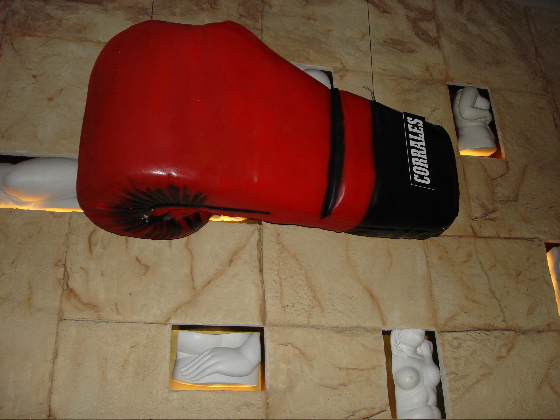
[Above, promotional decor for the first Corrales-Castillo fight outside the restaurant Aureole at Mandalay Bay.]

CORRALES-CASTILLO

8 May 2005

They're already calling it a classic, one for the ages, the fight of
the year — a year which isn't even half over and which has also seen
the recent epic combat between Morales and Pacquiao.

If you're a member of the Fancy you know I'm talking about the awesome
battle between Diego Corrales and Jose Luis Castillo at the Mandalay
Bay Events Center in Las Vegas last night. If you're not, take a look
at a rebroadcast or tape of the fight sometime and try to believe your
eyes. I was there, and I still don't believe mine.

There were some goofy undercard fights which did not prepare one for
what was to come — but looking at the faces of Corrales and Castillo
on the big video screens as they made their ways to the ring one could
see that the mood of the night was about to shift. These guys had the
air of men facing something terrible but inevitable.
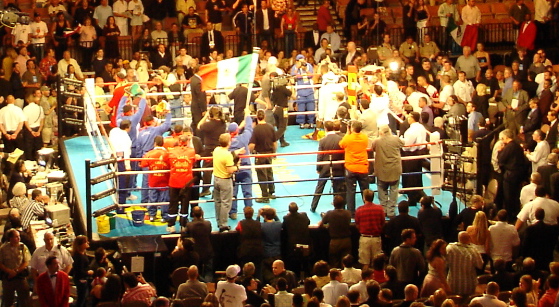
Castillo is a fighter who doesn't move exceptionally well on his feet
or punch exceptionally hard, but he's a skillful enough boxer. He likes
to go forward and pound away at an opponent and grind him down.
Corrales is taller and rangier, with more speed and a harder punch but
not known for his sturdiness. Like many rangy fighters he can't always
absorb punishment well and has been knocked down, though not out, a
lot. Both men have awesome wills, though, and never give up, so the
fight did not figure to go the distance.

My sense of it was this — either Corrales would knock Castillo out
sometime in the first four rounds, or Castillo, if he survived the
early going, would knock Corrales out sometime in the last four rounds.
Beyond that, prediction would be foolish.

In the end it went much (though not quite) as I had foreseen, but on a level no one could have imagined.

Corrales did indeed dominate the early rounds, but just barely. He hit
Castillo repeatedly with combinations that would have felled a lesser
man — and almost felled Castillo. But Castillo gave almost as good as
he got and the rounds were very close.

When the fourth ended, I thought — now Castillo's time has come . . . now he will win.
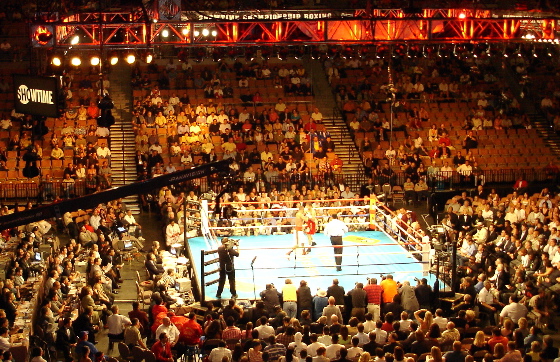
But the balance never tipped too far in either direction and as the
battle wore on I was gripped by a strong feeling of sadness at the
thought that someone was going to lose this fight. It had become a
battle of wills, a contest on a moral and spiritual plane. By the 8th
round I had a feeling that Corrales had the edge. He seemed to be
landing the harder blows and he seemed, surprisingly, fresher. But that
just made Castillo's refusal to surrender all the more admirable.
Still, moral determination can take you only so far — in the end the
body has its limits. But anyone who watched this fight now knows that
those limits are sometimes wider than the mind can easily conceive.

In the 8th Castillo made a startling comeback, fighting it seemed on
willpower alone. He opened a cut under one of Corrales's eyes and
nearly closed both of them. By this point both men seemed to have
abandoned defense altogether, willing to take any amount of punishment
to find the opening that would end things decisively.

And then, in the 10th, it happened — exactly as I had predicted.
Castillo landed a combination that put Corrales down. He got up to
continue but he looked dazed and unsteady on his feet. The crowd, which
heavily favored Castillo — Las Vegas boxing fans are overwhelmingly
pro-Mexican, and Corrales was a mere American — had been roaring
incoherently throughout the fight. The roar turned mournful in the
middle rounds, with an undertone of shock and anger. Now it soared into
the realms of delirium.

A guy behind me screamed, “It's over!” — and I agreed with him.
Corrales's destruction was now just a matter of time, and not much time
at that. Castillo struck with more combinations and Corrales went down
again. Somehow he got up on all fours and then up on his feet to beat
the count, but he looked like he was somewhere else, far from Las Vegas
and this ugly beating he was getting.

Both times he went down Corrales lost his mouthpiece — by crafty
design or simply from punch drunkenness. Fighters who are ready to give
up often spit out their mouthpieces in unconscious anticipation of
surrender. In any case, retrieving the mouthpiece and getting it put
back in by his cornermen gave Corrales a few extra seconds to get his
head together and his legs coordinated.

Referee Tony Weeks, a seasoned veteran, seemed to take his time
transferring the mouthpiece to Corrales's seconds — I had a feeling he
was giving them a chance to stop the fight, because Corrales looked on
the verge of absorbing some vicious and possibly debilitating further
punishment. But Joe Goosen, Corrales's trainer, obviously had no
intention of throwing in the towel. Indeed, after the second knockdown
he gave his fighter a stern and admonitory look — as though trying to
convey to him the gravity of the situation. Goosen appeared serious but
oddly calm — which may have had some influence on what happened next.

The fight resumed. Corrales didn't yet seem to be all there, but his
dislocation from reality took an astonishing form. He stood up
straight, with no attempt at defense, and attacked Castillo fearlessly.
There was no time to tie up and regroup — he'd lost three points in
the 10th, two from the knockdowns and one from Weeks, who had penalized
him, quite correctly, for spitting out his mouthpiece the second time.

At times in the middle rounds I'd had a sense watching Castillo of
seeing a ghost in action. Physically beaten, he was operating by pure
will, transcending the physical. Now Corrales seemed to have entered
the same disembodied territory. His body was beaten — something else
was fighting in the ring in its place.
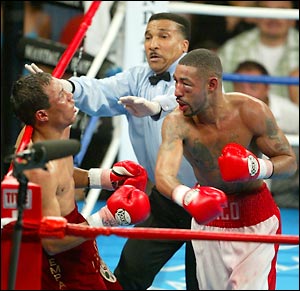
[AP Photo]

He hit Castillo with a punch that stunned him, sent him back into the
ropes. He hit him again four times as he leaned against the ropes, his
hands down, his eyes rolling upwards, out on his feet. Weeks called an
end to the fight to prevent certain permanent damage to Castillo and
possibly his death.

Corrales had come back from the dead and was now champion. Castillo,
who'd had the fight won in merely mortal terms, had lost. I discovered,
when my mind settled a bit, that my mouth was wide open and that I was
holding my head in my hands — a perfect cartoon-figure expression of
shock.

The cry from the crowd was indescribable — filled with sorrow and
astonishment and an almost inhuman excitement. The place seemed
suddenly crowded to the rafters, bursting its seams — a case of
emotional standing-room only.

At the end of the night, Steve Albert and Jim Gray, the Showtime
announcers, made their way past me out of the arena. Someone shouted
something to Gray, who turned back and said, “You'll never see a better
fight than that.”

I'm sure I never will. Joe Goosen, when asked about the possibility of
a rematch, on everyone's mind after such a contest, said, “These two
should never fight each other again — it's too much.” They will, of
course, boxing economics being what they are — but it's hard to
imagine any other outcome than one of them killing the other in the
bout.

I went over to RM Seafood, an ultra-moderne restaurant at the Mandalay
Bay, for some soothing crabcakes and beer. I couldn't think about the
fight — there didn't seem much to think about. All its meaning had
been fully explicated and exhausted in the ring. What remained for me
was a kind of wonder, an expanded sense of the horizons of the human
will.
DRIVING IN MEXICO

There's
really no way to explain this precisely, but driving in Mexico is
different from driving in the States.  Mexicans don't follow
roadsigns or rules except in the vaguest sort of way — they respond to
the behavior of other drivers.  At an intersection with four-way
stop signs, a Mexican driver, if he or she thinks there's time, will
scoot through on the cross street ahead of you without stopping at all
— you are expected to expect this and react accordingly.

Anything is permitted between drivers as long as it makes sense. 
It's more like navigating a crowded sidewalk as a pedestrian than
driving on streets and highways north of the border.  In other
words, it doesn't work if people aren't instinctively respectful of
other people's space and right of way.

I came to enjoy driving in Mexico very much — it was always an
adventure and always interesting, because it required you to pay
attention to other drivers, to imagine what they were thinking. 
It was disturbing to drive in Las Vegas afterwards.  I found it
almost impossible to imagine what other drivers were thinking —
because they usually weren't thinking at all.  Cell phones are a
big part of the problem here — in Mexico it's illegal to drive while
talking on a cell phone, and people, at least in Baja California, don't
do it.  Not, I suspect, because it's against the law, but because it's not
sensible.  In general, drivers in the States rely on lanes and
signs and signals to avoid collisions with other cars.  In Mexico, you have
to rely on a careful anticipation of how others are going to behave — and sometimes of how livestock are going to behave.

On a related note, streets signs are posted very spottily in Mexican
towns, even in big towns like La Paz.  You can't navigate by them,
even with a reliable map.  This requires stopping often to ask
directions — an occasion for a social interaction that is almost
always pleasant.  Why put up street signs when you can have a
friendly interchange with a human being who will tell you how to get
where you're going, and the best way to get there?

Once we got caught in a maze of street construction in Loreto. 
There were policemen posted at all the intersections with
detours.  When you asked one how to get to Mexico 1, he would
point vaguely in a certain direction — “That way.”  Eventually,
that way would lead you to another policemen, who would tell you to go
“up there.”  At last you'd find yourself back on a familiar
street, heading for Mexico 1.  Why complicate things with
elaborate directions, much less with temporary signs, when there are
enough officers around to give you the part of the puzzle you need at
any given moment?

It should be noted that the police in Mexico do enforce the driving
laws.  Contrary to popular belief they don't target tourists, but
they don't give them a pass, either.  Noting the presence of
police is part of the acute environmental awareness necessary for
driving in Mexico.


For previous Baja California trip reports, go
here.


[Photos © 2007 Harry Rossi]

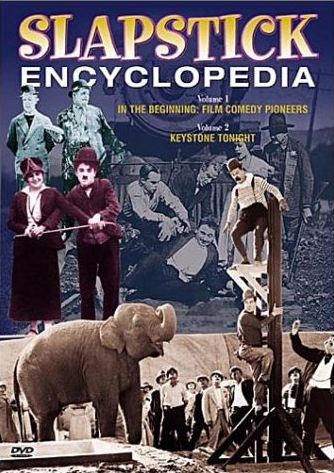
THE SLAPSTICK ENCYCLOPEDIA


In
case there's anyone out there who doesn't know it,
The Slapstick
Encyclopedia
is awesome — offering about eighteen hours worth of
silent comedy shorts on five DVDs. It's an education in silent comedy,
and the first lesson it teaches is that silent comedy could accommodate
a stunning range of talent and tone, from the subtle sophistication of
Sidney Drew to the certifiable madness of Charlie Bowers.


The
pantheon isn't seriously challenged, however — the work of Chaplin,
Keaton and Lloyd shines with a special radiance, as you'd expect — but
there are pleasant surprises at every turn.


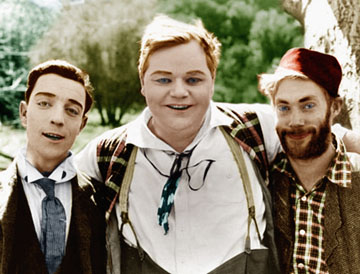
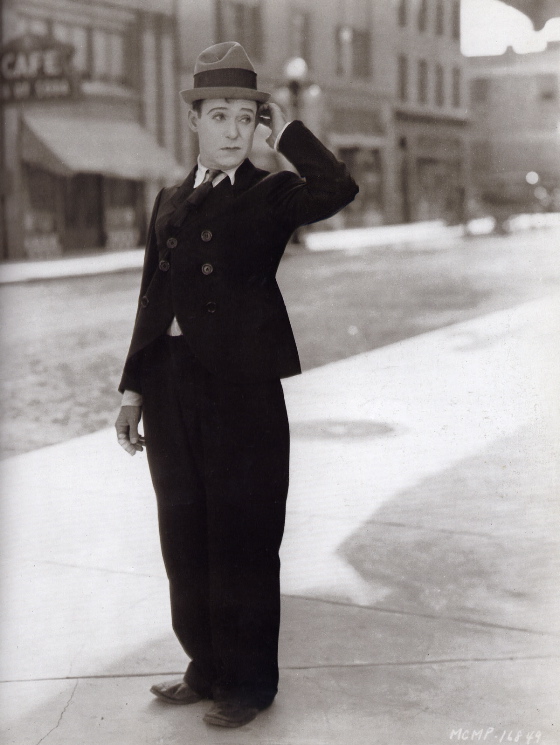
Harry Langdon remains a
puzzlement to me, based on the two shorts included here, from his
Sennett days. I can't decide if his art is sublime or boring or, by
some mysterious alchemy, both at once. Langdon moves so beautifully
that you simply can't take your eyes off of him, even though you
desperately want to.


The
Charley Chase vehicle
Fluttering Hearts, directed by Leo McCarey, has
a light but sure comic tone that never falters, and a short directed by
Roscoe Arbuckle after the scandal,
The Iron Mule, is proof positive
of Arbuckle's exquisite plastic imagination.


The
collection is organized logically but flexibly, with shorts grouped
sometimes by studio, where there was a strong studio style at work (in
the cases of Sennett and Roach,) sometimes by artists noted for their
collaboration, sometimes by theme.


Chaplin appears in a volume devoted
to the influence of the English music hall, and it's fascinating to see
how much he took from its traditions, and also how magically he
transformed them. Lesser artists working from the same traditions —
even the wondrous Stan Laurel — simply inhabit another, more
circumscribed realm of cinematic possibility.

The Slapstick Encyclopedia ends with a grab bag called The Anarchic Fringe, which
presents several shorts of outright lunacy verging on the incoherent,
but t
he
collection
actually climaxes in the penultimate volume, The Race Is On,
which offers comedies involving various mad chases. Chasing Choo
Choos
, with Monty Banks, cut down into a short from the climax of a
feature, includes the God-damnedest train sequence ever put on film.
Delirious, relentless, impossibly beautiful and beautifully impossible,
it's one of the most glorious passages in all of movies, and is as
close to a religious experience as one can have by purely cinematic
means.

The
DVD set is marred by one irritation. There is no single listing by
volume and disc of all the shorts included. This will only bother you
when you decide to revisit one of the many treasures included — but
then again that's something you'll probably end up doing a lot. The
Silent Era website offers a complete listing of the films which is
worth printing and keeping with the box.


Here's a link to the list:

The Silent Era Web Site

Check out other posts in the Slapstick Blog-A-Thon here.

TODAY’S TIP FOR TRAVELING IN MEXICO

The most important thing to know about everyday Mexican culture is that it’s organized around a system of subtle but highly formal and ritualized courtesies between people.  Even when you have business to conduct in Mexico, the situation — at a gas pump, a cashier’s stand in a department store, a roadside taquería — is first and foremost social, not commercial.  If you treat a Mexican waiter or merchant or clerk as a functionary, if you get right down to business or generally act as if you’re in a hurry to conclude it, the Mexican is likely to see you, quite correctly, as a barbarian.
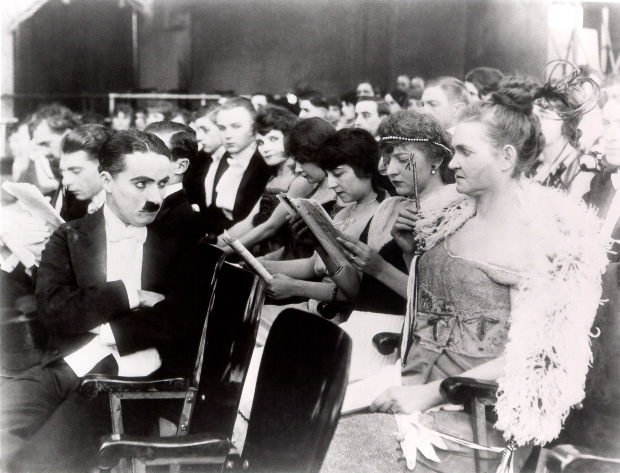
Mexicans are accustomed to Yankees behaving like barbarians.  They have a defensive reserve when dealing with gringos.  We saw pompous middle-aged Yankees, soi-disant sportsmen, ordering dignified waiters and bartenders around as though they were children.  The waiters and bartenders took a little extra time doing what they were told, and if you caught their eye in such moments, they would offer the slightest trace of a smile . . . and a shrug.  A civilized person can never be humiliated by a barbarian — only saddened, or amused.

But if you take your time, look them in the eye, exchange greetings like a civilized human being, they are more than likely to break out in wide smiles and treat you with an almost familial warmth.  If you show them that you’re interested in them, they become interested in you, interested in what you want, interested in helping you get it.  The situation has become personal — humane.

The moment of greeting, of establishing a personal contact, can be very brief, but it must entail a perceptible pause, an unhurried ease, a sense that nothing will or should happen until the two of you have sized each other up and shown each other respect.  Your Spanish can be dreadful — it’s the timing and the demeanor of the parties that define the interchange.

Mexicans are never servile, but they have a servile mask they can assume when dealing with barbarians.  It’s a mechanism for getting through with the interaction as quickly and painlessly as possible.  It has a melancholy quality, too — because in truth they are feeling sorry for you.  But nothing delights a Mexican more than being of service to a compadre.  Accommodation and co-operation are values of the highest order in Mexico — a legacy of its revolutionary history and a necessity in an underdeveloped economy.

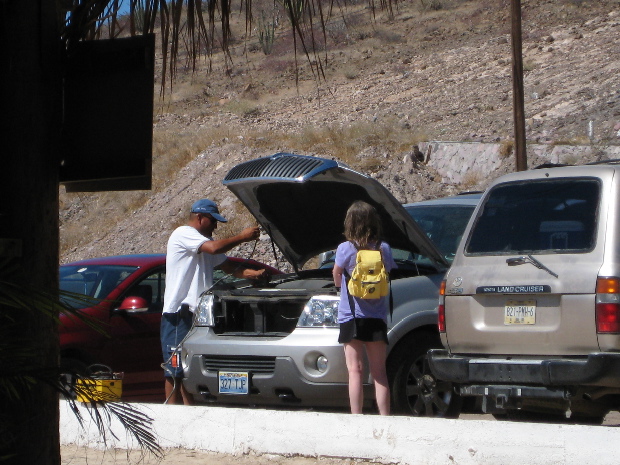
When we took our cruise to the Isla Espíritu Santo I left the
lights of my car on.  When we got back the battery was dead.
The guy who rents the kayaks at Pichilingue instantly went to his car,
pulled it around to mine and got out his jumper cables.  But we
couldn’t get my car into neutral without power and so couldn’t push it
out close enough to the guy’s car to hook the engines up.  The guy
went and got his boat battery, which charged my engine enough to allow
the shift to neutral.  We pushed the car next to his and soon had
it going again.  He never once gave the impression that he was
doing me a favor.  When I slipped him 100 pesos afterwards he
nodded gravely but didn’t look at the bill — just tucked it into his
pocket.  The gesture had been enough — but the gesture was very
important.

Bargaining in Mexico is a game between equals, conducted not for financial advantage to either party, but for fun.  We saw fellow tourists angrily and self-righteously berating a hotel clerk for not honoring some sort of discount coupon, treating the clerk like an imbecile.  The clerk, who spoke perfect English, pretended not to understand what they were saying.

But when my sister haggled with a hotel clerk for a reduced room rate by
suggesting, with a face that was a little too perfectly straight, that
her children were weeping and fainting in the car from heat exhaustion,
the clerk laughed . . . and reduced the rate.  Once a hotel clerk
told my sister that he couldn’t reduce his rates because it was high
season.  “But high season is in February,” she replied.  The
clerk looked around furtively, pressing a finger to his lips.
“Tell no one,” he said.  My sister laughed . . . and he reduced
the rate.  The game had been played well.

Some mornings in La Paz I would go across the street from our hotel to a little food stand in a park, for a cup of coffee.  It cost eight pesos and I would always leave the señora behind the counter ten pesos, which she always accepted with a mixture of gracious formality and genuine delight.  Once my sister joined me for coffee and when she went to pay for it, the señora felt it was her duty to tell my sister that I customarily left a two-peso tip.  I think she was afraid that my sister might embarrass herself, and perhaps compromise my own honor, by forgetting this tiny, infinitesimal courtesy.

[Photos © 2007 Harry Rossi]