Follow this link for the fourth in a series of essays in honor of André Bazin . . .

Follow this link for the fourth in a series of essays in honor of André Bazin . . .
The fourth in a series of essays in honor of André Bazin . . .
André
Bazin was exhilarated by the idea of a cinema grounded in photographic
images that conjured up an intense illusion of space. He saw this
as the center of cinema's power. Montage, he believed, created
only secondary and less powerful effects, merely intellectual and
therefore not as profound. Cutting between shots of a single
location could create a mental impression of the space of the location
but not a visceral sense of experiencing that space first-hand.
“Metaphorical montage”, cutting between images to create a conceptual
relationship between them — as between a shot of a kiss and a shot of
fireworks going off — he saw as equally “intellectual” and thus
equally secondary. Cutting, he believed, tended to undermine the
power of cinema to imaginatively, as opposed to rationally, engage us.
He was on to a signal truth here, but there are some problems with his
argument. He consistently identified cinema's spatial illusion
with realism, and saw that realism, the shared ontological identity of
an actual space and its photographic record, as crucial to cinema's
power. However, as I've argued before, this fails to account for
the cinematic power of hand-drawn or computer-generated images, both of
which can create impressions of spaces which can engage us
imaginatively just as powerfully as photographic images.
Consider also the realm of dreams. We often in dreams enter
spaces which have no correlative in the waking world — a new wing of
our house, for example, which seems just as real as the house we know
in waking life. The impression of “reality” here does not depend
on any shared ontological identity between the imaginary wing and our
dream experience of it. The mechanical authority of the camera
does not figure into the equation, and yet the imaginary wing feels
just as real as the spaces of waking reality. Our dreaming mind
convinces us of this reality without any forensic corroboration.
It is the impression of space alone which links photographed cinema
with animated cinema. Photography and animation are merely
techniques for creating illusions of space which we can imaginatively
enter as wholly and as confidently as we enter the spaces of dreams.
Bazin argues that shots need to convey a sufficient impression of
“realism” to counteract the enervating tendency of montage, which
again is a profound insight, but fails to account fully for the dual
nature of some “metaphorical” editing. When Hitchcock cuts from a
shot of Cary Grant and Eve Marie Saint embracing on the train at the
end of North By Northwest to
a shot of the train entering a tunnel, the intellectual aspect of the
visual pun is clear enough — but both shots are interesting and
powerful plastically, both deliver a visceral impact, so that we can
not only comprehend the meaning of the shot of the train rationally
(as a pun) but also feel it as a physical evocation of intercourse.
Finally, Bazin's evaluation of montage does not fully take into account
the musical effects which editing can create. I would agree with
Bazin that such effects only have true power when the images involved
have an intrinsic plastic power of their own. We have all seen
those “experimental films” in which indifferent images are cut to the
rhythms of a piece of music — their effect is thin, superficial, the
correspondences between the rhythms of the music and the rhythms of the
editing merely mechanical, an exercise in redundancy.
But consider the musical rhythms of the editing in Orson Welles' Falstaff.
The images, however fleeting, are always powerful plastically,
viscerally evoking space, but the editing gives them a new musical
quality — much the way the rhythms of poetic meter confer a
meta-meaning above and beyond the literal meaning of the poet's words.
My arguments with Bazin here are narrow but important, I believe.
If I were speaking with him today, face to face, as I sometimes feel I
actually am, so vivid is his presence in his writing, I would urge him
to cut loose from his attachment to photographic “realism” and
concentrate on the imaginative uses of all illusory space in cinema,
however it's achieved, and to think again about the ways illusory space
can be enlisted in the service of montage, not just as a kind of
compensation for the intellectual reductionism of montage but as a way
of investing montage with an über-cinematic artistic capacity all its
own.
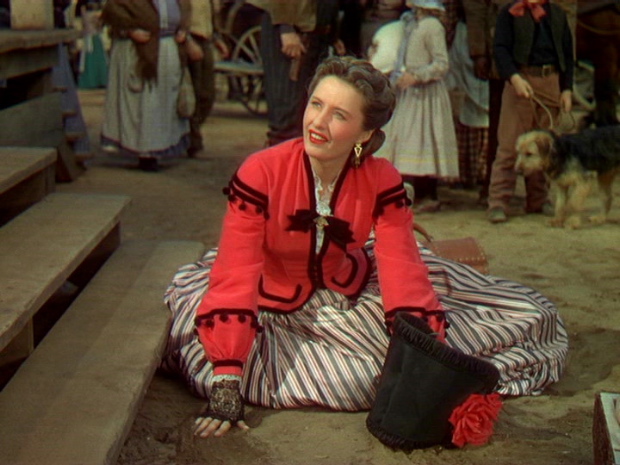
John
Farrow wasn't by any means a great director but he was a very
interesting man and he made some very interesting movies. A devoted
Catholic and a serious student of Catholicism — he wrote a book about
the history of the Popes — he was also known as a mean son-of-a-bitch
on the set who liked to bully his actors and crew. After shooting
wrapped on California (above), star Barbara Stanwyck demanded that he make a public apology to everyone who worked on the production.
On the other hand, she gives a terrific performance in California,
way better than the mediocre script deserves, and the film is filled
with surprising passages, notably a number of extremely long and
complicated scenes played out in single takes with extensive camera
moves. None of these, however, is framed or choreographed
dynamically, so they don't have the excitement of the long takes found
in the films of Welles or Renoir.
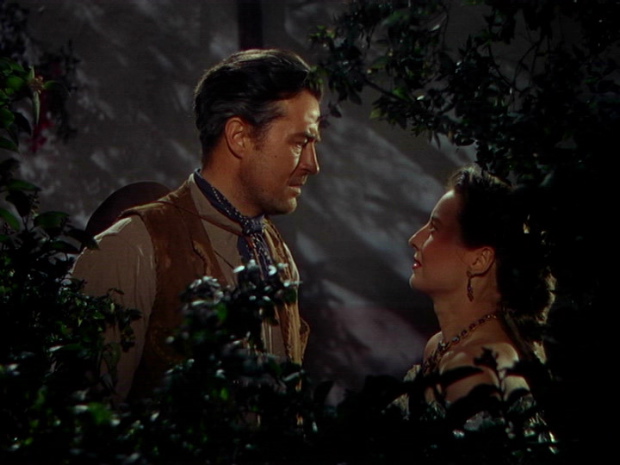
California doesn't have a
coherent tone in any respect. It has odd, grandiose montages with
opera-like chorales playing under them, and conventional Western
musical interludes in which characters sing improbably. The
gritty, sexy frontier hustler created by Stanwyck seems to be from
another movie.
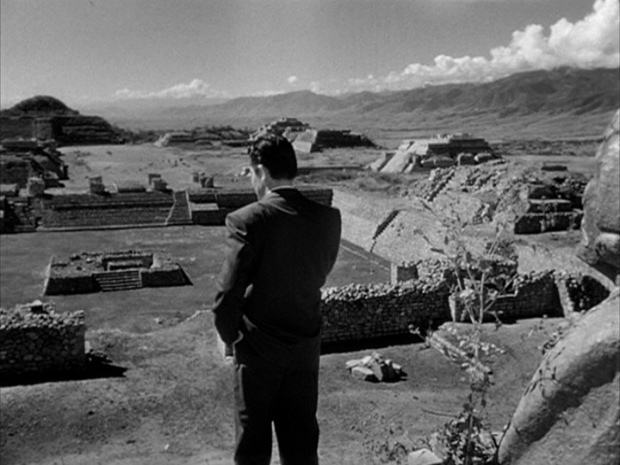
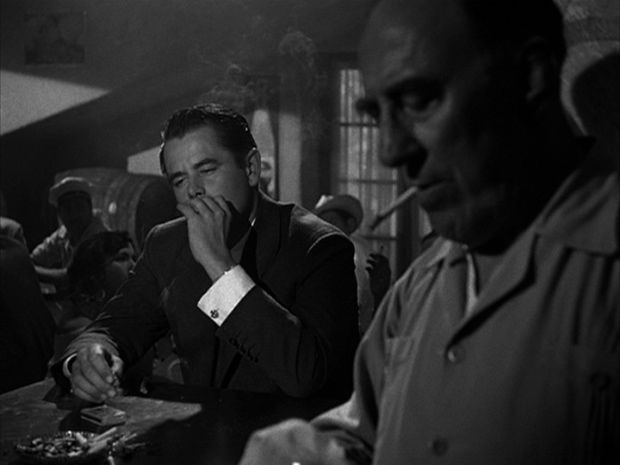
Farrow didn't seem to have a good feel for genre or for script. Plunder Of the Sun (above), filmed entirely, and very evocatively, on location in Mexico has one of the most stylish and promising film noir
openings ever concocted, but the story just dribbles away, turns into a
conventional treasure-quest adventure. Again, a superb central
performance — this time by Glenn Ford, tense with understated despair
— is wasted.
Still, there's usually something in a John Farrow movie worth paying
close attention to — some flight of inspiration that redeems the
clunkiest programmer. He had a kind of ambition, a kind of
vision, but it seems to have come to him in fits and starts.
Maybe the frustration of that was the source of his on-set rages.

In a previous post about Orson Welles's ill-fated Brazilian film It's All True
I mentioned that Welles came to see the history of the samba as the key
to Brazilian culture. I wondered if there might be a CD
collection that showcased that history. Of course there was, and
of course it was French — the French having a knack for combining
passion about American music with a logical approach to presenting it.
Fremeaux & Associates offers several historical surveys of
Brazilian music which give a good idea of what Welles found when he
visited the country in 1942. The one above surveys the samba
alone, which originated around 1917 as music for the Carnival and
eventually became a highly commercialized form of dance music
throughout the Americas in the 1940s.
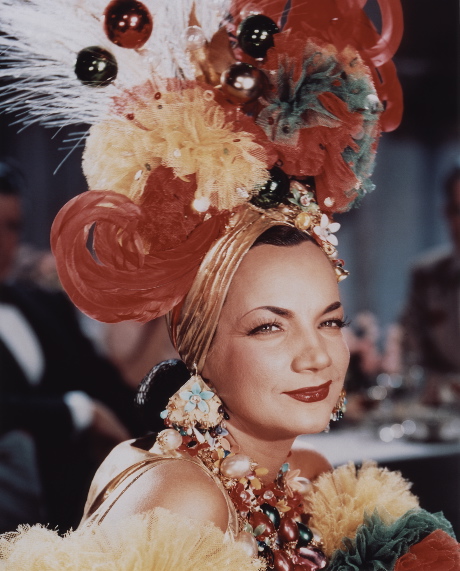
The great revelation of this set is Carmen Miranda in her pre-Hollywood
days. Before she became a musical comedy star, famous for her
tall fruit-basket hats (“Bananas is my business!”), she was one of the
musical treasures of Rio — a terrific and very sexy singer.
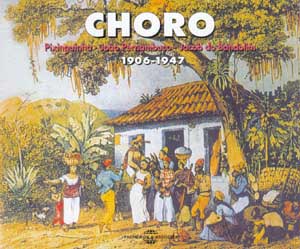
But samba, as it turns out, is just the rio
into which all streams of Brazilian music flow. The oldest style
it incorporates is choro, an instrumental form meant for listening, not
dancing. It usually features ornate flute lines accompanied by
various stringed instruments. It started out very European in
sound, with African rhythms adding flavor, but later became a bit more
rambunctious. Its evolutions are charted in the collection
illustrated above.

Other subsets include brass marching-band compositions and various
regional styles, many of which are charted in the Fremeaux
&
Associates collection above. Fremeaux offers a couple of other
historical surveys, but these three will give you a comprehensive
picture of Brazilian music in the first half of the 20th Century.
The pleasures they deliver are not primarily scholarly, however.
There's hardly a song on any of the two-disc sets which is less than marvelous, and all of them
will set you either dreaming or dancing. (The imported sets can
be found on Amazon, most cheaply through their Amazon Marketplace
sellers.)
Listening to these CDs you'll see right away what so enchanted Welles
back in 1942 and grieve anew that he never got a chance to finish his
film about Brazil and the samba.
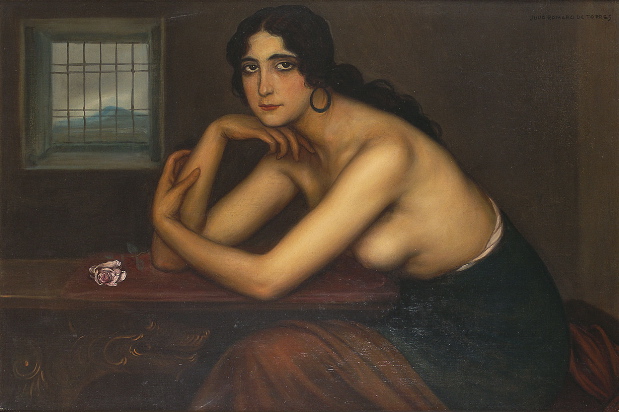
This wonderful portrait, Carmen Of Cordova,
is by Julio Romero de Torres, a Spanish painter of the late Victorian
and early modern eras. His images are dark, earthy and
erotic, with a hint of the perverse.
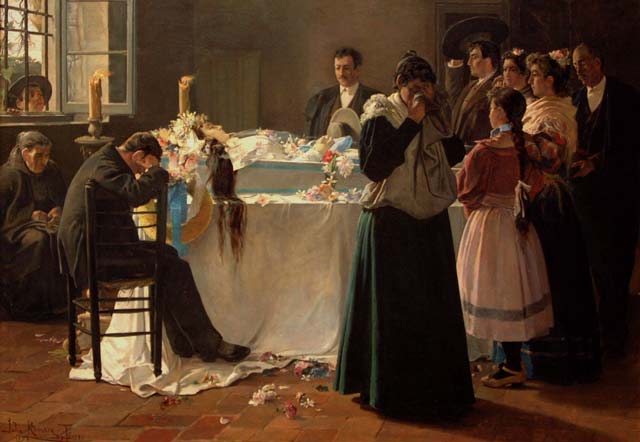
He started out doing conventional Victorian narrative tableaux, like the one above — titled Look How Beautiful She Was! — but eventually developed a more eccentric vision. Below, a twist on a famous paiting by Velasquez:

Like any respectable Spaniard he both loved and feared women . . .

. . . and also tended to see them in a mystical light:
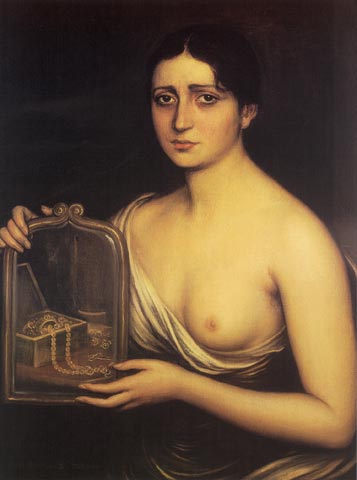
His sensibility represents an odd blend of the carnal and the spiritual
— always in his work, however sensual, we can hear the Spanish saying
“Where the body goes, there goes death.”
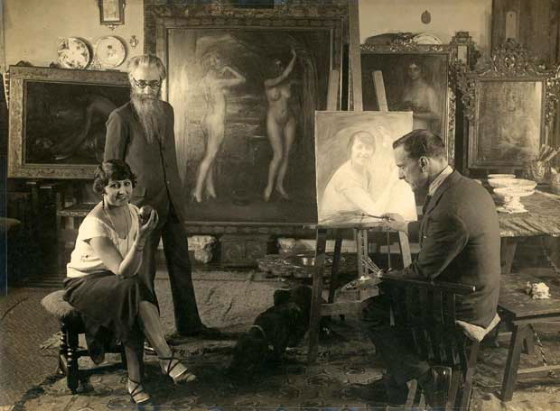
Above, the artist in his studio with a model and a visitor.
Romero de Torres was born and spent most of his life in Córdoba, taking
time out to serve as a pilot in WWI and to visit the Argentine, where
he got sick, returning to Córdoba to die at the age of 55. There
are no books in English which collect his work, although twelve more
books about the mildly amusing advertising artist Andy Warhol were
published last week.
Something is terribly wrong with our civilization — but you knew that.
There is a museum in Córdoba which lovingly preserves his house and work, which you can visit virtually here.
Thanks, as so often, to Little Hokum Rag and Femme Femme Femme for pointing the way to this enchanting painter.
Jean-Luc
Godard once observed that, with the passing of time, the fantasy films
of Georges Méliès have become actualities, now that man has in fact
made a voyage to the moon, while the actualities of the Lumière
Brothers have become fantasies, since they record lost worlds to which
we can never return, as mythological now as Oz.
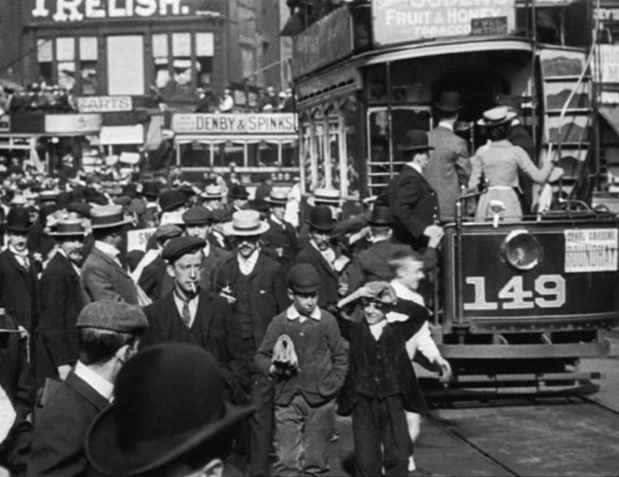
I thought of this while watching Electric Edwardians,
the Milestone DVD of Mitchell & Kenyon actualities of Edwardian
Britain. I must say I was blown away. It's the most
gorgeous collection of cinematic images outside of Intolerance or Sunrise or Welles's Falstaff, lyrical and deeply moving.
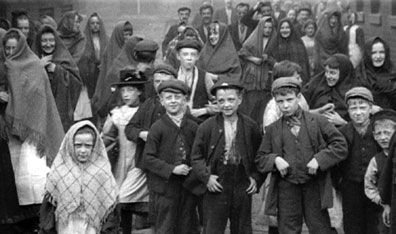
With the
possible exception of a few infants who lived to a great age, all the
people in these films are dead. As a commentator on the DVD
observes, the young boys in the films were part of a generation that
would be swept into oblivion long before their time by the mass carnage
of the Great War a decade or so later. The bustling street life
that most attracted Mitchell & Kenyon becomes for us now a memento
mori, incredibly sweet and sad.
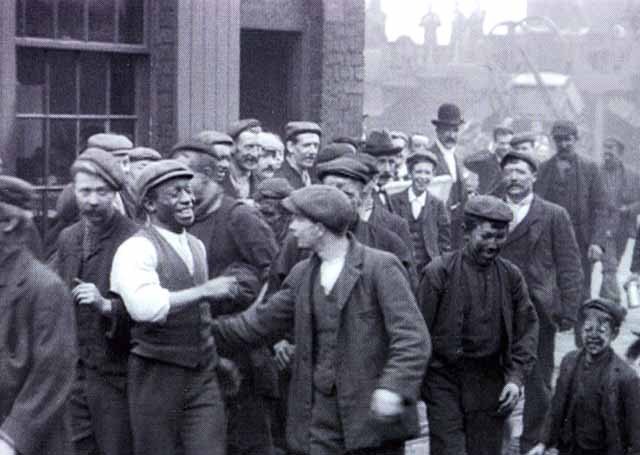
I can't imagine
that anyone who loves movies and owns a DVD player wouldn't want to
have this DVD and to watch the films on it over and over again.
They may constitute a kind of unconscious art, but it's art of a very
high order.
In 1942, right after he finished principal photography on his second film, The Magnificent Ambersons,
but before editing on it began, Orson Welles headed off to make a film
in Brazil promoting inter-American friendship. America was at war
and Welles had been convinced by the government that it was his
patriotic duty to undertake this assignment, designed to keep our
neighbors to the south from drifting into the sphere of Axis influence.
Welles, exempted from military service by various ailments, could
hardly have refused. He planned to make an omnibus film mixing
fictional and documentary episodes
— a kind of essay on aspects of South American culture. He fell
in love with Brazil and groped his way slowly towards a form in which
to convey what he found there, finally settling on the history of the
samba as a key to the society.
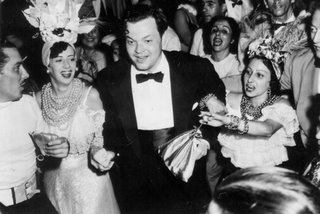
His groping frustrated his corporate masters at RKO back in
Hollywood. They were also worried that much of his documentary
footage of Carnival and the samba clubs of Rio showed what they called
“jigaboos” mixing and dancing with white people. It was precisely
this racial diversity that Welles admired in the Brazilian culture.
Eventually RKO pulled the plug on the project. Welles was left
with one camera, no sound equipment, 40,000 feet of black-and-white
film and $10,000. Hoping to salvage something from the adventure,
he headed north to what was then the small coastal village of Fortaleza (below) to make a documentary-like reconstruction of a
legendary event in recent Brazilian history — the 1500-mile voyage of
four fisherman on a crude sailing raft to present grievances to the
government in Rio.

The voyage made the four men national heroes, and they were received by
Brazil's strongman leader, a sort of populist dictator, who granted the
substance of their demands.
Welles shot most of the footage he needed for this film-within-a-film,
but was never allowed to edit it. After his death, the footage
was assembled into something presentable and included in a documentary
about Welles' ill-fated Brazilian project. The documentary is now
available on DVD:
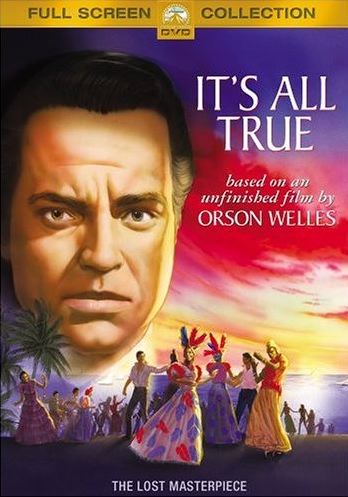
The episode of the four fishermen, even crudely reconstructed, is
simply stunning. It may be the most beautiful semi-documentary
ever made. Eisenstein's very similar project, done in Mexico a
decade earlier, ¡Que Viva Mexico!, looks like static fashion photography by comparison. Four Men On A Raft, as Welles called the episode, also blows away the semi-documentaries of Robert Flaherty (like Nanook Of the North) and Michael Powell (The Edge Of the World.)
Welles's images are dynamic, lyrical, full of movement and yet also
convey a convincing documentary feel. They are cinematic poetry
of the highest order.
Simon Callow, in his multi-volume biography of Welles, says that if
Welles had shot nothing else in his life but this footage he would have
to be recognized as one of the supreme masters of cinema. This is
true.

While Welles was creating this miracle in Brazil, the executives at
RKO, with the aid of some of Welles' most trusted associates, were busy
mutilating The Magnificent Ambersons.
They blamed the collapse of the South American film on Welles's
procrastination and extravagance, even though he had not exceeded the
project's budget at the time it was scrapped. The vandalism of Ambersons
had a vindictive quality to it, to judge by internal RKO correspondence
on the subject, and the myth of Welles as an irresponsible artist,
created by RKO to justify its actions, which included the dismantling
of Welles' production unit at RKO, haunted him for the rest of his life.
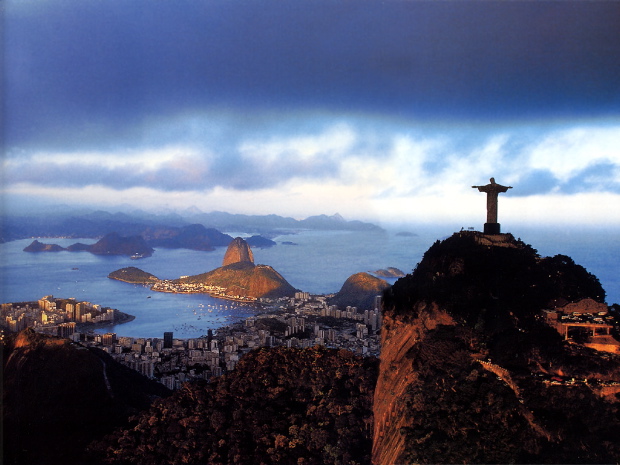
RKO made a point of destroying the footage they cut from Ambersons, although Hollywood figures like David O. Selznick begged them to preserve it, but the It's All True footage somehow survived. It includes ravishing Technicolor sequences shot in Rio, some of which can be seen in the It's All True documentary . . . and the material for Four Men On A Raft. (The color images above are not from the film.)
Do
yourself a favor sometime and have a look at the material on the DVD —
unfinished as it is, it's still one of the treasures of 20th-Century
art.
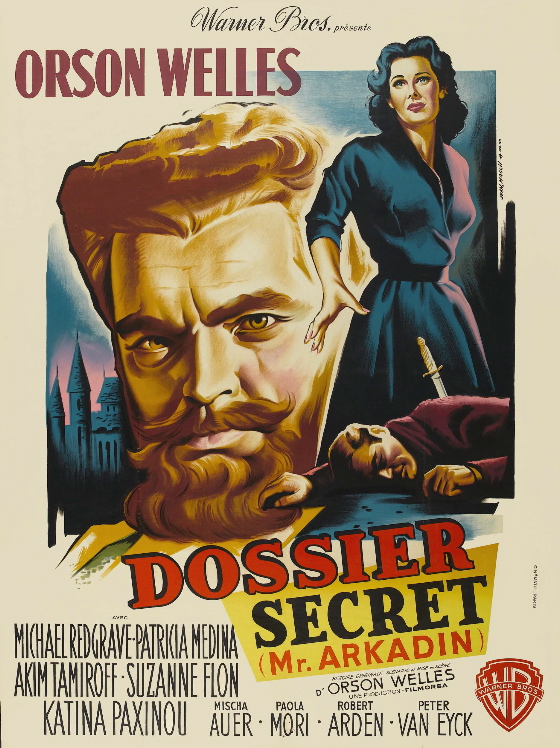
[With plot spoilers . . .]
Mr. Arkadin,
Orson Welles's very strange film from 1955 (also known as Confidential Report), is a kind of parody of an
international suspense thriller — with a cartoonish expressionism of
style that sometimes verges on the Gothic, on the perfectly preposterous. Welles plays
the fabulously wealthy tycoon Gregory Arkadin, a man who is not at all what he seems to be
— and he plays him in a false nose and a bad beard and an even worse
wig that seem to make a joke of the whole proceedings.
Arkadin is ostensibly trying to keep the secret of his scandalous past
from his daughter, but this aspect of the story is barely dramatized
and totally unconvincing. We have no sense that the daughter has
anything invested in the image of her father as a respectable man, no
sense that she (or anybody else) sees him as a respectable man, and we're offered no psychological insight into why his daughter's good opinion of him matters to Arkadin.
But Welles never had much interest in psychology — anymore than
Shakespeare did. For a great dramatist, psychology is always a
reductive science. Why does Hamlet pretend to be mad? To
make himself seem less threatening to Claudius? To amuse himself
with play acting? Os is it because he is mad, and knows he's mad,
and enjoys the black irony of pretending to be what he actually is?
There are no answers to these questions. People have been
psychoanalyzing Hamlet for 400 years precisely because Shakespeare
didn't.
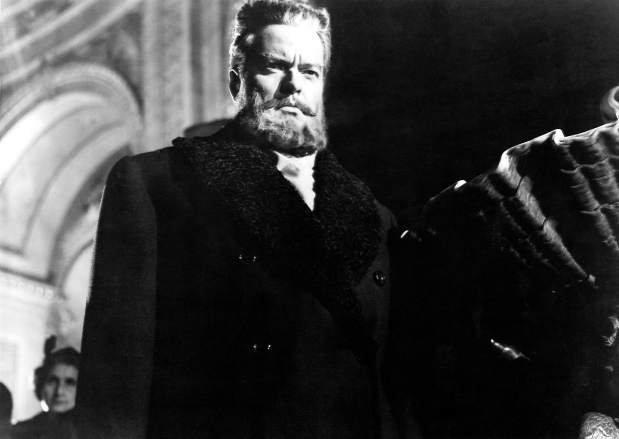
There's no point in psychoanalyzing Arkadin, either — he is a perfect
blank at the center of Welles's film. But, by a wonderful mystery hidden in the storyteller's art, we learn all we need to
know about him at the fringes of the film — including his terrible
“secret”, which, like the character of Arkadin himself, is not at all what it seems to be.
The clue to everything lies back in Warsaw, before 1927 — the year in which
Arkadin claims he was afflicted with amnesia. We eventually learn that the
“amnesia” was self-induced. But what was he trying to forget?
The petty crook Arkadin hires to investigate his supposedly lost past
talks to people who knew Arkadin or his associates in
Warsaw. Although they are recalling a criminal underworld, they
all speak of Warsaw as though it was, in fact, a lost paradise — now
(in 1955) locked behind the Iron Curtain, a place they can never revisit.
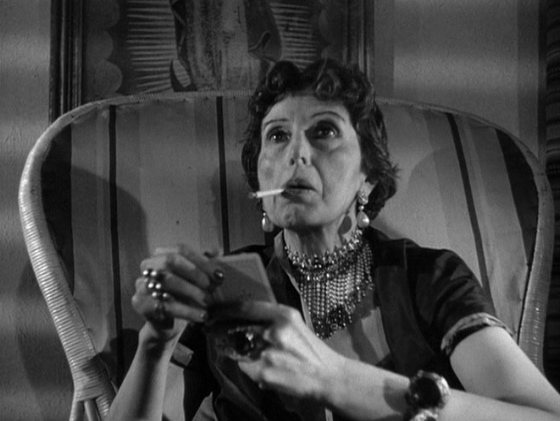
Finally, what “Warsaw” really means is revealed by Arkadin's old lover
there, now a faded beauty who speaks of him and of their time together as worth the
betrayal that ended it all. “Warsaw” is simply youth — it's the
loss of this that Arkadin cannot abide. It's what has engendered
his vaguely incestuous obsession with his daughter, it's what leads
him to kill off all his old associates from Poland. Not to hide his
crimes but to wipe away the evidence of passing time, of the lost
paradise — the evidence that he was a
lover once, that he had comrades-in-arms . . . a connection to other human beings.
Welles's performance as Arkadin offers us only one moment when real
emotion seems to grip the character. It's the moment when he
looks into the decayed face of his last surviving friend
from Warsaw — and laughs, with an imperfectly disguised fury that is
genuinely chilling. When asked what it is he finds so funny,
Arkadin replies, “Old age.”
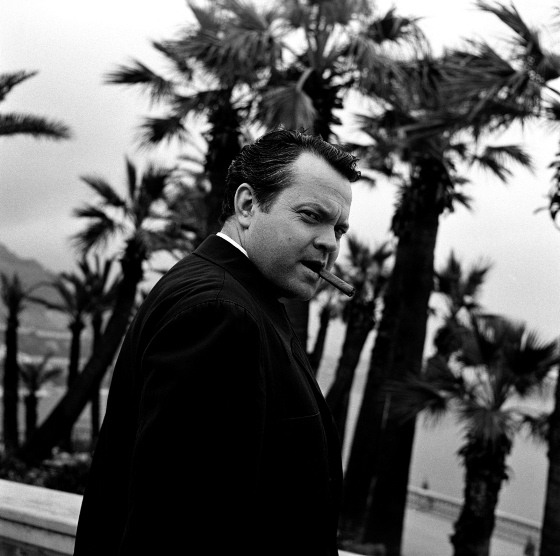
The story of Mr. Arkadin had its origins in a script Welles wrote for an English radio series he starred in, The Lives of Harry Lime.
There the name of the man of mystery is Mr. Arkadian, with its clear
reference to Arcadia, the mythological paradise which is also used as a
synonym for death, as in the Latin phrase Et in Arcadia ego . . . “even
now I am in death.”
In the film, Arkadin recounts a dream he has of walking through a
cemetery whose tombstones all record very brief lifespans. He
learns that they in fact record the spans of friendships — these being
the true measures of a life. This is the graveyard Arkadin now
inhabits — literally killing off his old friends is just his expression of
rage that they are dead to him already, and thus that he is dead.
The Latin phrase quoted above found its way into the Anglican Book Of Common Prayer,
in the burial service — “In the midst of life we are in death.”
That might serve as Arkadin's motto — one he cannot accept.
In the end, scared of losing his last friend, his daughter, he kills
himself. Because of the oblique way Welles has chosen to tell his
tale, we feel no great emotion at this. But our minds keep
drifting back to the monologue about the old days delivered by
Arkadin's aging lover from Warsaw — one of the most memorable scenes in cinema history. This is the narrow aperture
though which we get a glimpse of the real Mr. Arkadin, fleeting,
devastating, heartbreaking. Like Kane, he is, very simply, a lost
soul, bewildered and ultimately destroyed by his aloneness.
To have told us this in so many words would have been to trivialize the
insight. By making us tease it out for ourselves, feel it as a
haunting melancholy at the edge of consciousness, Welles takes us
inside Arkadin in a way Dr. Freud could never have managed.

The Democratic Party continues its triumphant march to
oblivion. John McCain can probably nap between now and 4 November
and still wake up on the morning of 5 November as the President-elect.
What we're seeing I think is a phenomenon characteristic of monopoly
“capitalism”, something that might be called morbid inertia.
Large
institutions which are accustomed to monopoly power in some arena
cannot change, even when they are marching towards the edge of a cliff.
So the recording industry, faced with widespread consumer revolt
against the shoddiness and overpricing of its products, made possible
by a virtual monopoly over distribution, will not change its products
or its marketing methods when a new system of distribution
emerges. It tries instead to enforce the old distribution system
by legal (and illegal) actions which have no logic and no hope of
success. It sues soccer moms for downloading a few songs, it
introduces the concept that consumers don't own the songs they buy, or
even the machines which play the songs they buy.
So the television networks, losing market share steadily, year after year,
refuse to adapt to new conditions and keep doing the same old
things over and over again — going for the last cash they can squeeze
out of a paradigm which even a child can see is doomed.
So Hollywood refuses to make films for large segments of the public and
concentrates instead on the one segment it thinks it knows best, young
males, and fails to satisfy even them on a regular basis. The
market, reacting in kind to this contempt for consumers, resorts to
casual piracy, which Hollywood then identifies as the source of all its woes.

So the establishment of the Democratic Party, faced in Barack Obama with the almost unimaginable gift of a
transformative candidate who is swelling its ranks with new, young
voters, the Democrats of the future, and building a new and virtually
inexhaustible fund-raising base of millions of small-time donors,
clings to its old ways and tries to muscle an establishment, machine-anointed candidate
into the White House against the will of the majority of voters.
The larger issue underlying all this is a general atmosphere of greed
and despair, a philosophy of “get it while you can before the whole
thing blows up in your face.”
The great institutions of our culture believe in nothing these days
except oblivion and grabbing a little more short-term power or
short-term cash before the apocalypse. The catchphrase of our time
is “The fierce urgency of me.” It's utterly irrational of
course. What good will power and money be after the apocalypse?
[Images by the redoubtable Fluharty.]
There lies the port; the vessel puffs her sail:
There gloom the dark broad seas. My mariners,
Souls that have toil'd, and wrought, and thought with me —
That ever with a frolic welcome took
The thunder and the sunshine, and opposed
Free hearts, free foreheads — you and I are old;
Old age hath yet his honour and his toil;
Death closes all: but something ere the end,
Some work of noble note, may yet be done,
Not unbecoming men that strove with Gods.
The lights begin to twinkle from the rocks:
The long day wanes: the slow moon climbs: the deep
Moans round with many voices. Come, my friends,
'Tis not too late to seek a newer world.
Push off, and sitting well in order smite
The sounding furrows; for my purpose holds
To sail beyond the sunset, and the baths
Of all the western stars, until I die.
It may be that the gulfs will wash us down:
It may be we shall touch the Happy Isles,
And see the great Achilles, whom we knew
Tho' much is taken, much abides; and though
We are not now that strength which in old days
Moved earth and heaven; that which we are, we are;
One equal temper of heroic hearts,
Made weak by time and fate, but strong in will
To strive, to seek, to find, and not to yield.
— from Ulysses
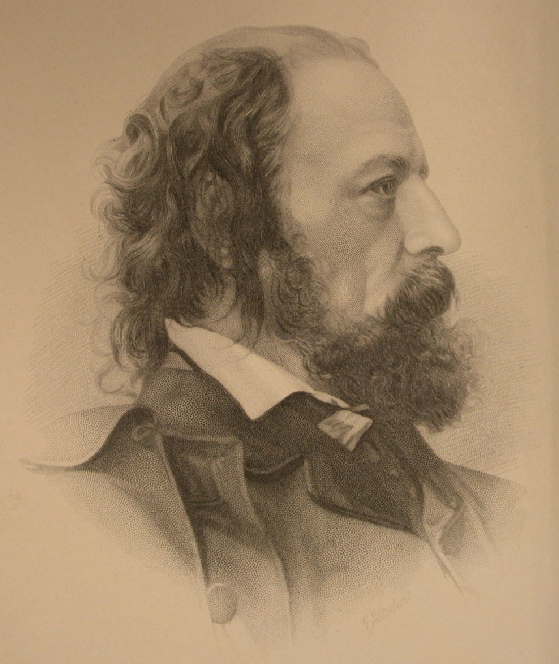
Engraving of Tennyson by G. J. Stodart
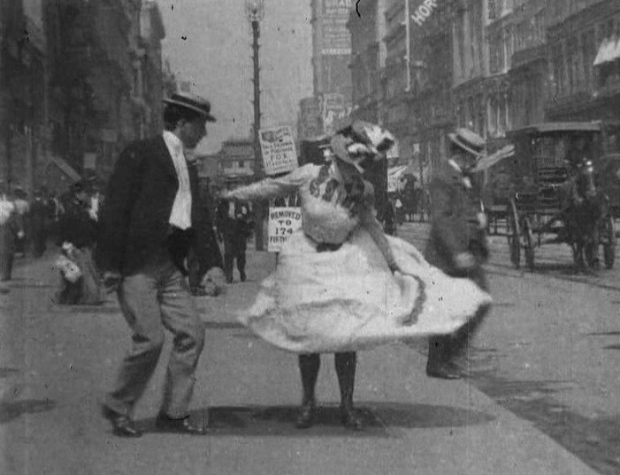
Check out The Art and Culture Of Movies,
a great blog by filmmaker and writer Matt Barry, for some interesting
thoughts about film pioneer Edwin S. Porter (director of the The Great Train Robbery from 1903.) The post is illustrated with terrific screen shots from Porter's films. (The frame above is from It Happened On 23rd Street — shot in 1901 on a block, between 5th and 6th Avenues, which looks almost the same today, architecturally speaking.)
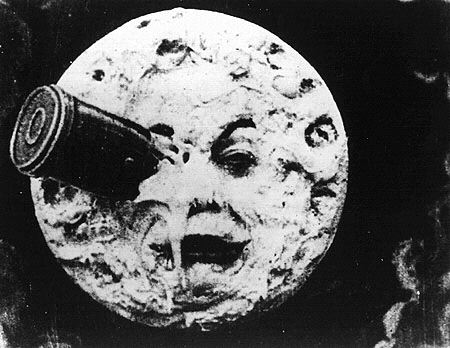
From
a strictly historical, generic perspective, the work of Georges Méliès
was a kind of magical dead end. Although his films are commonly
spoken of as the precursors of science fiction and all forms of film
fantasy involving special effects, they are in fact so peculiarly
original in form, so deeply rooted in the traditions of the stage, that
they presaged nothing.
Méliès
was a magician and the operator of a theater dedicated to stage
magic. He used cinema as an extension of the sort of acts he
performed and presented in his Théatre Robert-Houdin, built as a
showcase for his own art by Robert-Houdin, the great 19th-Century conjurer, the
legendary pioneer of modern theatrical magic (and the man after whom
his masterful successor Houdini named himself.)
Méliès
saw cinema as a way of presenting stage magic and amplifying its
effects by the use of in-camera tricks like stop motion and
super-imposition. His images evoked the stage precisely, with
strict proscenium framing and frankly theatrical painted flats and
props. He used many practical tricks from the stage, like flying
people and objects on wires or making them appear and disappear
through traps. He added his camera tricks on top of these
time-worn effects.
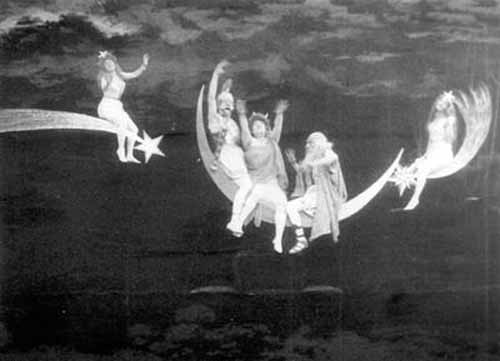
The problem was that camera trickery is not the same as live trickery
in the presence of the trickster — the novelty of camera tricks
dissipates quickly, once you become familiar with them. Méliès's
films were wildly popular for a while and then, with the rise of the
narrative form in movies, suddenly went out of fashion — to a degree
that live magic shows never have. In great live magic shows, you
know you're being tricked, but you can't for the life of you figure out
how. You may not know exactly how a camera trick works, but you
know it has to do with some fundamentally technical resource of the
medium — and so can't
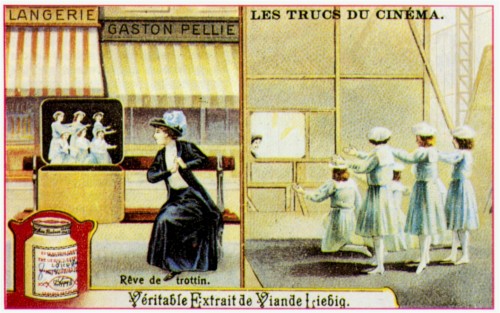
be real magic. As early as 1905 people began to get wise to the
mechanical tricks of movies, as this postcard, part of a series, shows:
In movies, if the tricks are not done in the service of a story, or at
the very least in the service of creating a convincingly unified
alternate reality, they grow stale. Méliès
never tried to create a convincingly unified alternate reality — his
reality was always the reality of the stage, without the excitement of
the live presence of the performers. His magical stop-motion
substitutions were charming as ideas but could never take the breath
away like the “impossible” substitutions of the live magician.
Méliès
could not, in short, enlist the magic of the camera as an extension of
the magic of live stage performance. He created a vision of a
theater where anything was possible but in the process he lost the core
of the theatrical experience — the tangible presence of its spectacle.
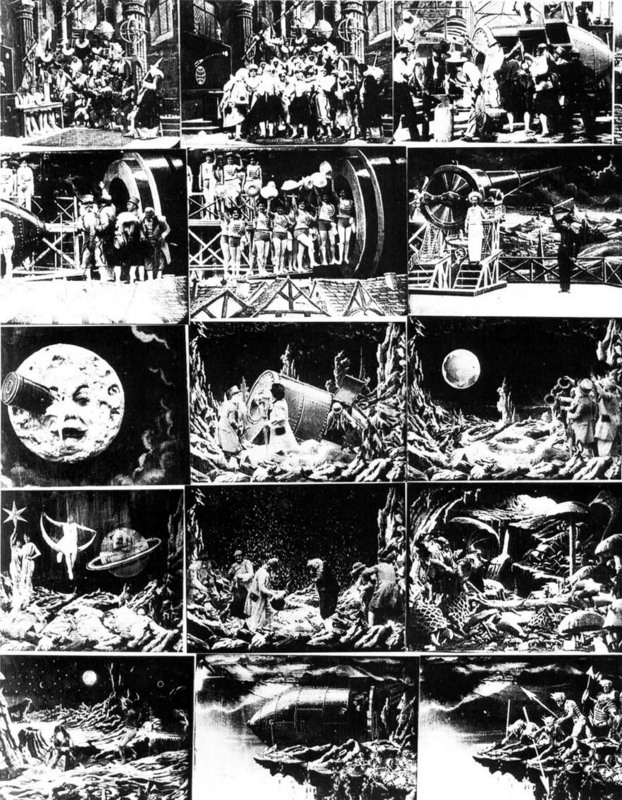
Méliès influenced other filmmakers, like Edwin S. Porter, in the area of narrative. Méliès's
films occasionally have simple narrative structures, but these are
always just the armature for his tricks. He called his scenes
tableaux — they were self contained, and he was perfectly happy to
sell individual scenes as stand-alone attractions to the fairgrounds
showmen who constituted the initial market for his films. Each
scene had a gag, after all, and he saw the gags as the principal element of his
art.
When story films began to dominate the market he lost interest in the
industry, even as his audience lost interest in him. Storytelling wasn't at the heart of his ambition.
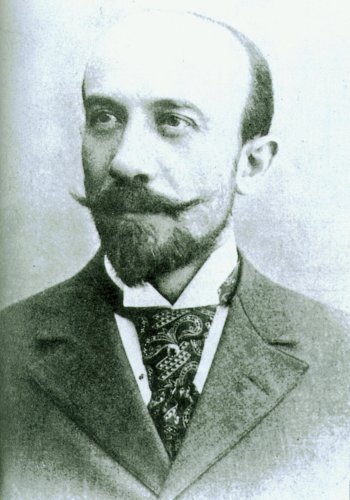
This is all speaking to the formal side of Méliès's work, but of course it had qualities which transcended its formal side. Méliès
had a sweet, antic, energetic, whimsical imagination which comes across
excitingly in his films, even today. It reminds one of the
imagination of the great Warner Brothers cartoonists of the 1940s,
silly, flip and surreal. But cartoon animation was of a piece and
so created an alternate universe that was of a piece, that audiences
could surrender to wholly. Méliès,
who never could leave the imaginative precincts of his beloved stage,
doesn't allow that kind of identification — we are always reminded
that we are, and are not, in a theater.
Méliès
was, in one sense, a great artist who made ephemeral art, in a form
that had no future. But his irresistible sensibility often soars
above the contradictions of his formal means. His films will
always be fun to watch, simply because it's so clear that he was having
an incredible amount of fun making them. He communicates his joy in stage magic and his
joy in camera magic, even if he never quite finds a way to reconcile
the two practices aesthetically.
In the history of cinema, his only legacy is joy — but there are many more important formal pioneers who left us less.
Nothing has ever been too good for the public.
Nothing has ever been good enough for the public.
Amen.
Follow this link for the third in a series of essays in honor of André Bazin . . .
The third in a series of essays in honor of André Bazin.
In a previous essay in this series I wrote:
As long as a movie constructs a substantial and coherent alternate
reality it has the power to express and manipulate our emotions.
As long as it delivers the illusion of a world that is convincingly
real while we are inside it
a
film can mimic the process of dreaming. Cinema is not about, or
not only about, the mummification of reality — it is about the
translation of psychology into the realm of oneiric reality, and the
essential quality of oneiric reality is that it feels absolutely real.
But this doesn't quite tell the whole story. Even in the grip of
the most convincing oneiric illusion, there is a part of the brain that
recognizes it as an illusion. This accounts for the exhilaration
we feel when, for example, we find ourselves able to fly in a dream.
We are conscious on some level that we have been freed from the usual
restrictions of gravity, which means that some part of us remembers the
usual restrictions of gravity — we are enchanted to find ourselves in
an alternate physical universe.
There are also moments in dreams when the waking self intrudes into the
oneiric universe — something so outrageous happens in the dream that we think,
“This must be a dream,” and we think this while dreaming. (This is usually a prelude to waking up, since the dream
state can not long survive rigorous evaluation by the mind of the
waking state.)
Whatever psychological compensations and satisfactions we get from the
oneiric state, there is always, to one degree or another, a
corresponding sense of wonder at the alternate universe we have entered
— a sense of inhabiting two states at the same time. The unreal,
and therefore constructed, nature of the dream state invests it with the quality of magic.
The same rule applies to the dreamlike illusion of cinema, though on a
level that is consistently closer to consciousness. However
seduced we might be by the alternate universe of the cinema, the sides
of the screen are always there in our peripheral vision. The
visible boundaries of cinema's dream space place a greater burden on
the medium to seduce us into forgetting those boundaries, but also remind
us delightfully of the constructed nature of that dream space, which
induces wonder.
There are other phenomena related to cinema which offer even more
obtrusive reminders of their constructed nature and can actually seem
all the more wonderful for that. We see precisely how they are
seducing us, and yet we cannot help but be seduced — and we marvel at
the process as a process. One might point to elaborate miniature
environments, for example, like fantastically detailed and realistic
doll houses, or to the Bunraku puppet tradition. In the latter,
we can plainly see the puppeteers manipulating the puppets, wearing
black clothing to symbolically distance themselves from the puppet
figures — and yet the movements of the puppet figures are so real, so
like the movements of actual human beings, that we have to remind
ourselves that they are not in fact tiny people.
Realistic automata, toy soldiers, dolls, puppets of all kinds, can
plunge us into this middle world between illusion and the consciousness
of illusion. The joy they all induce must be complex, difficult
to define precisely, but I think it rests on two bases. One is
the creation of an alternate reality very like everyday reality in many
crucial respects but entirely within the control of human agents —
including ourselves as spectators, who can surrender to or resist the
illusion at will. Another is the creation of an alternate reality
in which psychological tensions and desires can be safely engaged — as
they are engaged in dreams. Thus little children can enact
fantasies of mastery by moving small armies across tabletops, or fantasies
of nurturing by parenting dolls.
All of these things are related to the joys of cinema. Thus we
can see the fundamental error of André Bazin's “ontology of cinema” —
which he saw as rooted in the shared ontological identity of the
photographic image and its subject, like the ontological identity
between a finger and its fingerprint. This ontological identity
does exists in photographed cinema, but it is not the source of its
power — it is only a technique for creating the convincing illusion of
a coherent alternate reality.
As I've observed elsewhere, drawn and computer-generated animation can
also create such an illusion — as can the the techniques of
scale-modeling and puppetry.