ESSAY IN HONOR OF ANDRE BAZIN: WORD AND IMAGE

Follow
this link to an essay on the place of popular visual art in the
intellectual culture of the modern age — the first in a series of essays
dedicated to the great film theoretician André Bazin.  I couldn't
find appropriate images to illustrate this essay and in any case it's
too long and serious to be a regular web log post, but some might find
it interesting . . .

JOHN ADAMS

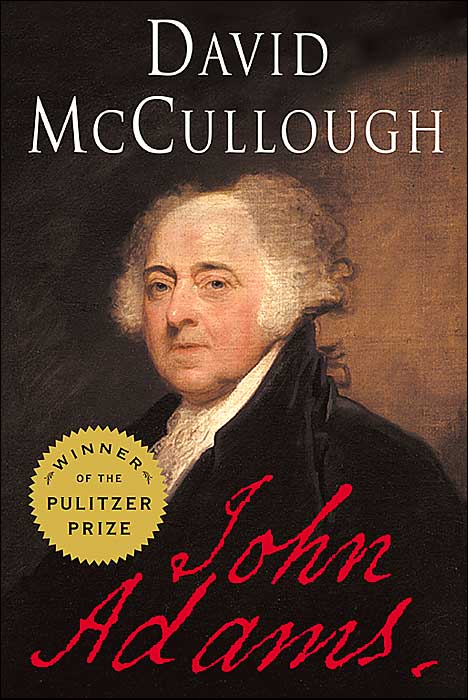
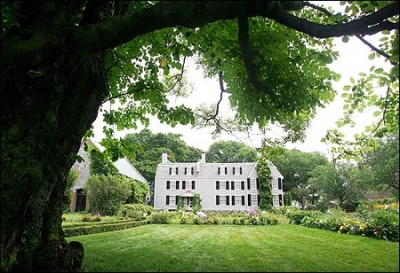
I commend to all my fellow citizens of this republic David McCullough's wonderful biography John Adams. 
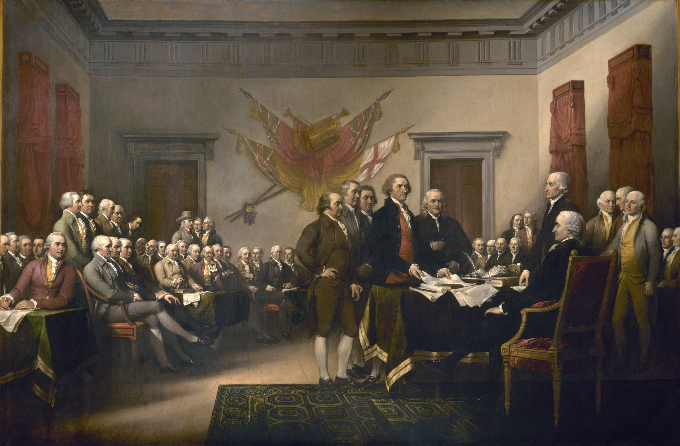
(That's Adams, bald and slightly pot-bellied, standing in the exact
center of John Trumbull's painting of the signing of the Declaration Of
Independence, above.)  Erudite and sagacious the book is also
compulsively readable, magically evoking the physical world of the 18th
and early 19th Centuries but also bringing the men of the Revolutionary
era to vivid life.

The founders of the United States Of America were certainly the
God-damnedest collection of characters who ever collaborated on a great
enterprise.  They seem mysteriously modern, perhaps because they
remain so recognizably American
— frank, down-to-earth, open-minded, industrious, optimistic . . . also pig-headed, venal and hypocritical 
There were scoundrels and rakes among them, men of faith and skeptics,
simple farmers and grand seigneurs — but they were all so unaccountably radical in their devotion to the ideas (if not always to the practical realities) of liberty and equality, of self-government.

And they were brave.  All the men above seen signing the
Declaration, many of them men of great wealth and position, would have
been hung as traitors by the English if their improbable revolution had
failed.  They don't seem to have had the slightest doubt that it
was a risk worth taking, and merely joked about the jeopardy — as
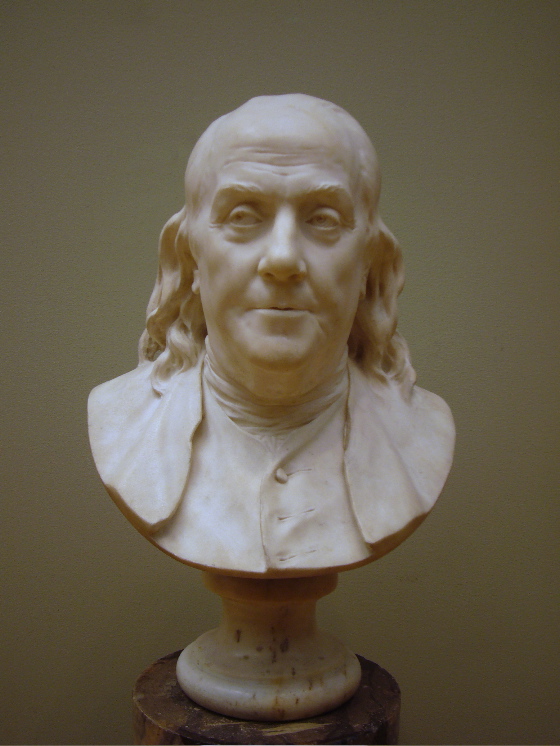
Franklin did when he said, “We must hang together or hang separately.”

It can't really be explained, except as a result of something that had
evolved over many generations in the experience of living in the new
world, habits of self-reliance and independence which the Founding
Fathers explicated and guided but did not invent.  Adams himself
knew this.  “The Revolution,” he wrote, “was in the minds and
hearts of the people.”

Adams may have been the oddest of all the “indispensable men” of that
time — neither a soldier nor a politician of any particular skill, not
a great writer or thinker but possessed of an orderly mind and endless
energy, he had a personal independence of thought and an an
incorruptible integrity which made him the go-to guy in any crisis.

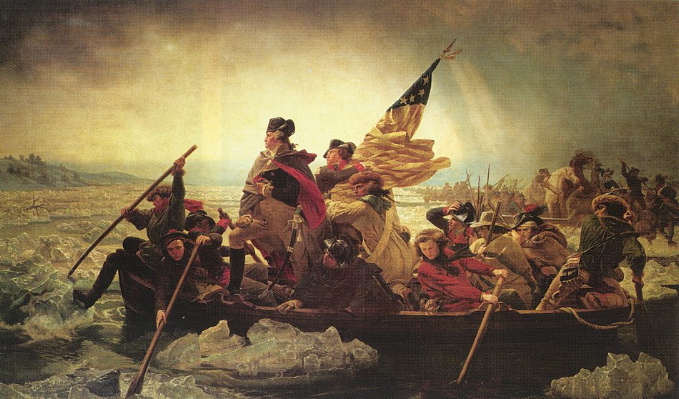
It was Adams who ensured the appointment of George Washington as
commander in chief of the Continental Army, Adams who procured loans
from the Dutch to keep the government afloat in the early days of the
Confederation, Adams who, in drafting the Constitution of the
Commonwealth Of Massachusetts, created a key model for the American
Constitution.

And it was Adams who served as America's first ambassador to the Court of St. James, received with honor as the representative of a new and independent nation by the same king who had once hoped to hang him.

The whole tale is surreal, unbelievable, but one loves Adams because he
didn't see it that way.  He seems always to have believed that the
seeds of liberty, once planted in good soil, would bear fruit — just
as the seeds he sowed on his Massachusetts farm brought forth peas and
corn.  At the end he was proud of what he had done for his
country, but he was just as proud of his farm.

Adams became President of course, for one term, after serving as George
Washington's Vice-President for two terms.  He lost his bid for
reelection to his then arch-rival Thomas Jefferson, and became the
first President to hand over the reigns of power unwillingly, convinced
that Jefferson would ruin the new nation before it could fairly get
going.  He groused about it, then jumped into a public stagecoach
and rode home, back to his farm, his peas and his corn.  He bowed
to the will of the people without further complaint.

In that moment, the American experiment justified itself to itself and to the whole world.

Perhaps the strangest thing about looking at these old
revolutionaries today is that they always seem to be staring right back at us, at the American future we
now inhabit.  In their regard there's hardly more than a trace of
self-satisfaction in what they accomplised, not a lot of sentiment, and
more than a little impatience.  “We started this business well enough,” they seem to
be saying, “now get on with it.”

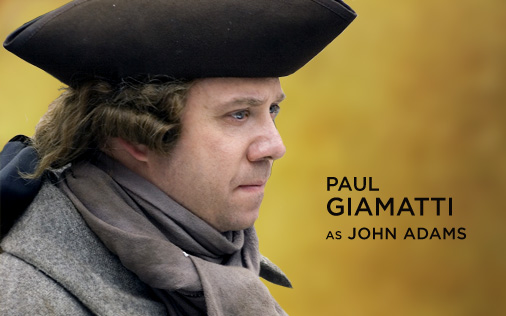
[I read the biography as a prelude to watching HBO's upcoming
mini-series taken from it, starring Paul Giamatti as Adams.  This
strikes me as a brilliant piece of casting, Giamatti having a knack for
conveying the kind of adorable peevishness which many people observed
as a characteristic trait of Adams.  The series will  premiere on March 16.]

IDIOT WIND

As
every political junkie must know by now, Texas had a two-step system
for choosing delegates to the Democratic Convention this August — a
primary in which about two-thirds of the delegates would be selected
and a caucus in which about a third of the delegates would be selected.

Only the results of the primary voting were known in the wee hours of 5
March — Hillary Clinton won in that voting, by a three-percent
margin.  The cable news services, anxious to put a period to the
day's events, reported that Clinton had “won Texas”, and this has become
the story out of Texas, Clinton's “Texas victory” one aspect of her
“comeback”.

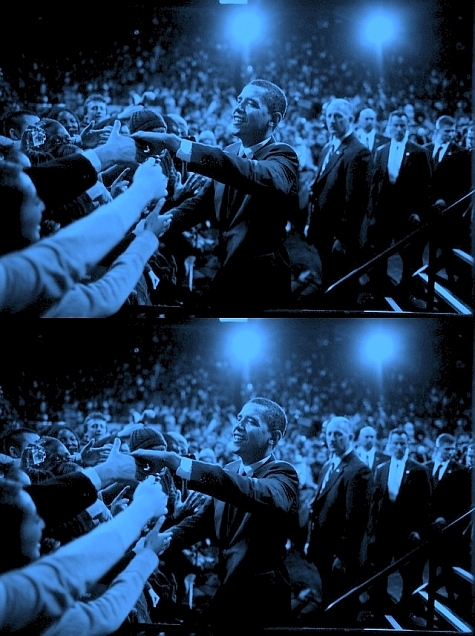
But with about 40% of the caucus votes tabulated it is clear that Obama
will win the caucus by a substantial margin and that he will gain about
six delegates overall from the Texas election.  By any measure, he
will win Texas, because he will win more delegates there.

Don't expect the corporate media to tell you this, or to make anything
of it.  The “Texas story” is set in stone now — Obama's victory
in Texas, when it becomes official, will just be a footnote.

The pundits of cable news are clowns, parroting the predictions of
fallible polls and dutifully reporting whatever spin the respective
camps decide to put out, without making the slightest effort to
evaluate the reliability of the press releases or media conference
calls.  They will justify themselves by saying that they're just
reporting on “the perception” that Clinton won Texas, even though they
created that perception by irresponsible reporting.

They're riding the idiot wind.

WOODEN PINHOLE CAMERA

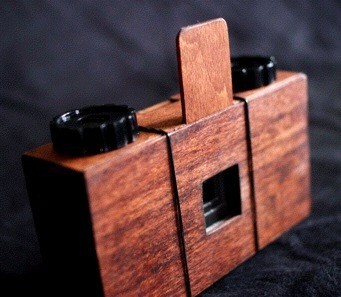
My friend Jae Song is selling a pinhole camera in a customized wooden casing online here.  It's awesomely beautiful and cheap, considering that the casing is handmade.

Jae, a brilliant cinematographer and expert on digital photography, writes this about the pinhole camera:


The thing I love about the pinhole camera is that it slows me down.
Because of the long exposures, the camera needs to be placed down at a
stable place and left alone for awhile. In this world of instantaneous
gratification, it makes me wait. And while I wait, it makes me really
look and see. I also like the fact there is no viewfinder, no lens to
set focus nor aperture to adjust. It’s just me and time. I am forced to
use my instincts. It brings back the thrill of mystery and wonder and
surprise when the film comes back from the lab.


Jae also sells hand-made kites in hand-made wooden boxes and hand-drawn
cards with pressed flowers — you can see all of his hand-made stuff here.

STREETFIGHTING?

Hillary
Clinton says that Barack Obama is not a secret Muslim “as far as I
know.”  It's good to see she's keeping an open mind on the
subject, unwilling to come to any definite conclusion until all the
facts are in.  That's the sort of nuanced judgment one likes to
see in an elected official.

Another inspiring thing about Hillary Clinton is that while Barack Obama talks a lot about hope Hillary is running a campaign grounded
in hope — the hope that she can cut a backroom deal with Super
Delegates to override the will of the voters in the Democratic primaries and caucuses.  That should make
the streets of Denver an interesting place to be this August when the Democratic Convention assembles there.

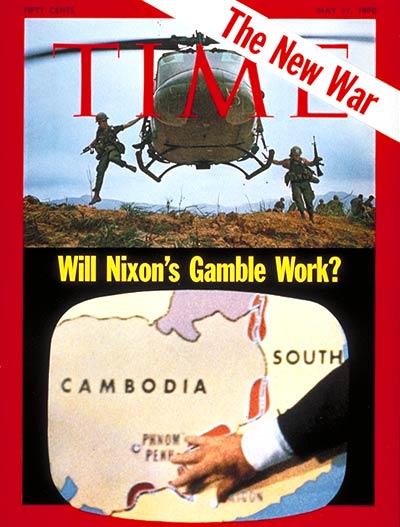
In a box somewhere I have the headband with a peace sign on it I wore
when I got tear-gassed in front of the White House
protesting Nixon's invasion of Cambodia and the Kent State killings in
1970.  (At the time I was trying to overturn one of the buses
lined up end-to-end around the executive mansion to keep me and a few thousand of my closest friends
from knocking down the wrought-iron fence around the White
House.)  To me the headband is like a campaign ribbon — a symbol of one of
the only signal services I ever did my country.

Am I going to have to pull that headband out again, Hillary? 
Am I going to have to totter through the streets of Denver like an old
Confederate veteran re-enacting Pickett's Charge at Gettysburg forty
years after the guns fell silent?  It won't be a pretty picture,
Hill — but I'm ready.

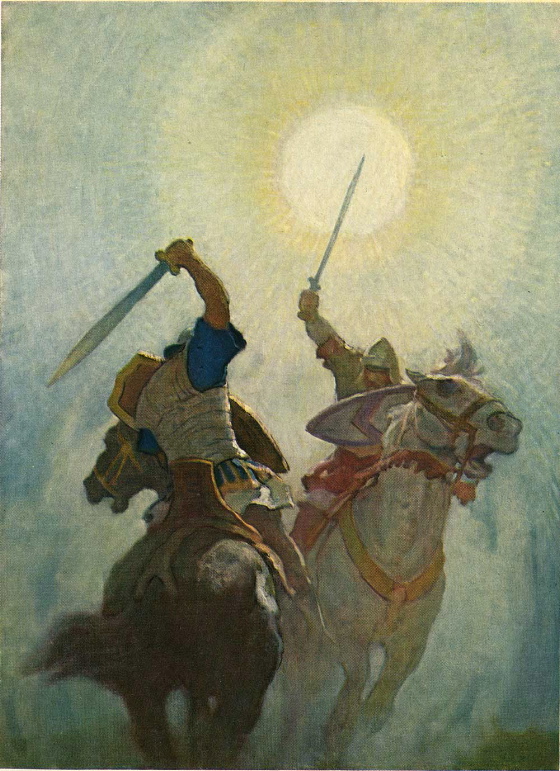
AN N. C. WYETH FOR TODAY

The above is an illustration by N. C. Wyeth for the book Legends Of Charlemagne
N. C. Wyeth, the father of Andrew, was the greatest of American book
illustrators and one of the greatest of American painters.  His
influence on cinema, especially the work of John Ford, cannot be
overestimated.

[The image is courtesy of the ASIFA-Hollywood Animation Archive, one of the most delightful sites on the Internet.]

WORD AND IMAGE

The first in a series of essays in honor of André Bazin.

Nothing
is so inaccessible to mainstream intellectual thought as popular
art.  Popular art derives much of its glamor from the sense that
it is new, at one with its time — to see its roots in the past is to
disenchant it.  At the same time, its very currency, the
perception that it is wholly of the present, robs it of value, brands
it as transient.  Add to this the modernist notion that art with
mass appeal is fatally compromised by commercialism and you have a recipe for
confining popular art to an intellectual ghetto.  It can be
studied as a sociological or political subject, as a stepchild of high art or as
amusing, suggestive ephemera, but it cannot be examined on it own terms.

The modern academy, and the critical traditions associated with it, may
sometimes attempt to examine popular art as an aesthetic and historical phenomenon
but the standards for such an examination are shabby — they would not
be tolerated by any other academic discipline.

The proof of this, I think, can be seen in the fact that we have no
critical language for discussing the unique visual methods of
movies.  The standard critical concepts for discussing movies are borrowed
from literature or painting.  The unique methods of cinema must be
suggested impressionistically or simply avoided.  In their
critical study of the films of King Vidor, Raymond Durgnat and Scott Simmon state
honestly that they have made no attempt to analyze Vidor's visual
methods, feeling that it's impossible to do so apart from the physical
presence of the films.

Of course it's easier to critique a work of art, especially a work of
visual or plastic art, in the physical presence of the work, but that
is not to say that critics have nothing useful to say about painting or
sculpture or dance — that their physical effects cannot be evoked and
discussed in words.

André Bazin took an heroic first step towards creating a critical
language for analyzing the plastic phenomena of film images but it has
never led to a general system of terms and concepts.

By the same token, there has been no systematic examination of the
aesthetic roots of cinematic technique, except insofar as these were based in the
literature of the novel or the stage.  There has been no
comprehensive investigation of the history and aesthetic of the comic
strip, though the comic strip has been with us since the beginning of
the 19th Century, and no comprehensive investigation of the history and aesthetic of Victorian academic
painting — that is to say, painting in the age of photography. 
Yet the comic strip and Victorian academic painting were far greater
influences on movies, on the aesthetic methods of movies, than the
literature of the Victorian stage, from which movies are customarily seen to have derived.

Intellectual fashion and a territorial segregation of word and image in
the academy have left the crucial arts of our time unexamined.  On
the whole this may be a good thing, since art that is unexamined in
this sense tends to be more innovative and vital than art which feels
itself accountable to an intellectual and academic authority.

Still, we should recognize the state of things for what it is.  We have no substantive intellectual access to and are discouraged from engaging intellectually (in any truly rigorous way) with the most vital and innovative arts of the past century and of our own time.

EL CID

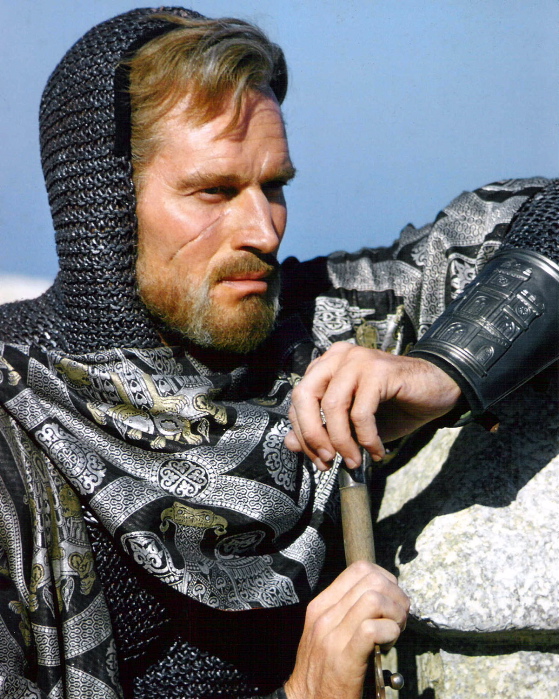
Finally . . . this extraordinary film is available on DVD, in a wonderful edition with lots of extras from The Miriam Collection, a new home video division of Miramax.

El Cid might be be the best of
all the widescreen epics.  It's visual style is bold, elegant and
often stunning, with none of the process photography that dates so
many big films from this era.  The narrative has tremendous momentum
and the melodrama is stark and wrenching, very adult for an epic,
inflected with a mature kind of eroticism.

Its tale of conflict between Christian and Moor in medieval Spain has
troubling resonances today, though the film makes an effort to
distinguish between humane and fanatical Muslims and to posit the idea
of an alliance between Christians and Muslims of goodwill.

The action sequences, stage by second unit director Yakima Canutt, who essentially directed the chariot race episode in Ben Hur,
are gripping and the choreography of the armies on the move and in
battle is both elegant and stirring.  No amount of computer
genius could ever dispose CGI soldiers and armies in virtual space this
beautifully and convincingly.

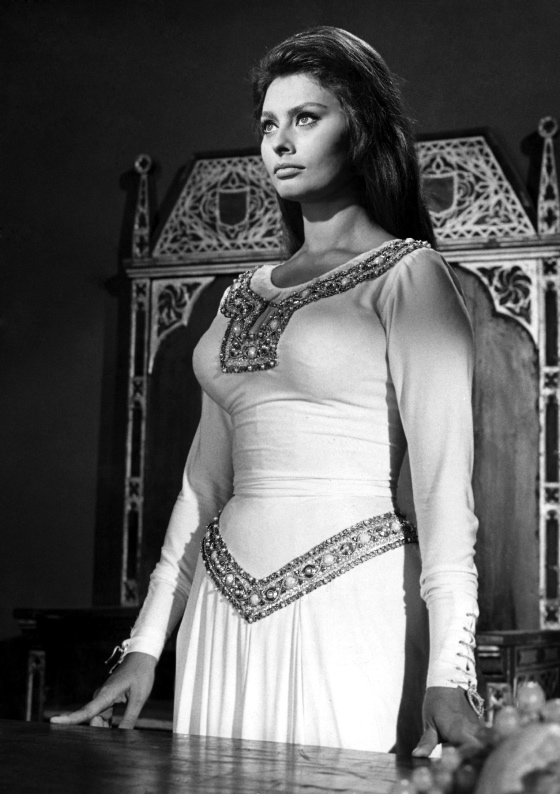
As a kid on the edge of puberty I had my first recognizably sexual
feelings while watching Sophia Loren in El Cid — she's a
breathtaking incarnation of the Eternal Feminine, with a power beyond
rational challenge.  Heston does what he does best — hold his own
plausibly against backdrops (and, in the case of Loren, bosoms) of epic
size.

The film has a dark, macabre undertone but is still wildly entertaining, and a great work of art and craft in the bargain.

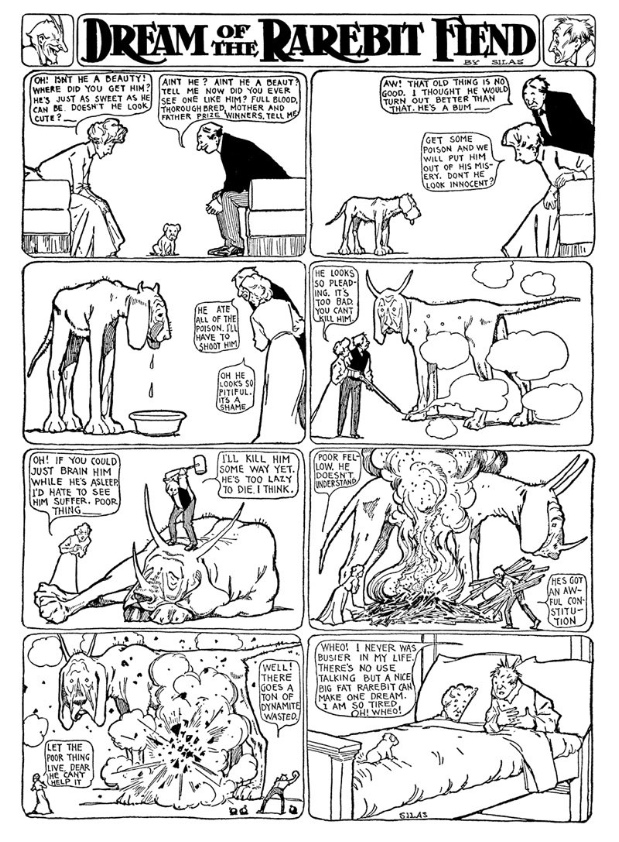
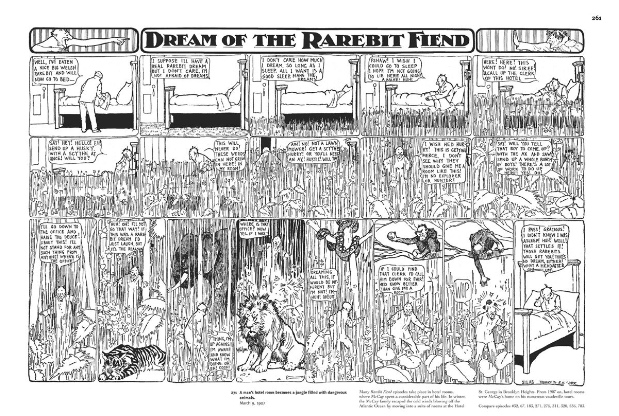
UNSPEAKABLY COOL: DREAM OF THE RAREBIT FIEND

The fourth of the four coolest books published in the last few years, like
two of the others, collects the work of Winsor McCay — in this case
the extraordinary strip Dream Of the Rarebit Fiend — but unlike the other three wasn’t put out by Sunday Press Books.  Privately published by Ulrich Merkl, it
includes all of the strips from the series — those not reproduced in
the book itself are supplied on a DVD that comes packaged with the book.

The book is gigantic and presents the strips, published between 1904
and 1913, in their original size.  It also has a wealth of other
illustrative material showing McCay’s sources and documenting the
enormous influence his images have had on America’s visual culture,
especially that of the movies.

The draftsmanship of the strips is stunning, the visual imagination exhilarating.  Its central gag involves the dreams of people given indigestion by eating Welsh Rarebit, making it a kind of run-up to McCay’s masterpiece strip Little Nemo In Slumberland, which illustrates the dreams of a restless little boy.

Merkl’s book, published in a limited edition, is expensive but worth every penny.  It lovingly documents a brilliant and endlessly enchanting work of popular art.

Check out my reports on the other three coolest books of recent years:

Little Nemo

Little Sammy Sneeze

Walt and Skeezix

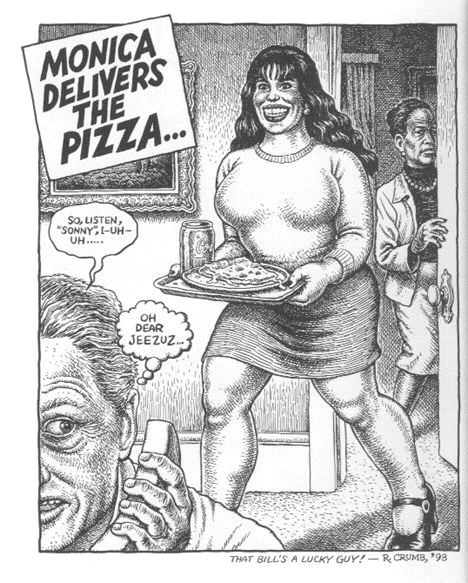
BACK TO THE FUTURE


[Image © 1998 R. Crumb]

With the circulation of the photo of Barack Obama looking silly (and oh
so “other”) in traditional Somali garb, it's clear that the Bill and
Hill machine is back on message, delivering its urgent warning to all
real Americans:

“The Negroes are coming!  The Negroes are coming!”

Bill and Hill have now officially used up all their passes for creepiness.  Voters of Texas, please — make them go away.

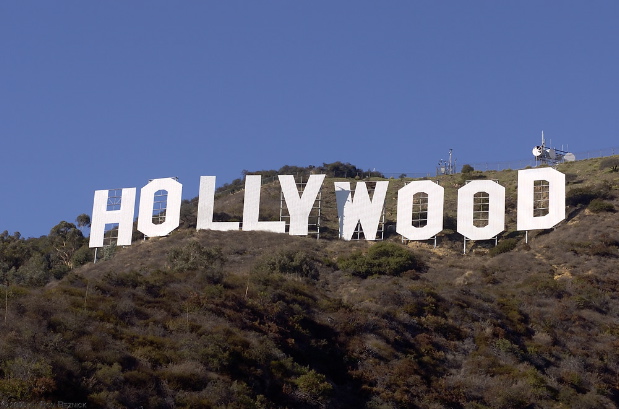
HOLLYWOOD: ART VERSUS COMMERCE

One
of the enduring myths of Hollywood is that the town is an eternal
battleground between art and commerce — between studio executives who
only care about money and filmmakers who only care about art.

The truth is that movies have been, almost since the moment they were
invented, a popular art form.  They attracted, for the most part,
popular artists — which is to say, artists who wanted to reach large
audiences.  Long before there was an established studio system run
by corporate functionaries, filmmakers courted a mass audience and
reached it.  The financial returns that followed created the industry that corporations at once set about dominating and
controlling.

The art of cinema was created by the same people who created the mass
market for films — Griffith, Chaplin, Pickford, Keaton, Lloyd. 
Because they were popular artists, commerce was an intimate aspect of
their endeavor.  The corporate executives who took over the
industry these artists created were by no means more
interested in the box office than the artists had been — they were
interested in power and turning the art form into a more predictable
revenue source . . . interests which often conflicted with maximum
box-office potential.

When executives and filmmakers clashed over the content of films, it
was not a battle between art and commerce — it was a battle between
popular artists who actually knew how to make popular films and
bean-counters who thought they knew better.  Since the
bean-counters quickly gained a virtual monopoly over the distribution
of films, they had the last word, and also the ability to insure that
this word could never be challenged, since the overruled filmmakers had
no practical way of getting films before the public without the
bean-counters' consent.

John Ford fought constantly with studio executives and, by his account,
never won a single battle with them — but does anyone seriously
believe that Ford, one of the most consistently successful popular
artists since Dickens, was fighting for some
private, noncommercial artistic vision?  Ford did make a few films, like The Fugitive,
which he may have known in advance would not be wildly commercial, but
for the most part he wanted to address a mass audience as effectively
as possible.  For a genuine popular artist like Ford — or Dickens, or Shakespeare, for that matter — there is no
conflict between art and commerce.

Ford was fighting against executives who could not have created a
popular work of art if their lives depended on it, executives who only
managed and bullied and second-guessed those who could create such
works.  The real issue was not art or commerce — it was
power.  Without their corporate control of the means of film
distribution, these executives would have remained in the realm of
exhibition, from which most of them emerged and where they belonged.

Hollywood in truth has been a battleground between monopoly and a free
market, between corporate standardization and homogenization and
entrepreneurial innovation.  The conflict between art and commerce
has been nothing more than a smokescreen.

PIERROT'S EMBRACE

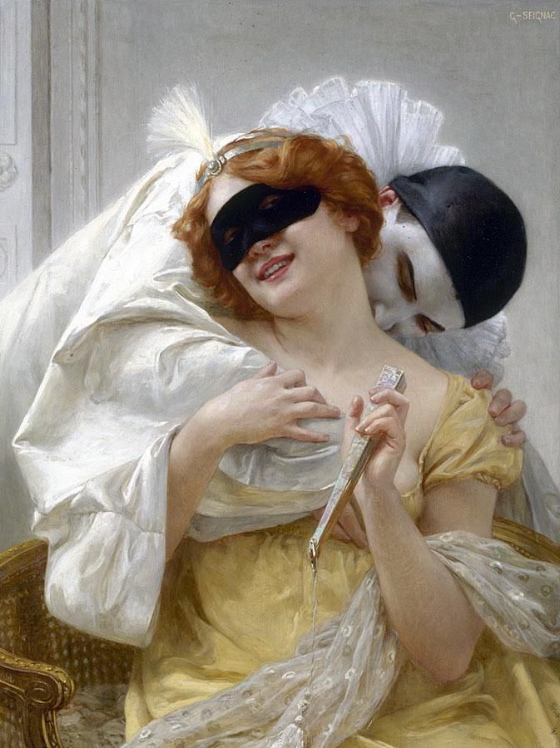
Guillaume Seignac
was a late Victorian painter (he died in 1924) who mostly turned out
undistinguished but sometimes amusing imitations of Bouguereau. 
His draftsmanship could be flabby and his images didn't have the
über-photographic authority of his master.

The image above is different, though.  It has an odd suggestive
power, almost perverse, that's rooted in theatrical gesture.  I
find it haunting, for reasons I can't quite put my finger on.

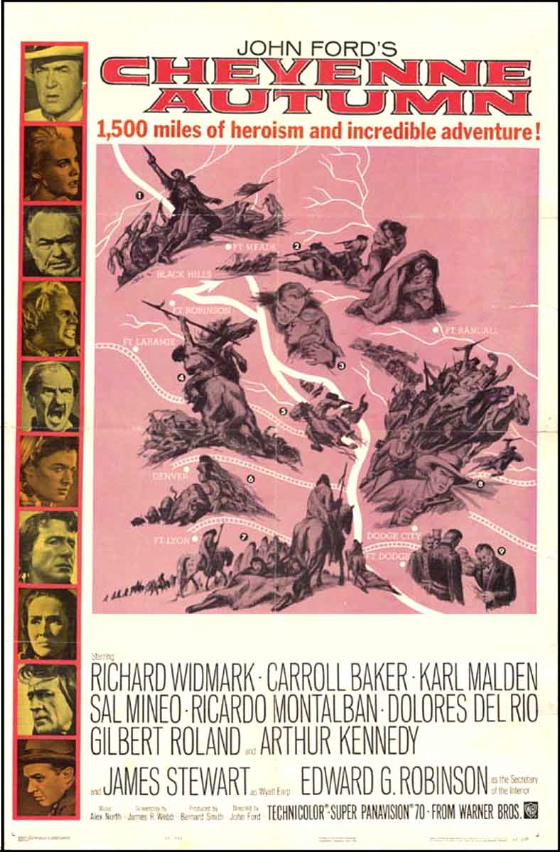
CHEYENNE AUTUMN

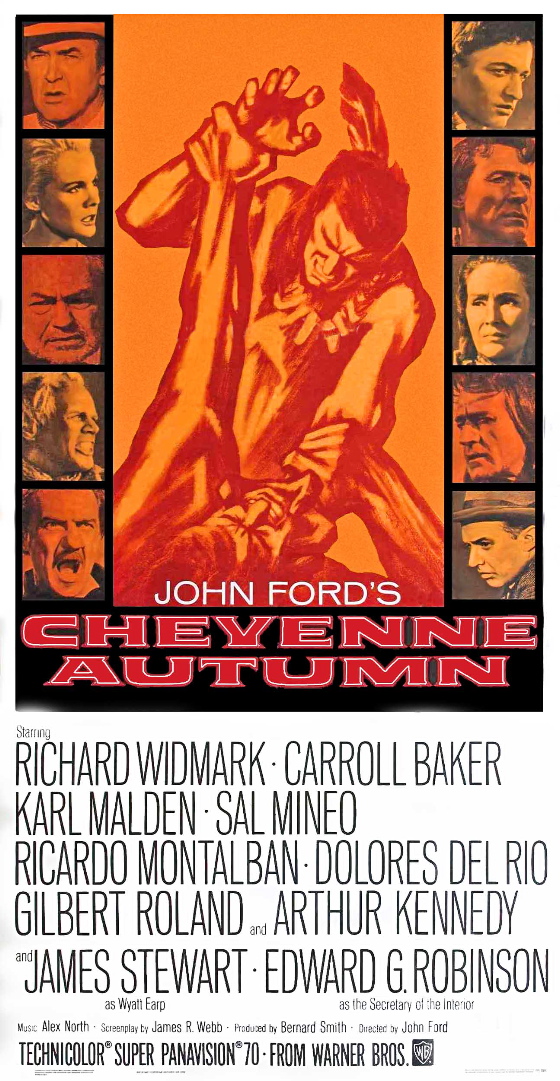
This
was the next to last feature film John Ford completed, in 1964, when he
was 69 years-old.  It doesn't work as a drama, much less a
melodrama, or as a character study or as an historical epic . . . but
it's one of the most sublime visual poems in the history of movies and
a very great work of art.

It tells the once little-known story of a band of Cheyenne who, in
1879, broke out of confinement on a reservation in Indian territory,
present-day Oklahoma, and made a 1500-mile trek back to their homeland
in Montana.  Pursued and harried by a succession of cavalry
expeditions, starved and near death, the band made it to its old home where
it was allowed to remain.

In his excellent commentary on the wonderful new DVD edition of the film, Ford
biographer Joseph McBride says that Ford originally intended to make Cheyenne Autumn
as a small, black-and-white film, an intimate study of the Cheyenne
pilgrims, but that he was persuaded by the studio to expand it into a
big wide-screen Technicolor extravaganza.  It was, says McBride, a
“Faustian bargain” which led to a film that was neither fish nor fowl,
since Ford lost sight of the Cheyenne characters yet failed to create a
genuine epic.

This may indeed reflect the development of the project but I think it
misses the essence of the film that Ford finally made.  All
of the characters in the film, both Cheyenne and white, recede into the
images, become secondary to the images.  Ford doesn't lose sight
of them as dramatic personae because he has no real interest in them as
dramatic personae.  They're just narrative markers that guide us
through the landscape of the film.
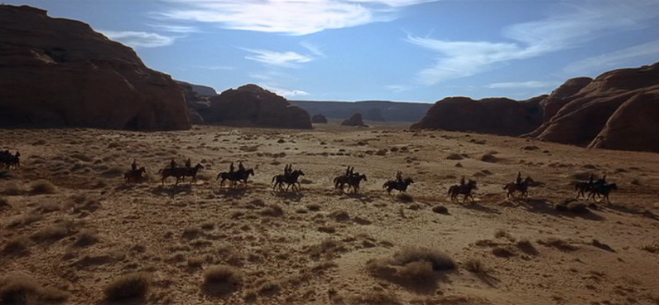
Landscape was always a character in
Ford's Westerns, a kind of Greek chorus commenting on the relative
smallness of human intention and desire.  It stood in, one might
even say, for the regard of Eternity, in which human endeavor held an
insignificant place.  It transformed the melodrama of his stories
into tragic
absurdity.

In Cheyenne Autumn, as in
Shakespeare's late romances, the author lost interest in the mechanics
of plot altogether, in the centrality of individual character, and became enchanted by the
mystery of his medium — the magical poetry of words, in Shakespeare's
case, and of images in Ford's.  The
progress of the Cheyenne through the magnificence of the landscape, the
evolutions of mounted cavalry on the march or at the charge, fill
Ford's imagination fully — the characters dissolve into the beauty of
movement itself.  They are elevated into a transcendent glory not
by the specificity of self but by their possession of space.  They
are dancers, sculptures in motion.
This is not an abstract vision, however, a celebration of
technique.  In his old age, disillusioned with the legends of the
West he did so much to reinforce, Ford lost his faith in man's
essential goodness, or at least in that part of it related to his
will.  Primal values, transcending individual human character,
were all he could believe in — the dumb urge to go home, to preserve
community, to do one's duty.

At the center of the film Ford inserted, unaccountably to many critics,
a 21-minute sequence set in Dodge City which mercilessly satirizes the
myth of the Western hero, of the frontier town.  Jimmy Stewart
appears as a corrupt and cynical Wyatt Earp leading the hysterical townspeople on an
absurd pursuit of the phantom Cheyenne, who in truth are nowhere near
Dodge.  The familiar narrative of the old West is deconstructed, revealed as
a tale told by an idiot, full of sound and fury, signifying nothing.

After this strange interlude, the film switches back to the story of
the Cheyenne, doing what they have to do, and the horse soldiers, doing
what they have to do.  When the Cheyenne are restored to their
ancestral Eden, Ford shows us how much they have lost recovering it,
just as
he shows us how much honor the soldiers have lost in fulfilling a duty
that's been applied to a meaningless and inhuman mission.

The triumph on both sides was only in the journey, the movement, the dream — all of
which vanish in the end, as the eternal landscape looks on impassively.

The
film has a nominal “upbeat” resolution in its penultimate episode in
which
Secretary of the Interior Carl Schurz, wonderfully played by Edward G.
Robinson, goes to visit the escaped Cheyenne in Montana and promises to
help them stay there.  This scene, oddly, is shot against
cheesy-looking back-projections — such a radical violation of the look
of the rest of the film that it almost seems deliberately surreal . . .
as though Ford was asking us not to take this superficial “climax” too
seriously.  Perhaps it can be compared to the improbable events
that “resolve” the narrative of Shakespeare's The Winter's Tale,
in which the playwright seems to be asking us to laugh with him at the
conventions of the stage — to remind us that the true heart of his
work lies elsewhere.

DUDLEY NICHOLS AND JOHN FORD

With the notable exception of Stagecoach,
I'm not a big fan of the movies John Ford made with screenwriter Dudley
Nichols, even though these include some of Ford's most celebrated and
entertaining films.

Nichols was an extremely skillful writer, with a sound sense of story structure and a good ear (usually) for
colorful dialogue.  But he also had a self-conscious, “literary”
style — he tended to see situations and characters in emblematic,
metaphorical terms.  This aspect of Nichols' work encouraged Ford
to indulge his gorgeous visual expressionism at the expense of what he
did best — create cinematic spaces and places of mesmerizing
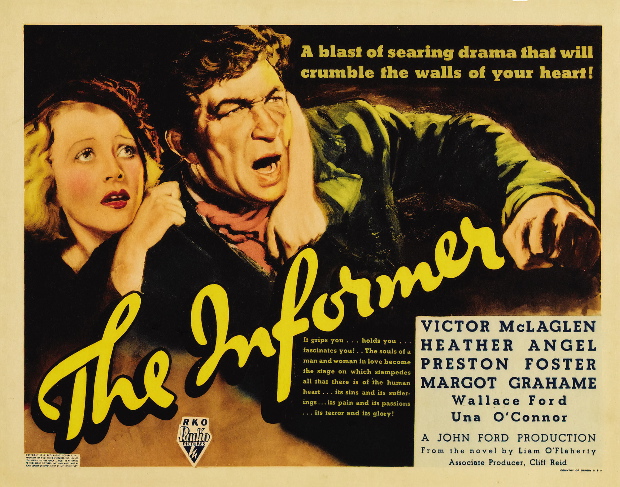
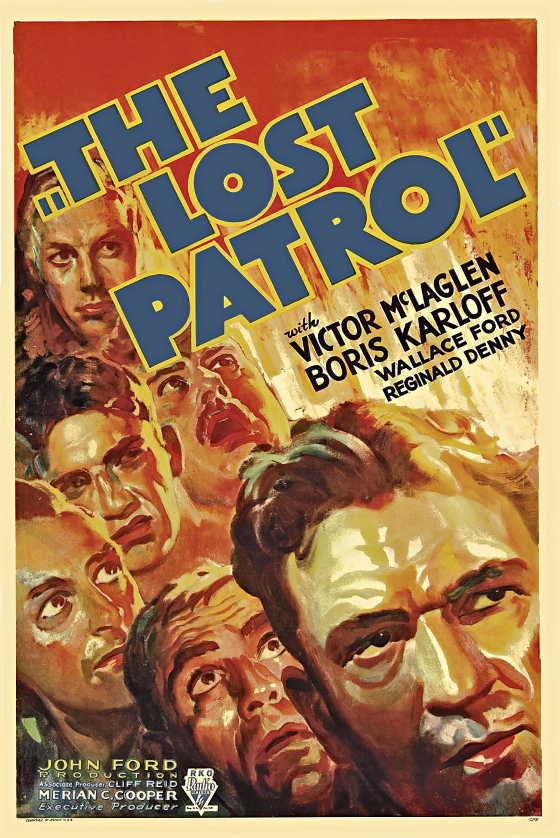
specificity.  The images of The Lost Patrol and The Informer
are supremely beautiful but they grow claustrophobic after a
while.  The desert and the fog-bound city are too obviously
surrogates for existential states, symbolic and airless.

In his best work Ford found ways of imbuing interiors and landscapes
with an uninsistent symbolic quality — we read them as real spaces and
feel their emotional resonances on a subliminal level.  We have a
sense of discovering and exploring these spaces on our own, no matter
how many times we come back to them.  The shadowy streets of Gypo
Nolan's Dublin in The Informer, the merciless desert that swallows up The Lost Patrol, are places we visit with a guide, always reminding us what these environments “mean”.

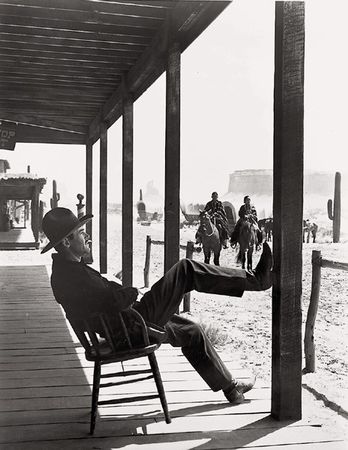
The streets of Tombstone in My Darling Clementine,
the unfinished church on the edge of town, the maze of the O. K.
Corral, are every bit as charged with meaning and significance, but
Ford lets us tease them out for ourselves — he lets us inhabit them at
our ease, until the places seem to speak to us in their own voices.