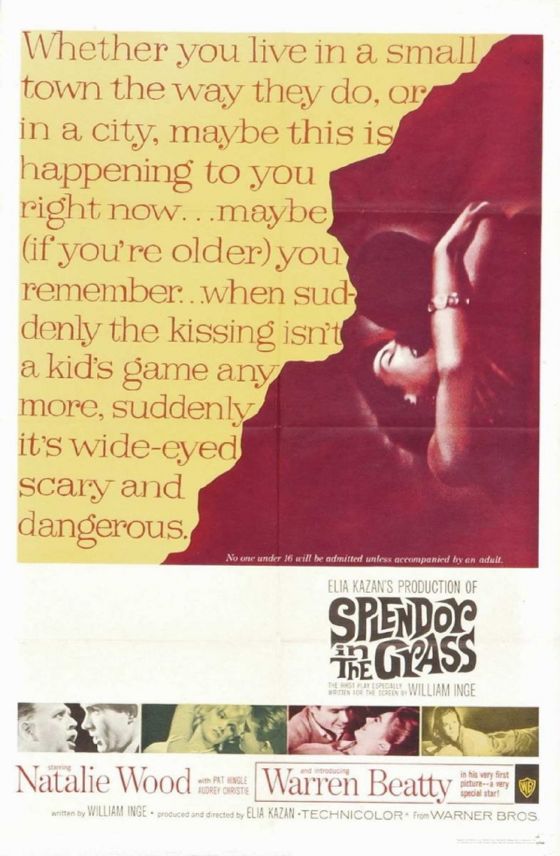
SPLENDOR IN THE GRASS

I'm working my way through the big DVD box set of Elia Kazan's films, and also through his autobiography.  In both, I'm up to Splendor In the Grass.  In his book, Kazan doesn't have a lot to say about the making of the film, beyond reporting the gossipy stuff, as he always does — he was cheating on his wife with the film's second lead Barbara Loden, Natalie Wood was cheating on her husband Robert Wagner with Warren Beatty.  Yawn.
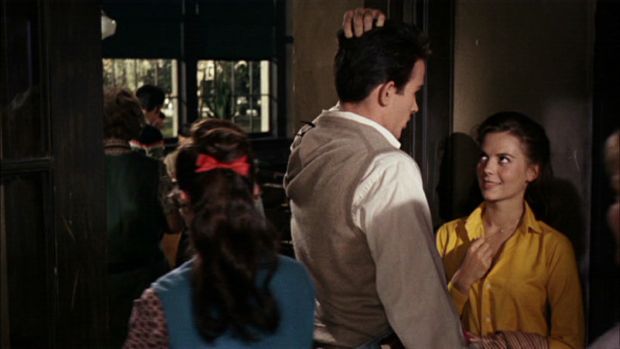


What he does say about William Inge's original screenplay, though, is fascinating.  “His story had the one essential, an excellent flow of incident to a true conclusion.”  He says that the film was easy to direct — “the scenes Bill wrote were the simplest I'd ever done.  People came together, spoke to each other, a point was made, an issue decided, quietly and meaningfully.  Then they parted and the story went on.  That was Bill's talent.”
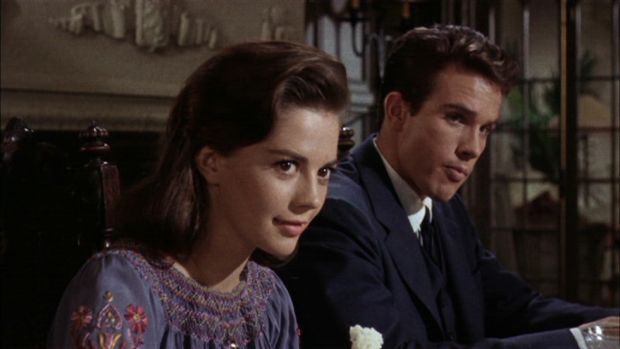


In a way, that was Kazan's talent, too — investing each scene with meaning, establishing a narrative momentum, keeping the thing moving, emotionally speaking.  It's why Kazan's films are always entertaining, even when they aren't great.  He developed a good eye for images, though he was rarely capable of creating passages of visual lyricism that lift the spirit.  Even his great films rarely arrive at cathartic climaxes which knit the whole narrative together — one tends to remember moments between the characters rather than the whole sweep of the story.
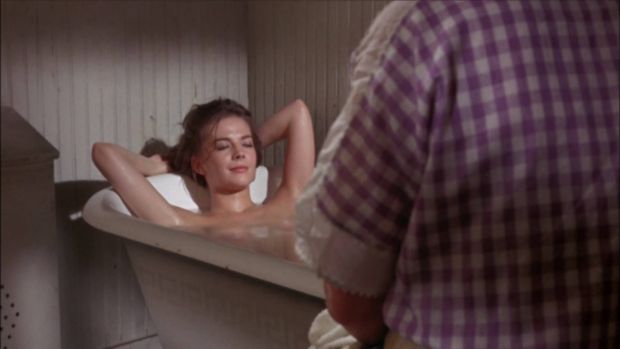


Kazan seems to see Inge's talent as limited, that of a mere storyteller, yet he admits that the last reel of Splendor In the Grass, the climax, is his favorite of all his last reels.  And he's right to feel that way.  Splendor In the Grass, thanks to Inge's skill as a storyteller, and with some crucial help from Wordsworth, is the most profoundly satisfying of all Kazan's films, because of that ending.
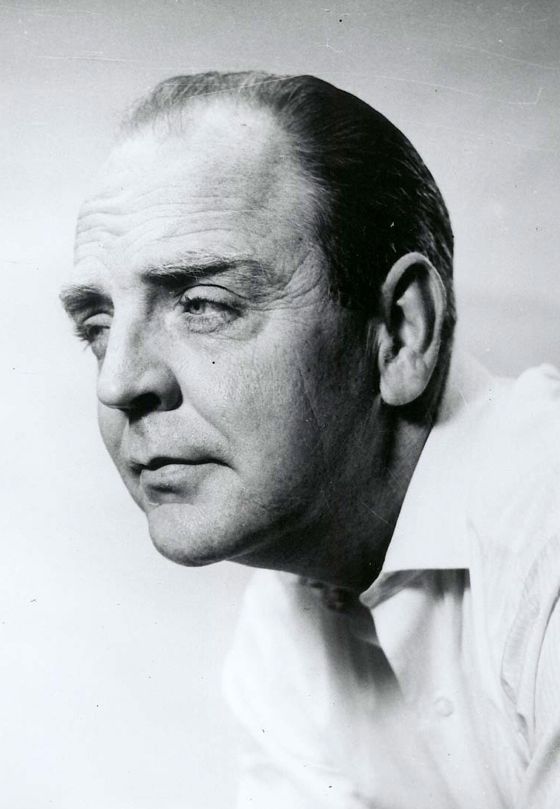


Inge (above) did not have the reputation of Tennessee Williams, who could write dazzling, unforgettable endings that packed a punch, but often in a synthetic way, relying on a great exit line, for example, which seems to say more than it really does.  The ending of Kazan's film of A Streetcar Named Desire doesn't break my heart — its poetic, tragic quality feels too neat.  The ending of Splendor In the Grass does break my heart.  It seems far truer, though certainly less grand and eloquent, than anything Williams ever wrote.

Williams was a better writer than Inge, but Inge was a better storyteller.  We don't often think of making a distinction like this with the work of good dramatists, but it's one that sometimes can be made, and it's one well worth pondering.

[Click here for some extended thoughts on the film's plot and theme.]
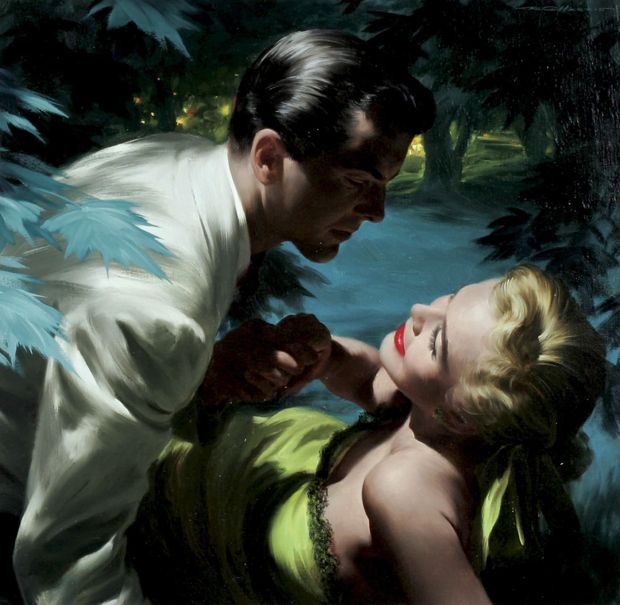
SOHO

Remember the mornings I kissed you goodnight . . .

My friend J. B. White composed this song for a script I wrote in the early 1980s,
about Soho, when that part of Manhattan was just coming into its own as a Bohemian enclave, and where I had so many magical adventures.  Thirty years later, none of that Soho remains — it's a Yuppie shopping mall today — though the ghosts, the faces in the windows, are still there, I suppose, my own among them.

The places you
love that you can never return to are also places you can never
leave.  They become part of your own small portion of eternity.


[Song © J. B. White]

MARY TAKES THE CHALLENGE

My friend Mary decided to “take the challenge” at a strawberry shortcake restaurant near her home in Florida.  The deal is simple — eat twelve pounds of strawberry shortcake within five minutes and the dessert is free.

Mary managed the feat with only seconds to spare.  “I don't even remember eating those last few pounds,” she said.  “I was just on automatic pilot at that point.”

STRAWBERRY SHORTCAKE

Next Tuesday, as everyone knows, is National Strawberry Shortcake Day.  Stores all over the country are already running short of the berries and the fixings as folks scramble to stock up for the big celebration.

Restaurants which specialize in the magnificent treat, like the one in Florida whose sign is shown above, are gearing up for the biggest crowds of the year.

There's a reason that millions agree — National Strawberry Shortcake Day is the most delicious day of the year!

ALONG THE RIO GRANDE

Most B-movie Westerns were done as parts of series featuring a star and
recurring actors in supporting roles, often a comic sidekick but
sometimes a musical sidekick, if the star wasn’t himself a singing
cowboy.  The bad guys and the female romantic leads changed from
picture to picture.

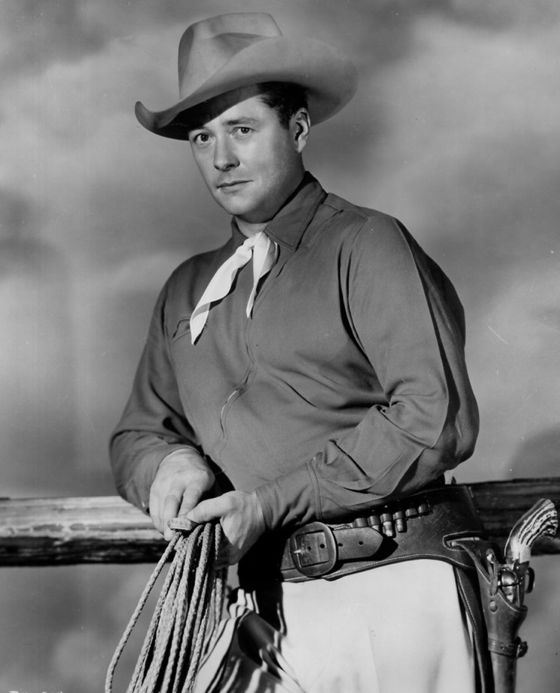
When RKO set Tim Holt up as the star of his own B-Western series in the
early 1940s, they gave him a comic sidekick and a musical sidekick.
Even when a B-Western star didn’t have a musical sidekick, musical
numbers were usually a part of the formula in the 1930s and 1940s, and
they were usually anachronistic — Western Swing numbers written for
the films rather than authentic cowboy songs.


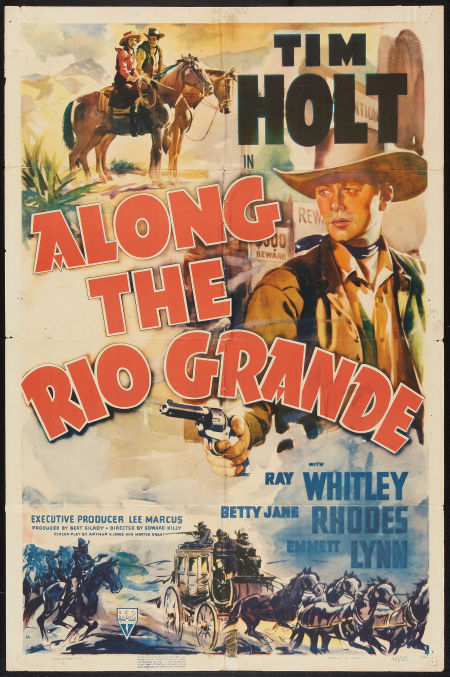
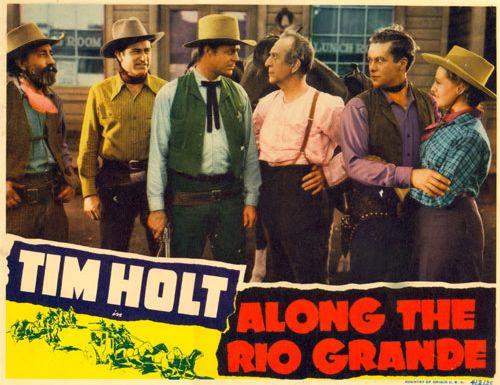
Along the Rio Grande, from 1940, is the first film in the new Tim Holt B-Western
collection from The Warner Archive which features Holt in the starring role.  It was, I believe, the third B-Western in which he starred.  (He had earned his spurs before this playing second leads to more established B-Western stars.)

These early Holt Westerns play like variety shows rather than dramas.
Dramatic exposition and action sequences alternate with musical numbers
and comedy bits in a regular pattern.  In a way they harken back to the
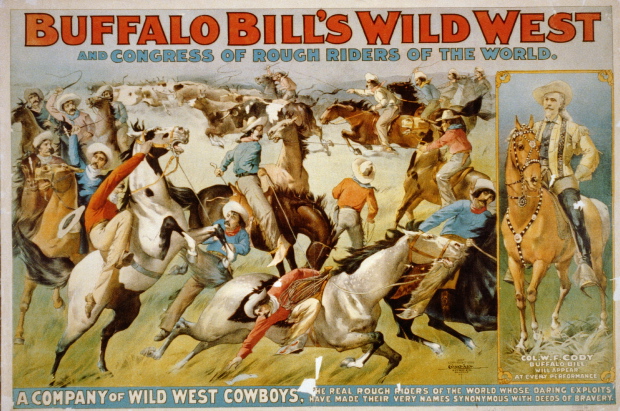
Western arena shows of the 19th Century, which were essentially variety
shows with a Western theme, mixing staged dramatic spectacles — mini-narratives, like the attack on the stagecoach, on the settler’s cabin — with self-contained acts featuring theatrical displays of marksmanship and horsemanship, all knitted together with musical
interludes.


A little something for everybody was the idea in most B-Westerns, too — all of a simple and unsophisticated nature, reflecting the primary audience for these films, kids
everywhere and older folks in the smaller towns and rural areas.

The variety is what keeps the films enjoyable even today.  The
conventional plots and merely serviceable acting couldn’t sustain them
as works of drama, but (as was true in vaudeville, or Buffalo Bill’s
Wild West) you always knew there was going to be a change of pace soon
— another routine by the comic sidekick, another song, another awkward
but charming interchange with the leading lady, another thrilling chase
on horseback.

There’s usually a lot of entertainment packed into these short films —
modest, perhaps, but pleasantly varied.  The horsemanship is always
first-rate, though, and if all else disappoints, you rarely have long
to wait before someone says, “We’ve got to head them off at the pass!”
. . . at which point the screen will explode with beautiful images of
beautiful animals galloping through scenic landscapes, with heroic
figures in the saddle, bent on righting one wrong or another.  If for
nothing else than this, the B-Western remains a delightfully dependable
form of amusement.

THE THREAT FROM THE MUSLIM WORLD


Rep.
Peter King should switch the subject of his House hearings on radical
Islam in America to a much more urgent question — could the outbreak
of democratic ideals in the Muslim world spread to the U. S. and
threaten our plutocratic way of life?

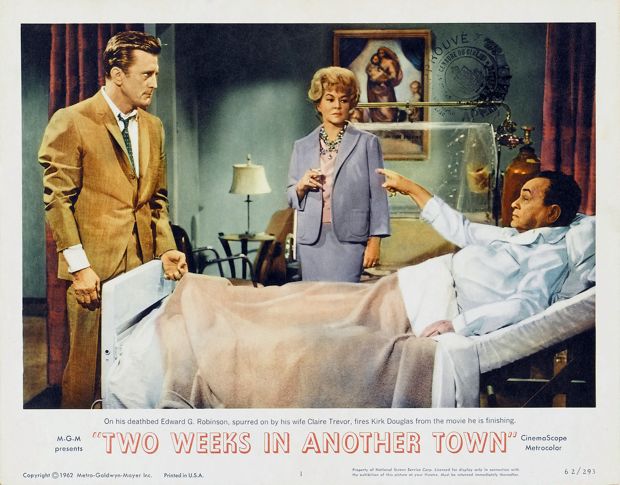
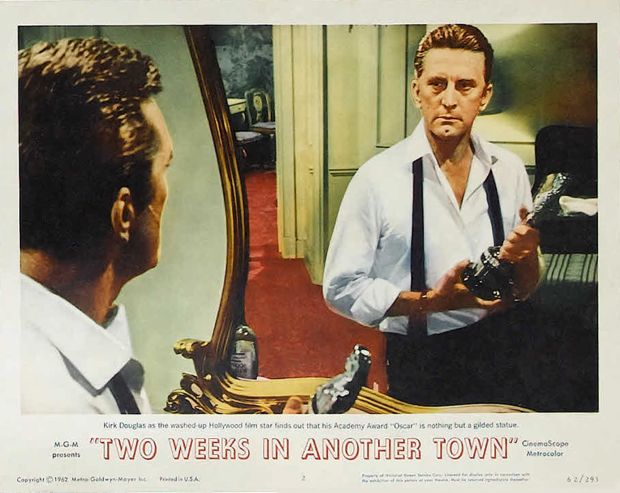
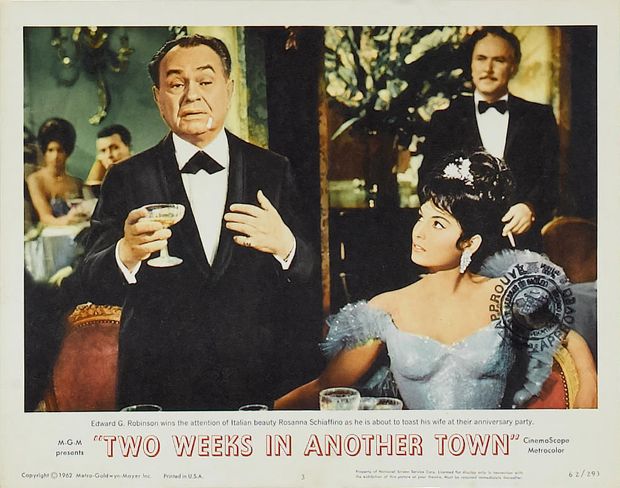
TWO WEEKS IN ANOTHER TOWN

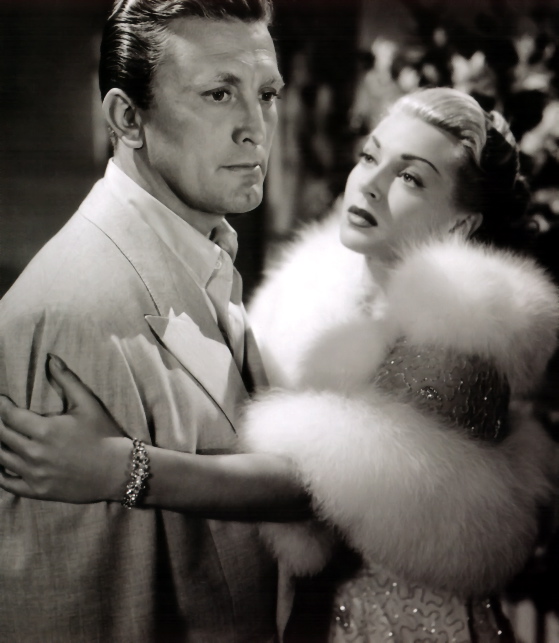
Many people know The Bad and the Beautiful, Vincente Minnelli's classic melodrama about the film business, from 1952, produced by John Houseman and starring Kirk Douglas, with a script by Charles Schnee, based on a story by George Bradshaw.

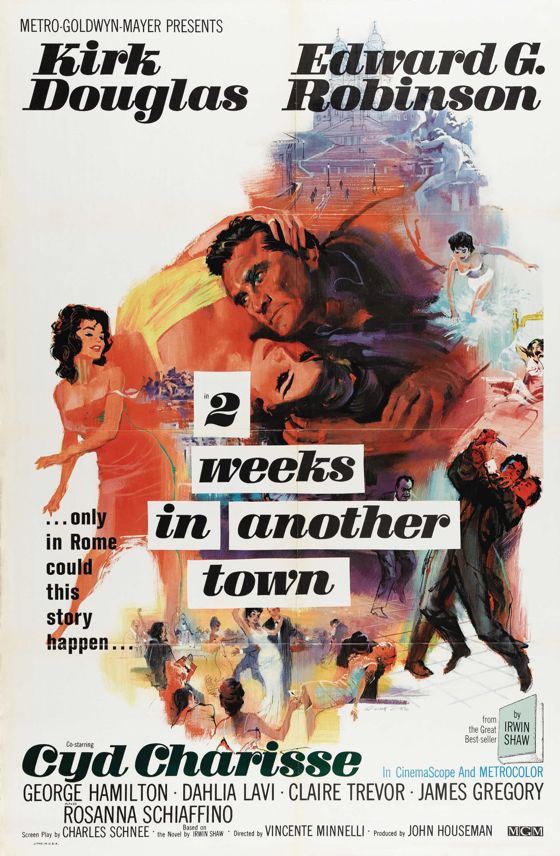
Ten years later, Minnelli, Houseman, Douglas and Schnee tackled the same subject again, in their adaptation of Irwin Shaw's novel Two Weeks In Another Town.  The second film is much darker, and less well known — it flopped at the box office and was only released on DVD this year, by The Warner Archive.

Long known as a kind of lesser pendant to The Bad and the Beautiful, it has nevertheless found champions among admirers of Minnelli's work, and is by far the greater film — one of Minnelli's masterpieces.


I have written before about my problems with The Bad and the Beautiful (above) — for my views on it click here — but they boil down to my mistrust of the film's self-congratulatory message.  It displays a gallery of glamorous but despicable characters, lets us relish their savaging of each other, but ultimately asks us to admire them as noble monsters for their dedication to the art of film.  The Bad and the Beautiful all but suggests that their egomania and meanness are required attributes for those who serve the celluloid muse.

When artists excuse the bad behavior and character flaws of artists in this way, we have a right to be suspicious of their motives, to resent the self-serving nature of the enterprise, which may be telling us more about the artists who actually made the film than about the nature of artistic creation.


Two Weeks In Another Town is a much more mature and honest work.  It's a descent into the hell that the film business really is — a hell in which personal betrayal and selfishness serve only as tokens of power, not as the means of artistic accomplishment.  It charts the personal cost of the industry's meanness, not to its obvious victims, the system's losers, but to those who exercise their power for show, to demonstrate prestige — in short, to the “winners”.


All the industry professionals featured in the film have shriveled souls, live in a state of existential terror.  As they howl on the margins of nonentity, they look about desperately for one last target, one last peer to hurt and humiliate, as though they might recover their sense of self in the act.

It's truly terrifying, and only two people escape from this version of the wreck of the Pequod — a young actor embarked on a self-destructive binge and the older actor who jerks him out of the whirlpool at the last minute, because he's been there himself and knows what it feels like to drown.


Kirk Douglas, in one of his greatest performances, plays the older actor.  We meet him as he hovers near rock bottom as a man and an artist, his life and his career in shambles.  Finally hitting rock bottom on location in Rome, in a desperate bid to salvage his career, is what saves him.  It's when he gives up on recovering his past that he finds a way to the future.  It's a powerful tale, but not very pleasant, and one can see why audiences rejected this look at the dream factory without illusions.  We really don't want to see too much of that man behind the curtain, especially when he turns out to be a vicious jerk.


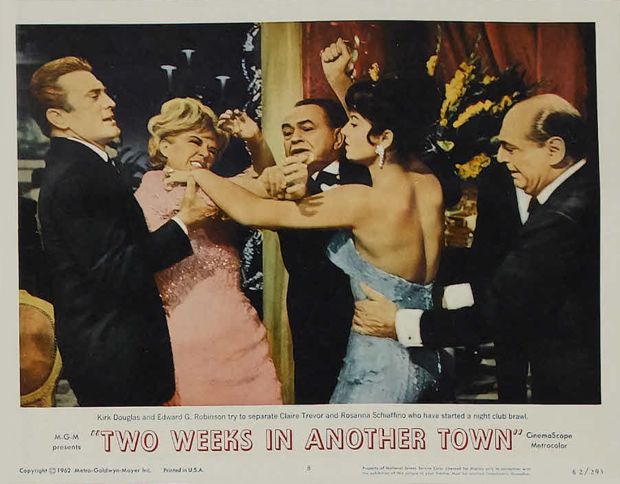
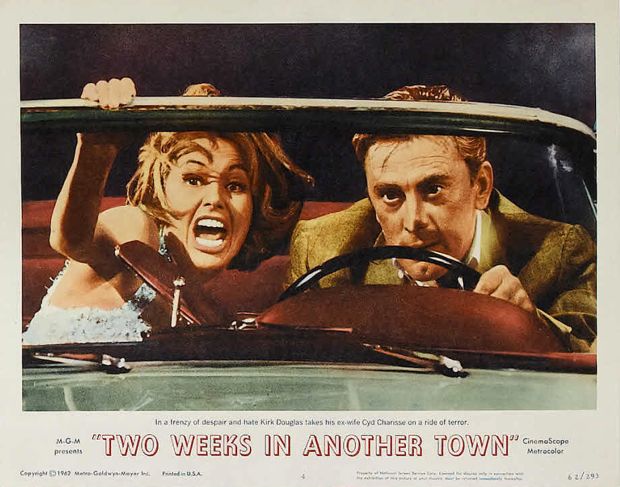
Two Weeks In Another Town may be the best movie ever made about the film business, and it's definitely one of Minnelli's most beautifully crafted films, with consistently inventive use of the Cinemascope frame and of lurid colors that mirror the lurid recesses of the Hollywood soul.  The acting is uniformly fine, even from George Hamilton doing a pretty good impersonation of James Dean.  Minnelli got Edward G. Robinson to give a restrained performance, and Cyd Charisse an unrestrained one — extraordinary accomplishments.  Charisse has an episode of hysterics in a speeding car that will chill your blood.

The Bad and the Beautiful is more satisfying, the way a lie can be more satisfying than the truth — for a while, anyway.  The later film is two weeks in another town altogether — the real town of Hollywood, which can't escape itself even when it goes on location in Rome.