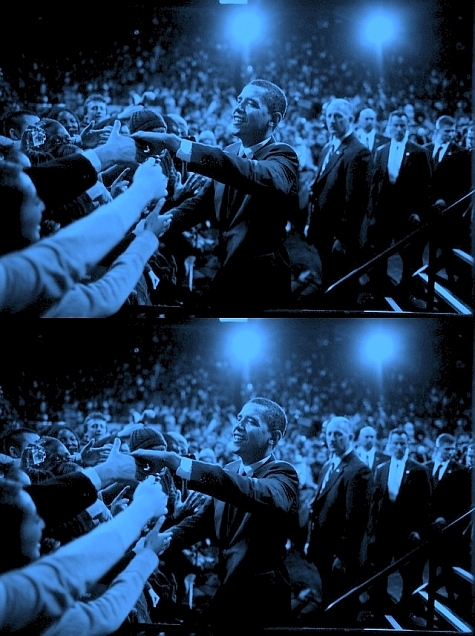
ENOUGH IS ENOUGH

Today
Bill Clinton mused wistfully about how nice it would be to have a
Presidential race in November between two candidates “who love America”
— meaning his wife and John McCain.  It was a statement whose
unspoken but unmistakable premise was that the the third possible
candidate in November, Barack Obama, is someone who doesn't love
America.

Hillary has almost no chance of winning the Democratic nomination, and
therefore almost no chance of becoming President.  Her thinking
seems to be that if she can't have the Presidency, then no Democrat
will.  She's already suggested that only she and McCain are
qualified to be commander in chief.  Now her husband is riffing on
the right-wing radio notion that Obama is not a true, patriotic
American.

The
moral decay of the Clintons has become positively rancid — it's
starting to stink up the whole body politic.  Don't they have any
friends who'll take the keys away from them before they drive their car
over a cliff, dragging the entire Democratic party down with them?


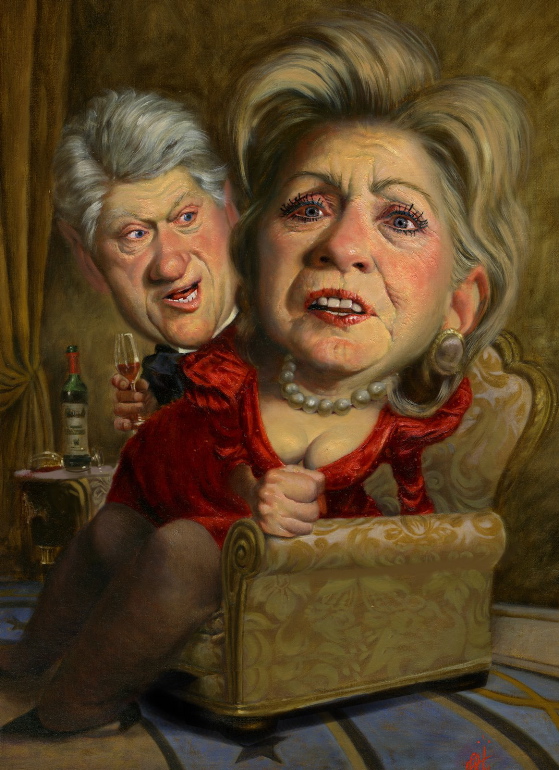
[The lovely portraits above are by the great caricaturist Thomas Fluharty, whose web log Amazed By Grace
says that he's not interested in being the best artist he can be but
only in glorifying God and his son Jesus Christ.  Check it out for
some wicked-amazing art work and some fervent Christian proselytizing — a
strange combination.  And thanks to the wonderful web site Potrzebie for directing me to Fluharty's work.  Fans of Mad Magazine will understand where Potrzebie is coming from.]

HARRY ON KANE

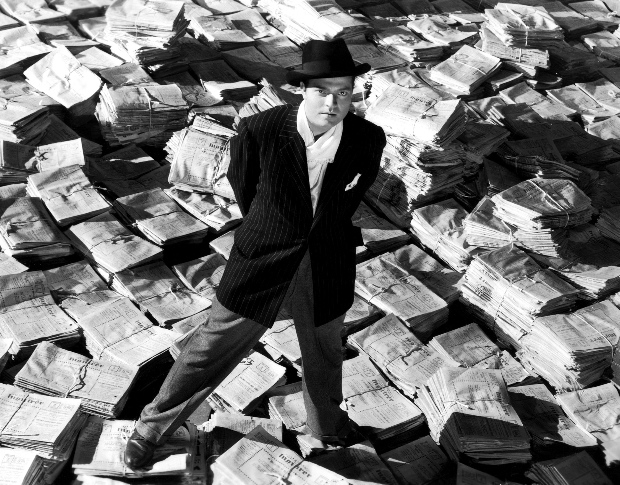
Below are my nephew Harry's notes for an oral presentation on Citizen Kane for his 9th-grade history class:

February 26, 2008

Citizen Kane

Intro Facts:

-Directed by Orson Wells in 1941.  
-He also starred in , co-wrote and co-produced it
– all at the age of 24
-Previously, had been in radio, creator of the famous War of the Worlds episode for Mercury Theater in N.Y.C.
-Citizen Kane= the first and last major studio film over which he would have total control.
-Considered universally to be one of the greatest films ever created

Some Elements that make this film revolutionary:
 
-use of depth of focus shots (=wide angle lenses to capture the details
of the foreground, middle ground and background without prioritizing)
-depth of focus important because it allows the viewer to actively
investigate the space, make conclusions, see relationships between
characters and their space in more complex ways, spectator is an active
participant in the scene
-use of ceilings and the “fourth wall” = more interesting camera angles, more creative lighting , more real
-camera is inquisitive, as if it is a character itself, instead of a stationary machine that records what’s in front of it
-non-linear storytelling
-narrative told in bits and pieces, out of chronological order
-some scenes are revisited more than once from different perspectives
-story of Kane’s life is revealed as a reporter interviews people who
were closest to Kane in attempt to learn meaning of Kane’s last dying
words
-leads to a richer, more complex portrait of a person

Conclusion:

-On initial release, film was hated by most major film studios. 
-Negative was almost burned
-Wells was persecuted by newspaper tycoon William Randolf Hearst, who
saw unflattering parallels between himself and Charles Foster Kane.
-Wells was blacklisted in Hollywood
-Citizen Kane was never distributed to major commercial theaters
-Sad because this movie defines us – what drives power, materialism, and what we may have lost on the way

After Harry's presentation his teacher said, “We always hear that Citizen Kane is one of the greatest movies ever made — now we know why.”


My notes on the notes:

A superb summary — excellent stylistic and thematic analysis.  I
personally wouldn't call any of the stylistic elements of the film
“revolutionary”, however, since they had all been used before — just rarely
with such brilliance.  It's true that most studio heads hated the
picture, because it offended Hearst and they were afraid of him, but
the Hollywood community recognized its brilliance — it was nominated
for several Academy Awards and won in the category of Best
Screenplay.  The negative was indeed almost burned — Louis B.
Mayer offered to buy it from RKO and destroy it, as a favor to Hearst and to
protect the industry from his wrath.  Welles wasn't exactly
blacklisted in Hollywood — it just became hard for him to work as a
director there after his first two films, and a third which he
produced, tanked at the box office.  Kane
was distributed erratically and never got a chance to prove itself
commercially but it did play at a few major theaters in major cities —
it had its Los Angeles premiere at the El Capitan, which is still
standing.  The El Capitan wasn't the most prestigious house in
town but it was a respectable venue.

Conclusion:

Well done, Harold!

THE SPEECH

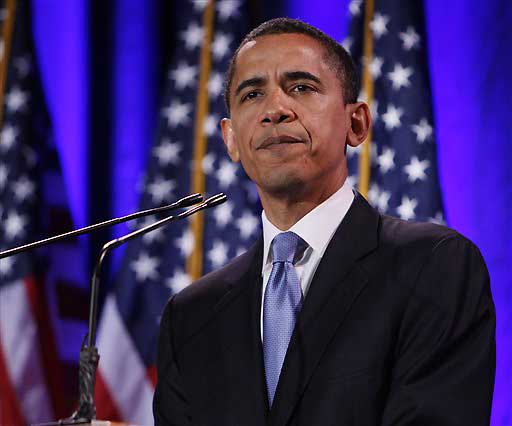
It has sometimes been suggested that Barack Obama “transcends race”
— or that he's selling the delusional notion that America has
transcended race.  I
think the truth of it is quite otherwise — that one of the deepest
unspoken appeals of Barack Obama, to all Americans, has been the
sneaking suspicion that one day he was going to speak
about race directly, open up the honest conversation about race which
this country has been too confused and too frightened to have.  It
makes him slightly dangerous but also utterly intriguing.

I always assumed that he would say what he had to say on the subject
after he was elected President, and perhaps he made the same
assumption, but the Reverend Wright controversy made it necessary to
say it sooner rather than later.  So on 18 March, within hailing
distance of Independence Hall in Philadelphia, he gave the most
important
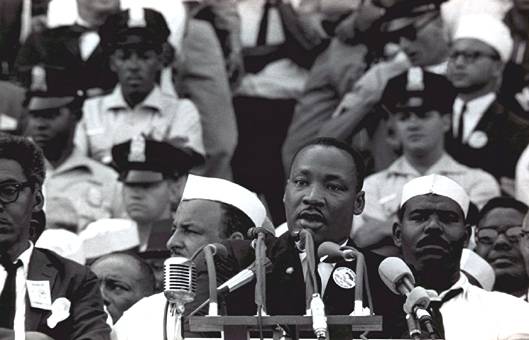
speech on race delivered in this country since Martin Luther King's
address from the steps of the Lincoln Memorial to the crowds gathered
for the March On Washington.

At this point I don't think it matters how people respond to Obama's speech
as a bit of political strategy, how it may hurt or hinder his campaign
for the Presidency.  It's a speech that will echo down the
years.  Curiously, for a man who is both praised and condemned for
emotional rhetoric, the speech was most notable for its sober and sobering
analysis of the state of half-conscious or unconscious racial division
in the country.  There were no sweeping appeals to idealism, no
sense that the division could be repaired by lofty slogans, by “dreams”.

He told us where we are — where, on some level, we all know we
are.  He gave us permission to speak about the issue from where we
are.  He brought the talk around the kitchen table into the public
square.  Nothing but good can come of it.

We may draw back from him, as a candidate, decide once again that we're
not ready to have this conversation.  But we won't be able to stop
it now.  William Blake said, “
Truth can never be told so as to be understood, and not be believ'd.”  That's why prophets get
stoned to death — for starting uncomfortable conversations that can't be
stopped.  That's also why we need prophets and cherish them, if only in retrospect.

THE TIME GARDEN

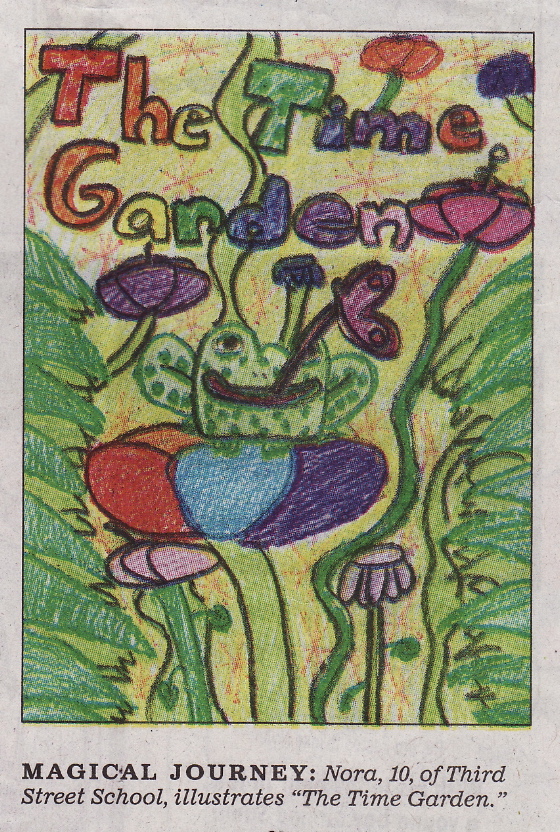
The Los Angeles Times published a book review by my niece Nora, age 10, in their Kids' Reading Room section on 2 March.  (That's Nora in the green shirt, above, screaming on a roller coaster.)

Here's her review . . . of Edward Eager's The Time Garden, with the illustration she did to accompany the review:


The minute I looked at the
title I thought it was just another fairy tale, but boy, was I wrong!
This is a marvelous story. One sniff of the thyme and the magic begins.


Eliza, Ann, Roger and Jack find the Natterjack (a creature in a
frog's form) and run off on an amazing adventure through time and
space. They find out what really happened long ago and save people just
like them. Any boring day can be turned into an astounding journey if
they go into the garden. People of all ages, kid or adult, will want to
be in the magical adventures.

I love Edward Eager's books and have since I was a kid.  His Knight's Castle is one of my favorite books of all time.  I gave Nora her first Edward Eager book last summer, Half Magic, and now she's read them all.  You should, too.

SEARCHING FOR JOHN FORD

I recently finished Joseph McBride's excellent (and massive) biography Searching For John Ford. It tells you everything you want to know about the man . . .
except who the hell he was.  The mysteries and contradictions of his
character simply cannot be sorted out.  I'm sure the same would be true
of Shakespeare if we had massive documentation and testimony about his
life.  The depth of the work in each man's case comes out of the
mysteries and contradictions and transcends them but sheds no light backwards on the
man himself.  Perhaps, to be a truly great dramatist, you have to
abandon all hope of a coherent self in real life.

The biggest revelation in the book, to me, was the extent of Ford's
WWII service, which was far greater than I realized — but even in that
arena, nothing he did seemed to satisfy him.  He told outrageous
lies about his wartime service, even when the things he actually did
were far more impressive.  Reading the book makes one more and
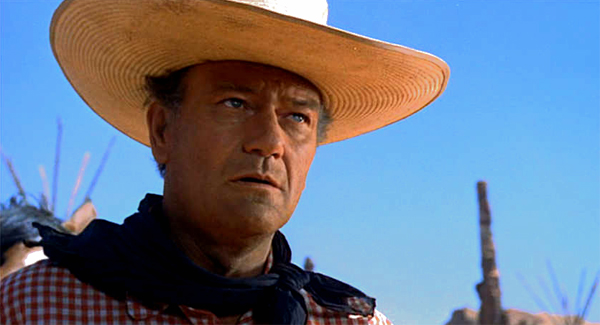
more convinced that Ethan Edwards comes as close to a portrait of Ford
the man as we will ever have — a psychotic searcher who does heroic
things that no one else can do, and then wanders off alone, permanently
lost.

It's a sad tale but also, in some mysterious, unaccountable way, inspiring.

T-SHIRTS

I'm a person with too many T-shirts — way
too many T-shirts.  Periodically I make vows not to buy any more
T-shirts, but sometimes you just can't help yourself.  Two years
ago, on a visit to Memphis, Tennessee, I couldn't resist buying a
T-shirt from Graceland, from the Sun Records studio and from the Stax
studio.

Recently I broke down again.  I bought two T-shirts featuring the
work of Fletcher Hanks, the worst comic book artist of all time, and
one featuring the work of Amy Crehore, a terrific painter (the design
is featured above.)

I really don't see how anyone could resist buying these T-shirts, so at the risk of enabling other people with T-shirt acquisition problems
I will add that the Tickler T can be had here and the Hanks Ts
here.  May I also remind you that T-shirt should always be spelled
with a capital T, because only the capital T reflects the shape of the
shirt.  A t-shirt would be some kind of turtleneck T.

FALSTAFF

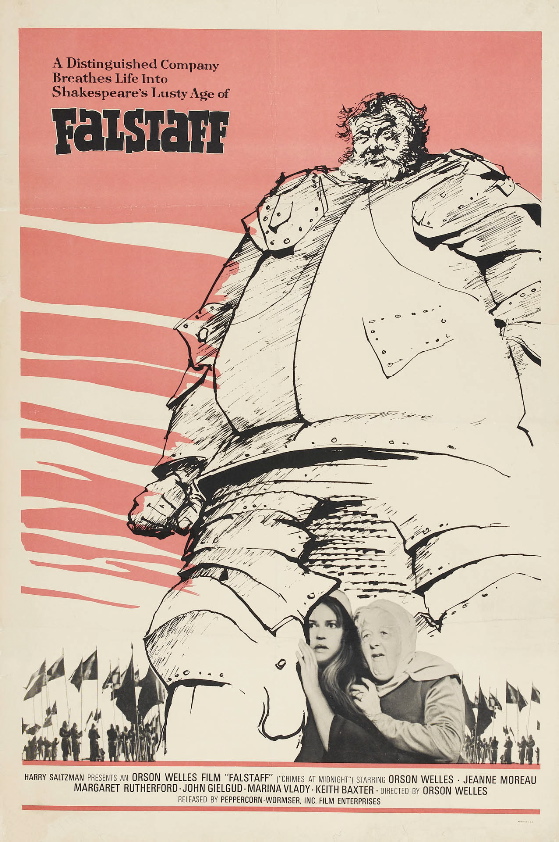
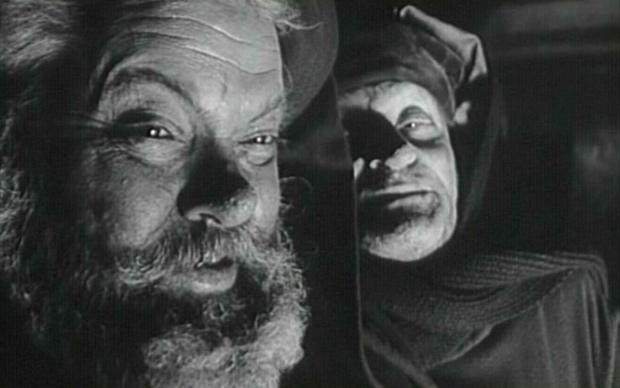
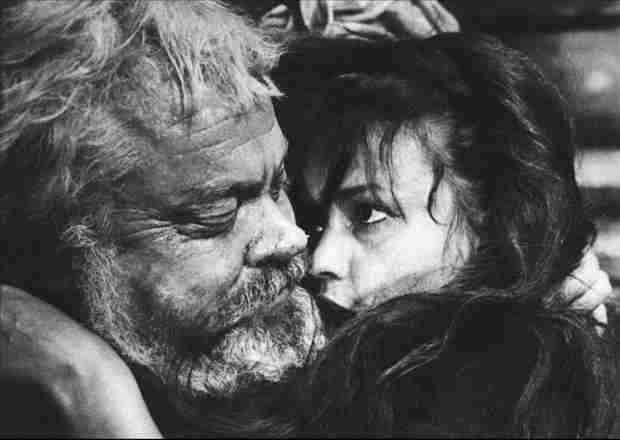
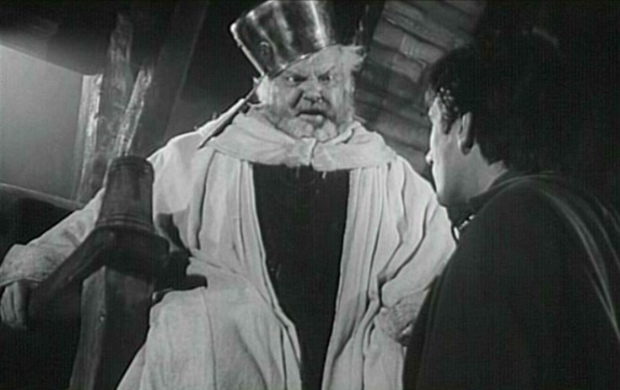
Orson Welles once said that if any one of his films would qualify him for entry into heaven it would probably be Falstaff (also known as Chimes At Midnight.)  As credentials for salvation go, Falstaff is probably as impeccable as any — it’s one of the greatest movies ever made, so great that it almost seems to inhabit a new medium all its own.

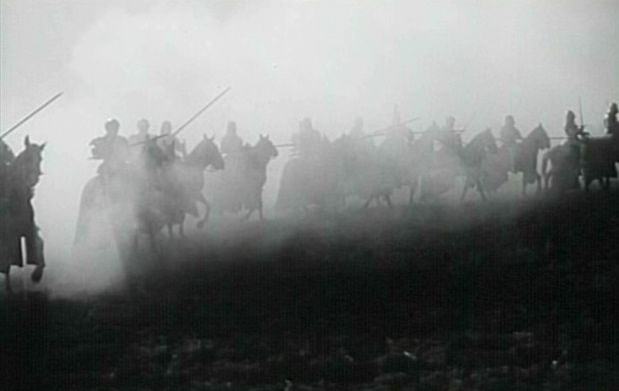
Visually it’s a torrent of dense, lyrical, consistently exhilarating images — an explosion of plastic invention unequaled since the days of silent cinema.  But it’s a talkie, and its words are not just any words — they’re the words of Shakespeare.  It’s not too much to say that Welles’ images, with their musical rhythms of movement within individual shots and from shot to shot, constitute a co-equal element with Shakespeare’s poetry.  Image and word fly, dance, crack, soar and sing together.  There has never been anything quite like it.

The soundtrack has technical flaws, however, which make it hard to appreciate the full scope of Welles’ achievement.  The production was beset with severe financial problems — almost all the dialogue had to be dubbed, and Welles had to supervise the re-recording at a distance.  The line readings are uniformly superb but the sync is not always perfect and the “room tone” surrounding the dubbed voices is inconsistent and often disorienting.

I don’t know if the original sound elements still exist — if they do, modern digital technology could certainly be applied to correct the flaws, though it would probably cost a small fortune.

As things stand, one needs to accept a slight disconnect between image and dialogue — which is no more than saying  that the Parthenon has sustained a bit of damage through the years.  One makes allowances.

The film is not available on DVD in this country.  There is a barely acceptable all-region Brazilian edition in NTSC format which can be had online, but it’s not optimized for a widescreen monitor and the transfer of both sound and picture is mediocre.  Still, if you’ve seen the film on a big screen, the Brazilian DVD can evoke the experience well enough.

I saw Falstaff at the Paris Theater in New York in the summer of my 17th year.  During the battle scene my hair stood on end — I think I probably trembled with excitement.  I know what cinema is, I thought to myself — the secret of it is here, in this film.  It was more a gut feeling than a practical or intellectual insight, but the moment has inspired all my thinking about movies ever since.  A hundred years from now people will still be studying Falstaff in an effort to apprehend the craft and mystery of movies.

BEER

Benjamin
Franklin said, “Beer is proof that God loves us and wants us to be
happy.”  You probably know this already, and may know the famous
advertising line for Guinness Stout — “Guinness Is Good For
You.”  In fact it is — incredibly good for you.  A moderate
daily intake of beer has long been known to reduce stress and the risk
of heart attack but there are ingredients in beer that work many other
wonders besides lowering cholesterol, including reducing the risk of
cancer and cognitive decline (drink beer, stay smart forever!) and fighting off viruses.  Beer also increases the
metabolism of protein, which is useful if the consumption of beer
causes you to neglect regular meals.  (Hey, it can happen.)

And you thought your love of beer was based purely on moral
depravity.  Not so, my friend!  Far from it!  A beer belly is the unmistakable sign of
a lifelong commitment to personal health.

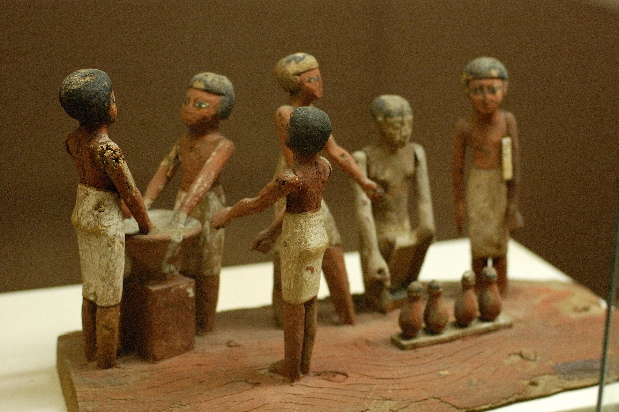
Some anthropologists believe that grain was first cultivated by the human race not as a food source but
for fermentation into beer — bread was a happy by-product of the
activity.  (The figures above are ancient Egyptians making beer.)  This would mean that the entire advance of human
civilization, which was founded on the cultivation of grain, proceeds
from the desire to toss back some suds.  The next time you're
enjoying a Bach Cantata or a play by Shakespeare or the sculptures of
the Parthenon, raise a glass to the good old boys and girls of 10,000 B. C., who got the party going . . .

. . . and cheers!

ORSON WELLES ON RADIO

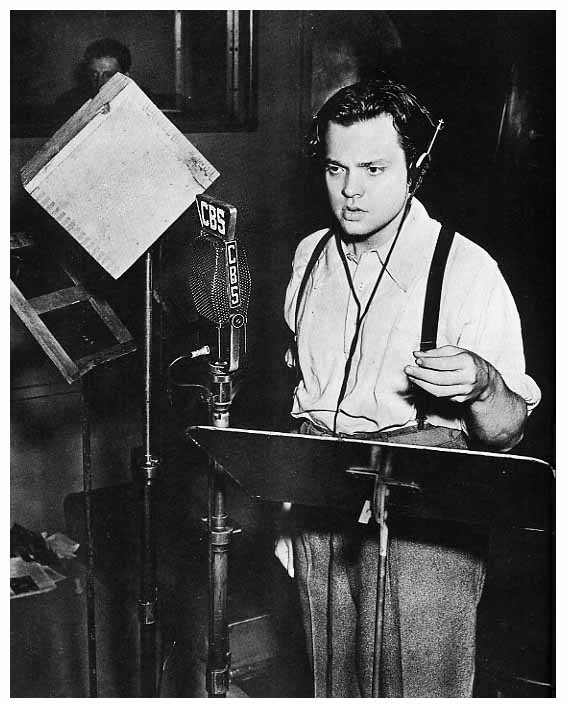
There
is simply no end to the wonders of the web.  One I recently
discovered is a web site which hosts many of the radio plays Orson
Welles created before Hollywood scooped him up.  These are
brilliant and extremely entertaining productions in which Welles
experimented with the aural effects he later applied to his movie
soundtracks.

Though they have a patina of “artiness”, and are often adaptations of
famous works of literature, the shows are aimed at a popular audience
— they blend the ambitions of Welles' innovative stage productions
with the lessons he learned as an actor on commercial radio.  The result is popular art of a very high order.

On the site you can download many of the featured shows in MP3 format and listen
to all of them in streaming audio.  Check it out here:


The Mercury Theater On the Air

. . . and thank Kim Scarborough, who created the online archive, for a signal service to our culture.

ESSAY IN HONOR OF ANDRE BAZIN: WORD AND IMAGE

Follow
this link to an essay on the place of popular visual art in the
intellectual culture of the modern age — the first in a series of essays
dedicated to the great film theoretician André Bazin.  I couldn't
find appropriate images to illustrate this essay and in any case it's
too long and serious to be a regular web log post, but some might find
it interesting . . .

JOHN ADAMS

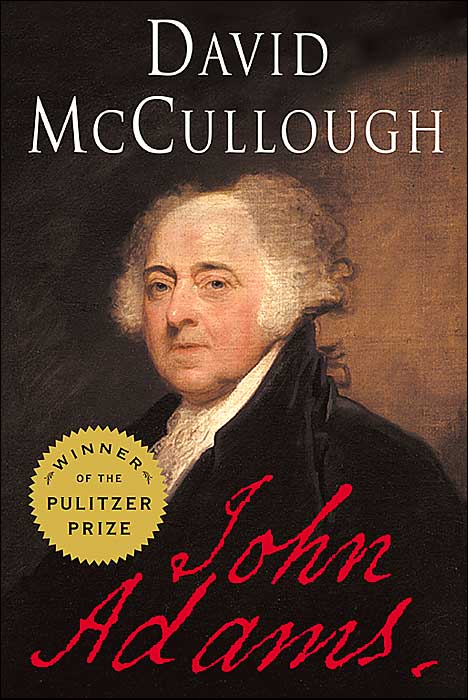
I commend to all my fellow citizens of this republic David McCullough's wonderful biography John Adams. 
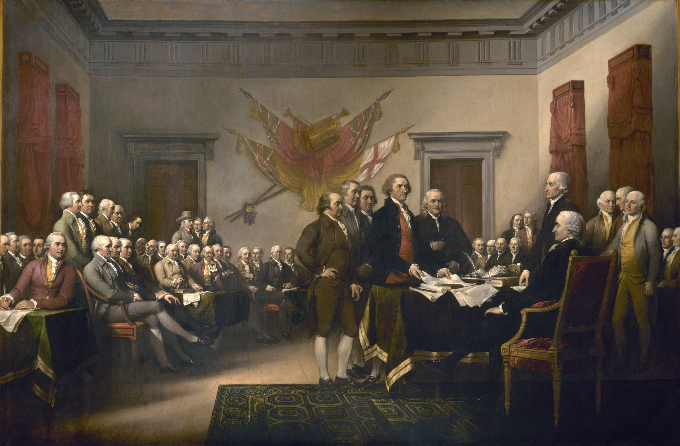
(That's Adams, bald and slightly pot-bellied, standing in the exact
center of John Trumbull's painting of the signing of the Declaration Of
Independence, above.)  Erudite and sagacious the book is also
compulsively readable, magically evoking the physical world of the 18th
and early 19th Centuries but also bringing the men of the Revolutionary
era to vivid life.
The founders of the United States Of America were certainly the
God-damnedest collection of characters who ever collaborated on a great
enterprise.  They seem mysteriously modern, perhaps because they
remain so recognizably American
— frank, down-to-earth, open-minded, industrious, optimistic . . . also pig-headed, venal and hypocritical 
There were scoundrels and rakes among them, men of faith and skeptics,
simple farmers and grand seigneurs — but they were all so unaccountably radical in their devotion to the ideas (if not always to the practical realities) of liberty and equality, of self-government.

And they were brave.  All the men above seen signing the
Declaration, many of them men of great wealth and position, would have
been hung as traitors by the English if their improbable revolution had
failed.  They don't seem to have had the slightest doubt that it
was a risk worth taking, and merely joked about the jeopardy — as
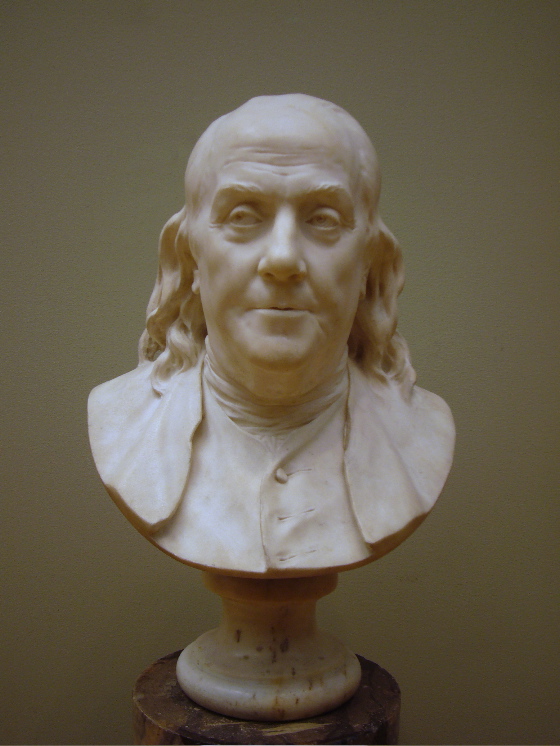
Franklin did when he said, “We must hang together or hang separately.”
It can't really be explained, except as a result of something that had
evolved over many generations in the experience of living in the new
world, habits of self-reliance and independence which the Founding
Fathers explicated and guided but did not invent.  Adams himself
knew this.  “The Revolution,” he wrote, “was in the minds and
hearts of the people.”

Adams may have been the oddest of all the “indispensable men” of that
time — neither a soldier nor a politician of any particular skill, not
a great writer or thinker but possessed of an orderly mind and endless
energy, he had a personal independence of thought and an an
incorruptible integrity which made him the go-to guy in any crisis.
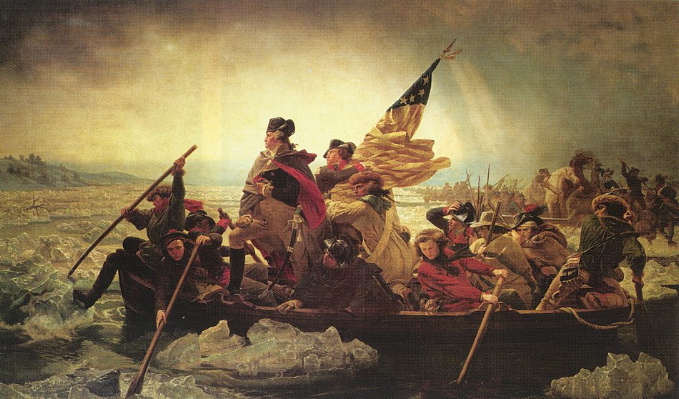
It was Adams who ensured the appointment of George Washington as
commander in chief of the Continental Army, Adams who procured loans
from the Dutch to keep the government afloat in the early days of the
Confederation, Adams who, in drafting the Constitution of the
Commonwealth Of Massachusetts, created a key model for the American
Constitution.

And it was Adams who served as America's first ambassador to the Court of St. James, received with honor as the representative of a new and independent nation by the same king who had once hoped to hang him.

The whole tale is surreal, unbelievable, but one loves Adams because he
didn't see it that way.  He seems always to have believed that the
seeds of liberty, once planted in good soil, would bear fruit — just
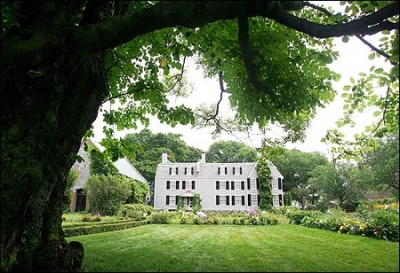
as the seeds he sowed on his Massachusetts farm brought forth peas and
corn.  At the end he was proud of what he had done for his
country, but he was just as proud of his farm.
Adams became President of course, for one term, after serving as George
Washington's Vice-President for two terms.  He lost his bid for
reelection to his then arch-rival Thomas Jefferson, and became the
first President to hand over the reigns of power unwillingly, convinced
that Jefferson would ruin the new nation before it could fairly get
going.  He groused about it, then jumped into a public stagecoach
and rode home, back to his farm, his peas and his corn.  He bowed
to the will of the people without further complaint.

In that moment, the American experiment justified itself to itself and to the whole world.

Perhaps the strangest thing about looking at these old
revolutionaries today is that they always seem to be staring right back at us, at the American future we
now inhabit.  In their regard there's hardly more than a trace of
self-satisfaction in what they accomplised, not a lot of sentiment, and
more than a little impatience.  “We started this business well enough,” they seem to
be saying, “now get on with it.”
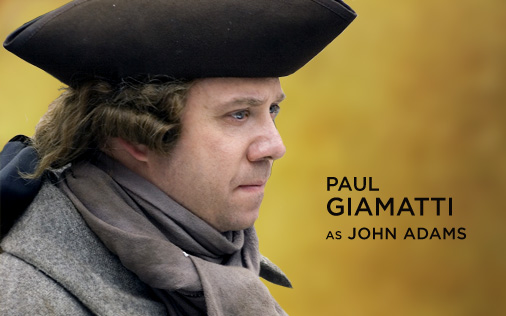
[I read the biography as a prelude to watching HBO's upcoming
mini-series taken from it, starring Paul Giamatti as Adams.  This
strikes me as a brilliant piece of casting, Giamatti having a knack for
conveying the kind of adorable peevishness which many people observed
as a characteristic trait of Adams.  The series will  premiere on March 16.]
IDIOT WIND

As
every political junkie must know by now, Texas had a two-step system
for choosing delegates to the Democratic Convention this August — a
primary in which about two-thirds of the delegates would be selected
and a caucus in which about a third of the delegates would be selected.

Only the results of the primary voting were known in the wee hours of 5
March — Hillary Clinton won in that voting, by a three-percent
margin.  The cable news services, anxious to put a period to the
day's events, reported that Clinton had “won Texas”, and this has become
the story out of Texas, Clinton's “Texas victory” one aspect of her
“comeback”.

But with about 40% of the caucus votes tabulated it is clear that Obama
will win the caucus by a substantial margin and that he will gain about
six delegates overall from the Texas election.  By any measure, he
will win Texas, because he will win more delegates there.

Don't expect the corporate media to tell you this, or to make anything
of it.  The “Texas story” is set in stone now — Obama's victory
in Texas, when it becomes official, will just be a footnote.

The pundits of cable news are clowns, parroting the predictions of
fallible polls and dutifully reporting whatever spin the respective
camps decide to put out, without making the slightest effort to
evaluate the reliability of the press releases or media conference
calls.  They will justify themselves by saying that they're just
reporting on “the perception” that Clinton won Texas, even though they
created that perception by irresponsible reporting.

They're riding the idiot wind.

WOODEN PINHOLE CAMERA

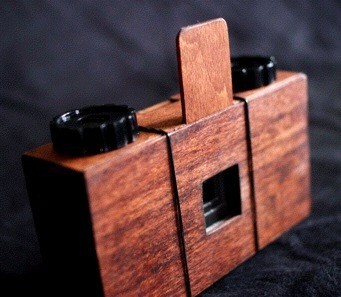
My friend Jae Song is selling a pinhole camera in a customized wooden casing online here.  It's awesomely beautiful and cheap, considering that the casing is handmade.

Jae, a brilliant cinematographer and expert on digital photography, writes this about the pinhole camera:


The thing I love about the pinhole camera is that it slows me down.
Because of the long exposures, the camera needs to be placed down at a
stable place and left alone for awhile. In this world of instantaneous
gratification, it makes me wait. And while I wait, it makes me really
look and see. I also like the fact there is no viewfinder, no lens to
set focus nor aperture to adjust. It’s just me and time. I am forced to
use my instincts. It brings back the thrill of mystery and wonder and
surprise when the film comes back from the lab.


Jae also sells hand-made kites in hand-made wooden boxes and hand-drawn
cards with pressed flowers — you can see all of his hand-made stuff here.